Morel Mushrooms — Medicinal Research
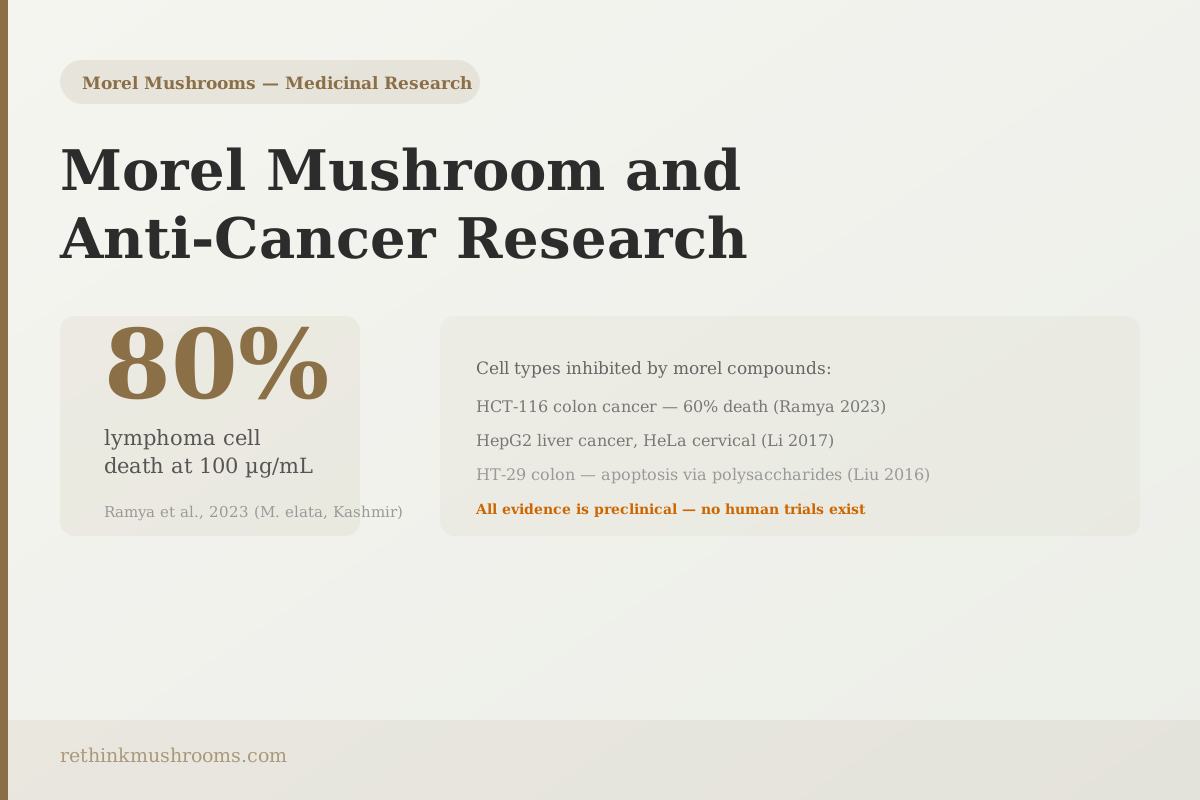
80% cancer cell death
A 2023 study found that Morchella elata extract from Kashmir's Himalayan region induced 80% cell death in lymphoma cells and 60% in colon cancer cells at 100 µg/mL — the strongest anticancer result in the morel research literature to date.
Ramya et al., International Journal of Medicinal Mushrooms, 2023
60%
colon cancer cell death (HCT-116 cells) at 100 µg/mL (Ramya et al., 2023)
4 cancer types
inhibited by morel compounds across separate lab studies: colon, liver, cervical, lymphoma
0 human trials
all anticancer evidence is preclinical — in vitro and animal studies only
Ramya et al., International Journal of Medicinal Mushrooms, 2023
 View as image ↗
Laboratory studies show that compounds extracted from morel mushrooms can kill multiple types of cancer cells. The most dramatic data comes from a 2023 study on Morchella elata collected from Kashmir's Himalayas: an ethyl acetate extract induced 60% cell death in colon cancer cells and 80% death in lymphoma cells at a concentration of 100 micrograms per milliliter.[1] Polysaccharides from Morchella esculenta have separately shown the ability to suppress proliferation of colon, liver, and cervical cancer cells in laboratory cultures.
All of this evidence is preclinical. It comes from cells in dishes and animals in controlled experiments. No clinical trials of morel extracts for cancer treatment in humans have been conducted. That gap between laboratory finding and clinical medicine is the most important fact in this article, and it will be present throughout.
This article covers the anticancer research on morel mushrooms specifically. For the full picture of morel's medicinal properties including liver protection, blood sugar, and heart health, see Morel Mushroom Bioactive Compounds: Beyond Culinary Luxury to Medicinal Potential. For an overview of what morels are beyond the culinary world, see What Is Morel Mushroom? Beyond the Culinary Experience.
Key Takeaways
- Ramya et al. (2023) found that Morchella elata extract from Kashmir induced 60% death in HCT-116 colon cancer cells and 80% death in DLA lymphoma cells at 100 µg/mL, via anticarcinogenic, antiangiogenic, and proapoptotic mechanisms
- Liu et al. (2016) showed that Morchella esculenta polysaccharides (MEP, ~81,835 Da, galactose-dominant) inhibited HT-29 colon cancer cell proliferation in a time- and dose-dependent manner through apoptosis
- Li et al. (2017) demonstrated that ME-fermented polysaccharides inhibited three cancer cell lines — HepG2 (liver), HeLa (cervical), and HCT-116 (colorectal) — while also activating natural killer cells, suggesting both direct and immune-mediated anticancer effects
- Huo et al. (2020) showed morel polysaccharides restored immune function in cyclophosphamide-treated mice, improving natural killer cell activity and cytokine production — a mechanism relevant to cancer patients receiving chemotherapy
- Wu et al. (2021) confirmed a multi-target anticancer picture for morel bioactives: polysaccharide-mediated apoptosis, immunomodulation via the gut-immune axis, and potential mitigation of chemotherapy toxicity
- No human clinical trials on morel extracts for cancer treatment exist; the translation path from in vitro cell killing to effective cancer therapy in humans is long and uncertain
What Laboratory Studies Have Found About Morel and Cancer Cells
When researchers place cancer cells in a dish with morel mushroom extracts and return the next day to count how many cells survived, they consistently find fewer cancer cells than started. This happens across multiple studies, multiple research groups, and multiple cancer cell types.
In laboratory research on cancer cells, finding that an extract kills cells is not rare. Many compounds do this, including things that would be toxic to the whole organism. What matters is whether the killing is specific enough and potent enough to be relevant, what mechanism causes it, and whether those findings hold in more complex living systems like animals and, eventually, humans.
For morel mushrooms specifically, the cell culture evidence exists and the mechanisms are beginning to be understood. The evidence does not yet extend to human trials. That is where the literature stands as of 2026.
The most useful way to read this research is as the first two rungs of a long ladder. The question isn't "does this work?" in the clinical sense — it's "is there enough here to justify continuing up the ladder?"
The Most Striking Finding: Morchella elata Extract from Kashmir
Ramya and colleagues collected Morchella elata, one of the true morel species, from the Kashmir Himalayas and tested an ethyl acetate extract against two cancer cell types in the laboratory.[1] At 100 micrograms per milliliter, a concentration achievable in laboratory cell culture, the extract caused 60% cell death in HCT-116 cells, a type of human colon cancer cell widely used in preclinical research. In DLA cells, a type of lymphoma cell, the same concentration caused 80% death.
The researchers characterized three mechanisms through which the extract acted: anticarcinogenic, antiangiogenic, and proapoptotic. In plain terms: it worked against cancer development, it blocked the growth of new blood vessels that tumors use to feed themselves, and it triggered the cellular program that causes cells to die on their own internal schedule rather than proliferating unchecked.
Using liquid chromatography-mass spectrometry, a technique that identifies specific chemical compounds in a mixture, the team identified the major bioactive molecules in the extract. The presence of multiple active compounds rather than a single molecule suggests a complex extract with multiple points of action on cancer biology.
Morchella elata is not the same species as the more common Morchella esculenta. The studies reviewed in this article involve both species, and the compounds differ somewhat between them. The Kashmir M. elata data is the most potent anticancer finding in the morel literature, but it comes from one study on one geographic collection of one species.
How Morel Polysaccharides Kill Cancer Cells: The Apoptosis Mechanism
The dominant class of morel compounds studied for anticancer activity is polysaccharides, which are long chains of sugar molecules linked together. Liu and colleagues isolated and characterized morel polysaccharides (called MEP) from Morchella esculenta using a method that avoids high-heat processing, and then tested them on HT-29 cells, another type of human colon cancer cell.[2]
The MEP they isolated had an average molecular weight of approximately 81,835 Daltons and a sugar composition dominated by galactose at 72.3%, with the remainder split among xylose, glucose, mannose, and rhamnose. Most well-studied medicinal mushroom polysaccharides, like those in reishi or maitake, are dominated by glucose chains (called beta-glucans). MEP's galactose-heavy structure is structurally different and may account for some of its unique biological activity.
When added to HT-29 cancer cells in culture, MEP inhibited their proliferation in a time-dependent and dose-dependent way. Higher doses and longer exposure both produced greater inhibition. The mechanism was apoptosis: the polysaccharides triggered the cellular process by which a cell dismantles itself from within. Apoptosis is the body's normal mechanism for eliminating unwanted or damaged cells. Cancer cells typically disable this mechanism, allowing them to proliferate indefinitely. Compounds that can restore apoptosis signaling are a target of cancer research precisely because they act on this fundamental defect.
For a detailed look at MEP's chemical structure and how morel polysaccharides compare to those in other mushroom species, see Morel Bioactive Compounds: Polysaccharides and Unique Chemistry.
Three Cancer Cell Lines, One Extract: The Li 2017 Findings
Li and colleagues took a different experimental approach: rather than isolating polysaccharides from dried morel, they fermented soybean residue with Morchella esculenta and extracted the polysaccharides produced during that process.[3] The resulting polysaccharides were then tested against three human cancer cell lines simultaneously.
The results showed inhibition across all three: HepG2 cells (a type of human liver cancer cell), HeLa cells (a type of cervical cancer cell), and HCT-116 cells (colorectal cancer). All three cell types showed reduced proliferation after exposure to the morel-fermented polysaccharides.
Li's study also examined whether the extract activated natural killer cells, which are immune cells that patrol the body and destroy cancer cells before they can establish themselves. The polysaccharides showed immunomodulatory activity via NK cell activation, suggesting that part of the anticancer effect may work through boosting immune surveillance rather than directly killing cancer cells.
This distinction between direct cytotoxicity and immune-mediated activity matters. A compound that only kills cancer cells in a dish would need to reach those cells in sufficient concentration after being ingested and processed by the body — a challenge that defeats many promising preclinical compounds. A compound that also activates immune cells has a second pathway that doesn't require direct contact with tumor tissue. Whether the immune pathway survives the journey from lab to human physiology is unknown, but it adds mechanistic interest.
This immune activation angle is relevant to the broader relationship between mushroom consumption and cancer risk. For population-level evidence on daily mushroom consumption and cancer outcomes, see Daily Mushroom Consumption and Cancer Risk Reduction.
The Immune Pathway: How Morel Polysaccharides Restore Anti-Cancer Defenses
Huo and colleagues specifically studied morel polysaccharides in mice that had been immunosuppressed by cyclophosphamide, a chemotherapy drug that severely depletes immune function.[4] This is a deliberate model: it tests whether the polysaccharides can restore the immune capacity that chemotherapy destroys.
In the immunocompromised mice, morel polysaccharides improved spleen and thymus function (both organs central to immune activity), increased natural killer cell activity, and raised levels of signaling proteins that help immune cells multiply and target pathogens. Specifically, IL-2 and IFN-γ — two proteins that help coordinate immune responses — increased after polysaccharide treatment. The gut microbiota composition also shifted in the treated animals, with more beneficial bacterial species and fewer harmful ones.
These findings are relevant to cancer biology in two ways. First, natural killer cells are a front-line defense against cancer cells — they can recognize and destroy cells that have lost the normal markers of healthy tissue. Second, cancer patients undergoing chemotherapy experience exactly the kind of immune collapse that this mouse model captures. Whether morel polysaccharides could realistically support immune function during chemotherapy is a specific and testable hypothesis. It has not been tested in humans.
For how this immune pathway compares to the mechanism of reishi's cancer-related compounds, which operate through a different chemical class, see Ganoderic Acids and Cancer: Specific Anti-Tumor Research.
Where the Research Stands: Promising Preclinical Evidence, No Clinical Path Yet
Wu and colleagues reviewed the full body of research on Morchella esculenta bioactive ingredients in 2021, synthesizing findings from multiple study types.[5] Their characterization of the anti-tumor evidence confirmed a multi-target picture: polysaccharide-mediated apoptosis, immunomodulation through the gut-immune axis, and suggestive data on chemotherapy toxicity mitigation. They also identified the cancer types most studied: colon, liver, and cervical cancer cells appear consistently across the literature.
Li and colleagues' 2023 systematic review provided the most current synthesis, concluding that morels are a high-value functional food with antioxidant, anti-inflammatory, immunomodulatory, and emerging anticancer properties based on the available experimental evidence.[6] The review was published in Frontiers in Nutrition and reflected the most comprehensive survey of the morel research literature at that time.
Neither review, nor any of the primary studies cited above, represents human clinical trial data. The path from an in vitro finding to a clinical application is long, expensive, and uncertain. Most compounds that kill cancer cells in a dish never become useful treatments. They fail because achieving therapeutic concentrations in a living tumor without toxicity to surrounding healthy tissue is genuinely difficult, because oral bioavailability (how much survives digestion and reaches the bloodstream) varies enormously, and because animal models often do not predict human responses well.
This is not a reason to dismiss the morel data. It is a reason to read it accurately. The preclinical evidence establishes that morel compounds can affect cancer cell biology through multiple mechanisms. That is the honest current state: mechanistically interesting, preclinically active, and clinically untested.
For context on where morel's purely preclinical cancer data fits relative to the epidemiological evidence for another culinary species, see Enoki and Cancer: The Japanese Epidemiological Discovery, which covers population-level cancer outcome data from a different mushroom.
The Bottom Line
Morel mushrooms contain polysaccharides and small-molecule compounds with demonstrated anticancer activity in cell culture experiments. The 2023 Ramya et al. data on Morchella elata from Kashmir showed the strongest effects, with 60% and 80% cancer cell death rates across two cell types. The anticancer mechanisms include apoptosis induction, angiogenesis inhibition, and immune system activation. No human clinical trials have been conducted on morel extracts for cancer treatment. The preclinical evidence provides mechanistic justification for further research, not clinical application.
Frequently Asked Questions
Sources & References
- 1RTHM-01772·Ramya, Haridas et al. (2023). “Anticancer Activity of the Bioactive Extract of the Morel Mushroom (Morchella elata, Ascomycetes) from Kashmir Himalaya (India) and Identification of Major Bioactive Compounds..” International journal of medicinal mushrooms.Study breakdown →PubMed →↩
- 2RTHM-00805·Liu, Chao et al. (2016). “Characteristics and Antitumor Activity of Morchella esculenta Polysaccharide Extracted by Pulsed Electric Field..” International journal of molecular sciences.Study breakdown →PubMed →↩
- 3RTHM-00889·Li, Shuhong et al. (2017). “Purification, antitumor and immunomodulatory activity of polysaccharides from soybean residue fermented with Morchella esculenta..” International journal of biological macromolecules.Study breakdown →PubMed →↩
- 4RTHM-01206·Huo, Wenyan et al. (2020). “Effects of polysaccharides from wild morels on immune response and gut microbiota composition in non-treated and cyclophosphamide-treated mice..” Food & function.Study breakdown →PubMed →↩
- 5RTHM-01454·Wu, Haishan et al. (2021). “Recent Advances on Bioactive Ingredients of Morchella esculenta..” Applied biochemistry and biotechnology.Study breakdown →PubMed →↩
- 6RTHM-01732·Li, Yitong et al. (2023). “Cultivation, nutritional value, bioactive compounds of morels, and their health benefits: A systematic review..” Frontiers in nutrition.Study breakdown →PubMed →↩