Emerging & Specialty Mushrooms
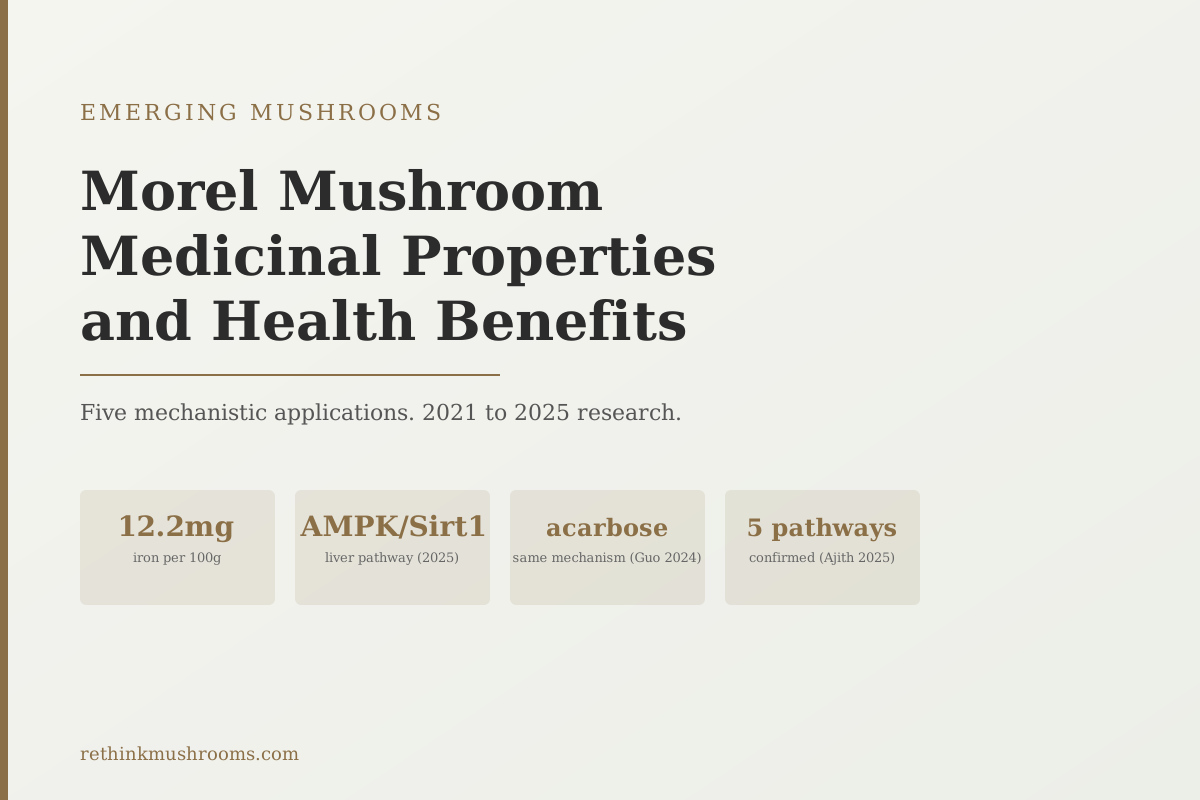
12.2mg iron per 100g
Morels provide 12.2mg of iron per 100g, a full day's requirement for men. But the polysaccharide research that has accumulated from 2021 to 2025 goes further: liver protection, blood sugar control, and cardiovascular support.
Tietel & Masaphy, Critical Reviews in Food Science and Nutrition, 2018
AMPK/Sirt1
metabolic liver pathway activated by morel polysaccharides in NAFLD mice; reduced triglycerides and fibrosis (Wang 2025)
same as acarbose
morel polysaccharides inhibit alpha-amylase and alpha-glucosidase, the same enzymes targeted by a front-line diabetes drug (Guo 2024)
atherosclerosis
plaque area reduced in LDLR-knockout mice on high-fat diet with morel polysaccharide MCP (Wang 2021)
Tietel & Masaphy, Critical Reviews in Food Science and Nutrition, 2018
 View as image ↗
Morel mushrooms occupy an unusual position in the medicinal mushroom conversation. They're famous as a culinary ingredient, prized by chefs and foragers, but rarely mentioned in the same sentence as reishi, lion's mane, or turkey tail. The mainstream health-food world treats them as a luxury ingredient with generic antioxidant properties.
The polysaccharide research published since 2021 tells a more specific story. Morel polysaccharides have been studied in mouse models for nonalcoholic fatty liver disease, atherosclerosis, obesity, blood sugar regulation, and immune function. A 2025 review confirmed five distinct mechanistic pathways. None of this has found its way into popular health coverage.
All of it is animal or in vitro research. No clinical trials exist. That context matters and this article states it throughout. But for anyone wanting to understand what the science actually says about morel mushroom medicinal properties from a functional-food standpoint, the accumulated research through 2025 is worth examining in detail.
Key Takeaways
- Morels contain 12.2mg of iron per 100g (a full daily requirement for men), along with significant vitamin D, zinc, selenium, and ergosterol, making them exceptional nutritionally among culinary mushrooms (Tietel & Masaphy, 2018)
- Morel polysaccharide activated AMPK/Sirt1 signaling in mice with nonalcoholic fatty liver disease, reducing hepatic lipid accumulation, triglycerides, cholesterol, and fibrosis markers; the most recent and specific liver data from this species (Wang et al., 2025)
- Morel polysaccharides inhibited alpha-amylase and alpha-glucosidase in a dose-dependent manner, the same enzyme-inhibition mechanism used by acarbose, a frontline oral diabetes medication (Guo et al., 2024)
- Morel polysaccharide MCP reduced atherosclerotic plaque area, LDL cholesterol, and pro-inflammatory cytokines in LDLR-deficient mice on a high-fat diet, also modulating gut microbiota toward a cardioprotective composition (Wang et al., 2021)
- Morel polysaccharide supplementation reduced body weight gain, adipose accumulation, and inflammatory markers in high-fat diet mice while shifting gut microbiota away from pathogenic taxa (Rehman et al., 2022)
- In immunocompromised mice treated with cyclophosphamide, morel polysaccharides restored NK cell activity, cytokine levels (IL-2, IFN-gamma), and spleen and thymus indices, suggesting immune-restoration potential (Huo et al., 2020)
The Nutritional Foundation: Iron, Vitamin D, and More
Before the polysaccharide research, morels were already exceptional nutritionally. Tietel and Masaphy documented in their 2018 comprehensive review that 100g of morel mushrooms provides approximately 12.2mg of iron, essentially a full day's iron requirement for adult men and more than half the requirement for women.[10]
Morels are also among the richest natural sources of vitamin D2 among commonly consumed mushrooms. Like all mushrooms, they produce ergosterol (a provitamin D compound) when exposed to UV light. A 2011 analysis of mushroom vitamin D and sterol content across 10 commercially available types confirmed morels' significant sterol content, and their high ergosterol concentration is consistent with notable vitamin D2 levels following sun exposure or UV treatment.[11]
Additional trace minerals (zinc and selenium) appear at meaningful concentrations. The Tietel 2018 review also documented tocopherols (vitamin E family compounds) and a rich array of volatile flavor compounds, which partly explains why morels have a flavor intensity that few other mushrooms match.
Beyond individual micronutrients, the 2023 systematic review by Li and colleagues confirmed morels' status as a high-value functional food, cataloguing their polysaccharides, phenolics, tocopherols, and ergosterols with documented antioxidant, anti-inflammatory, immunomodulatory, and anti-cancer properties across multiple experimental models.[8]
This nutritional richness is the baseline. What follows is the medicinal research built on top of it.
Liver Protection: The AMPK/Sirt1 Mechanism in NAFLD
The most recent and specific liver health data comes from a 2025 study by Wang and colleagues in the International Journal of Biological Macromolecules.[1]
The researchers tested morel polysaccharide on mice fed a high-fat diet to induce nonalcoholic fatty liver disease (NAFLD), a condition in which excess fat accumulates in liver cells, progressing to inflammation, fibrosis, and sometimes cirrhosis. NAFLD affects an estimated 25% of the global adult population and has no fully approved pharmacological treatment.
Morel polysaccharide activated two metabolic regulators: AMPK (a cellular energy sensor that responds to fuel stress by switching cells into fat-burning mode) and Sirt1 (a protein that modulates metabolic gene expression and inflammation). Both are known therapeutic targets for fatty liver disease. Several pharmaceutical compounds being investigated for NAFLD work through these same pathways.
The practical results in mice: reduced hepatic and serum triglycerides, reduced total cholesterol, attenuated fat accumulation in liver cells, reduced inflammatory markers, and slowed progression of fibrosis. The combination of a mechanistic explanation and measurable outcomes in a validated disease model makes this the most compelling morel liver data published to date.
This is mouse data, not human data. NAFLD mouse models frequently fail to translate to clinical outcomes. But the specificity of the AMPK/Sirt1 mechanism, combined with the measurable outcomes across multiple liver health markers, makes the finding worth noting for anyone following this area of research.
Blood Sugar Regulation: The Diabetes Drug Comparison
The blood sugar data from morel polysaccharides comes from a 2024 study by Guo and colleagues.[2]
The mechanism they tested is enzyme inhibition. Two enzymes in the gut break complex carbohydrates into glucose: alpha-amylase (which cleaves starch into smaller pieces) and alpha-glucosidase (which converts those pieces into glucose for absorption). Slowing either enzyme slows the rate at which glucose enters the bloodstream after a carbohydrate-containing meal, reducing post-meal blood sugar spikes.
This is the same mechanism used by acarbose, one of the most widely prescribed medications for type 2 diabetes. Acarbose works by inhibiting alpha-glucosidase at the gut lining. It is approved and in clinical use globally.
Morel polysaccharides, in Guo's experiment, inhibited both alpha-amylase and alpha-glucosidase in a dose-dependent manner. Both intracellular and extracellular polysaccharides from submerged fermentation of Morchella esculenta showed this activity, with intracellular polysaccharides showing the stronger effect. The structural differences between the two types were characterized by FT-IR and NMR spectroscopy, confirming they are distinct molecular entities with different potencies.
The explicit comparison to acarbose's mechanism is not hype. Enzyme inhibition assays of this type are the standard method for identifying potential antidiabetic compounds. Many candidates fail to translate to in vivo effects, and many more fail in human trials. But the mechanism at least operates at the right target. The 2025 review by Ajith and colleagues confirmed this antidiabetic activity pathway, and its confirmation alongside the liver protection data makes blood sugar regulation one of the more robust signals in the morel literature.[7]
Heart Health: Atherosclerosis Reduction in a High-Risk Mouse Model
Wang and colleagues published a 2021 study testing morel polysaccharide MCP in LDLR-deficient mice, animals engineered to lack functioning LDL receptors and used as a high-fidelity model for human atherosclerosis and familial hypercholesterolemia.[3]
Fed a high-fat diet, LDLR-deficient mice develop severe atherosclerosis rapidly. MCP treatment significantly reduced atherosclerotic plaque area. It also reduced LDL cholesterol and pro-inflammatory cytokines (TNF-alpha and IL-6, both key drivers of plaque progression). Beyond the lipid and inflammatory markers, MCP shifted gut microbiota toward a cardioprotective composition.
The gut microbiota finding connects multiple disease pathways in one study. Gut bacterial composition influences both lipid metabolism and systemic inflammation. A treatment that simultaneously reduces LDL, reduces inflammatory cytokines, and reshapes the microbiome toward cardioprotective taxa is doing more than one thing simultaneously.
This is animal data using a genetically modified mouse model, which limits direct extrapolation to humans. LDLR-deficient mice have a more severe lipid phenotype than most humans with atherosclerosis. The finding is mechanistically interesting and worth continued investigation, but it is not evidence that eating morels prevents heart disease in humans.
Gut Health and Anti-Obesity Effects
Two studies by Huo and colleagues, both from 2020, examined how morel polysaccharides affect gut microbiota composition in mice.[5]
The first study tracked gut microbiota changes along the entire intestinal tract after wild morel polysaccharide supplementation. Bacterial diversity increased, particularly in the small intestine. Lachnospiraceae, a family of bacteria known to produce short-chain fatty acids (SCFAs), increased in the cecum and colon. SCFAs are fermentation products that serve as fuel for gut lining cells and have well-documented effects on metabolic and immune regulation. The treatment also increased valeric acid production.
A complementary 2022 study by Rehman and colleagues extended this to metabolic outcomes.[4] In high-fat diet mice, morel polysaccharide supplementation significantly reduced body weight gain and fat accumulation, lowered inflammatory markers including TNF-alpha and IL-1beta, and shifted gut microbiota toward more beneficial compositions. The simultaneous reduction in body weight, inflammation, and pathogenic bacteria in a single treatment is the kind of multiple-pathway finding that characterizes polysaccharide research generally, where the gut microbiome is a downstream amplifier.
None of this is human research. Obesity mouse models have a notoriously poor track record of predicting human weight loss outcomes. The gut microbiota findings are mechanistically coherent but represent an early-stage signal.
For how the gut microbiome connection fits within the broader picture of specialty mushrooms and metabolic health, see what is tiger milk mushroom?, another specialty mushroom with polysaccharide-based research in this same pillar.
Immune Support: Restoring Function After Chemotherapy
The second Huo 2020 study examined immune function in mice treated with cyclophosphamide, a chemotherapy agent that suppresses the immune system.[6]
Cyclophosphamide-treated mice are used as a model for chemotherapy-induced immunosuppression. The immune parameters measured included spleen index, thymus index (both measure immune organ size and function), NK cell activity (natural killer cells that attack cancer cells and viral infections), and cytokine levels (IL-2 and IFN-gamma, both involved in immune coordination).
Morel polysaccharides restored all of these measures. NK cell activity, which cyclophosphamide had suppressed significantly, recovered toward normal levels. IL-2 and IFN-gamma levels, which had dropped with chemotherapy, increased. Spleen and thymus indices improved.
This immune restoration finding is particularly relevant because it addresses a specific, measurable deficit rather than a vague "immune boosting" claim. Cyclophosphamide-induced immunosuppression is a validated preclinical model for a clinically meaningful condition. The recovery of NK cell activity is especially notable because NK cells are among the primary immune effectors against tumor cells and virally infected cells.
Sunil and Xu's 2022 mycochemical profile review confirmed that immunomodulatory activity is one of the best-documented activities of ME bioactive constituents across multiple experimental models, alongside antioxidant and anti-inflammatory effects.[9]
For context on how mushroom immune data compares to population-level cancer risk evidence, see daily mushroom consumption and cancer risk reduction and enoki and cancer: the Japanese epidemiological discovery, which covers how other species with similar preclinical immune data have fared in epidemiological research.
What the 2025 Research Confirms
A 2025 review by Ajith and colleagues synthesized the accumulated research on Morchella esculenta polysaccharides, confirming five distinct biological activities and their mechanisms.[7]
The five mechanisms confirmed:
-
Antioxidant activity via the Nrf2/Keap1 pathway. Nrf2 is a transcription factor that activates the cell's endogenous antioxidant defense systems. When morel polysaccharides activate this pathway, cells upregulate their own protective enzymes rather than relying solely on dietary antioxidants. This is a more sophisticated mechanism than simple radical scavenging.
-
Antidiabetic activity via alpha-amylase and alpha-glucosidase inhibition, consistent with the Guo 2024 data above.
-
Immunomodulation via SCFA production, cytokine regulation, and G protein-coupled receptor activation. The SCFA-GPR axis connects gut microbiota metabolites to immune cells in a mechanism that is increasingly well-characterized in the broader microbiome literature.
-
Hepatoprotective effects via oxidative stress and inflammation mitigation, consistent with and preceding the more specific AMPK/Sirt1 data from Wang 2025.
-
Anti-obesity effects via the gut microbiota modulation documented in the Rehman and Huo studies.
The Ajith 2025 review represents the highest-quality synthesis available for this topic. Its publication in Natural Product Research and its post-2024 date mean it incorporates the most recent findings.
Where the Evidence Actually Stands
The research on morel medicinal properties has a common structure across every application reviewed here: mouse or cell culture data, mechanistic specificity, and no human trials.
The liver, blood sugar, cardiovascular, and immune findings are not interchangeable. Each rests on a different mechanism. The AMPK/Sirt1 liver data is the most specific and most recent. The blood sugar data has the strongest mechanistic parallel to approved medicine (acarbose). The atherosclerosis data comes from the most disease-relevant mouse model. The immune data addresses a specific, measurable deficit in a validated immunosuppression model.
What all five findings share: they are preclinical. The translational record from mushroom polysaccharide animal research to human outcomes is modest. Many promising signals in mice have not replicated in human trials. This is not a reason to dismiss the data. It is the appropriate frame for evaluating it.
Morel mushrooms have been eaten safely for centuries. They are rich in iron, vitamin D, and selenium at levels most culinary mushrooms don't match. The bioactive compounds being studied in this research literature are the same ones you consume when you eat the mushroom. Whether the quantities in a serving of morels are sufficient to produce the measured effects in humans is an open question that preclinical data cannot answer.
For a deeper look at the polysaccharide chemistry and what distinguishes morel polysaccharides structurally from the beta-glucans found in most medicinal mushrooms, see morel bioactive compounds: polysaccharides and unique chemistry. For the anti-cancer research specifically, see morel mushroom and anti-cancer research.
The Bottom Line
Morel mushrooms are nutritionally exceptional (12.2mg iron per 100g, significant vitamin D and selenium) and have accumulated a specific body of polysaccharide research since 2021. Mouse studies document liver protection via AMPK/Sirt1 signaling, blood sugar regulation via the same enzyme-inhibition mechanism as the diabetes drug acarbose, atherosclerosis reduction in a high-risk genetic model, anti-obesity and gut microbiota effects, and immune restoration after chemotherapy. All of this is preclinical. No human trials exist for any morel medicinal application. The research is mechanistically specific and internally consistent; the human evidence gap is real.
Frequently Asked Questions
Sources & References
- 1RTHM-02202·Wang, Dandan et al. (2025). “Hepatoprotective effects of polysaccharide from Morchella esculenta are associated with activation of the AMPK/Sirt1 signaling pathway in mice with NAFLD..” International journal of biological macromolecules.Study breakdown →PubMed →↩
- 2RTHM-01897·Guo, Weihong et al. (2024). “Comparative study on physicochemical properties and hypoglycemic activities of intracellular and extracellular polysaccharides from submerged fermentation of Morchella esculenta..” International journal of biological macromolecules.Study breakdown →PubMed →↩
- 3RTHM-01452·Wang, Dandan et al. (2021). “Polysaccharide MCP extracted from Morchella esculenta reduces atherosclerosis in LDLR-deficient mice..” Food & function.Study breakdown →PubMed →↩
- 4RTHM-01607·Rehman, Ata Ur et al. (2022). “Morchella esculenta polysaccharide attenuate obesity, inflammation and modulate gut microbiota..” AMB Express.Study breakdown →PubMed →↩
- 5RTHM-01205·Huo, Wenyan et al. (2020). “Polysaccharide from wild morels alters the spatial structure of gut microbiota and the production of short-chain fatty acids in mice..” Bioscience of microbiota.Study breakdown →PubMed →↩
- 6RTHM-01206·Huo, Wenyan et al. (2020). “Effects of polysaccharides from wild morels on immune response and gut microbiota composition in non-treated and cyclophosphamide-treated mice..” Food & function.Study breakdown →PubMed →↩
- 7RTHM-02047·Ajith, Thekkuttuparambil Ananthanarayanan et al. (2025). “Morchella esculenta polysaccharides: a functional food with potential immunomodulatory properties..” Natural product research.Study breakdown →PubMed →↩
- 8RTHM-01732·Li, Yitong et al. (2023). “Cultivation, nutritional value, bioactive compounds of morels, and their health benefits: A systematic review..” Frontiers in nutrition.Study breakdown →PubMed →↩
- 9RTHM-01622·Sunil, Christudas et al. (2022). “Mycochemical profile and health-promoting effects of morel mushroom Morchella esculenta (L.) - A review..” Food research international (Ottawa.Study breakdown →PubMed →↩
- 10RTHM-01012·Tietel, Zipora et al. (2018). “True morels (Morchella)-nutritional and phytochemical composition, health benefits and flavor: A review..” Critical reviews in food science and nutrition.Study breakdown →PubMed →↩
- 11. Source details for this reference are not yet available.