Matsutake Research
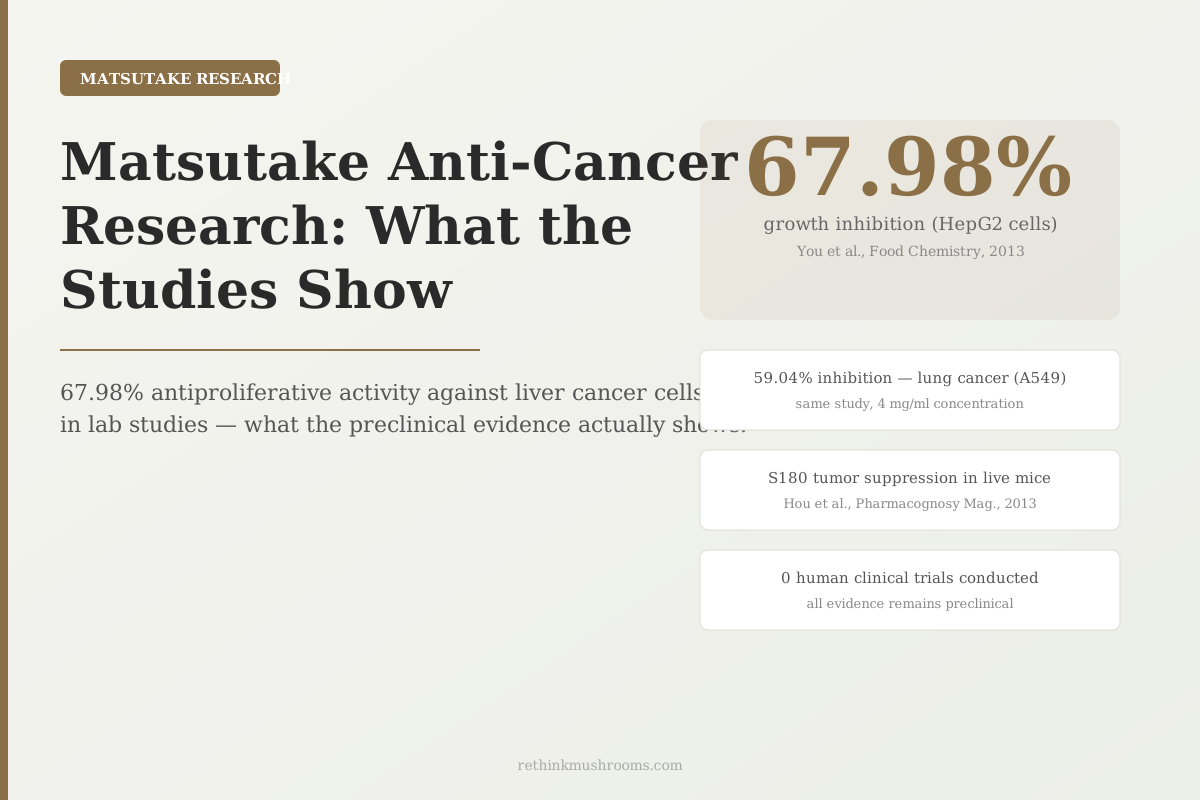
67.98% growth inhibition
Matsutake polysaccharide fractions inhibited liver cancer cell growth by 67.98% and lung cancer cells by 59.04% in lab studies. These are the most cited numbers in matsutake anticancer research.
You et al., Food Chemistry, 2013
4 studies
in vitro and animal model preclinical evidence base
S180 mice
in vivo tumor suppression confirmed in live animal models (Hou et al., 2013)
0
human clinical trials on matsutake for cancer published to date
You et al., Food Chemistry, 2013
 View as image ↗
In 2013, researchers in China extracted multiple polysaccharide fractions from Tricholoma matsutake and tested them against cancer cells in a laboratory. One fraction stopped liver cancer cells from growing by 67.98%. Another slowed lung cancer cells by 59.04%.[1] These are the most concrete numbers in matsutake anticancer research, and they are also the numbers most important to contextualize carefully. Every piece of evidence in this article comes from lab dishes and animal models, not human clinical trials.
Matsutake has centuries of use in East Asian traditional medicine, long before any laboratory confirmed what it might contain. Modern research has begun explaining the chemistry behind that traditional use. For readers interested in the broader world of emerging and specialty mushrooms, matsutake represents an unusually well-studied case: a luxury wild ingredient with a real, peer-reviewed preclinical evidence base for anticancer properties. For the full overview of what matsutake is and why it commands up to $2,000 per pound, see what is matsutake.
Key Takeaways
- Matsutake polysaccharide fractions showed 67.98% antiproliferative activity against HepG2 liver cancer cells and 59.04% against A549 lung cancer cells at 4 mg/ml in lab conditions (You et al., Food Chemistry, 2013)
- A polysaccharide called TMP-A inhibited S180 tumor growth in live mice (roughly 68% inhibition at the highest dose) and stimulated lymphocyte proliferation and macrophage activity, marking the step beyond cell culture (Hou et al., Pharmacognosy Magazine, 2013)
- The antitumor effect was independently replicated with a polysaccharide (TMP-B) from matsutake harvested in Tibet's Maerkang region, confirming bioactivity across geographic variants of the species (Hou et al., Int J Biol Sci, 2017)
- The Maerkang polysaccharide (TMP-B) suppressed S180 tumors in live mice and triggered apoptosis in cultured cells, while also driving macrophage proliferation and cytokine release (Hou et al., 2017)
- The primary molecular targets are three established cancer biology signaling pathways: NF-κB, MAPK, and PI3K-Akt (Zhou, El-Seedi & Xu, Crit Rev Food Sci Nutr, 2023)
- No human clinical trials on matsutake polysaccharides for cancer have been conducted; all evidence remains preclinical
Traditional Medicine Got There First: What Centuries of East Asian Use Suggested
In Japan, matsutake has been a celebrated medicinal ingredient since at least the Heian period (794-1185 CE), appearing in poetry and court records as a gift of exceptional value. In Chinese and Korean traditional medicine, it appeared in preparations associated with strengthening vital energy and supporting recovery from illness. The specific language of these traditions did not map to modern oncology, but the general idea, that this particular mushroom had something restorative and protective about it, persisted across centuries and national borders.
Scientific interest in matsutake's chemistry intensified in the early 2000s, driven partly by parallel research into polysaccharides from other medicinal mushrooms. Shiitake's lentinan had already received regulatory approval in Japan as a cancer adjunct therapy. Maitake's D-fraction showed immunostimulatory properties in multiple studies. Researchers began asking whether T. matsutake, equally revered in traditional medicine and far more expensive than any cultivated mushroom, contained comparable compounds.
A 2023 comprehensive review in Critical Reviews in Food Science and Nutrition, the highest-quality synthesis of the existing evidence, concluded that matsutake contains proteins, polysaccharides, phenolic compounds, steroids, nucleoside derivatives, fatty acids, and volatile aromatic compounds; each class shows distinct potential bioactivities.[4] The polysaccharides attracted the most research attention, and the anticancer work centered entirely on this compound class.
The Specific Numbers: 67.98% Growth Inhibition at 4 mg/ml
You and colleagues, publishing in Food Chemistry in 2013, isolated multiple polysaccharide fractions from T. matsutake and tested each one against cancer cells in culture.[1] The strongest fraction also showed antioxidant activity in a standard oxygen radical absorbance capacity (ORAC) assay, suggesting antioxidant and antiproliferative properties coexist in the same compounds.
The antiproliferative results against two cell lines are the study's most cited findings.
Against HepG2 cells (a standard laboratory model for human liver cancer, used in hundreds of studies to screen compounds for hepatic anticancer potential), one matsutake fraction showed 67.98% growth inhibition. Against A549 cells, a human lung adenocarcinoma line commonly used in cancer drug screening, a fraction produced 59.04% inhibition. Both measurements came at a concentration of 4 mg/ml.
That concentration matters for interpretation. Four milligrams per milliliter is a laboratory dose, not a dietary one. It is the amount of compound dissolved in a small volume of culture medium, applied directly to cancer cells growing in a dish. The human body's digestive system, circulatory system, and cellular uptake mechanisms would all affect how much of any ingested polysaccharide fraction reaches tumor tissue, and at what concentration. These steps are not captured by cell culture studies.
What the numbers do establish is meaningful: specific polysaccharide fractions from T. matsutake have real, measurable antiproliferative activity in controlled conditions. For a compound to advance in cancer research, demonstrating this activity in standardized cell lines is the required first step.
Beyond Cell Cultures: Tumor Suppression in Live Mice
The limitation of any cell culture study is that cancer cells in a dish are not cancer cells in a living organism. Compounds that kill cells in a petri dish sometimes turn out to be simply toxic to all cells equally, or to break down before reaching tumors in the body, or to fail at the tissue-penetration step entirely. Moving from in vitro to in vivo, from cell culture to a living animal, is the first major filter separating candidates worth studying further from dead ends.
Hou and colleagues crossed that threshold in 2013 with a polysaccharide called TMP-A, isolated from T. matsutake and characterized by its chemical structure.[2]
TMP-A was tested in mice implanted with S180 sarcoma, a fast-growing, reliably reproducible tumor model routinely used to evaluate antitumor compounds in preclinical research. The results: TMP-A inhibited S180 tumor growth in living mice, with inhibition reaching roughly 68% at the highest dose tested. That is a qualitatively different category of evidence than a cell culture result.
The same polysaccharide also stimulated lymphocyte proliferation and macrophage activity, key arms of the cell-mediated immune response. Macrophages are frontline immune cells capable of identifying and attacking cancer cells, and the study's authors attributed the antitumor effect largely to this immune stimulation rather than to direct cytotoxicity. This profile, in vivo tumor suppression combined with immune system activation, made TMP-A one of the most comprehensively characterized individual matsutake compounds at the time of publication.
The antimicrobial activity Hou 2013 also reported, while not directly relevant to cancer, added to the picture of TMP-A as a polysaccharide with broad biological activity rather than a single narrow effect.
For more on how polysaccharides from mushrooms activate immune defenses through macrophage and cytokine pathways, see how mushroom sugars activate cancer-fighting immune cells.
Replicated in Tibet: Different Region, Same Anticancer Effect
One persistent question in natural product research is whether a bioactivity finding reflects something real about a species or something specific to one harvest batch, one extraction method, or one laboratory. Regional variation in wild-harvested fungi is real: altitude, soil composition, associated tree species, and climate all influence the chemical profile of a mushroom.
Hou and colleagues addressed this question directly in 2017 by working with matsutake harvested from Maerkang, a high-altitude region in the Tibetan part of Sichuan province, China, rather than the Japanese or lowland Chinese samples used in earlier studies.[3]
The Maerkang matsutake polysaccharide, designated TMP-B, showed antitumor activity both in vivo and in vitro. In live mice, it suppressed the growth of S180 tumors, the same aggressive model used to evaluate TMP-A. In cell culture, it triggered apoptosis, or programmed cell death, and it promoted macrophage proliferation and cytokine release, echoing the immune-activating profile of the earlier work.
What matters most about the Maerkang study is not a single new number but the fact of replication. Selective toxicity, the ability to harm cancer cells while leaving healthy tissue intact, is the central unsolved problem in cancer drug development. Most chemotherapy agents damage healthy tissue along with tumors, and the side effect profiles of many cancer treatments stem from this lack of selectivity. The matsutake polysaccharide studies have begun to characterize how these compounds act on tumor cells and the immune system, but whether they spare healthy tissue in a living body, the property that would make them genuinely promising rather than simply cytotoxic, is a question the current preclinical work has not yet resolved.
Independent research teams, working with matsutake from different regions and testing across multiple cancer cell lines and tumor models, have arrived at consistent results. That consistency strengthens the case that the antitumor activity is a real property of T. matsutake polysaccharides rather than a methodological artifact.
How It Works Inside the Cell: The Three Pathways Cancer Researchers Already Study
Understanding how a compound produces an effect is separate from demonstrating that the effect exists. Mechanism studies don't confirm efficacy, but they do explain why a compound might work and connect the finding to established cancer biology. They also help predict whether the bioactivity would generalize across different cancer types.
The 2023 comprehensive review by Zhou, El-Seedi, and Xu synthesized the mechanistic evidence for T. matsutake bioactives and identified three primary molecular targets.[4]
The first is NF-κB. This protein complex acts as a master regulator for genes involved in inflammation, cell survival, and cell death. In healthy tissue, NF-κB is activated temporarily in response to infection or injury, then switches off. In many cancers, NF-κB is constitutively active, meaning it stays permanently switched on, overriding the cellular signals that would normally trigger programmed cell death. Matsutake polysaccharides appear to interfere with this constitutive activation, pushing cancer cells back toward normal apoptosis pathways.
The second is MAPK, which stands for mitogen-activated protein kinase. MAPK is a cascade of proteins that relays signals from the cell surface to the nucleus, telling the cell whether to grow, divide, differentiate, or die. Dysregulated MAPK signaling drives a large proportion of known cancers, which is why it has been extensively targeted by cancer drug development programs. The matsutake evidence suggests its polysaccharides modulate this cascade, though the specific mechanism within the pathway remains less characterized than the NF-κB connection.
The third is PI3K-Akt. This pathway governs cell growth, survival, and metabolism. Hyperactivation of PI3K-Akt is present in numerous cancer types and promotes the survival of cancer cells that would otherwise self-destruct. Several cancer drugs already approved by the FDA specifically target this pathway.
What is notable about these three targets is not that they are novel discoveries; they are among the most studied pathways in cancer biology, implicated in the action of many existing drugs. What is notable is that matsutake polysaccharides appear to affect all three simultaneously. Compounds that modulate multiple cancer-relevant pathways at once are of particular research interest because cancer cells commonly develop resistance to agents that target a single pathway.
For context on how lectins, another class of bioactive compounds found in medicinal mushrooms, interact with cancer cells through related mechanisms, see mushroom lectins and anticancer potential.
Evidence Map
Four Studies, All Preclinical — and the Rung That Is Still Empty
The matsutake anticancer evidence stacks up from cell culture through mouse tumor models, but the top rung — a human trial — is empty. Bar width reflects how close each rung sits to a claim about people: the in vivo mouse studies sit closest, the mechanistic review furthest, and the dashed bar is what has not been done.
Human clinical trial
gapDoes not yet exist
No human trial has ever tested matsutake or its isolated polysaccharides against any cancer. This is the rung the preclinical work has not reached.
In vivo tumor suppression — animal models
preclinicalHou 2013 [2] · Hou 2017 [3]
The closest evidence to a living organism: TMP-A suppressed S180 mouse tumors by up to roughly 68% at the highest dose (Hou 2013), and TMP-B replicated S180 tumor suppression with a Maerkang/Tibetan-sourced polysaccharide (Hou 2017).
In vitro antiproliferation — cell culture
preclinicalYou 2013 [1]
The most-cited numbers: fraction TM-P2 inhibited HepG2 liver-cancer cells by 67.98% and A549 lung-cancer cells by 59.04% at 4 mg/ml, alongside ORAC antioxidant activity (You 2013).
Immune activation & apoptosis
preclinicalHou 2013 [2] · Hou 2017 [3]
Lymphocyte proliferation, macrophage activation, and cytokine release — the cell-mediated arm the authors credit for the antitumor effect — plus apoptosis triggered in cultured cells.
Mechanistic synthesis / review
preclinicalZhou 2023 [4]
A comprehensive review converges the activity on NF-κB, MAPK, and PI3K-Akt — three signaling pathways central to cancer biology (Zhou, El-Seedi & Xu 2023).
How to read it: every solid bar is real, converging evidence — but all of it is preclinical. Antiproliferation in a dish and tumor suppression in mice replicate important features of human cancer without reliably predicting what happens in people, and lab doses like 4 mg/ml are far above anything a diet delivers. The consistency across model types is why the stack is worth taking seriously as a foundation; the empty top rung is why no claim about humans can be made yet. Nothing here is medical advice.
Sources: You 2013 [1]; Hou 2013 [2]; Hou 2017 [3]; Zhou, El-Seedi & Xu 2023 [4]. Bar widths are illustrative of how close each rung sits to a human-relevant claim, not quantitative effect sizes.
What the Evidence Doesn't Show, and Why That Distinction Matters
The three-word phrase "fights cancer" is one of the most consequential simplifications in health communication. It collapses a spectrum of evidence, from in vitro cell line activity to human clinical benefit, into a single claim that implies far more certainty than exists. What the matsutake evidence currently supports is specific and limited.
All four studies reviewed here are preclinical. Preclinical means conducted in cell cultures and animal models, not in human beings. The gap between preclinical findings and clinical outcomes is substantial and frequently underestimated. Consider the record: hundreds of compounds have shown impressive antiproliferative activity in HepG2 and A549 cell lines. Many have confirmed antitumor effects in mouse models. Very few have translated into effective cancer treatments in human trials. The reasons for failure are multiple: absorption and metabolism differences between mice and humans, the complexity of human immune systems, cancer heterogeneity, and the simple reality that tumors in patients resist treatment in ways that laboratory models cannot fully replicate.
This is not an argument against taking the matsutake evidence seriously. It is an argument for describing the evidence accurately.
What the available data supports: specific polysaccharides isolated from T. matsutake have demonstrated antiproliferative and antitumor properties in lab and animal settings, acting through molecular pathways central to cancer biology.
What the available data does not support: matsutake treats cancer, consuming matsutake prevents cancer, or eating this mushroom produces effects comparable to the isolated polysaccharides tested in these studies.
No human clinical trials on matsutake polysaccharides for any cancer indication have been published. The research base, while genuinely promising by preclinical standards, has not advanced to clinical investigation. That is not unusual for a compound at this stage of research, but it is the honest state of the science.
For a deeper look at the full polysaccharide chemistry, including the structural characterization studies that identified which specific compounds are responsible for these effects, see matsutake polysaccharides and immune research. For a broader view of the matsutake bioactive compound profile beyond polysaccharides, see matsutake bioactive compounds.
The Bottom Line
Independent research teams found that polysaccharide fractions from Tricholoma matsutake inhibit cancer cell growth in lab studies and suppress tumor growth in animal models, with the most specific numbers showing 67.98% inhibition of liver cancer cells and 59.04% of lung cancer cells at 4 mg/ml. The molecular pathways involved, NF-κB, MAPK, and PI3K-Akt, are established cancer biology targets. All evidence is preclinical; no human clinical trials have been conducted.
Frequently Asked Questions
Sources & References
- 1RTHM-00572·You, Lijun et al. (2013). “Structural characterisation of polysaccharides from Tricholoma matsutake and their antioxidant and antitumour activities..” Food chemistry.Study breakdown →PubMed →↩
- 2RTHM-00523·Hou, Yiling et al. (2013). “Anti-microorganism, anti-tumor, and immune activities of a novel polysaccharide isolated from Tricholoma matsutake..” Pharmacognosy magazine.Study breakdown →PubMed →↩
- 3RTHM-00875·Hou, Yiling et al. (2017). “Structure elucidation and antitumor activity of a new polysaccharide from Maerkang Tricholoma matsutake..” International journal of biological sciences.Study breakdown →PubMed →↩
- 4RTHM-01840·Zhou, Yifan et al. (2023). “Insights into health promoting effects and myochemical profiles of pine mushroom Tricholoma matsutake..” Critical reviews in food science and nutrition.Study breakdown →PubMed →↩