Mushroom Cultivation Technology
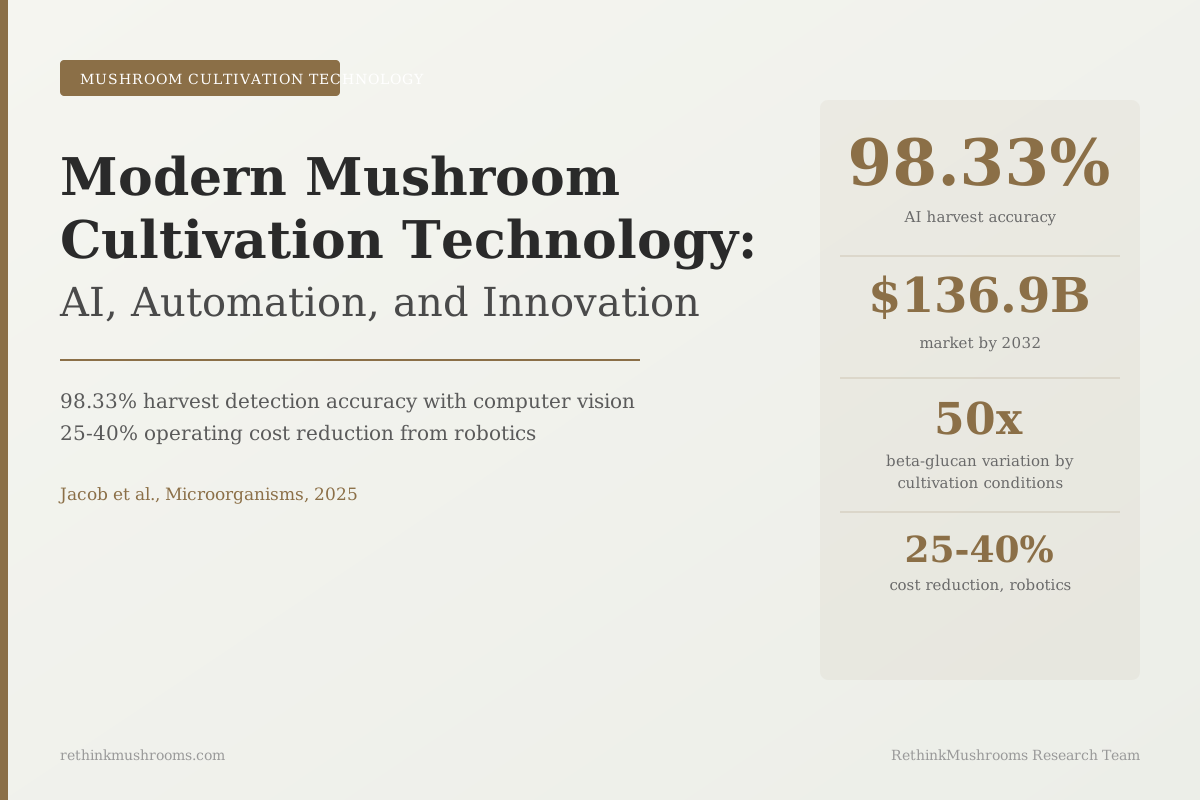
98.33%
AI-powered computer vision systems now detect mushroom disease and harvest readiness at 98.33% accuracy, faster and more precisely than any human inspector. This accuracy level is one of several reasons the global mushroom industry is deploying AI at scale.
Jacob et al., Microorganisms, 2025
$136.9B
projected global mushroom market by 2032, up from $62.3B in 2023 at 9.1% annual growth
50x
variation in beta-glucan content across commercial products based solely on cultivation conditions
25-40%
reduction in operating costs achievable through robotic harvest systems
Jacob et al., Microorganisms, 2025
 View as image ↗
A commercial mushroom can double in size every 24 hours. The gap between a perfectly ripe mushroom and one that is past its peak can be a matter of hours, not days. At commercial scale, with hundreds of thousands of mushrooms growing across stacked beds, the human eye cannot track that window reliably. This is why AI mushroom cultivation technology has moved from experiment to standard practice at the world's largest commercial farms, and why the pace of adoption is accelerating.
The commercial case for automation is straightforward: mushrooms are high-value, perishable, and grow in cycles that are difficult to manage manually at scale. But for readers of RethinkMushrooms, the technology story has a second dimension. The precision that AI systems bring to controlled environment cultivation does not just improve yield. It determines the concentration of the bioactive compounds (beta-glucans, triterpenoids, polysaccharides) that make medicinal mushrooms worth growing in the first place.
For the market context behind why cultivation investment is surging, see our article on the functional mushroom market: growth and what is driving it.
Key Takeaways
- AI computer vision systems now detect mushroom disease and harvest readiness at 98.33% accuracy using models like YOLOv5 and DenseNet201, according to a comprehensive 2025 academic review of AI in mushroom cultivation
- The global mushroom market is projected to grow from $62.31 billion in 2023 to $136.90 billion by 2032, a 9.1% compound annual growth rate, driving investment in cultivation automation
- Robotic harvest systems cut 25-40% of total operating costs compared to manual harvesting, representing the largest single cost reduction available to commercial producers
- Analysis of commercial Ganoderma products found up to 50-fold differences in beta-glucan content based solely on cultivation conditions; the same species can have radically different health properties
- The challenge of artificially cultivating Cordyceps sinensis (one of the world's most valuable medicinal mushrooms) illustrates why high-value medicinal species are driving the most sophisticated AI adoption
- Smallhold's February 2024 bankruptcy demonstrates that cultivation technology alone does not guarantee profitability; market positioning and unit economics must also work
The 24-Hour Problem: Why Mushroom Farming Is Uniquely Hard to Manage
Commercial mushroom cultivation creates a monitoring challenge that has no real parallel in most crop farming. Most vegetables and grains give growers days or weeks to respond to changes in crop state. Mushrooms give farmers hours.
At peak growth, mushrooms can double in size within a single day. A button mushroom ready to harvest this morning may be unmarketable by this afternoon. At commercial scale (farms producing millions of pounds annually across tens of thousands of growing beds), checking each cluster individually and repeatedly is not feasible with human labor alone.
The harvest window problem is compounded by the number of other variables that must be monitored simultaneously: temperature, humidity, carbon dioxide levels, airflow, light spectrum, and substrate moisture. Each affects growth rate, fruiting timing, and the profile of compounds the mushroom produces. Drift in any one variable can delay a crop, trigger disease, or reduce bioactive potency without any visible sign until the harvest reveals the problem.
Manual inspection under these conditions is not just labor-intensive. It is slow. A skilled grower walking a growing room sees a snapshot. An AI system connected to a network of sensors sees the room continuously, with millisecond response times to emerging problems.
This operational reality is why commercial mushroom farms have become early adopters of agricultural technology that other crop farmers are still evaluating. The speed of the production cycle demands faster responses than human management can reliably deliver.
Six Ways AI Is Transforming Mushroom Cultivation
A comprehensive 2025 review by Jacob and colleagues synthesized the state of AI in mushroom cultivation across breeding, growing, and classification applications.[1] The review documented six distinct domains where AI is now being used in commercial and research settings:
1. Harvest detection via computer vision. Computer vision systems use cameras and trained neural networks to identify individual mushrooms that have reached optimal harvest size and cap development. Models including YOLOv5 and DenseNet201 have achieved 98.33% accuracy in harvest readiness assessment across test populations, substantially more accurate and consistent than human visual inspection across a full shift.
2. Disease identification and early warning. AI-powered imaging systems identify fungal diseases, bacterial blotch, and environmental stress indicators in growing rooms before they become visible to the naked eye. Early disease detection is one of the highest-value applications because a single contaminated batch can spread rapidly in the warm, humid conditions that mushrooms require. The same models achieving 98.33% accuracy in harvest detection have been applied to pathogen identification with comparable results.
3. Environmental optimization through IoT integration. Commercial farms now deploy networks of sensors measuring temperature, humidity, CO2 concentration, and airflow at multiple points throughout growing rooms. Machine learning models trained on historical yield and quality data analyze this sensor data continuously and make automated adjustments to climate control systems. The result is growing conditions that are more stable and more precisely optimized than human-managed climate control achieves.
4. Yield prediction and scheduling. Predictive models trained on growth rate data, environmental parameters, and substrate age can forecast harvest dates with significantly better accuracy than experiential estimation. This matters for supply chain management: mushroom distributors, restaurants, and food manufacturers need reliable delivery timing. AI-based scheduling reduces the premium that buyers charge for supply uncertainty.
5. Breeding optimization. Machine learning is being applied to mushroom breeding programs to identify genetic markers associated with yield, disease resistance, and bioactive compound production. This application is still early in commercial deployment, but the academic research reviewed by Jacob and colleagues shows meaningful predictive power in lab settings.
6. Quality grading at speed. Computer vision grading systems can classify mushrooms by size, shape, color, and surface quality at harvesting speed, far faster than manual sorting. Consistent quality grading improves pricing consistency and reduces the product that is downgraded to lower-value uses.
Companies now deploying these technologies include 4AG Robotics, which developed AI yield prediction and automated suction harvesting systems for button mushrooms; Funghii, which provides AI crop monitoring and harvest prediction as a service; and MushR, whose smart automated harvesting system was published in a 2023 academic case study. AgEye Technologies offers turnkey indoor farm systems that integrate manufacturing execution software with automated environmental control.
The Medicinal Mushroom Case: Why Precision Drives High-Stakes Adoption
The highest-value medicinal mushrooms are often the ones hardest to grow. This pressure is accelerating technology adoption faster in the medicinal segment than in the commodity mushroom market.
Cordyceps sinensis provides the most extreme example. Li and colleagues' 2018 systematic review documented the challenges of artificially cultivating this species, one of the world's most commercially valuable medicinal fungi.[2] In the wild, Cordyceps sinensis grows exclusively on specific caterpillar larvae at elevations above 3,800 meters on the Tibetan Plateau. Natural harvest has been depleted by decades of high-value collection.
Artificial cultivation requires extremely precise environmental mimicry: specific temperature gradients, humidity cycles, atmospheric pressure analogs, and host substrate conditions that replicate the Tibetan alpine environment at production scale. Small deviations from optimal parameters produce a mushroom that looks similar to authentic Cordyceps but lacks the bioactive profile (the adenosine, cordycepin, and polysaccharide content) that drives its market value.
The commercial incentive to get this right is significant. Authentic Cordyceps sinensis can command prices of several thousand dollars per kilogram on specialty markets. A producer who can consistently replicate the environmental conditions that produce authentic therapeutic-quality material commands a premium that justifies substantial investment in AI-controlled climate systems.
Cordyceps is an extreme case, but the principle applies across the medicinal mushroom category. Lion's mane producing hericenones and erinacines in sufficient concentrations, reishi producing the triterpenoid fractions that drive its immunomodulatory research profile, turkey tail producing the beta-glucan fractions at concentrations that match clinical study doses: all require consistent controlled conditions to achieve consistent therapeutic compound levels. AI-managed growing environments are the practical means of delivering that consistency at commercial scale.
How Growing Conditions Determine What Is Actually in Your Mushroom
For readers who care about the health properties of mushrooms, the cultivation technology story has a dimension that farming trade press never covers: growing conditions determine not just whether a mushroom looks good, but what compounds it contains.
Chang and Wasser's comprehensive review bridging agricultural cultivation and biomedical applications documented this relationship extensively.[3] The review establishes that cultivation method (substrate composition, environmental parameters, harvest timing, post-harvest handling) directly affects the bioactive compound profile of medicinal mushrooms. This is not a marginal effect. Analysis of commercial Ganoderma (reishi) products found up to 50-fold differences in beta-glucan content, ranging from 2% to 100% dry weight, based on cultivation conditions. Triterpenoid content showed up to 30-fold variation (0.5% to 15% dry weight) depending on substrate, harvest timing, and growing conditions.
A 30-fold difference in the active compounds responsible for reishi's pharmacological research profile is the difference between a product that has any plausible relationship to clinical evidence and one that does not. This variation is why questions about substrate, growth stage, and cultivation method matter when evaluating mushroom supplement quality.
The mechanism is biological. Mushrooms produce secondary metabolites in response to environmental stressors. Compounds like triterpenoids are often defensive responses to specific environmental pressures: certain light spectra, substrate nutrient availability, and temperature fluctuations influence how much of these compounds the mushroom synthesizes. Precision climate control does not just optimize yield. It determines whether the specific environmental conditions that trigger secondary metabolite production are met consistently.
This is the connection that agricultural technology coverage and health media coverage both miss. Farming trade press covers AI for yield. Health media covers compounds for benefits. The link between how a mushroom is grown and whether it contains the compounds that produce those benefits is the gap this cluster covers.
For a direct examination of how substrate choice drives this variation, see our article on hardwood vs. grain substrate: impact on supplement quality. For the circular economy angle on agricultural waste as substrate, see circular economy and mushrooms.
Market Growth and One Honest Counterpoint
The commercial context for mushroom cultivation technology adoption is significant. The global mushroom market was valued at $62.31 billion in 2023 and is projected to reach $136.90 billion by 2032, at a compound annual growth rate of 9.1%. The functional and medicinal mushroom segment is growing faster than the commodity food segment, driven by consumer demand for lion's mane, reishi, turkey tail, chestnut, and maitake for health applications.
This market growth creates clear commercial justification for technology investment. Robotic harvest systems are projected to cut 25-40% of total operating costs relative to manual harvesting labor. AI-optimized climate control reduces energy waste and contamination losses. Computer vision quality grading reduces human labor and increases pricing consistency.
The counterpoint is equally important. Smallhold, a vertical mushroom farming company backed by significant venture capital, filed for bankruptcy in February 2024. The company built sophisticated automated systems but could not achieve the unit economics necessary for profitability at scale. Energy costs for year-round climate control, depreciation on capital-intensive automation equipment, and supply chain challenges in selling premium mushrooms at volume combined to create a structural cost problem that technology alone could not solve.
The lesson from Smallhold is not that cultivation technology doesn't work. The company's technology functioned as designed. The lesson is that technology is necessary but not sufficient. Market access, species selection, sales channel strategy, and energy cost management are equally decisive. A farm that automates an unviable business model automates its losses.
For prospective growers and investors, this context matters: the farms succeeding with AI and automation are those where the technology investment is paired with market positioning that justifies the capital cost, typically through premium species, direct relationships with buyers, or supplement market supply contracts rather than commodity food sales.
For a deeper look at the commercial landscape, see our articles on the functional mushroom market: $50B projected by 2030 and how technology is transforming mushroom production. For readers considering entering the industry, see mushroom farming as a business: industry entry guide. For the full AI-controlled vision of where this is heading, see vertical farming and AI-controlled mushroom cultivation: the next generation.
The Bottom Line
AI, computer vision, and IoT automation are now core technologies in commercial mushroom production, driving harvest accuracy above 98%, cutting operating costs by 25-40%, and enabling the environmental precision required for consistent medicinal mushroom quality. The deeper case for precision cultivation is not yield: it is bioactive compound consistency. Analysis of commercial products shows 50-fold variation in active compounds based solely on growing conditions, which means AI-controlled environments matter as much for supplement quality as for farm economics. Technology alone is not sufficient for commercial viability, as demonstrated by Smallhold's 2024 bankruptcy; market positioning must also work.
Frequently Asked Questions
Sources & References
- 1RTHM-02097·Jacob, Muharagi Samwel et al. (2025). “Artificial Intelligence in Edible Mushroom Cultivation, Breeding, and Classification: A Comprehensive Review..” Journal of fungi (Basel.Study breakdown →PubMed →↩
- 2. Source details for this reference are not yet available.
- 3RTHM-00946·Chang, Shu Ting et al. (2018). “Current and Future Research Trends in Agricultural and Biomedical Applications of Medicinal Mushrooms and Mushroom Products (Review)..” International journal of medicinal mushrooms.Study breakdown →PubMed →↩