Mushroom Industry & Market Trends
$136.90B projected global mushroom market by 2032
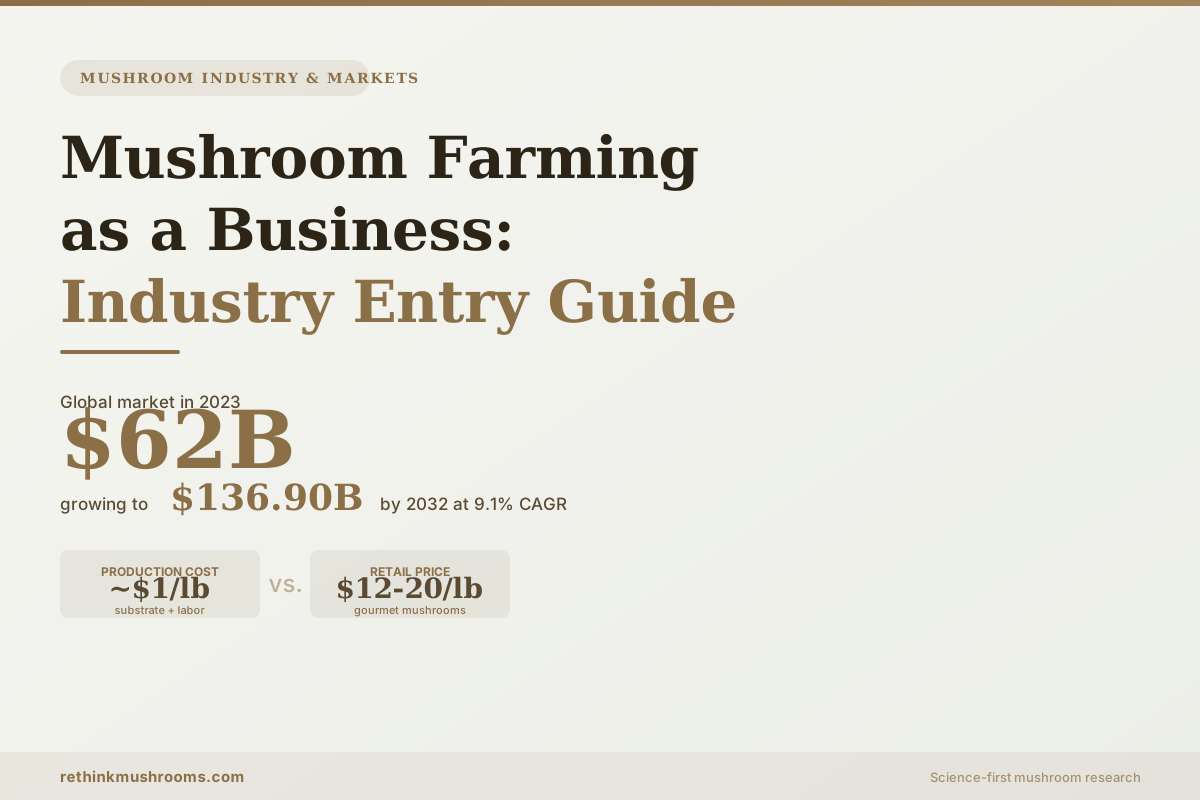
The global mushroom market reached $62.31 billion in 2023 and is growing at 9.1% annually. The gap between production cost (~$1/lb) and premium selling price ($12-20/lb) makes mushroom farming one of the highest-margin crops per square foot in commercial agriculture.
Verified market research, 2023-2032
$3K-$50K
startup cost range, from basement operations to automated commercial systems
25-150%
profit margin range depending on scale, automation, and market channel
26%
of commercial reishi supplements tested matched their label content — documented quality is what unlocks the premium supplement channel
Verified market research, 2023-2032
 View as image ↗
The global mushroom market was valued at $62.31 billion in 2023 and is projected to reach $136.90 billion by 2032, growing at 9.1% per year. Within that market, gourmet and medicinal mushrooms command prices of $8 to $20 per pound at retail, while production costs run around $1 per pound for substrate and labor. That spread is the business case.
What no mushroom farming guide currently explains is the science angle that separates premium-priced supplement-quality production from commodity food production. Research on how cultivation conditions affect bioactive compound profiles shows that a grower who understands substrate effects can access a fundamentally different market at fundamentally different prices. This article covers the numbers first, then the science. For market context on the demand driving this growth, see the functional mushroom market: $50B+ projected by 2030.
Key Takeaways
- Global mushroom market: $62.31B in 2023, projected $136.90B by 2032, 9.1% CAGR
- Startup costs range from $3,000-$5,000 for a basement/garage operation to $20,000-$50,000+ for automated commercial systems
- Production cost of approximately $1/lb (substrate and labor), vs. gourmet wholesale prices of $8-10/lb and retail of $12-20/lb
- Most profitable species for small commercial operations: lion's mane, oyster, shiitake, maitake, chestnut
- Substrate composition directly affects bioactive compound profiles: oyster mushrooms grown on differently supplemented substrates produce measurably different yield, bioactive-compound, and antioxidant content (Jin et al., 2020)
- Because they grow in vertical stacks without needing light and convert agricultural waste into food, mushrooms are among the most land- and input-efficient crops per unit of floor area (Grimm and Wösten, 2018)
The Species Profitability Table: What Each Mushroom Earns
The choice of species is the single most important business decision in mushroom farming. Different species have different grow cycles, difficulty levels, market positions, and selling prices.
| Species | Wholesale/lb | Retail/lb | Days to harvest | Difficulty | Primary market |
|---|---|---|---|---|---|
| Oyster | $8-10 | $12-16 | 25-35 | Easy | Restaurants, farmers markets |
| Lion's mane | $10-14 | $18-25 | 30-40 | Moderate | Premium retail, supplement processors |
| Shiitake | $8-10 | $14-18 | 60-90 | Moderate | Restaurants, grocery, supplement |
| Maitake | $12-16 | $20-30 | 60-90 | Difficult | Specialty retail, supplement |
| Chestnut | $8-12 | $14-20 | 30-45 | Easy | Farmers markets, restaurants |
Oyster mushrooms are the standard entry species: fast fruiting cycle, tolerant of substrate variation, and established demand in restaurants. Lion's mane has the highest premium pricing and is the species most in demand from the functional mushroom supplement market. Shiitake has the deepest established market and the most processing options (dried, powdered, supplemented). Maitake commands the highest restaurant price but has longer cycles and more precise environmental requirements. Chestnut occupies a favorable position as an easy-to-grow species with better differentiation than oyster in farmers market settings.
Speed vs. Premium
Where Each Species Sits: Harvest Speed vs. Retail Ceiling
Plotted from the profitability table above. Left is a faster cash cycle; higher is a stronger premium price. Lion’s mane is the rare species that is both quick to fruit and premium-priced.
Read it as a strategy grid: oyster and chestnut win on speed and low difficulty (fast, forgiving cash flow); maitake trades a 60–90 day cycle and higher difficulty for the top retail ceiling; lion’s mane is the standout, pairing a 30–40 day cycle with premium supplement-market demand.
Values are midpoints of the wholesale/retail and days-to-harvest ranges in the species profitability table in this article.
The key metric for business planning is not gross price per pound but net margin after accounting for substrate cost, labor, packaging, and sales channel fees. Direct-to-consumer at farmers markets captures full retail price but requires time. Restaurant wholesale eliminates retail overhead but accepts lower price. Supplement processor sales require quality documentation but can access the highest volume at consistent terms.
Starting a Mushroom Farming Business: Realistic Startup Costs
Getting the capital requirements right is where many aspiring mushroom farmers make early errors. Costs vary enormously by scale and automation level.
Small-scale (basement or garage):
- Initial investment: $3,000-$5,000
- Essential equipment: $1,000-$5,000 (shelving, humidifiers, HVAC modification, lighting)
- Substrate and spawn: $300-$500 per production cycle
- Annual income potential at this scale: $50,000-$100,000 (fully utilized, direct sales channels)
The small-scale operation runs primarily on oyster and lion's mane, requires no specialized agricultural space, and can achieve positive cash flow within the first growing cycle if sales channels are established before production begins. The bottleneck is usually sales, not production.
Medium commercial (dedicated grow room, 2,000-5,000 sq ft):
- Initial investment: $10,000-$25,000
- Requires HVAC systems capable of holding precise temperature (55-65°F for fruiting), humidity (85-90%), and CO2 levels
- May require agricultural zoning compliance and food handler certification
- Annual income potential: $100,000-$250,000
Large-scale automated:
- Initial investment: $20,000-$50,000+
- Integrates environmental sensors, automated misting, LED lighting systems
- Requires significant capital for climate control systems
- Annual income potential: scales with floor space and vertical stacking
The lowest-risk entry path for a new business is the small-scale basement operation with established restaurant or farmers market buyers, expanding only after proving demand absorption and operational consistency. The circular economy nature of mushroom cultivation (agricultural waste streams as substrate inputs) significantly lowers ongoing input costs at all scales. For more on waste-to-value substrate economics, see circular economy and mushrooms: waste-to-value applications.
Profitability Math: $1/lb to Produce, $8-20/lb to Sell
The gross margin potential in mushroom farming is among the highest in commercial agriculture, but gross margin and net income are different numbers.
Revenue calculation (sample small-scale operation):
- 100 lbs/week output (realistic for 300 sq ft, 3 oyster varieties)
- Wholesale price: $8/lb average
- Gross weekly revenue: $800
- Annual gross revenue: $41,600
Upgrade to lion's mane and direct retail:
- 100 lbs/week at $14/lb average
- Annual gross revenue: $72,800
Cost structure:
- Substrate (straw, coffee grounds, sawdust): $0.20-0.40/lb produced
- Spawn: $0.10-0.20/lb produced
- Labor (self-operated): variable; commercial operations budget 0.5-1 hour per 5 lbs harvested
- Packaging: $0.15-0.30/lb
- Overhead (utilities, HVAC, humidity): $0.20-0.40/lb depending on climate and automation
Net production cost: approximately $1/lb at efficient small-to-medium scale.
Profit margin on $8 wholesale: 700% gross margin on inputs. After overhead allocation, operating margins run 25-50% on wholesale and 40-150% on direct retail. The wide range reflects energy costs (heating and humidity control can be significant in cold climates), labor costs, and sales efficiency.
The business model that consistently reaches the upper margin range: automated climate control (reducing labor for environment management), multiple species for market diversification, and at least one premium channel (specialty retail or supplement processing) mixed with restaurant/farmers market volume.
Where to Sell: Channels by Volume, Price, and Complexity
Market access determines realized price more than production quality alone. The main channels in descending price order:
Supplement processors and nutraceutical companies: Highest per-pound value, but require consistency documentation (batch records, beta-glucan testing, contamination screening). Access the premium segment willing to pay $15-30/lb for verified quality supply. Generally require months of relationship development and consistency demonstration before first purchase order.
Specialty grocery and natural food retail: $12-20/lb retail if self-managed; $8-14/lb wholesale to stores. Requires packaging, labeling compliance, and often private label capability.
Farmers markets and CSAs: Full retail pricing, direct consumer relationship. Labor-intensive for sales time. Best for building initial customer base and learning what sells at what price.
Restaurant wholesale: High-volume, consistent orders, but at the lowest price ($6-10/lb depending on species and relationship). Restaurants provide reliable demand volume; margin is lower but logistics are simpler than retail.
Online direct-to-consumer: Dried and powdered mushrooms can ship; fresh mushrooms are logistics-limited. Online channel has high margin but requires brand investment and marketing.
The most sustainable small-scale business model typically combines farmers market or restaurant base for volume and cash flow stability, with a specialty/supplement channel that captures the premium price for the portion of production that meets documentation standards.
The Science Angle No Farming Guide Covers: Substrate and Bioactive Quality
Most mushroom farming guides treat substrate choice as a cost optimization decision. Research shows it is also a product quality decision that directly affects which markets a grower can access.
A 2020 study by Jin and colleagues cultivated oyster mushrooms (Pleurotus ostreatus) on substrates supplemented at different ratios and measured the effects on yield, bioactive compounds, and antioxidant properties.[2] Substrate composition significantly affected not just how much mushroom grew, but what the mushroom contained: yield, bioactive-compound content, and antioxidant activity all varied measurably with the substrate formulation.
This pattern shows up starkly in the finished-product market. When researchers analyzed 19 batches of Ganoderma lucidum (reishi) dietary supplements purchased in the United States, only 26.3% had measured bioactive content — triterpenes and polysaccharides — consistent with their label claims.[3] Bioactive concentration in commercial products varies widely with cultivation conditions, substrate, and harvest timing, and much of the market cannot document what it is actually selling. That gap is the opportunity: verified, documented content is what separates a premium supplement-grade supply from a commodity one.
This variation is not just a quality label issue. A mushroom grower targeting supplement processors needs to demonstrate verified bioactive compound concentrations. A grower using grain substrate for lion's mane will produce material with different beta-glucan content than one using hardwood sawdust. A supplement processor buying for encapsulated product needs documented beta-glucan percentages. The grower who can provide that documentation accesses the premium market; the one who can't sells into commodity food channels.
The practical implication: substrate choice is a business strategy decision, not just an input cost decision. Hardwood-based substrates for lion's mane and shiitake are more closely aligned with the fruiting body bioactive profiles that supplement buyers specify. Documentation of substrate type and growing conditions is the foundation of accessing the verified-quality premium tier.
For the detailed science on how substrate type determines supplement quality, see hardwood vs. grain substrate: impact on supplement quality. For the full technology landscape connecting growing conditions to compound quality, see modern mushroom cultivation technology: AI, automation, and innovation.
Why Mushrooms Are Among the Most Land-Efficient Crops
A 2018 review by Grimm and Wösten in Applied Microbiology and Biotechnology examined mushroom cultivation from a circular economy perspective and made a point that rarely reaches the farming business guides: because mushroom-forming fungi convert low-quality lignocellulosic waste streams into high-quality food and can be grown in vertical stacks, they use land and inputs far more efficiently than conventional crops.[1]
This efficiency advantage comes from three structural features of mushroom cultivation. First, mushrooms do not photosynthesize, meaning they do not need sunlight and can grow in complete vertical stacks without shading interference. Second, they convert cellulosic agricultural waste (coffee grounds, straw, sawdust, corn cobs) into high-value food and bioactive compounds. They are, by definition, waste processors that produce premium outputs. Third, the spent substrate after mushroom harvest is an effective soil amendment or animal feed input, closing the nutrient loop.
For a business, these features translate to:
- Land cost is a minimal consideration relative to most agricultural operations
- Input substrate can often be sourced from local agricultural or food processing waste streams at low or no cost
- The vertical dimension of the growing space is productive, not wasted
The circular economy model (waste input → mushroom production → spent substrate recycled) is not just an environmental story. It is a cost structure story: mushroom farming's input economics are unusually favorable because the raw material has negative value (agricultural waste disposal costs) before it enters the production system. For more on how mushroom cultivation connects to circular economy models, see indoor mushroom farming: the vertical agriculture connection.
Technology Adoption: What to Realistically Expect at Different Scales
The mushroom farming technology landscape now includes AI harvest-prediction systems, computer-vision disease and maturity detection, robotic harvesting platforms, and IoT-integrated environmental monitoring. Research prototypes have demonstrated high accuracy in automated detection tasks, and commercial operations that adopt climate automation and monitoring report meaningful reductions in labor and crop-failure costs. The magnitude of the savings depends heavily on scale, climate, and how much manual labor the automation actually replaces.
For a first-time commercial grower, the relevant technology tier is not AI harvest detection. It is reliable climate control automation: a system that holds temperature and humidity within target ranges without manual adjustment. This single investment pays for itself in reduced crop failure rates and reduced manual monitoring labor. It is also the prerequisite for everything more sophisticated that follows.
The honest cautionary note: Smallhold, a venture-backed vertical mushroom farming company, filed for bankruptcy in February 2024. Technology investment does not substitute for positive unit economics. A high-tech mushroom operation that sells below its cost of production, at insufficient volume, or without customer relationships established before production scales, faces the same failure modes as a low-tech one.
Technology adoption should follow proven unit economics, not precede them. Start with the operation the capital supports, prove the sales and margin model, then invest in automation as a cost reduction once volume justifies it. For more on how technology is transforming commercial mushroom production at scale, see how technology is transforming mushroom production and vertical farming and AI-controlled mushroom cultivation.
The Bottom Line
The mushroom farming business case rests on a production cost of approximately $1/lb against retail prices of $12-20/lb. Startup costs range from $3,000 for small basement operations to $50,000+ for automated systems, with profit margins of 25-150% depending on scale and channel. The science angle competitors miss: substrate composition directly affects bioactive compound profiles, which determines whether a grower can access premium supplement markets or only commodity food channels. Technology investment follows proven unit economics; it does not create them.
Frequently Asked Questions
Sources & References
- 1RTHM-00511·Grimm, Daniel et al. (2018). “Mushroom cultivation in the circular economy..” Applied microbiology and biotechnology.Study breakdown →PubMed →↩
- 2RTHM-01213·Jin, Zhiqiang et al. (2020). “Effect of cultivating Pleurotus ostreatus on substrates supplemented with herb residues on yield characteristics, substrates degradation, and fruiting bodies' properties..” Journal of the science of food and agriculture.Study breakdown →PubMed →↩
- 3RTHM-00499·Wu, Ding-Tao et al. (2017). “Evaluation on quality consistency of Ganoderma lucidum dietary supplements collected in the United States..” Scientific reports.Study breakdown →PubMed →↩