Mushroom Gummies & Edible Products
19 US reishi supplements tested; some had no detectable species DNA
When researchers analyzed 19 Ganoderma (reishi) supplements sold in the United States, some products contained no detectable reishi DNA despite being labeled as reishi. The label on a mushroom gummy tells you less than it appears to.
Wu et al., Scientific Reports, 2017
AOAC 995.16
the validated enzymatic assay that separates active beta-glucan from inactive starch; rarely cited on gummy labels
Alpha-glucan
the inactive grain starch that's counted inside 'total polysaccharides' on most mushroom gummy labels
2025
Windsor et al. confirmed quality inconsistency continues in commercial Chaga supplements using DNA barcoding and HPLC
Wu et al., Scientific Reports, 2017
 View as image ↗
The mushroom gummy market operates under a regulatory framework that requires products to contain what their labels say, but does not require manufacturers to prove their products work or disclose what they contain in a format that allows meaningful evaluation. A gummy can list "reishi extract, 500mg" on the label and satisfy legal requirements even if that extract contains no measurable reishi DNA, as some US-market reishi supplements were found to contain in a 2017 study.[2] Reading a mushroom gummy label is a skill with specific criteria, and most product pages don't explain what those criteria are. This article is part of a broader look at functional mushroom products across different forms and what the evidence says about each.
Key Takeaways
- "Total polysaccharides" on a mushroom gummy label includes alpha-glucan starch from grain in addition to active beta-glucan; the two are not the same, and a label can show a high polysaccharide percentage while containing very little active compound (McCleary & Draga, 2016)
- The AOAC 995.16 enzymatic assay is the validated method for separating beta-glucan from alpha-glucan; labels citing this specific method indicate the manufacturer has measured what actually matters
- Analysis of 19 US Ganoderma supplements found massive quality inconsistency including some products with no detectable species DNA despite reishi labeling (Wu et al., 2017)
- MALDI-TOF mass spectrometry analysis of commercial supplements across five mushroom species found significant discrepancies between labeled species and actual polysaccharide profiles (López-García et al., 2016)
- A 2025 Chaga supplement study using DNA barcoding, HPLC, and metabolomics confirmed that quality variation in commercial products has not improved (Windsor et al., 2025)
- A gummy label with five specific elements (beta-glucan %, AOAC-validated testing, fruiting body source, dose per serving, and third-party COA) is a meaningfully different product from one disclosing none of them
What "Polysaccharides" on a Label Actually Means
The most common quality claim on mushroom gummy labels is a polysaccharide percentage: "contains 40% polysaccharides" or "standardized to 30% polysaccharides." This number sounds like a potency indicator. It is not.
Polysaccharides are a broad category of carbohydrate molecules. They include two fundamentally different types that are both counted in "total polysaccharides" testing: beta-glucan, which is the active structural compound linked to most of the documented health effects of medicinal mushrooms, and alpha-glucan, which is primarily grain starch.
McCleary and Draga developed and validated the AOAC 995.16 enzymatic assay specifically to address this measurement problem.[1] The assay uses specific enzymes to separately measure alpha-glucan and beta-glucan. Their work demonstrated that total polysaccharide measurement, which is the simpler and cheaper test, conflates inactive grain starch with active beta-glucan. A product made from mycelium grown on grain substrate can have a very high "total polysaccharides" number because the grain contributes starch (alpha-glucan) to the total.
The practical consequence for label reading: a mushroom gummy listing "40% polysaccharides" could theoretically have a beta-glucan content anywhere from 5% to 35% or more. The "40%" number is not the active compound percentage. It is a combined measurement that includes inactive starch.
The label language that indicates a manufacturer has done the right test is specific: it will cite "beta-glucan," not just "polysaccharides," and will reference the AOAC 995.16 method or equivalent. Products that list only "polysaccharides" have either not measured their beta-glucan separately or have measured it and chosen not to disclose it.
For readers interested in the technical details of how beta-glucan testing works, how to test for beta-glucans in mushroom supplements explains the AOAC method and what it actually measures.
What Happens When Tested Products Meet Label Claims
The polysaccharide labeling problem would be concerning on its own, but the peer-reviewed evidence suggests the quality issues run deeper: some commercial mushroom supplements don't contain what they claim to contain at the species level, before any questions about compound percentage arise.
Wu and colleagues analyzed 19 commercial Ganoderma lucidum (reishi) dietary supplements sold in the United States, testing polysaccharide content and verifying species identity via DNA testing.[2] The results showed massive polysaccharide content variation across products. Some contained no detectable Ganoderma DNA. These were products on retail shelves in the United States, labeled as reishi.
A separate analysis used a molecular technique called MALDI-TOF mass spectrometry to examine commercial mushroom supplements across five species.[3] This technique reads the molecular fingerprint of complex compounds, allowing researchers to confirm what species-specific polysaccharide profiles are actually present in a product. López-García and colleagues found significant discrepancies between the mushroom species listed on labels and the actual compound profiles in the products. The contents did not consistently match the labeling across the five species studied.
The most recent data comes from a 2025 multi-method analysis of commercial Chaga supplements.[4] Windsor and colleagues used DNA barcoding to verify species identity, high-performance liquid chromatography to measure specific compound concentrations, and metabolomics to profile the full chemical composition of each product. They found wide variation in bioactive compound content across commercial products. The study's co-author Jeff Chilton of Nammex is a recognized industry critic of quality issues in mushroom supplements, particularly around mycelium-on-grain products. The 2025 data confirms the quality pattern documented in 2016 and 2017 has not resolved.
For readers interested in the DNA testing side of species verification, DNA testing for mushroom supplements covers how barcoding works as an authentication tool.
The Five Red Flags on a Mushroom Gummy Label
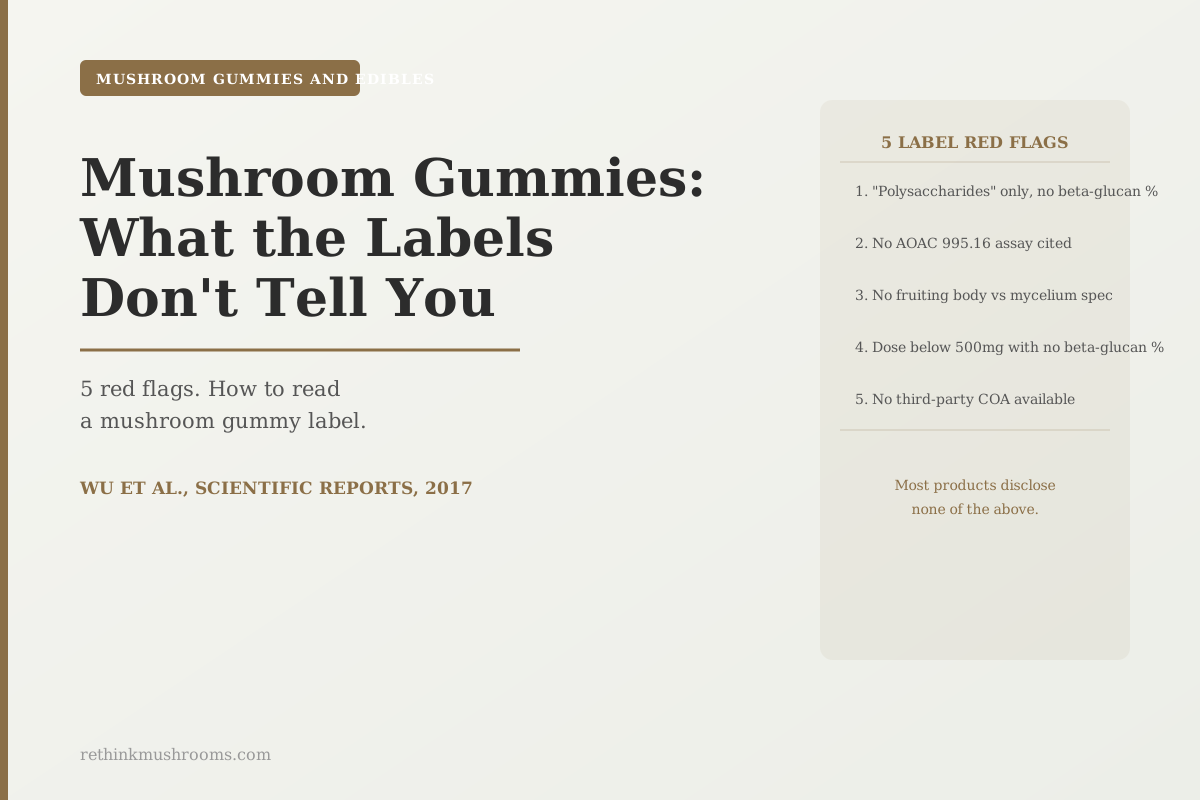
Based on the analytical chemistry research on mushroom supplement quality, five label patterns indicate elevated risk of a product that fails to deliver its claims.
Red flag 1: "Polysaccharides" listed as the potency indicator without a beta-glucan percentage. A label saying "standardized to 40% polysaccharides" without a separate beta-glucan figure includes inactive starch in the potency claim. The meaningful number is beta-glucan percentage, measured by a validated assay.
Red flag 2: No reference to AOAC 995.16 or equivalent validated assay. The AOAC 995.16 enzymatic assay is the validated method for measuring true beta-glucan content separate from alpha-glucan starch.[1] Products specifying this method on their label or certificate of analysis have done the test that distinguishes active compound from starch. Products that don't cite it may be measuring total polysaccharides only.
Red flag 3: No specification of fruiting body vs. mycelium source. Mycelium grown on grain substrates contains substantial grain starch, which counts toward total polysaccharide measurements. Fruiting body extracts do not have this problem. A label that says "mushroom extract" without specifying which part of the organism cannot be evaluated for this quality variable.
Red flag 4: Dose below 500 mg of concentrated extract per serving without disclosed beta-glucan content. Without knowing the beta-glucan percentage, a dose number is difficult to interpret. But at very low extract amounts (under 100–200 mg per species), even a high-quality extract is unlikely to approach the gram-level doses used in clinical research. Dose, combined with beta-glucan percentage, is what determines how much active compound a serving actually contains.
Red flag 5: No certificate of analysis from an independent laboratory. Given the species authentication failures documented by Wu 2017 and Windsor 2025, a manufacturer's own quality claims are insufficient verification. A third-party COA from a recognized analytical laboratory, available to consumers on request or published on the brand's website, is the mechanism that makes label claims verifiable. Without it, there is no external check on what the product actually contains.
What the Food Matrix Adds to the Label Problem
The label issues described above apply to any mushroom supplement. For gummies specifically, the food manufacturing process adds a further layer.
A 2023 comprehensive review of medicinal mushrooms in functional food applications documented that incorporating mushroom bioactives into confectionery formats introduces heat, sugar, and fat interactions that can degrade polysaccharides, alter their structural integrity, and reduce compound stability from the ingredient to the finished product.[5] This means the quality of the mushroom extract before it enters the gummy manufacturing process is the ceiling for what can end up in the final product. Poor-quality extract, processed through gummy manufacturing, cannot produce high-quality product. Even a properly characterized extract may contain less active compound by the time it reaches the consumer.
The label captures the extract quality at the point of formulation, not necessarily the compound activity in the finished gummy after processing, shelf time, and any temperature variation in storage.
What an Honest Label Looks Like
A mushroom gummy label that provides meaningful quality information would include five elements:
- Beta-glucan percentage, not just polysaccharides percentage
- Analytical method used (AOAC 995.16 or equivalent), with reference to independent testing
- Source specification: fruiting body, not just "mushroom extract"
- Per-species dose and per-species beta-glucan content when a multi-species formula is used
- A third-party COA that is accessible to consumers before purchase
Products providing all five are uncommon in the current market. Products providing none are the default. The gap between those two categories is the information that determines whether a mushroom gummy is a premium functional product or a well-packaged sugar delivery vehicle with trace mushroom content.
For a broader look at how gummy doses compare against clinical research thresholds for specific outcomes, mushroom gummies and whether they have enough active compounds addresses the dose adequacy question directly. For the full picture of how edible mushroom formats compare on potency versus convenience, edible mushroom products across formats covers the landscape. And for readers who have already investigated the chocolate format, mushroom chocolate bars: functional or just marketing applies the same quality framework to that product category.
The Bottom Line
Reading a mushroom gummy label requires understanding that "polysaccharides" includes inactive grain starch alongside active beta-glucan, and that most labels don't disclose which is which. The peer-reviewed literature shows consistent species authentication and compound content problems in commercial mushroom supplements, with evidence across three independent analytical studies spanning 2016 to 2025 showing that some products fail to deliver what their labels claim. Five label elements indicate higher quality: a beta-glucan percentage measured by AOAC 995.16, fruiting body sourcing, per-species dose disclosure, and an accessible third-party COA. Most products in the current market provide none of these.
Frequently Asked Questions
Sources & References
- 1RTHM-00438·McCleary, Barry V et al. (2016). “Measurement of β-Glucan in Mushrooms and Mycelial Products..” Journal of AOAC International.Study breakdown →PubMed →↩
- 2RTHM-00499·Wu, Ding-Tao et al. (2017). “Evaluation on quality consistency of Ganoderma lucidum dietary supplements collected in the United States..” Scientific reports.Study breakdown →PubMed →↩
- 3RTHM-00437·López-García, Marta et al. (2016). “MALDI-TOF to compare polysaccharide profiles from commercial health supplements of different mushroom species..” Food chemistry.Study breakdown →PubMed →↩
- 4RTHM-02209·Windsor, Coleton et al. (2025). “What This 2025 Chaga Supplement Authentication Study Actually Found.” International journal of molecular sciences.Study breakdown →PubMed →↩
- 5RTHM-00843·Łysakowska, Paulina et al. (2023). “Medicinal Mushrooms: Their Bioactive Components, Nutritional Value and Application in Functional Food Production-A Review..” Molecules (Basel.Study breakdown →PubMed →↩