Mushroom Forms & Products
34 RCTs reviewed; doses spanned 2.5 mg–1 g/day
A systematic review of 34 randomized controlled trials of fungal beta-glucans found doses ranging from 2.5 mg to 1000 mg daily for up to 6.5 months, mostly for immune outcomes — with inconsistent cellular and molecular findings, and no optimal dose established.
Vlassopoulou et al., Food & Function, 2021
100–500mg
typical mushroom content per serving in gummies and chocolate bars
By difference
how mushroom beta-glucan is actually measured: total glucan minus alpha-glucan (McCleary & Draga, 2016)
26.3%
of 19 US reishi supplements matched their own label for triterpenes and polysaccharides (Wu et al., 2017)
Vlassopoulou et al., Food & Function, 2021
 View as image ↗
Every edible mushroom product on the market faces the same fundamental question: does the dose and delivery method match what the clinical research used? Gummies, chocolate bars, mushroom-infused coffees, capsules, and powders all claim benefits backed by mushroom science. But the human trials behind the best-known claims were built almost entirely on one delivery format — standardized dried extract or powder, taken as a tablet or capsule, in a measured daily amount.
This does not mean gummies and chocolate bars can never work. It means the burden of proof is on the format, not just the species. This article is part of the complete guide to mushroom forms and products, and provides a framework for evaluating any edible mushroom product against what the peer-reviewed evidence actually establishes.
Key Takeaways
- Vlassopoulou et al. 2021 systematically reviewed 34 RCTs of fungal beta-glucans (from S. cerevisiae, A. pullulans, P. ostreatus, L. edodes, G. lucidum) at doses spanning 2.5 mg to 1000 mg daily; most reported immune benefits, but cellular and molecular findings were inconsistent and the authors concluded an optimal dose has not been established
- "Total polysaccharides" on a label includes inactive starch (alpha-glucan) and is not equivalent to active beta-glucans; McCleary and Draga 2016 developed the reference method for separating them in mushroom material — total glucan by acid hydrolysis, alpha-glucan enzymatically, beta-glucan by difference
- AOAC 995.16 is a cereal method for barley and oat beta-glucan, not a mushroom method; seeing it cited on a mushroom certificate of analysis is a sign the wrong test was run
- Measured beta-glucan spans roughly 13.5 to 40.9 g/100 g dry mass across species, and the assay chosen shifts the ceiling by about half — so a bare percentage with no method named cannot be compared across brands (Mirończuk-Chodakowska et al. 2017, 2020)
- Fruiting body extract outperformed mycelium extract in a direct comparison in Antrodia camphorata; this is one species in one disease model and has not been shown to generalize to lion's mane, reishi, or cordyceps (Wang et al. 2012)
- Only 26.3% of US reishi supplements matched their own label, and none of 20 products tested genetically contained G. lucidum sensu stricto (Wu et al. 2017; Loyd et al. 2018)
- A clinical-grade dose does not guarantee a clinical result: 3 g/day of reishi for 16 weeks produced no change in blood glucose in an 84-person RCT (Klupp et al. 2016)
- Powders and capsules best match the delivery format used in trials; gummies and chocolate carry the least dose transparency, and the food-matrix question for them remains formally unresolved
What Clinical Doses Actually Look Like
The dose comparison is where most edible mushroom products fail the evidence test before anything else is evaluated — but the comparison is more subtle than the marketing on either side suggests.
Vlassopoulou et al. conducted a systematic review of 34 randomized controlled trials, drawn from 917 records, examining fungal beta-glucans for health outcomes.[2] The sources were Saccharomyces cerevisiae, Aureobasidium pullulans, Pleurotus ostreatus, Lentinula edodes, and Ganoderma lucidum, and supplementation ranged from 2.5 mg to 1000 mg daily for up to 6.5 months. The primary outcome across most interventions was immunomodulation — reduced incidence and symptoms of cold, flu, and other respiratory infections, and improvement in allergic symptoms. Notably, no adverse event was causally related to the glucans. But the authors also recorded that findings on immune response alterations were inconsistent at the cellular and molecular level, and concluded that more studies are needed to establish the optimal dose.[2]
Vlassopoulou, Yannakoulia, Pletsa, Zervakis, Kyriacou (2021) · Food & Function
- Population
- Healthy subjects and patients across 34 RCTs, screened from 917 records
- Intervention
- Oral fungal beta-(1→3,1→6)-D-glucans, 2.5 mg to 1000 mg daily, up to 6.5 months
- Comparator
- Placebo-controlled randomized designs
- Finding
- Most trials reported immunomodulation — fewer and milder respiratory infections, improved allergic symptoms — with no adverse events causally linked to glucans. Findings on cellular and molecular immune markers were inconsistent across studies.
mixed Benefit signal is reasonably consistent at the symptom level; the mechanism and the optimal dose are not settled.
Vlassopoulou M, et al. Effects of fungal beta-glucans on health — a systematic review of randomized controlled trials. Food Funct. 2021;12(8):3366-3380.
The whole-mushroom trials behind specific consumer claims sit toward the upper end of that range or above it. The most-cited lion's mane cognitive trial gave participants with mild cognitive impairment four 250 mg tablets of 96% Hericium erinaceus dry powder three times daily — 3 g/day of tablets — for 16 weeks, and saw cognitive scores improve at weeks 8, 12, and 16 before declining again during a four-week washout.[9] A reishi trial in metabolic syndrome used 3 g/day for 16 weeks.[10]
Many gummies and chocolate products deliver 100–500 mg of mushroom extract per serving. That falls inside the broad Vlassopoulou envelope, but it is an order of magnitude below the whole-mushroom trials that generated the specific cognitive and immune claims used in marketing. Without a disclosed beta-glucan percentage, there is no way to tell which comparison applies.
Fact Check
Does hitting a 'clinical dose' mean the product works?
The claim
“If a product delivers the same number of grams used in a clinical trial, it should produce the same result.”
Dose-matching is the most legible way to compare a supplement to research, so marketing leans on it heavily.
What research shows
OverstatedKlupp et al. gave 84 people with type 2 diabetes and metabolic syndrome 3 g/day of Ganoderma lucidum, with or without Cordyceps sinensis, for 16 weeks. It changed nothing: HbA1c differed by 0.13% (95% CI -0.35 to 0.60, p = 0.60) and fasting plasma glucose by 0.03 mmol/L (95% CI -0.90 to 0.96, p = 0.95).
Dose adequacy is necessary, not sufficient. Species, extract preparation, the outcome being measured, and the population all determine whether a gram-level dose does anything. A gummy that reaches a trial dose has cleared one hurdle out of several — and a trial dose that cleared all of them still returned a null result here.
Klupp NL, et al. A double-blind, randomised, placebo-controlled trial of Ganoderma lucidum for the treatment of cardiovascular risk factors of metabolic syndrome. Sci Rep. 2016;6:29540.
The Format-by-Format Breakdown
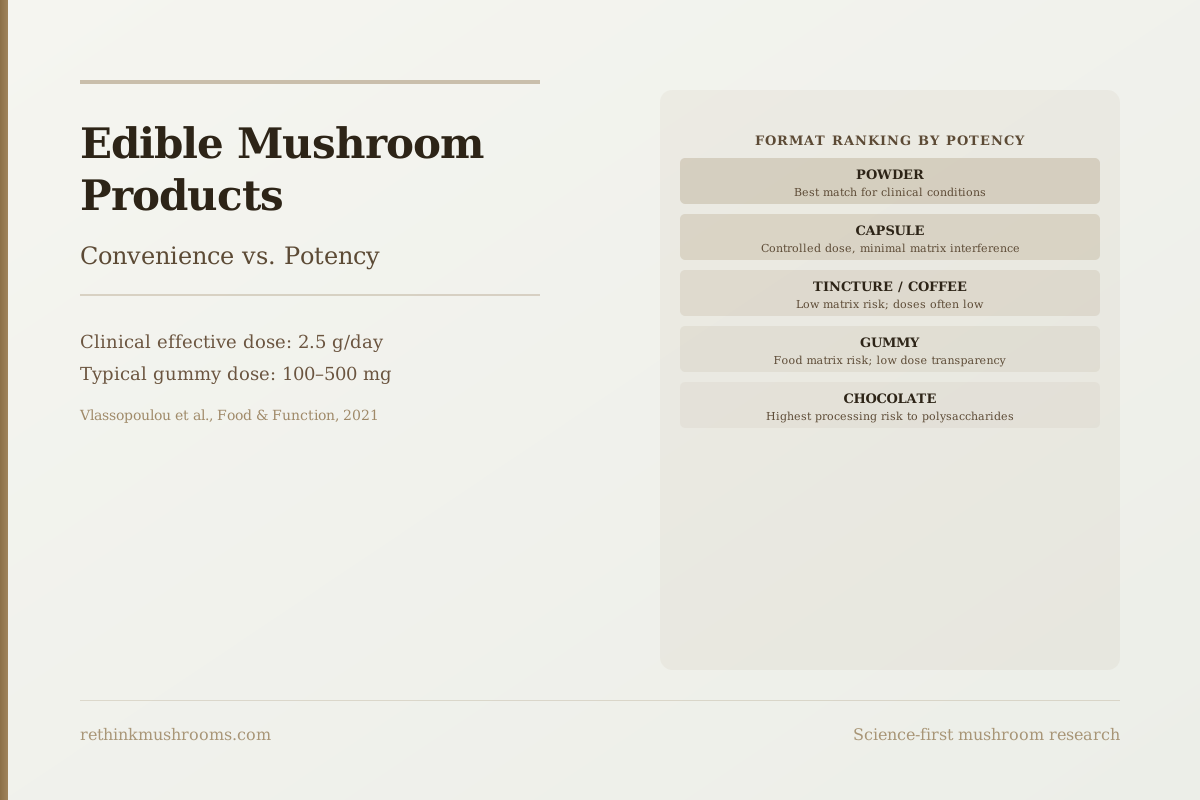
The table below ranks common edible mushroom formats by how closely they match clinical trial conditions. Ratings reflect typical market products, not the theoretical best product possible in each category.
| Format | Typical dose per serving | Usually discloses beta-glucan % | Food matrix concern |
|---|---|---|---|
| Powder | 2–5g per scoop | More often | Minimal |
| Capsule | 300mg–2g | More often | Minimal |
| Tincture | Variable (ml dosing) | Rarely | Low |
| Coffee / drink mix | 50–200mg per packet | Rarely | Low–moderate |
| Gummy | 100–500mg | Rarely | Moderate |
| Chocolate bar | 100–500mg | Rarely | High |
The dose gap between powder and gummy formats is not a brand quality issue. It is a category issue. A powder scoop of 2–4 grams of high-quality lion's mane can physically contain the quantity of extract that multiple gummies cannot match without exceeding the product's intended serving size.
The Beta-Glucan Label Problem
The word "polysaccharides" appears on nearly every mushroom supplement label. It sounds specific but it is not. Polysaccharides include both beta-glucans (the immune-active compounds from mushroom cell walls) and alpha-glucans (the starch found in grain substrates used to grow mycelium). Both are polysaccharides. Both are counted when a manufacturer reports total polysaccharide content.
McCleary and Draga developed and validated the reference method for separating them in mushroom and mycelial material.[3] The logic is subtractive rather than direct: total glucan is released by controlled acid hydrolysis with sulfuric acid and the liberated glucose measured with a glucose oxidase/peroxidase reagent; alpha-glucan (starch and glycogen), together with free glucose and glucose from sucrose, is measured separately using glucoamylase and invertase. Beta-glucan is then determined by difference — total glucan minus alpha-glucan. There is no step that measures beta-glucan directly.[3]
Same Sample, Different Number
How the Hydrolysis Method Moves the Beta-Glucan Result
McCleary & Draga compared several acid and enzyme routes for releasing glucose from beta-glucan. The direction of each result is what they reported — the bars below rank those directions and are not measured percentages.
Sulfuric acid (H₂SO₄)
Reference procedure
Highest recovery
Selected as the best option of all acid and enzyme hydrolysis routes compared. For Ganoderma lucidum and Poria cocos specifically, it returned significantly higher values than HCl.
Hydrochloric acid (HCl)
Optimized alternative
Similar for most samples
Gave similar beta-glucan values to H₂SO₄ across most samples tested — but diverged sharply on the two species above.
Trifluoroacetic acid (2 N TFA)
Acid hydrolysis, 120 °C
Much less effective
Found to be much less effective at hydrolysing beta-glucan than either of the other two acids evaluated.
Fully enzymatic assays
No acid step
Much lower values
Assays based totally on enzymatic hydrolysis generally yielded much lower values than the H₂SO₄ procedure on the same material.
Why this matters on a label: no regulation names a required assay. Two laboratories testing the same batch honestly, using different accepted hydrolysis routes, can print different beta-glucan percentages. A percentage with no method named beside it cannot be compared to another brand's percentage.
Source: McCleary BV, Draga A. Measurement of β-Glucan in Mushrooms and Mycelial Products. J AOAC Int 2016;99(2):364–73. Ranking is schematic; the study reported comparative direction, not a cross-method percentage table.
One correction worth carrying to the supplement aisle: AOAC 995.16 is not a mushroom method. It is the streamlined enzymatic method for beta-D-glucan in barley and oats, which uses lichenase and beta-glucosidase to target the mixed-linkage (1→3,1→4) beta-glucan of cereal grains. Mushroom beta-glucan is predominantly (1→3,1→6)-linked and is not what that assay is built to quantify. A mushroom certificate of analysis citing AOAC 995.16 is reporting a cereal test run on a fungal product.
This matters most for products using mycelium-on-grain extracts. Mycelium grown on grain (typically oats or rice) accumulates starch from the substrate. A raw mycelium-on-grain extract can carry a large alpha-glucan load, meaning the labeled "polysaccharide content" is substantially starch rather than beta-glucan. A gummy produced from this starting material will show high polysaccharide totals on paper and low beta-glucan content in practice.
Look for: a beta-glucan figure with the assay named beside it, and an alpha-glucan figure alongside it. A percentage with no method attached cannot be compared to any other brand's percentage.
The Food Matrix Question
Even when a gummy or chocolate product starts with a high-quality extract, the manufacturing process raises a second question — one that is, importantly, still open.
Łysakowska et al. reviewed the bioactive components of medicinal mushrooms — including the (1,3)(1,6)-beta-D-glucans, triterpenes, phenolics, and sterols in lion's mane, reishi, chaga, cordyceps, shiitake, and turkey tail — and their application in functional food production.[1] Their assessment was that medicinal mushrooms have real potential as functional food ingredients, and that two things are not yet settled: the detailed mechanisms, safety of use, and dosage still require long-term clinical studies, and there is an explicit need for further research into how mushroom bioactives interact with other ingredients once incorporated into a food matrix.[1]
That is the accurate state of the evidence, and it cuts both ways. The concerns commonly raised about confectionery formats are mechanistically plausible rather than demonstrated:
Heat processing: Gummy manufacturing involves heating a gelatin or pectin mixture. Polysaccharide structure can in principle be altered under sustained heat. What has not been published is a controlled measurement of beta-glucan before and after commercial gummy production.
Sugar and ingredient interactions: High sugar concentrations can influence polysaccharide solubility and behavior in other food systems. Whether this meaningfully changes mushroom beta-glucan activity in a finished gummy is precisely the interaction question Łysakowska et al. flagged as needing study.[1]
Chocolate matrix: Conching and tempering expose ingredients to extended moderate heat. A chocolate bar claiming both cacao and mushroom benefits is making two simultaneous bioavailability claims in a matrix where neither has been verified for the finished product.
For a full examination of bioavailability differences across formats, see Bioavailability by Supplement Form: What Gets Absorbed?.
Fruiting Body vs. Mycelium: Why Source Matters Before Format
Before the format question comes the ingredient source question. Wang et al. directly compared fruiting body extract against mycelium extract of Antrodia camphorata in both a cell model (PC-12 neurons exposed to amyloid beta-40) and a live animal model of Alzheimer's-type memory impairment. The fruiting body showed stronger antioxidative and anti-inflammatory activity and better inhibition of amyloid-induced neurotoxicity and accumulation.[4]
That is a genuine head-to-head result, and it is worth taking seriously. It is also one species, in one disease model, in cells and rodents. Antrodia camphorata is not lion's mane, reishi, or cordyceps, and this study does not establish that fruiting body beats mycelium for those species or for immune outcomes in humans. It is a reason to prefer disclosed fruiting body sourcing, not proof that mycelium products are inert.
The cost economics still push in one direction. Fruiting body cultivation is more labor-intensive and yields less extract per unit cost than mycelium grown on grain substrate. Gummies, chocolates, and coffee products sold at consumer-friendly price points often use mycelium-on-grain extracts, because fruiting body extracts at trial-comparable doses would make the unit economics difficult.
The chain of compromise compounds: a mycelium-on-grain source carrying substantial starch, a food matrix whose effect on the actives is unstudied, and a serving an order of magnitude below the whole-mushroom trials. Each link is individually defensible. Together they can produce a product that shares very little with the research in its marketing.
This is not universal across the category. Some premium gummy brands use certified fruiting body extracts, disclose beta-glucan percentages with the assay named, and publish third-party testing. These represent a meaningfully different proposition than budget options. The label indicators that distinguish them are covered in Mushroom Gummies: Convenient or Underdosed? What the Labels Don't Tell You.
The Species Problem
Mirończuk-Chodakowska et al. measured beta-glucan across eight wild-growing edible Polish species plus cultivated Agaricus bisporus. Mean total beta-glucan ranged from 13.5 g/100 g dry mass in portobello to 40.9 g/100 g in Tricholomopsis rutilans. The branched 1,3-1,6-beta-D-glucan fraction — the one most often invoked in immune claims — ranged from 3.9 g/100 g in cremini to 16.8 g/100 g in wood ear, and made up as much as 54% of total beta-glucan in some species and far less in others.[5]
A follow-up study by the same group measured 18 wild and three commercial species using two different procedures. The Megazyme method returned a top mean of 34.97 g/100 g in Tricholoma portentosum; the Congo red method, on the same material, topped out at 17.11 g/100 g in Lactarius deliciosus.[6] The species you choose changes the number. The assay you choose changes it again, by roughly half.
What Has Actually Been Measured
Beta-Glucan Content by Species — and by Assay
Reported means in grams per 100 g dry mass. The top two bands are the spread across species within one study. The bottom two are the same research group measuring wild mushrooms two different ways — which is why a percentage with no method named beside it cannot be compared to another brand's percentage.
Total β-glucan
Colorimetric method, 8 wild Polish species + cultivated Agaricus bisporus
13.5–40.9 g/100 g
A. bisporus (portobello) 13.5
T. rutilans 40.9
1,3-1,6-β-D-glucan only
The branched fraction most often invoked in immune claims — a subset of the total
3.9–16.8 g/100 g
A. bisporus (cremini) 3.9
A. auricula-judae 16.8
Megazyme assay
18 wild + 3 commercial species; wild values comparable to commercial
up to 34.97 g/100 g
T. portentosum 34.97 (highest mean)
Congo red assay
Same study, same material, different procedure — a markedly lower ceiling
up to 17.11 g/100 g
L. deliciosus 17.11 (highest mean)
Scale: 0–45 g/100 g dry mass
The practical reading: across these studies the species spread is roughly three- to four-fold, not the hundred-fold sometimes implied in marketing copy. But the assay itself moves the ceiling by about half. Both numbers refer to dried mushroom material, not to a finished gummy — and none of these species are the ones most edible products are built from.
Sources: Mirończuk-Chodakowska I, et al. Rocz Panstw Zakl Hig 2017;68(3):281–90. Mirończuk-Chodakowska I, Witkowska AM. Int J Environ Res Public Health 2020;17(19). Values are reported means; individual samples varied around them.
So the species spread is real but more modest than sometimes implied — roughly three- to four-fold across these studies, not hundred-fold. The more consequential variable for a shopper is that the reported figure is uninterpretable without knowing both the species and the method.
"Mushroom blend" products face the sharpest version of this. A 500 mg blend of five species averages 100 mg per species before accounting for individual beta-glucan percentages. If a species contributes at the lower end of the measured range, the actual beta-glucan from that component is a few milligrams. The Vlassopoulou review's lowest tested dose was 2.5 mg daily, so single-digit milligram amounts are not automatically outside all studied territory — but nothing in that literature supports a benefit claim for a few milligrams of one species buried in a blend.[2]
And all of this assumes the label names the right organism. Two independent audits of US reishi products suggest that assumption is fragile. Wu et al. assessed 19 batches of Ganoderma lucidum supplements by chromatography and saccharide mapping and found only five — 26.3% — consistent with their labels.[7] Loyd et al. sequenced 20 manufactured reishi products and found that none contained G. lucidum sensu stricto; 93% were Ganoderma lingzhi, the taxon actually cultivated and studied in Asia, alongside several other Ganoderma species.[8]
Before Dose, Identity
Two Audits of What Is Actually in US Reishi Products
Dose arithmetic assumes the label is describing the right organism in the right amount. Two independent groups tested that assumption on the same product category using different tools.
Chemical audit
Wu et al., 2017
26.3%
matched their own label
5 of 19 · 19 batches of US reishi supplements
Method: Chromatography and saccharide mapping of labelled triterpenes and polysaccharides
The authors concluded quality consistency in the US market was poor and warranted investigation.
Genetic audit
Loyd et al., 2018
0 of 20
contained G. lucidum sensu stricto
0 of 20 · 20 manufactured reishi products
Method: DNA extraction with ITS and tef1α sequencing, plus Illumina MiSeq of the ITS1 region
93% were identified as Ganoderma lingzhi — the taxon actually cultivated and studied in Asia — with G. applanatum, G. australe, G. gibbosum, G. sessile and G. sinense also detected.
What this does and does not show: both audits sampled reishi specifically, and neither tested gummies or chocolate. They do not establish a failure rate for the edible category. What they establish is that in the one product category where this has been checked carefully, label fidelity was the weak link before dose was ever considered — and reishi is one of the most common ingredients in edible mushroom blends.
Sources: Wu D-T, Deng Y, Chen L-X, Zhao J, Bzhelyansky A, Li S-P. Sci Rep 2017;7(1):7792. Loyd AL, Richter BS, Jusino MA, et al. Assessing the Ganoderma species composition in commercial reishi products, 2018.
Neither audit tested gummies or chocolate, so neither establishes a failure rate for the edible category. What they establish is that in the one category where identity has been checked carefully, the label was the weak link before dose entered the conversation.
Single-species products at disclosed doses remain easier to evaluate than blends. A product disclosing "500 mg lion's mane fruiting body extract, standardized to 30% beta-glucans, measured by [named assay]" gives the consumer 150 mg of beta-glucans per serving and a number that can be checked. Comparing that to the evidence still requires matching a specific trial's species, preparation, dose, and outcome — not the broad envelope of a systematic review.
Where Each Format Fits
- Mechanistic and cell workcompleted
Beta-glucan immune signaling is well characterized in vitro across many species.
- Animal comparisonscompleted
Includes the Antrodia camphorata fruiting body vs. mycelium comparison (Wang 2012).
- Small human trials of powders and capsulescompleted
Mori 2009 used 3 g/day of Hericium erinaceus tablets in 30 people with mild cognitive impairment.
- Larger RCTs of standardized dosescurrent
Klupp 2016 dosed 84 people with 3 g/day reishi and found no glycaemic effect — clinical doses are being tested, with mixed results.
- Trials of finished edible formatsmissing
No RCT has tested a mushroom gummy, chocolate bar, or coffee blend as sold against placebo.
The evidence base runs from mechanism up through gram-dose human trials of powders and capsules. The top rung — testing the actual consumer format — is empty. Every claim made for a gummy is therefore an extrapolation from a different delivery form.
Vlassopoulou 2021 (Food Funct); Mori 2009 (Phytother Res); Klupp 2016 (Sci Rep); Wang 2012 (Appl Microbiol Biotechnol).
Based on the clinical and analytical evidence:
Powder: Best match for trial conditions. Dose customization is possible and high-quality powders from certified sources are available. The format is not the most convenient, but it is the closest analog to how the research was done.
Capsule: Second-best match. Controlled dose, no confectionery processing, and more quality transparency than the edible categories. Single-species concentrated extracts in capsule form are the most direct path to studied doses.
Coffee and drink mixes: An aqueous solution avoids the gelatin and sugar system of gummies, but doses are typically low — often 50–200 mg per packet. See Do Mushroom Coffee Products Have Enough Mushroom to Matter? for the dose analysis specific to this format.
Gummies: Highest convenience and the least dose transparency. A well-made gummy from a quality source at a sufficient serving size could plausibly work; the label opacity makes that difficult for most consumers to verify.
Chocolate: The most processing between extract and finished product, and the same disclosure problems as gummies. Premium functional chocolates using lower-temperature methods may reduce the concern, but the finished products have not been tested.
For the direct comparison of capsules, powder, and tinctures using clinical evidence, see Mushroom Capsules vs. Powder vs. Tincture: Which Is Best?. For the specific gummy dose analysis: Mushroom Gummies: Do They Have Enough Active Compounds?.
Before You Buy
LowWhat this analysis is and is not
Concern
Framework articles about dose and format can read as instructions to take a particular amount of a supplement. Beta-glucan doses in the reviewed trials ran as high as 1000 mg daily and whole-mushroom trials used several grams per day, and mushroom supplements can interact with medication and with existing conditions.
What the research says
Vlassopoulou et al. recorded no adverse events causally related to glucans across 34 RCTs, and the authors judged supplementation well tolerated. That is reassuring for the compound class, but it is not a personalized safety clearance, and it says nothing about the other ingredients in a confectionery product.
Particularly relevant for: Anyone taking prescription medication, pregnant or breastfeeding, immunocompromised, undergoing cancer treatment, or managing diabetes — the Klupp trial population was specifically people with type 2 diabetes and metabolic syndrome.
What to do
Treat this article as a guide to reading labels, not as dosing advice. This is not medical advice; talk to a physician or pharmacist before starting any mushroom supplement, especially alongside existing medication.
Vlassopoulou M, et al. Food Funct. 2021;12(8):3366-3380; Klupp NL, et al. Sci Rep. 2016;6:29540.
The Bottom Line
Five edible mushroom formats sit at different distances from the clinical evidence used to justify mushroom supplementation. Vlassopoulou et al. 2021 systematically reviewed 34 RCTs of fungal beta-glucans across doses from 2.5 mg to 1000 mg daily; most reported immunomodulatory benefit with no glucan-related adverse events, but cellular findings were inconsistent and no optimal dose was established. The whole-mushroom trials behind specific claims used grams per day — 3 g/day in both the Mori 2009 lion's mane cognition trial and the Klupp 2016 reishi trial, the latter returning a null result. Most gummies and chocolate products deliver 100–500 mg per serving with beta-glucan content rarely disclosed. McCleary and Draga 2016 established how mushroom beta-glucan is actually measured — by subtracting enzymatically-measured alpha-glucan from acid-hydrolyzed total glucan — and AOAC 995.16, often cited on labels, is a barley and oat method rather than a mushroom one. Measured content ranges from about 13.5 to 40.9 g/100 g dry mass across species, and the assay itself shifts the ceiling by roughly half. Label fidelity is a prior problem: only 26.3% of US reishi supplements matched their labels and none of 20 sequenced products contained G. lucidum sensu stricto. The food-matrix question for gummies and chocolate remains formally unresolved — Łysakowska et al. 2023 identified it as needing research rather than documenting degradation. Powder and capsule formats best match the delivery used in trials; confectionery formats carry the least transparency and the most untested assumptions.
Frequently Asked Questions
Sources & References
- 1RTHM-00843·Łysakowska, Paulina et al. (2023). “Medicinal Mushrooms: Their Bioactive Components, Nutritional Value and Application in Functional Food Production-A Review..” Molecules (Basel.Study breakdown →PubMed →↩
- 2RTHM-01451·Vlassopoulou, Marigoula et al. (2021). “Effects of fungal beta-glucans on health - a systematic review of randomized controlled trials..” Food & function.Study breakdown →PubMed →↩
- 3RTHM-00438·McCleary, Barry V et al. (2016). “Measurement of β-Glucan in Mushrooms and Mycelial Products..” Journal of AOAC International.Study breakdown →PubMed →↩
- 4RTHM-00269·Wang, Li-Chun et al. (2012). “In vitro and in vivo comparisons of the effects of the fruiting body and mycelium of Antrodia camphorata against amyloid β-protein-induced neurotoxicity and memory impairment..” Applied microbiology and biotechnology.Study breakdown →PubMed →↩
- 5RTHM-00484·Mirończuk-Chodakowska, Iwona et al. (2017). “Quantitative evaluation of 1,3,1,6 β-D-glucan contents in wild-growing species of edible Polish mushrooms..” Roczniki Panstwowego Zakladu Higieny.Study breakdown →PubMed →↩
- 6RTHM-00637·Mirończuk-Chodakowska, Iwona et al. (2020). “Evaluation of Polish wild Mushrooms as Beta-Glucan Sources..” International journal of environmental research and public health.Study breakdown →PubMed →↩
- 7RTHM-00499·Wu, Ding-Tao et al. (2017). “Evaluation on quality consistency of Ganoderma lucidum dietary supplements collected in the United States..” Scientific reports.Study breakdown →PubMed →↩
- 8RTHM-00981·Loyd, Andrew L et al. (2018). “Identifying the "Mushroom of Immortality": Assessing the Ganoderma Species Composition in Commercial Reishi Products..” Frontiers in microbiology.Study breakdown →PubMed →↩
- 9RTHM-00165·Mori, Koichiro et al. (2009). “Improving effects of the mushroom Yamabushitake (Hericium erinaceus) on mild cognitive impairment: a double-blind placebo-controlled clinical trial..” Phytotherapy research : PTR.Study breakdown →PubMed →↩
- 10RTHM-00429·Klupp, Nerida L et al. (2016). “A double-blind, randomised, placebo-controlled trial of Ganoderma lucidum for the treatment of cardiovascular risk factors of metabolic syndrome..” Scientific reports.Study breakdown →PubMed →↩