Mushroom Gummies & Edible Products
2.5 g minimum daily dose in clinical trials
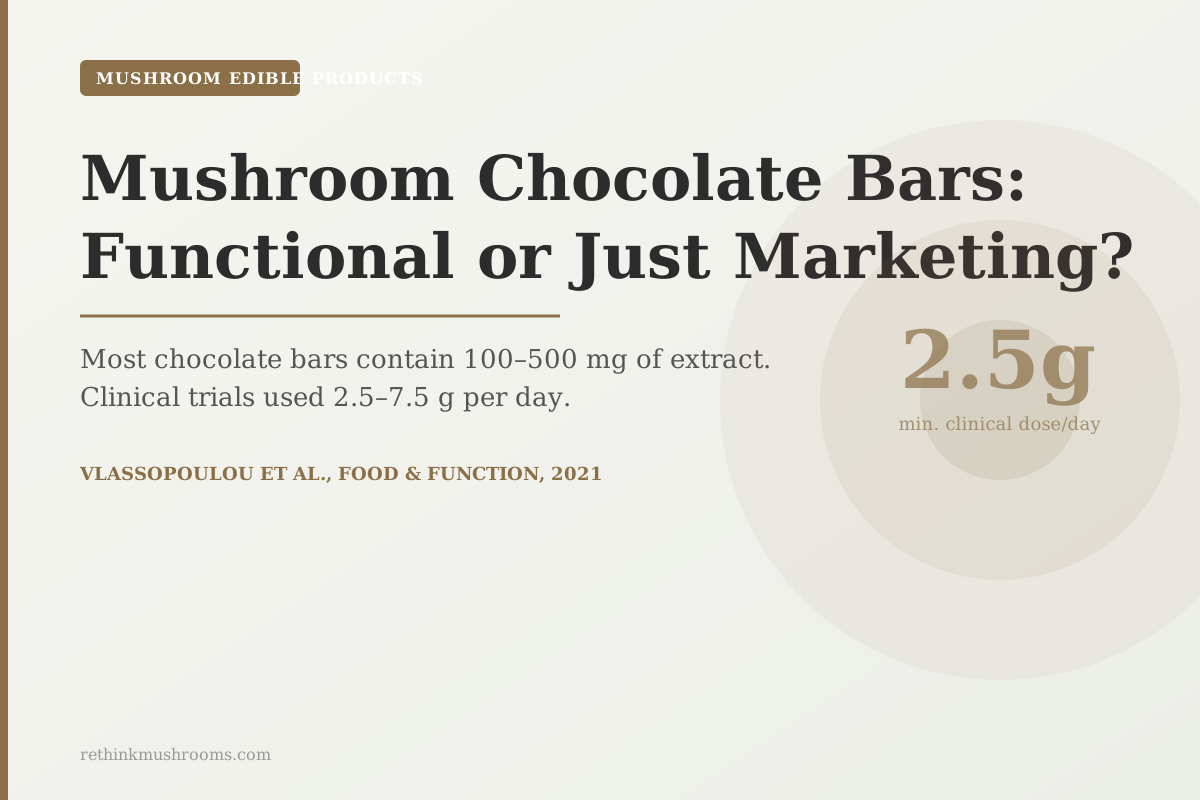
A 2021 systematic review of 14 randomized controlled trials found that fungal compounds produced consistent effects at 2.5–7.5 g per day. Most mushroom chocolate bars deliver a fraction of that per serving.
Vlassopoulou et al., Food & Function, 2021
100–500 mg
typical mushroom extract per chocolate bar serving
14 RCTs
reviewed by Vlassopoulou 2021 to establish dose benchmarks
0 species DNA
found in some US reishi supplements tested by Wu 2017
Vlassopoulou et al., Food & Function, 2021
 View as image ↗
The appeal of a functional mushroom chocolate bar is easy to understand. Instead of swallowing capsules or measuring out powder, you eat a piece of chocolate. But a 2021 systematic review of 14 randomized controlled trials found that the fungal compounds responsible for most documented effects worked at doses starting at 2.5 grams per day.[1] Most mushroom chocolate bars on the market contain 100 to 500 milligrams per serving, a gap of five to fifty times. Whether mushroom chocolate bars can deliver functional benefits, or whether they're primarily an enjoyable way to consume trace amounts of mushroom extract, comes down to three questions: whether the dose is anywhere near clinical trial levels, what the chocolate manufacturing process does to the active compounds, and whether the extract that went into the chocolate was good quality to begin with. This article is part of a broader look at functional mushroom products across different forms and what the evidence says about each.
Key Takeaways
- A 2021 systematic review of 14 RCTs found effective doses of fungal compounds started at 2.5 g/day; most chocolate bars contain 100–500 mg per serving, a 5–50x gap (Vlassopoulou et al., 2021)
- A 2023 review found that heat, sugar, and fat in confectionery manufacturing can degrade the active compounds in mushroom extracts during production (Łysakowska et al., 2023)
- A 2017 analysis of 19 US reishi supplements found some products had no detectable reishi DNA despite species labeling, showing quality problems start before any food manufacturing begins (Wu et al., 2017)
- Mass spectrometry analysis across five mushroom species found significant discrepancies between the species named on labels and the actual compound profiles inside commercial products (López-García et al., 2016)
- A 2025 Chaga supplement study using DNA barcoding, liquid chromatography, and metabolomics confirmed wide variation in bioactive compound content across commercial products (Windsor et al., 2025)
- Functional mushroom chocolate (lion's mane, reishi, cordyceps) is an entirely different product category from psilocybin-containing chocolate; the 2024 safety incidents involving "mushroom chocolate" involved synthetic compounds unrelated to functional mushroom extracts
The Dose Gap: Clinical Trials Used 5–50 Times More Than Most Chocolate Bars Contain
Before asking whether a mushroom chocolate bar works, the first question is what dose actually produced results in controlled research.
Vlassopoulou and colleagues reviewed 14 randomized controlled trials that tested fungal compounds against health outcomes, primarily immune function.[1] The trials that produced documented effects used 2.5 to 7.5 grams of fungal beta-glucans per day. Trials using lower doses tended to produce inconsistent results.
Beta-glucans are the active compounds in mushroom cell walls that researchers believe drive most of the immune effects documented in clinical studies. They are what the immune system appears to respond to. When a product label says "mushroom extract," the relevant figure is how much of that extract consists of actual beta-glucans rather than starch, inactive proteins, or other filler compounds.
Most mushroom chocolate bars list their mushroom content somewhere between 100 and 500 milligrams per serving. Some premium products push toward one gram. To reach the 2.5 gram floor from the Vlassopoulou review by eating 100 mg servings, a person would need 25 pieces of chocolate per day. At 500 mg per serving, they would need five.
That gap doesn't rule out lower-dose effects entirely. The trials reviewed tested specific populations, specific outcomes, and specific extraction methods. It's possible that lower doses have effects the RCTs didn't capture, or that certain populations respond at lower thresholds. The honest framing is that existing clinical research was conducted at dose levels most chocolate bar servings don't approach, and that any claim bridging "the research shows effects" to "this chocolate bar will produce those effects" is making a significant dose assumption that product pages almost never spell out.
For readers investigating whether the same dose problem applies to gummies, mushroom gummies face an identical dose-adequacy question covered in depth in a separate article.
What Chocolate Manufacturing Does to Mushroom Bioactives
Assume for a moment a chocolate product claimed doses near clinical trial levels. A second problem would still exist: the manufacturing process itself.
A 2023 comprehensive review by Łysakowska and colleagues examined the challenges of incorporating medicinal mushroom compounds into functional food products, including confectionery applications.[2] The review documented three distinct challenges relevant to chocolate manufacturing.
The first is heat. Making chocolate involves conching and tempering, processes that hold ingredients at temperatures ranging from roughly 40 to 80 degrees Celsius for extended periods. The active mushroom compounds are part of a molecular family called polysaccharides, and this family is not uniformly heat-stable. The Łysakowska review found that processing steps during functional food manufacturing can degrade bioactive compounds, with the extent depending on the specific extraction method used and the structural properties of the particular polysaccharide chains involved.
The second challenge is sugar. Most commercial chocolate bars contain substantial amounts of sugar or sugar alternatives. Sugars can interact chemically with polysaccharides during processing. The practical result is that the active compound fraction surviving to the finished product may differ from what was added at the start. This isn't unique to mushrooms; it's a known challenge across functional food formulation. The Łysakowska review noted these interactions as a reason why functional food production requires more careful formulation than simply adding an extract to a standard recipe.
The third challenge is the fat matrix. Chocolate is defined by cocoa butter, an oil-based fat that coats everything mixed into it. The active mushroom compounds are water-soluble. How they behave in digestion when delivered inside an oil matrix is a different question from how they behave in a capsule, a water-based drink, or a dry powder. The review flagged food matrix effects on compound absorption as an active area of uncertainty in functional food science.
One thing worth being precise about: dark chocolate contains flavanols, a family of antioxidant compounds that have their own separate evidence base. The stability challenges for cocoa flavanols during chocolate processing are different from those for mushroom compounds. Marketing language that conflates "the antioxidants in dark chocolate" with "the bioactives from mushroom extract" is combining two distinct compound categories with different chemistry, different stability profiles, and different evidence bases. They are not additive effects from a single ingredient.
For readers specifically interested in how the delivery format affects how well compounds are absorbed, bioavailability differences across mushroom supplement forms examines that question directly.
The Extract Quality Problem That Comes Before the Chocolate
The food matrix challenges assume the mushroom extract added to the chocolate was high quality before manufacturing began. The peer-reviewed literature suggests this is often not the case.
Wu and colleagues tested 19 commercial reishi dietary supplements sold in the United States, analyzing polysaccharide content and verifying species identity using DNA testing.[3] The findings were striking: polysaccharide content varied enormously across the 19 products. Some products had no detectable reishi DNA despite being labeled as reishi. These were not counterfeit products circulating informally; they were products on retail shelves in the United States.
A separate study used a technique called MALDI-TOF mass spectrometry to examine commercial mushroom supplements across five species.[4] This technique reads the molecular fingerprint of complex compounds, allowing researchers to confirm what is actually present in a product at a chemical level. López-García and colleagues found significant discrepancies between the mushroom species listed on labels and the compound profiles of the actual products. The contents didn't consistently match the labeling.
The most recent data comes from a 2025 analysis of Chaga supplements that used three analytical methods simultaneously: DNA barcoding to confirm species identity, high-performance liquid chromatography to measure specific compound concentrations, and metabolomics to profile the full chemical composition of each product.[5] Windsor and colleagues found wide variation in bioactive compound content across commercial products. The study was co-authored by Jeff Chilton of Nammex, an industry figure known for documenting quality problems in the supplement sector, particularly around mycelium grown on grain substrates. Grain-grown mycelium produces extracts that contain substantial grain starch alongside mushroom-derived compounds, diluting the active fraction.
The pattern across three independent studies spanning 2016 to 2025 is consistent: a meaningful fraction of commercial mushroom supplement products don't deliver what their labels say, not necessarily because of intentional fraud, but because the supply chain for mushroom extracts lacks routine analytical verification. A chocolate manufacturer sourcing mushroom extract as an ingredient is likely not running DNA barcoding and liquid chromatography to verify what they received. The result is a product that may contain poorly characterized extract, further processed through a manufacturing method that introduces additional degradation, served at doses that don't approach clinical trial levels.
For a closer look at how adulteration happens in the mushroom supplement supply chain, how widespread the adulteration problem actually is covers the evidence directly. The specific sugar and filler issues that affect edible formats are examined in the problem with mushroom gummies.
Functional Chocolate vs. "Magic Mushroom" Chocolate: Two Completely Different Products
A clarification is worth making directly because searches on this topic frequently surface two product categories that have nothing in common.
Functional mushroom chocolate contains extracts of culinary and medicinal fungi: lion's mane (Hericium erinaceus), reishi (Ganoderma lucidum), cordyceps (Cordyceps militaris), chaga, turkey tail, and similar species. These are the products this article addresses. They are legal, their mushroom species have been studied in peer-reviewed research across many studies, and at the doses typically found in commercial chocolate bars, their safety profile is generally unremarkable.
Psilocybin-containing chocolate is a different category entirely. These products contain the psychoactive compound found in certain mushroom species, or in some cases synthetic compounds designed to produce similar effects. The 2024 safety incidents that generated significant press coverage involving "mushroom chocolate," including a multi-state outbreak investigated by the CDC, were linked to Diamond Shruumz products. Those products contained muscimol and ibotenic acid, synthetic analogues of psychoactive compounds. They had nothing to do with lion's mane or reishi. The two product categories share branding language and sometimes packaging aesthetics, but they are entirely distinct in ingredients, mechanism, legal status, and safety profile.
This article addresses only functional mushroom chocolate. The safety and clinical questions for psilocybin-containing products involve a completely different evidence base.
What a Genuinely Functional Mushroom Chocolate Bar Would Need to Look Like
Given the dose gap, the food matrix challenges, and the extract quality problems documented across the peer-reviewed literature, it's possible to be specific about what would distinguish a genuinely functional product from a marketing-driven one.
Four criteria matter.
First, the beta-glucan content would need to be disclosed as a specific percentage, measured by a validated method. A label listing "500 mg reishi extract" says nothing about quality. The meaningful figure is what percentage of that extract consists of active beta-glucans, measured using an assay that separates beta-glucan from inactive starch, such as the AOAC 995.16 enzymatic method. Without that number, there is no way to know whether the extract is concentrated fruiting body material or diluted mycelium-on-grain starch.
Second, the source would need to be fruiting body, not mycelium grown on grain. Research comparing fruiting body extracts against mycelium extracts within the same species has found fruiting body material outperforms mycelium in measured bioactivity. Grain-grown mycelium extracts contain substantial grain starch that dilutes the mushroom-derived compounds, and the polysaccharide figure on a label from that kind of extract reflects the starch as well as the active fraction. How supply chain choices affect what ends up in a finished product is covered in detail in what mushroom gummy labels don't tell you.
Third, the dose per serving would need to approach the range used in clinical research. The Vlassopoulou systematic review found documented effects in trials using 2.5 grams per day and above.[1] A product providing one to two grams of verified, high-beta-glucan extract per serving from quality fruiting body material would be in a meaningfully different category from a product providing 100 mg of uncharacterized extract.
Fourth, a third-party certificate of analysis using a validated analytical method would need to be available. The Wu 2017 findings on US reishi supplements and the Windsor 2025 Chaga analysis both show that internal quality control within the supplement supply chain has been insufficient to prevent products with inaccurate labeling from reaching market. Independent verification using AOAC 995.16, DNA barcoding, or liquid chromatography is what separates a verifiable claim from an unverifiable one.
Products meeting all four criteria would be structurally different from most of what is currently marketed as functional mushroom chocolate. The dose requirement alone would mean either very high extract concentration at small serving sizes, or consuming multiple large squares per day. That is one practical reason why the chocolate delivery format faces limits that capsules and powders don't encounter in the same way. For the full comparison of how delivery formats trade off convenience against potency, the form comparison across mushroom supplement types provides that framework. For readers looking at the broader landscape of edible mushroom products, where edible mushroom products sit on the convenience-potency spectrum covers the tradeoffs across formats in a single overview.
The Bottom Line
The evidence on functional mushroom chocolate bars points to three compounding problems: typical serving doses fall well below what produced effects in clinical research, the chocolate manufacturing process involves heat, sugar, and fat interactions that can degrade mushroom bioactive compounds, and commercial mushroom extracts show wide quality variation before they reach the food manufacturer. A genuinely functional mushroom chocolate bar would require disclosed beta-glucan content from a validated assay, fruiting body sourcing, doses approaching clinical trial levels, and independent verification. Most products currently marketed don't disclose enough information to evaluate even the most basic of these criteria.
Frequently Asked Questions
Sources & References
- 1RTHM-01451·Vlassopoulou, Marigoula et al. (2021). “Effects of fungal beta-glucans on health - a systematic review of randomized controlled trials..” Food & function.Study breakdown →PubMed →↩
- 2RTHM-00843·Łysakowska, Paulina et al. (2023). “Medicinal Mushrooms: Their Bioactive Components, Nutritional Value and Application in Functional Food Production-A Review..” Molecules (Basel.Study breakdown →PubMed →↩
- 3RTHM-00499·Wu, Ding-Tao et al. (2017). “Evaluation on quality consistency of Ganoderma lucidum dietary supplements collected in the United States..” Scientific reports.Study breakdown →PubMed →↩
- 4RTHM-00437·López-García, Marta et al. (2016). “MALDI-TOF to compare polysaccharide profiles from commercial health supplements of different mushroom species..” Food chemistry.Study breakdown →PubMed →↩
- 5RTHM-02209·Windsor, Coleton et al. (2025). “What This 2025 Chaga Supplement Authentication Study Actually Found.” International journal of molecular sciences.Study breakdown →PubMed →↩