Mushrooms & Metabolism
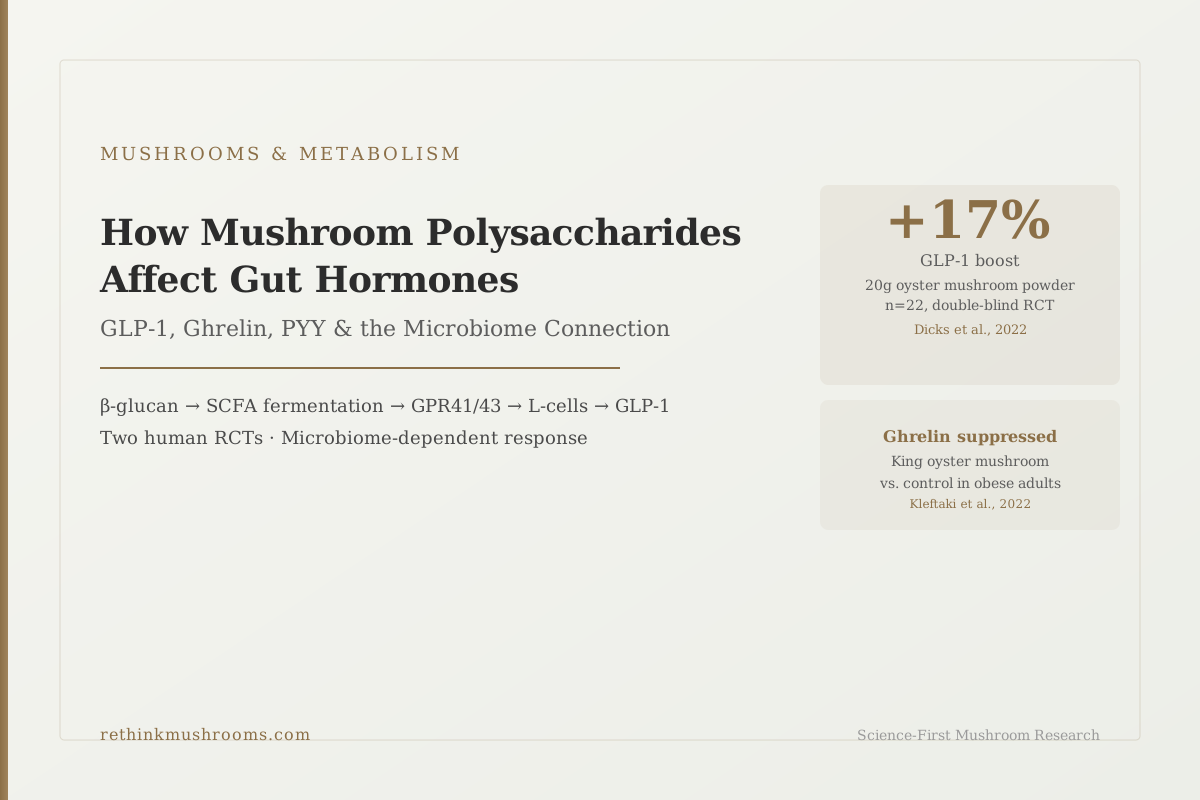
+17% GLP-1
Adding 20g oyster mushroom powder (containing 8.1g β-glucans) to a single meal raised post-meal GLP-1 levels by 17% in a double-blind randomized crossover trial of 22 adults with impaired glucose tolerance. GLP-1 is the hormone that semaglutide (Ozempic) pharmacologically targets.
Dicks et al., European Journal of Nutrition, 2022
Ghrelin suppressed
King oyster mushroom (Pleurotus eryngii) produced substantially greater suppression of ghrelin, the hunger hormone, than control, alongside improved fullness scores in obese adults (Kleftaki et al., Pharmacological Research, 2022)
Microbiome-dependent
Klümpen 2025: participants with lower gut microbiota evenness showed significantly greater GLP-1 response to mushroom β-glucans; the same mushroom dose produced different hormone effects depending on who was eating it
3 maitake studies
Three independent studies found maitake polysaccharides reshaped gut microbiota composition, the same ecosystem that determines the magnitude of GLP-1 responses to β-glucan
Dicks et al., European Journal of Nutrition, 2022
 View as image ↗
Your stomach and intestines produce hormones that tell your brain whether to keep eating or stop. These hormones are not minor signaling molecules; they are powerful enough that drugs designed to mimic one of them (GLP-1) produce the kind of weight loss and metabolic improvement that no other medication class has achieved at comparable scale.
Mushroom polysaccharides don't mimic these hormones. They don't bind to the same receptors as semaglutide or tirzepatide. What the evidence suggests they do is more interesting and more limited: they reach your colon intact, feed specific bacteria, and trigger the gut lining to produce more of these hormones through the body's own pathways.
Two human RCTs and a growing body of mechanistic research have mapped out how this happens. The data is preliminary, mostly from single-meal studies, and the effect sizes are much smaller than pharmaceutical GLP-1 drugs. But the biology is real and the mechanism is specific enough to examine honestly.
For the broader picture of mushrooms and blood sugar regulation, see mushrooms for type 2 diabetes: a research-based guide to evidence and species.
Key Takeaways
- Adding 20g of oyster mushroom powder (8.1g β-glucans) to a meal raised GLP-1 hormone levels by 17% and lowered free fatty acids by 14% in a double-blind crossover RCT of 22 adults with impaired glucose tolerance (Dicks et al., European Journal of Nutrition, 2022)
- King oyster mushroom (Pleurotus eryngii) produced significantly greater suppression of ghrelin (the hunger hormone) and greater feelings of fullness compared to control in metabolically unhealthy obese adults (Kleftaki et al., Pharmacological Research, 2022)
- A 2025 secondary analysis found that the magnitude of the GLP-1 response to oyster mushroom β-glucans depended on baseline gut microbiota composition; participants with lower microbial evenness showed significantly greater responses (p=0.012), implicating SCFA fermentation as the mediating mechanism (Klümpen et al., Mol Nutr Food Res, 2025)
- The mechanistic chain is: mushroom polysaccharides (β-glucans) resist digestion → reach the colon intact → gut bacteria ferment them into short-chain fatty acids (SCFAs) → SCFAs bind GPR41/43 receptors on L-cells in the gut lining → L-cells release GLP-1 and PYY
- Three independent studies found maitake polysaccharides reshaped gut microbiota composition in animal models, consistently increasing Lactobacillus and Bifidobacterium species, the same bacteria that produce the SCFAs driving appetite hormone secretion
- Most hormone data comes from single-meal experiments; long-term effects of regular mushroom polysaccharide consumption on body weight or appetite are understudied and not yet established in humans
The Four Gut Hormones Mushroom Polysaccharides Can Affect
Four distinct gut hormones are implicated in appetite regulation, and mushroom polysaccharides appear to interact with all four, through different mechanisms and to different degrees.
1. GLP-1 (glucagon-like peptide-1): Produced by L-cells scattered through the lower small intestine and colon after eating. GLP-1 tells the brain you're full, tells the pancreas to release insulin, and slows the rate at which food leaves the stomach. Pharmaceutical drugs like semaglutide (Ozempic) work by binding to GLP-1 receptors with much greater potency than the hormone itself and staying active for days instead of minutes.
2. PYY (peptide YY): Also produced by L-cells, typically alongside GLP-1. PYY slows how quickly food moves through the digestive tract (extending the period of fullness) and suppresses appetite through signals to the brain's hunger center. L-cells release GLP-1 and PYY in response to the same stimuli, so interventions that trigger GLP-1 usually trigger PYY as well.
3. Ghrelin: Produced mainly by cells in the stomach lining. Ghrelin levels rise before meals and signal hunger to the brain. They fall after eating. A food or supplement that keeps ghrelin suppressed longer after a meal extends the subjective sense of fullness. SSRIs blunt ghrelin to some extent; so does adequate protein; and the Kleftaki 2022 RCT found king oyster mushroom did too.
4. GIP (glucose-dependent insulinotropic polypeptide): Produced by K-cells in the upper small intestine. GIP works alongside GLP-1 to stimulate insulin release from the pancreas. The drug tirzepatide (Mounjaro) targets both GLP-1 and GIP simultaneously, producing stronger metabolic effects than single-target GLP-1 drugs alone. Whether mushroom polysaccharides affect GIP is less well-studied than their GLP-1 effects.
Ghrelin: The Hunger Hormone That King Oyster Mushrooms Suppress
Kleftaki and colleagues published a 2022 RCT in Pharmacological Research testing king oyster mushroom (Pleurotus eryngii) in metabolically unhealthy obese adults.[1]
Participants who consumed the king oyster mushroom showed significantly improved postprandial blood glucose (the blood sugar spike after a meal), reduced self-reported hunger, increased self-reported fullness, and substantially greater ghrelin suppression compared to control.
Ghrelin suppression is the underreported finding from this study. Most coverage of mushrooms and appetite focuses on the GLP-1 angle. But ghrelin is the hormone that makes people feel hungry before meals and drives cravings between them. A compound that extends post-meal ghrelin suppression means the body's "I'm still full" signal remains active longer. This is what people describe subjectively when they notice they're not as hungry at their next meal.
The Kleftaki 2022 study used whole king oyster mushroom in metabolically unhealthy obese participants, a population with disrupted appetite hormone signaling. Whether similar ghrelin suppression would appear in metabolically healthy people is unknown; appetite hormone dysregulation in obesity means these participants started with different baseline ghrelin dynamics.
GLP-1: The Satiety Hormone That Oyster Mushroom β-Glucans Boost by 17%
The most precisely measured hormone finding from mushroom polysaccharide research is the Dicks 2022 trial, published in the European Journal of Nutrition.[2]
Dicks enrolled 22 adults with impaired glucose tolerance (a pre-diabetic condition) in a double-blind randomized crossover study. Participants received a standard test meal either with or without 20g of oyster mushroom powder (containing 8.1g of β-glucans). Blood was drawn repeatedly afterward to measure hormone and metabolite levels.
The oyster mushroom meal produced:
- 17% higher GLP-1 area under the curve (total GLP-1 present in the blood over the post-meal period, not just the peak), p=0.001
- 14% lower non-esterified free fatty acids (a marker of fat mobilization, relevant to metabolic health), p=0.026
The 17% GLP-1 increase is a real, statistically significant effect. In context: pharmaceutical GLP-1 drugs produce effects many times larger and lasting far longer. A 17% increase from a single mushroom-fortified meal is not comparable in magnitude to semaglutide. But it confirms that the biological pathway exists and can be stimulated by food-derived compounds at realistic dietary doses.
For a comparison of what GLP-1 drugs do versus what mushroom-derived compounds do through the same pathway, see mushrooms and GLP-1: can fungi mimic the Ozempic effect?.
Why Your Gut Microbiome Determines How Much GLP-1 You Get
The Klümpen 2025 study is the finding that no competitor has yet covered, and it changes how to interpret the Dicks 2022 result.[3]
Klümpen and colleagues conducted a secondary analysis of the original Dicks 2022 cohort, examining whether individual differences in gut microbiota composition at baseline predicted how much GLP-1 response each participant got from the oyster mushroom powder.
They found a significant relationship (p=0.012): participants with lower microbial evenness in their gut bacterial communities showed substantially greater GLP-1 responses to the mushroom β-glucans.
Microbial evenness is a measure of how balanced your gut bacterial ecosystem is. A high-evenness gut has many different bacterial species present in roughly equal proportions. A low-evenness gut is dominated by a few species, often with disrupted diversity. The finding suggests that when the gut bacterial ecosystem is unbalanced, mushroom β-glucans may have more pronounced effects on appetite hormone secretion; possibly because the fermentation capacity is concentrated in a subset of highly active species.
The practical implication: the same 20g of oyster mushroom powder produced different GLP-1 responses in different people, based on the composition of their gut microbiome before they ate anything. Mushroom polysaccharides are not a uniform intervention; their hormone effects are personalized by gut biology.
How Polysaccharides Travel to the Colon and Become Appetite Signals
Most nutrients from food are absorbed in the small intestine. Mushroom polysaccharides, particularly β-glucans, are an exception. Human digestive enzymes cannot break them down; they resist the acid and enzymes of the stomach and small intestine and arrive in the colon largely intact.
In the colon, gut bacteria ferment these polysaccharides. The fermentation produces short-chain fatty acids (SCFAs): primarily acetate, propionate, and butyrate. These small molecules are the key intermediary between eating mushrooms and releasing appetite hormones.
SCFAs bind to receptor proteins on the outer surface of L-cells in the gut lining. These receptors are called GPR41 and GPR43. When SCFAs bind to GPR41/43, L-cells release GLP-1 and PYY into the bloodstream.
A 2022 review by Ma and colleagues in Critical Reviews in Food Science and Nutrition comprehensively documented this chain for edible mushroom polysaccharides.[4] The review confirmed that mushroom polysaccharides resist human digestive enzymes, reach the colon intact, are fermented into SCFAs by colonic bacteria, and that this SCFA production activates GPR41/43-mediated GLP-1 and PYY secretion.
A 2023 review by Zhao and colleagues added detail on the gut bacteria involved: mushroom polysaccharides consistently promote the growth of Lactobacillus, Bifidobacterium, and Akkermansia, bacterial genera associated with healthy metabolic function and known SCFA producers.[5]
This mechanistic chain explains both the GLP-1 finding from Dicks 2022 and the microbiome-dependence finding from Klümpen 2025: the pathway is real, but it requires functioning gut bacteria to ferment the polysaccharides. If your gut bacterial community has poor fermentation capacity, you get less SCFA production and less GLP-1 response.
For more on the incretin hormone picture (including the GIP angle that no competitor covers), see mushroom compounds and incretin hormones: GLP-1 and GIP research.
Beyond Oyster Mushrooms: Maitake Polysaccharides Reshape the Gut Ecosystem
The oyster mushroom RCTs are the best human evidence for the gut hormone pathway. But the mechanistic evidence extends to maitake through three independent animal studies, all converging on the same conclusion.
Chen and colleagues (2019) found that maitake polysaccharide lowered blood glucose in type 2 diabetic mice AND reshaped gut microbiota composition, notably increasing Lactobacillus acidophilus and Bacteroides acidifaciens.[7]
Li and colleagues (2019) found that maitake polysaccharides simultaneously reduced high-fat-diet-induced lipid disorders AND corrected gut microbiota dysbiosis in rats, with the microbiota correction identified as a mechanism for the metabolic benefit.[8]
Guo and colleagues (2020) confirmed in a third independent study that maitake polysaccharides' hypoglycemic and hypolipidemic effects correlated directly with intestinal microflora composition changes.[9]
Three independent research groups, three separate animal models, the same finding: maitake polysaccharides modify gut microbiota in ways that are mechanistically linked to metabolic improvement. Whether this extends to GLP-1 secretion specifically has not been tested in a maitake-specific human RCT. But the gut microbiota pathway, the same one implicated in the oyster mushroom GLP-1 finding, is consistently present in the maitake data.
A 2024 animal study by Du and colleagues specifically tested whole king oyster mushroom consumption in high-fat diet mice and found it reversed obesity-associated gut microbiota dysbiosis and normalized lipid metabolism, providing recent corroboration for the oyster mushroom human data.[6]
For a detailed look at maitake's metabolic evidence across all five metabolic syndrome criteria, see maitake and metabolic regulation: beyond blood sugar to full metabolic health.
What Single-Meal Studies Don't Tell Us
Both key human RCTs (Dicks 2022, Kleftaki 2022) measured what happens in the hours after a single mushroom-containing meal. They don't tell us what happens when someone eats mushrooms regularly over weeks or months.
This gap matters because gut microbiota composition changes slowly with sustained dietary change. The Klümpen 2025 finding (that gut microbiota evenness at baseline predicts the GLP-1 response) suggests that someone who regularly eats high-fiber, mushroom-rich food might progressively develop the gut bacterial profile that maximizes their GLP-1 response. But this is a hypothesis the data supports mechanistically; it hasn't been tested directly.
The animal studies (Chen 2019, Li 2019, Guo 2020) were longer-duration interventions and showed consistent gut microbiota and metabolic improvements over time. Those results can't be directly translated to humans, but they suggest the gut ecosystem effects of regular mushroom polysaccharide consumption may be cumulative.
What the existing evidence supports: a measurable, acute gut hormone response to mushroom polysaccharides at realistic dietary doses, mediated by gut bacteria, personalized by individual microbiome composition. What it doesn't yet support: conclusions about long-term weight loss, sustained appetite reduction, or clinical comparability to GLP-1 drugs.
For mushrooms and metabolic syndrome across all five criteria with a complete species-by-species assessment, see mushrooms and metabolic syndrome: targeting all five criteria. For the comparison between mushroom species on diabetes management, see comparing mushroom species for diabetes management: which has the strongest evidence?.
The Bottom Line
Mushroom polysaccharides, particularly β-glucans from oyster and king oyster mushrooms, affect appetite through gut hormone pathways: a 2022 RCT found 20g oyster mushroom powder raised post-meal GLP-1 by 17%; a 2022 RCT found king oyster mushroom significantly suppressed ghrelin and improved fullness in obese adults. The mechanism runs through gut bacteria: polysaccharides resist digestion, reach the colon, are fermented into short-chain fatty acids, and those fatty acids trigger L-cells to release GLP-1 and PYY. A 2025 secondary analysis confirmed the effect is microbiome-dependent; participants with less diverse gut bacteria showed greater GLP-1 responses. Three maitake animal studies extend the gut microbiota reshaping evidence to a second species. The honest limitation: all human data comes from single-meal studies; long-term effects on appetite and body weight are not yet established.
Frequently Asked Questions
Sources & References
- 1RTHM-01551·Kleftaki, Stamatia-Angeliki et al. (2022). “Pleurotus eryngii improves postprandial glycaemia, hunger and fullness perception, and enhances ghrelin suppression in people with metabolically unhealthy obesity..” Pharmacological research.Study breakdown →PubMed →↩
- 2RTHM-00753·Dicks, Lisa et al. (2022). “Fortifying a meal with oyster mushroom powder beneficially affects postprandial glucagon-like peptide-1, non-esterified free fatty acids and hunger sensation in adults with impaired glucose tolerance: a double-blind randomized controlled crossover trial..” European journal of nutrition.Study breakdown →PubMed →↩
- 3RTHM-02111·Klümpen, Linda et al. (2025). “GLP-1 Responses to a Single Meal Fortified With Oyster Mushroom Powder in Adults With Impaired Glucose Tolerance Depend on the Gut Microbiota Composition Before the Meal..” Molecular nutrition & food research.Study breakdown →PubMed →↩
- 4RTHM-01577·Ma, Gaoxing et al. (2022). “Health benefits of edible mushroom polysaccharides and associated gut microbiota regulation..” Critical reviews in food science and nutrition.Study breakdown →PubMed →↩
- 5RTHM-01835·Zhao, Jiahui et al. (2023). “The Interaction between Mushroom Polysaccharides and Gut Microbiota and Their Effect on Human Health: A Review..” Biology.Study breakdown →PubMed →↩
- 6RTHM-00876·Du, Hengjun et al. (2024). “Dietary intake of whole king oyster mushroom (Pleurotus eryngii) attenuated obesity via ameliorating lipid metabolism and alleviating gut microbiota dysbiosis..” Food research international (Ottawa.Study breakdown →PubMed →↩
- 7RTHM-01042·Chen, Yuqing et al. (2019). “Hypoglycemic activity and gut microbiota regulation of a novel polysaccharide from Grifola frondosa in type 2 diabetic mice..” Food and chemical toxicology : an international journal published for the British Industrial Biological Research Association.Study breakdown →PubMed →↩
- 8RTHM-01084·Li, Lu et al. (2019). “Grifola frondosa polysaccharides ameliorate lipid metabolic disorders and gut microbiota dysbiosis in high-fat diet fed rats..” Food & function.Study breakdown →PubMed →↩
- 9RTHM-01193·Guo, Wei-Ling et al. (2020). “Hypoglycemic and hypolipidemic activities of Grifola frondosa polysaccharides and their relationships with the modulation of intestinal microflora in diabetic mice induced by high-fat diet and streptozotocin..” International journal of biological macromolecules.Study breakdown →PubMed →↩