Mushrooms as Prebiotics + Probiotic Synergy
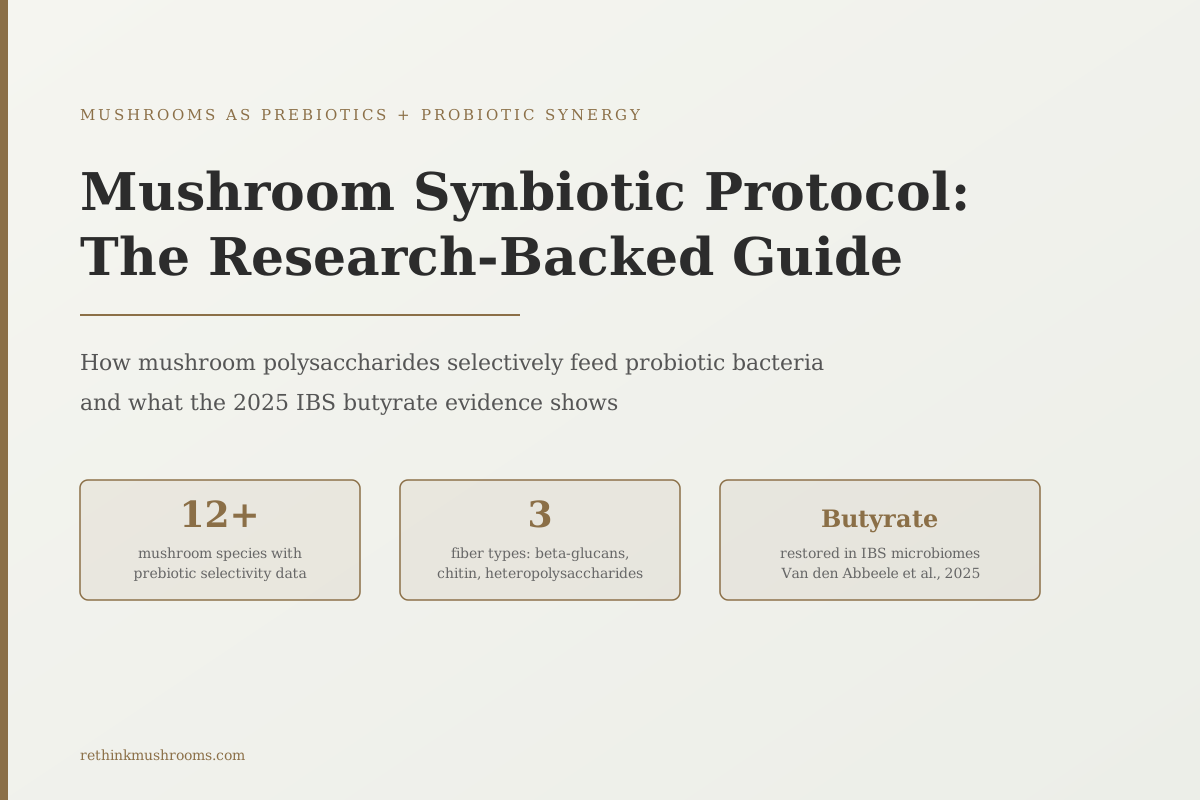
12+ mushroom species
At least 12 mushroom species consistently increase Bifidobacterium and Lactobacillus populations in the gut while suppressing pathogens. These are the same bacteria most probiotic supplements supply.
Yin et al., Carbohydrate Polymers, 2020
Bifidobacterium + Lactobacillus
the bacteria mushroom polysaccharides preferentially feed across species
3 fiber types
beta-glucans, chitin, and heteropolysaccharides; each selects different bacteria
Butyrate
the key short-chain fatty acid produced when bacteria ferment mushroom fiber
Yin et al., Carbohydrate Polymers, 2020
 View as image ↗
In 2025, Van den Abbeele and colleagues tested a mushroom blend against microbiome samples taken directly from IBS patients. Not healthy controls. Not a mouse model. The actual gut bacteria of people with irritable bowel syndrome. The blend restored butyrate production and improved gut barrier integrity markers in those dysbiotic samples.[1] Butyrate is the short-chain fatty acid that gut lining cells depend on, produced when bacteria ferment fiber. The fact that a mushroom blend could restore it in an already-broken microbiome tells you something important about why a mushroom synbiotic protocol deserves serious attention. This guide covers what a synbiotic is, which mushroom species qualify as synbiotic prebiotics, how to pair species to probiotic goals, and where the evidence honestly runs out. It builds on the broader approach to combining medicinal mushrooms effectively.
Key Takeaways
- Mushrooms are prebiotics, not probiotics: they feed beneficial bacteria rather than providing them. A synbiotic pairs a prebiotic that specifically feeds the probiotic strains present, and mushroom polysaccharides meet that bar for Bifidobacterium and Lactobacillus (Yin et al., 2020)
- The molecular structure of mushroom polysaccharides determines which bacteria get fed: beta-1,3 glucans, beta-1,6 glucans, and heteropolysaccharides each feed different bacterial genera. Different mushroom species produce different ratios of these structures (Zhao et al., 2023)
- A 2025 ex vivo study using actual IBS patient microbiomes found a mushroom blend restored butyrate production and improved gut barrier integrity markers. This was the first evidence from a dysbiotic gut system, not a healthy one (Van den Abbeele et al., 2025)
- Pleurotus ostreatus (oyster mushroom) showed the highest probiotic growth stimulation potential among species assessed in a 2024 review published in a dedicated probiotic journal (Kulshreshtha, 2024)
- Mushroom polysaccharides generate three types of short-chain fatty acids when fermented: butyrate, propionate, and acetate, with downstream effects on metabolism, immune function, and inflammation (Ma et al., 2022)
- No head-to-head clinical trial has tested a combined mushroom-probiotic supplement versus placebo in healthy adults. Protocol design draws from individual species studies, not combination trial data
What Makes a Combination a Synbiotic (Not Just Two Things Together)
The word synbiotic gets used loosely. Most supplement marketing treats it as shorthand for "prebiotic plus probiotic in the same product." The technical definition is more specific, and the difference matters.
A synbiotic is a product or protocol in which the prebiotic component specifically feeds and supports the probiotic strains present.[2] Randomness does not qualify. Adding any fiber to any probiotic does not create a synbiotic. The fiber has to selectively feed the bacterial strains in the probiotic supplement rather than bacteria in general, including pathogens.
This distinction raises the bar on what qualifies. A prebiotic that feeds pathogenic bacteria alongside beneficial ones is not synbiotic in any useful sense. A prebiotic that preferentially feeds the exact genera that probiotic supplements supply is.
Mushroom polysaccharides clear that bar. Reviews examining the interaction between mushroom fiber and gut bacteria consistently find the same pattern: mushroom polysaccharides preferentially increase Bifidobacterium and Lactobacillus populations while suppressing Clostridium and Fusobacterium.[3] Those first two genera are exactly what most probiotic supplements supply. The prebiotic selectivity of mushrooms, in other words, specifically supports the organisms a standard probiotic delivers.
That is what makes mushrooms candidates for synbiotic use, not just gut-health supplements in a general sense. The question is which species, paired with which probiotic strains, and for which bacterial targets.
For a deeper look at the prebiotic-versus-probiotic distinction and how mushrooms sit in that landscape, see mushrooms and probiotics: the prebiotic-probiotic synergy.
The Structural Reason Mushroom Fiber Feeds Specific Bacteria
Mushroom cell walls contain three types of fiber that survive digestion and arrive in the colon intact: beta-glucans, chitin, and heteropolysaccharides.[3] Each has a different molecular architecture. That architecture determines which bacteria can ferment it.
Zhao and colleagues mapped this in detail in a 2023 review in Biology. Beta-1,3 glucans preferentially feed one set of bacterial genera. Beta-1,6 glucans feed a different set. Heteropolysaccharides have their own selectivity profile.[4] Because different mushroom species produce different ratios of these three structures, their prebiotic profiles differ even when the gut health benefits sound similar.
Yin and colleagues (2020), reviewing data across at least 12 mushroom species in Carbohydrate Polymers, found a consistent directional pattern: Bifidobacterium up, Lactobacillus up, Akkermansia muciniphila up; Clostridium perfringens down, Fusobacterium down.[3] The species covered included shiitake (Lentinus edodes), oyster (Pleurotus), reishi (Ganoderma), and wood ear (Auricularia).
Akkermansia muciniphila is worth pausing on. It lives in the mucus layer of the gut lining. Researchers have linked higher Akkermansia populations to better metabolic health and stronger gut barrier function. Not all prebiotics reliably increase it. The fact that mushroom polysaccharides appear to do so, across multiple species and methodologies, is a consistent signal in this literature.
The downstream result of fermentation is short-chain fatty acid production. When bacteria break down mushroom polysaccharides, they generate butyrate, propionate, and acetate. Butyrate is the primary energy source for colon-lining cells. Propionate and acetate travel from the gut into the bloodstream and affect liver metabolism, immune regulation, and systemic inflammation.
For the full mechanistic picture of how mushroom fiber moves through the gut and what happens at each stage, see how mushroom prebiotics feed probiotic bacteria.
What a 2025 Study Found When Researchers Used Broken Microbiomes
Most prebiotic research tests healthy volunteers. That is a significant limitation, because people most interested in gut health protocols often have compromised microbiomes. What works in a healthy gut does not always translate to a dysbiotic one.
Van den Abbeele and colleagues (2025) addressed this directly. They populated an ex vivo model with microbiome samples taken from actual IBS patients, not healthy donors.[1] An ex vivo model takes living gut bacteria out of the body and maintains them in a controlled environment. It is not a clinical trial, but it is closer to clinical reality than a standard laboratory experiment, because the bacterial community is real and complex rather than a simplified culture.
The mushroom blend, combined with triacetin, restored butyrate production in those IBS microbiomes. Butyrate levels improved alongside gut barrier integrity markers.
The words "restored" and "dysbiotic" are the key detail here. This was not an increase from already-healthy baseline butyrate levels. This was a correction of a broken microbiome system producing abnormally low butyrate. That is the closest thing in the published literature to showing that a mushroom-based synbiotic approach can function when the gut is already in trouble.
The study does not prove clinical outcomes in living IBS patients. An ex vivo model is not a randomized controlled trial. But it is evidence that the mechanism works in dysbiotic conditions, which healthy-volunteer studies structurally cannot provide.
Species Pairing: Which Mushroom for Which Probiotic Goal
No clinical trial has directly tested turkey tail paired with Lactobacillus acidophilus versus oyster mushroom paired with Bifidobacterium longum in a head-to-head comparison. That study does not exist. The pairing logic comes from combining individual species data, not from combination trial evidence. Stating that clearly is part of using the evidence honestly.
With that caveat established, the species data points in consistent directions.
Turkey tail (Trametes versicolor) has the strongest documented evidence for feeding Bifidobacterium populations specifically. Multiple systematic reviews identify it as one of the best-studied mushroom prebiotics in this context, and the Bifidobacterium-increasing effect appears across methodologies and research groups.[3]
Oyster mushroom (Pleurotus ostreatus) stands out in the supplement-focused literature. A 2024 review published in Probiotics and Antimicrobial Proteins, a journal dedicated specifically to probiotic and prebiotic science, assessed multiple mushroom species for probiotic growth stimulation potential and identified Pleurotus ostreatus as the highest-performing species among those evaluated.[5]
Reishi (Ganoderma lucidum), maitake (Grifola frondosa), and shiitake (Lentinus edodes) all feed bacteria through the short-chain fatty acid production pathway. Ma and colleagues (2022) reviewed data across these species in Critical Reviews in Food Science and Nutrition and found that mushroom polysaccharides from each generated butyrate, propionate, and acetate through bacterial fermentation, with downstream effects on metabolism, immune function, and inflammation.[6]
Akkermansia muciniphila sits in a different position. Most probiotic supplements do not supply Akkermansia directly, because it is difficult to formulate with conventional probiotic technology. The fact that mushroom polysaccharides appear to increase it through prebiotic feeding represents a contribution that probiotic supplements typically cannot make on their own.
For a full species comparison using prebiotic-specific data, see which mushrooms are the best prebiotics.
Building the Protocol: What the Research Supports and What It Leaves Open
The research does not prescribe a specific mushroom synbiotic protocol. What it provides is a set of directions and constraints that a protocol should respect.
What the studies suggest:
Mushroom polysaccharide content matters more than mushroom weight per capsule. Ma and colleagues (2022) found that prebiotic effects tracked with polysaccharide content, not species identity alone.[6] A high-dose mushroom powder with low polysaccharide extraction may underperform a lower-dose extract standardized for beta-glucan content.
Matching the probiotic strain to the mushroom's strongest prebiotic target is consistent with the synbiotic principle. If turkey tail preferentially feeds Bifidobacterium, pairing it with a probiotic containing Bifidobacterium longum or B. breve follows the logic of synbiotic design more closely than pairing it with a generic mixed probiotic.[4]
The 2020 review in this literature documented that the immune signaling axis between the gut and the wider immune system, specifically the balance between bacteria-fighting and allergen-fighting immune responses, shifts measurably with mushroom prebiotic use through changes in bacterial short-chain fatty acid production.[2] This suggests the effects extend beyond microbiome composition changes alone and into systemic immune regulation.
What is not established:
No published study has tested the optimal timing of mushroom prebiotic dosing relative to probiotic supplement dosing. Whether both should be taken simultaneously or separated, and by how much time, is not defined by trial data.
Duration effects in humans are not clearly established. Most evidence comes from in vitro or animal work, where duration was experimentally controlled. How long a mushroom synbiotic protocol takes to produce measurable, lasting microbiome changes in living humans remains an open question.
Post-antibiotic gut restoration is a setting where the synbiotic approach is theoretically compelling: antibiotics deplete the bacteria that mushrooms feed, and combining mushroom prebiotic with probiotic reseeding is mechanistically coherent. The species-specific evidence for that context is covered in turkey tail for gut health after antibiotics.
For considerations on whether to cycle mushroom supplementation over time, which affects how a long-term protocol is structured, see on/off cycling protocols for mushroom supplements.
For the three-layer gut health stack that adds dietary fiber to this mushroom-probiotic foundation, see the complete gut health stack: mushrooms, probiotics, and fiber.
What the Evidence Can and Cannot Support
The studies reviewed here are primarily systematic reviews of in vitro experiments, fecal microbiota fermentation models, and animal research. The 2025 Van den Abbeele study is the most clinically relevant because it used real IBS patient microbiomes in an ex vivo model rather than healthy-volunteer or simplified laboratory conditions. It is still not a randomized controlled trial.
The gap is significant. No published, head-to-head clinical trial has tested a combined mushroom-probiotic supplement against placebo in healthy adults for a defined outcome. Protocol recommendations in this article are extrapolated from mechanistic evidence, not validated in combination.
What the evidence does support with consistency:
- Mushroom polysaccharides selectively feed Bifidobacterium and Lactobacillus across at least 12 species and multiple research methodologies
- Different mushroom species have distinct prebiotic profiles based on their polysaccharide molecular structures
- Fermentation of mushroom fiber produces butyrate, propionate, and acetate as downstream effects
- A mushroom blend can restore butyrate production in an IBS patient-derived ex vivo microbiome model
What requires clinical validation before stronger claims can be made:
- Whether mushroom-probiotic combination supplements outperform separate supplementation in human trials
- The optimal species, dose, and timing configuration for specific microbiome or health outcomes
- How long supplementation must continue for measurable and durable microbiome changes
For a balanced evidence-graded assessment of whether combination supplement products are worth purchasing, see mushroom and probiotic supplements: are they worth it.
The Bottom Line
Mushroom polysaccharides function as synbiotic prebiotics because they selectively feed Bifidobacterium, Lactobacillus, and Akkermansia muciniphila (the same bacteria most probiotic supplements supply) and drive butyrate production through bacterial fermentation. The species-pairing logic (turkey tail for Bifidobacterium, oyster mushroom for general probiotic stimulation, reishi and maitake for SCFA production) comes from individual species studies, not combination trials. The most clinically relevant evidence to date is a 2025 ex vivo study showing that a mushroom blend can restore butyrate production in a dysbiotic IBS microbiome. Head-to-head human combination trials remain unpublished.
Frequently Asked Questions
Sources & References
- 1. Source details for this reference are not yet available.
- 2. Source details for this reference are not yet available.
- 3. Source details for this reference are not yet available.
- 4. Source details for this reference are not yet available.
- 5. Source details for this reference are not yet available.
- 6. Source details for this reference are not yet available.