Mushrooms & Inflammation
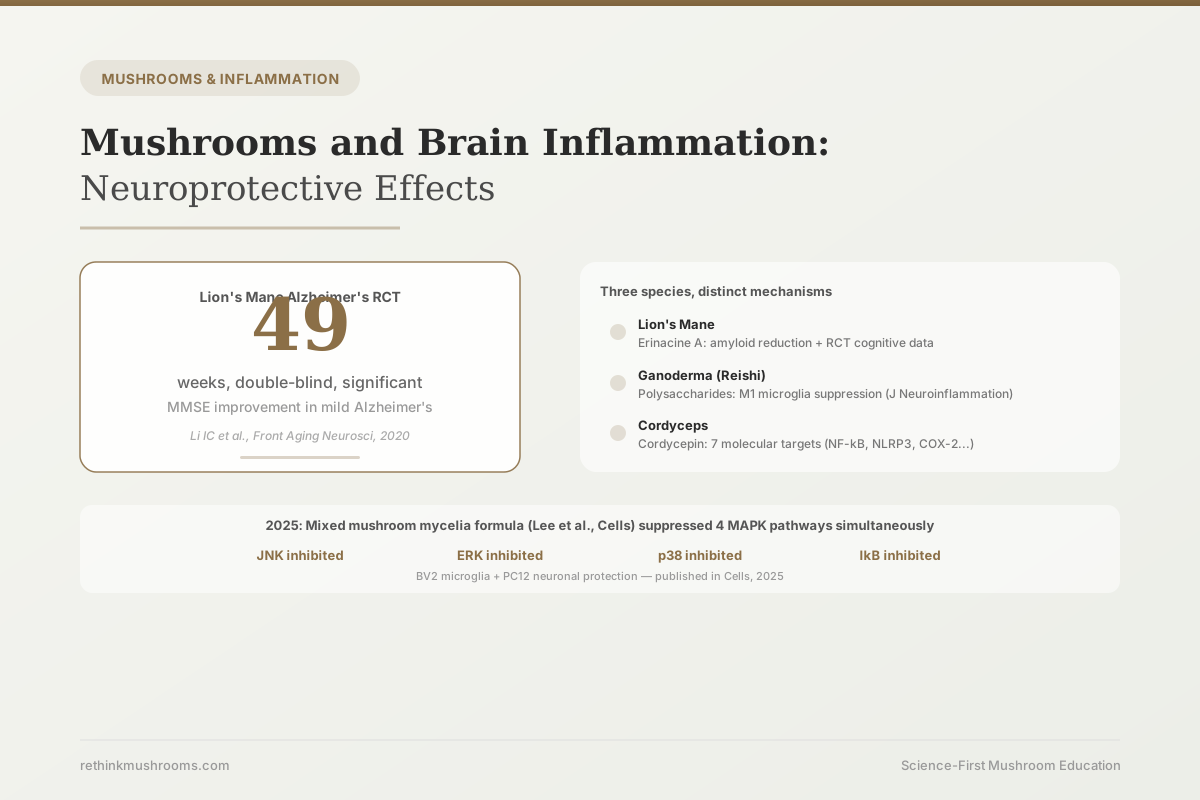
49 weeks
The longest mushroom brain health clinical trial tested Erinacine A-enriched Lion's Mane for 49 weeks in mild Alzheimer's patients and found significant improvement in MMSE cognitive scores versus placebo; the only double-blind RCT showing a mushroom compound improving Alzheimer's cognitive outcomes.
Li IC et al., Front Aging Neurosci, 2020
J Neuroinflammation
Ganoderma polysaccharides suppress IL-1β, IL-6, and iNOS in BV2 microglia (Cai et al., 2017); published in the field's primary journal
7 molecular targets
cordycepin inhibits neuroinflammation by simultaneously targeting 7 distinct signaling molecules (Govindula et al., 2021)
4 MAPK pathways
mixed mushroom formula suppressed JNK, ERK, p38, and IκB simultaneously in BV2 microglial cells (Lee et al., Cells, 2025)
Li IC et al., Front Aging Neurosci, 2020
 View as image ↗
In a 49-week double-blind placebo-controlled trial, patients with mild Alzheimer's disease who received Erinacine A-enriched Lion's Mane mycelium showed significantly better scores on the Mini-Mental State Examination than those who received placebo.[3] This is the longest and most rigorous clinical study of any mushroom compound for a neurological condition, yet it is largely absent from consumer content about medicinal mushrooms and brain health.
That gap extends across the broader neuroinflammation research. Ganoderma polysaccharides suppress microglia-mediated neuroinflammation in a study published in the Journal of Neuroinflammation, the primary specialty journal for this research area.[1] Cordyceps' active compound cordycepin targets 7 distinct neuroinflammatory signaling molecules.[4] A 2025 study of a mixed mushroom formula suppressed four parallel neuroinflammatory pathways simultaneously in brain immune cells.[5]
None of these findings appear in mainstream content about mushrooms and brain inflammation. This article covers the multi-species evidence, the mechanisms, and what the data actually supports.
For the broader framework on mushroom anti-inflammatory mechanisms, see How Mushrooms Fight Inflammation: NF-κB, COX-2, and Beyond.
Key Takeaways
- In a 49-week double-blind RCT, Erinacine A-enriched Lion's Mane (3 capsules/day) significantly improved MMSE scores in mild Alzheimer's patients versus placebo; the only clinical trial showing cognitive improvement from a mushroom compound in Alzheimer's disease (Li et al., Front Aging Neurosci, 2020)
- Ganoderma lucidum polysaccharides suppressed IL-1β, IL-6, and iNOS in LPS- and amyloid-beta-activated BV2 microglia while upregulating anti-inflammatory TGF-β, and also modulated microglial phagocytosis; published in the Journal of Neuroinflammation (Cai et al., 2017)
- Erinacine A-enriched Lion's Mane mycelium reduced cerebral amyloid-beta plaque burden, neuroinflammatory markers, and behavioral deficits in Alzheimer's transgenic mice (Tsai-Teng et al., J Biomed Sci, 2016)
- Cordycepin (from Cordyceps species) targets 7 distinct neuroinflammatory molecules: adenosine A2 receptor, NF-κB, NLRP3 inflammasome, IL-1β, iNOS, COX-2, and HMGB1 (Govindula et al., Eur J Pharmacol, 2021)
- A 2025 mixed mushroom mycelia extract suppressed neuroinflammation in BV2 microglia by inhibiting JNK, ERK, p38, and IκB phosphorylation simultaneously, while also protecting PC12 neurons from neurotoxicity (Lee et al., Cells, 2025)
- Ganoderma lucidum extract protected dopaminergic neurons in an MPTP-induced Parkinson's disease mouse model by modulating mitochondrial function, oxidative stress, and autophagy pathways (Ren et al., Acta Pharmacol Sin, 2019)
Why Brain Inflammation Is Different from Systemic Inflammation
The brain has its own dedicated immune cells called microglia. Unlike macrophages in the body, microglia are embedded throughout brain tissue and cannot easily be replaced if they dysfunction. Their job is surveillance: detecting pathogens, clearing debris, and responding to tissue damage.
Under conditions of acute infection or injury, microglia activate into what researchers call the M1 state: pro-inflammatory, releasing cytokines like IL-1β, IL-6, and TNF-α, and producing nitric oxide via the enzyme iNOS. This is a protective response. The problem arises when microglia stay in the M1 state chronically, which is a feature of Alzheimer's disease, Parkinson's disease, and other neurodegenerative conditions. Chronically activated M1 microglia damage the neurons they were meant to protect.
The alternative state, M2, is anti-inflammatory and regenerative: microglia in the M2 state produce TGF-β and other signals that promote neuronal survival and tissue repair. Shifting microglia from M1 to M2, or preventing excessive M1 activation in the first place, is the core mechanism by which several mushroom compounds appear to offer neuroprotection.
Lion's Mane: From Microglia to a Clinical Trial
Lion's Mane (Hericium erinaceus) has the strongest evidence chain of any mushroom for neuroinflammation, running from cell culture to animal models to a clinical trial.
Kushairi et al. (2019) tested Lion's Mane ethanolic extract directly against LPS-activated BV2 microglia, the standard cell model for neuroinflammation research.[7] Lion's Mane significantly reduced nitric oxide production in the activated microglia. The same extract also protected HT22 hippocampal neurons from hydrogen peroxide-induced oxidative damage. That is two relevant cell types responding to the same extract: immune cells quieted and neurons protected.
Tsai-Teng et al. (2016) moved to a transgenic mouse model of Alzheimer's disease, administering Erinacine A-enriched Lion's Mane mycelium orally for 30 days.[2] Erinacine A is a diterpenoid compound found in Lion's Mane mycelium (not the fruiting body) with direct NGF-stimulating properties. In the transgenic mice, the treatment reduced cerebral amyloid-beta plaque burden (one of the hallmarks of Alzheimer's pathology), reduced neuroinflammatory markers, and improved behavioral performance. The amyloid reduction was not a trivial effect; it suggests that the neuroinflammatory suppression translated to reduced pathological protein accumulation.
Li et al. (2020) then tested this in human patients.[3] The trial enrolled patients with mild Alzheimer's disease in a 49-week double-blind, placebo-controlled design. The active treatment was Erinacine A-enriched Lion's Mane mycelium at a dose delivering 5 mg/g of erinacine A. The primary outcome was MMSE (Mini-Mental State Examination) score, the standard clinical assessment of cognitive function. The treatment group showed significantly better MMSE scores than placebo at the 49-week endpoint.
This trial is described as a "pilot" study, indicating a smaller sample size than a definitive Phase III trial, and replication in larger trials would be needed before clinical conclusions can be drawn. But it is the only double-blind RCT showing cognitive improvement from a mushroom compound in Alzheimer's patients with significant statistical results, and it is based on 49 weeks of treatment; a timeframe long enough to capture genuine cognitive trajectory changes.
For a deeper look at the specific compounds driving these effects, see Hericenones and Erinacines: Lion's Mane's Brain-Boosting Compounds.
Ganoderma: The Journal of Neuroinflammation Paper
Cai et al. (2017) published a study specifically examining Ganoderma lucidum polysaccharides (GLP) and microglia in the Journal of Neuroinflammation; the primary peer-reviewed authority for this research area.[1] The journal selection matters: work published there is evaluated by specialists in neuroinflammation science.
The study activated BV2 microglia using two different stimuli: LPS (a bacterial toxin used to trigger M1 inflammation) and amyloid-beta (the Alzheimer's-relevant protein). GLP inhibited the pro-inflammatory response to both. The cytokines IL-1β and IL-6 were reduced. The enzyme iNOS (which produces the neurotoxic molecule nitric oxide) was reduced. At the same time, TGF-β; an anti-inflammatory and tissue-repair cytokine associated with M2 polarization; was elevated.
Beyond cytokine effects, Cai et al. also measured microglial behavior: phagocytosis (the cell's ability to engulf and clear debris) and migration. GLP modulated both, suggesting Ganoderma polysaccharides affect not just what microglia produce but how they physically operate in brain tissue. This is a mechanistic layer that goes beyond simple cytokine suppression.
Ren et al. (2019) validated the neuroprotective effects of Ganoderma in a Parkinson's disease animal model.[6] MPTP is a neurotoxin that destroys dopaminergic neurons in the substantia nigra, producing a Parkinson's-like syndrome in mice. Ganoderma extract significantly protected dopaminergic neurons from MPTP-induced loss by regulating mitochondrial function, reducing oxidative stress, and modulating autophagy and apoptosis pathways. Parkinson's disease is driven by a combination of neuroinflammation and mitochondrial dysfunction; Ganoderma appears to address both in this model.
Cordyceps: Seven Molecular Targets in One Compound
Cordycepin (3'-deoxyadenosine), the primary bioactive compound in Cordyceps species, has been studied extensively for its anti-neuroinflammatory effects. Govindula et al. (2021) synthesized this research into a review that explicitly mapped cordycepin's neuroinflammatory targets.[4]
The seven molecular targets cordycepin addresses in neuroinflammation:
- Adenosine A2 receptor; cordycepin modulates adenosine signaling, which has direct effects on microglial activation state
- NF-κB; the master inflammatory transcription factor; cordycepin inhibits its activation
- NLRP3 inflammasome; a protein complex that triggers the release of IL-1β; cordycepin suppresses its assembly
- IL-1β; the primary pro-inflammatory cytokine produced by activated microglia; directly reduced
- iNOS; the enzyme producing neurotoxic nitric oxide; inhibited
- COX-2; cyclooxygenase-2, the inflammation enzyme; suppressed
- HMGB1; a late-phase inflammatory mediator that drives sustained neuroinflammation; reduced
Addressing seven distinct signaling molecules across three different pathway levels (receptor, transcription factor, and downstream effectors) is a degree of mechanistic breadth that single-target pharmaceutical anti-inflammatory agents typically do not match. Govindula et al. proposed that this multi-target profile makes cordycepin particularly effective in chronic neuroinflammatory contexts where multiple pathways are simultaneously dysregulated.
The 2025 Multi-Species Synergy Data
Lee et al. (2025) tested a mixed mushroom mycelia extract (a multi-species formula designated GMK) against LPS-induced neuroinflammation in BV2 microglia and neurotoxicity in PC12 neurons.[5]
The anti-neuroinflammatory mechanism was mapped to four parallel MAPK (mitogen-activated protein kinase) pathways: JNK, ERK, p38, and the upstream regulator IκB. These are distinct signaling cascades that converge on inflammatory gene expression. The mixed mushroom formula inhibited phosphorylation (activation) of all four simultaneously, reducing downstream production of NO, TNF-α, and IL-6. The same extract also protected PC12 neuronal cells from neurotoxicity.
The simultaneous targeting of four pathways is mechanistically significant. Each pathway can independently drive neuroinflammation; inhibiting one while the others remain active produces incomplete suppression. A formula that addresses all four simultaneously suggests either that multiple compounds in the mixture work on different pathways, or that certain shared compounds have unusually broad-spectrum activity.
This 2025 data is the most current preclinical evidence in the neuroinflammation-mushroom literature and has not yet appeared in any consumer content.
For the general cytokine modulation mechanisms relevant across mushroom species, see How Mushrooms Modulate Inflammatory Cytokines. For the Alzheimer's-specific cross-species comparison, see Cross-Species Mushroom Research in Alzheimer's: Lion's Mane, Reishi, and Cordyceps.
Evidence Levels: Where Each Species Stands
The research across these species differs substantially in evidence quality. Understanding what stage each finding is at is necessary for accurate expectations.
Lion's Mane has the strongest translational evidence chain: cell model data (Kushairi 2019), transgenic animal model data (Tsai-Teng 2016), and a human RCT with significant cognitive outcomes (Li 2020). The human trial is a pilot study with limitations in sample size, but it exists and showed significant results.
Ganoderma has high-quality cell model data (Cai 2017, J Neuroinflammation) and validated animal model data for Parkinson's (Ren 2019, 2022). No human RCT for neurological conditions exists.
Cordyceps has mechanistic review-level evidence establishing the multi-target profile (Govindula 2021). The reviews draw on multiple cell and animal studies. No human RCT for brain inflammation exists.
Mixed formulas have the 2025 cell model data (Lee 2025). No animal or human data yet for the specific combination.
For all species: no mushroom supplement is approved for treating Alzheimer's disease, Parkinson's disease, or any neurological condition. The Li 2020 Alzheimer's pilot trial is not sufficient evidence for clinical guidance. The evidence is promising and justifies continued research; it does not justify medical claims.
The Bottom Line
Three mushroom species have distinct, mechanistically detailed evidence for brain anti-inflammatory effects. Lion's Mane has the most complete evidence chain, from BV2 microglia cell data (Kushairi 2019) to Alzheimer's transgenic mouse model (Tsai-Teng 2016) to a 49-week double-blind RCT showing MMSE improvement in mild Alzheimer's patients (Li 2020). Ganoderma polysaccharides suppress microglial M1 activation in research published in the Journal of Neuroinflammation (Cai 2017) and protect dopaminergic neurons in a Parkinson's model (Ren 2019). Cordycepin targets 7 distinct neuroinflammatory molecules (Govindula 2021). A 2025 mixed mushroom formula suppressed four MAPK pathways simultaneously in BV2 cells (Lee 2025). Nearly all evidence outside of the Li 2020 pilot RCT is preclinical.
Frequently Asked Questions
Sources & References
- 1RTHM-00462·Cai, Qing et al. (2017). “Polysaccharides from Ganoderma lucidum attenuate microglia-mediated neuroinflammation and modulate microglial phagocytosis and behavioural response..” Journal of neuroinflammation.Study breakdown →PubMed →↩
- 2RTHM-00452·Tsai-Teng, Tzeng et al. (2016). “Erinacine A-enriched Hericium erinaceus mycelium ameliorates Alzheimer's disease-related pathologies in APPswe/PS1dE9 transgenic mice..” Journal of biomedical science.Study breakdown →PubMed →↩
- 3RTHM-00631·Li, I-Chen et al. (2020). “Prevention of Early Alzheimer's Disease by Erinacine A-Enriched Hericium erinaceus Mycelia Pilot Double-Blind Placebo-Controlled Study..” Frontiers in aging neuroscience.Study breakdown →PubMed →↩
- 4RTHM-01359·Govindula, Anusha et al. (2021). “Molecular mechanisms of cordycepin emphasizing its potential against neuroinflammation: An update..” European journal of pharmacology.Study breakdown →PubMed →↩
- 5RTHM-02125·Lee, Sang-Seop et al. (2025). “Neuroprotective Effect of Mixed Mushroom Mycelia Extract on Neurotoxicity and Neuroinflammation via Regulation of ROS-Induced Oxidative Stress in PC12 and BV2 Cells..” Cells.Study breakdown →PubMed →↩
- 6RTHM-01118·Ren, Zhi-Li et al. (2019). “Ganoderma lucidum extract ameliorates MPTP-induced parkinsonism and protects dopaminergic neurons from oxidative stress via regulating mitochondrial function, autophagy, and apoptosis..” Acta pharmacologica Sinica.Study breakdown →PubMed →↩
- 7RTHM-01078·Kushairi, Naufal et al. (2019). “Lion's Mane Mushroom, Hericium erinaceus (Bull.: Fr.) Pers. Suppresses H2O2-Induced Oxidative Damage and LPS-Induced Inflammation in HT22 Hippocampal Neurons and BV2 Microglia..” Antioxidants (Basel.Study breakdown →PubMed →↩