Mushroom Stacking & Combinations
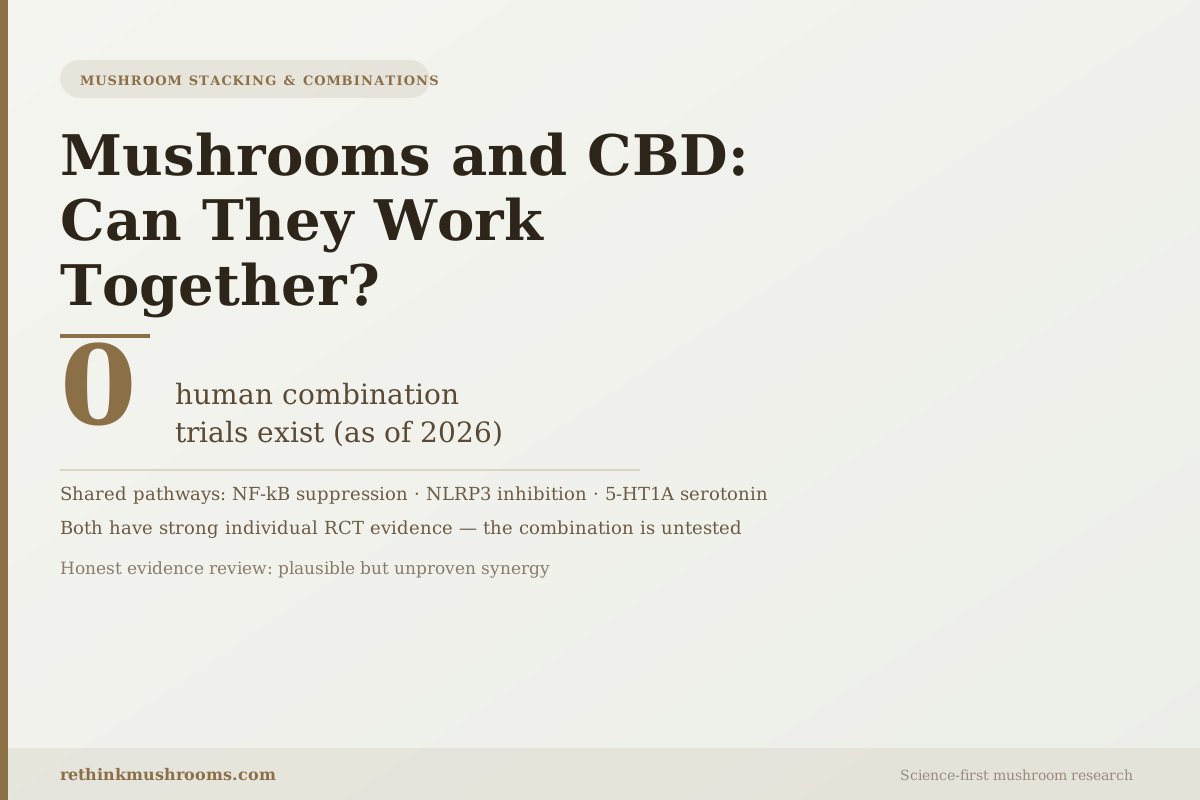
0 human combination trials
As of 2026, no published human clinical trial has tested functional mushrooms and CBD together. Both have substantial individual evidence. Any synergy is mechanistically plausible but not yet clinically confirmed.
Competitive landscape analysis, 2026
NF-kB
the shared anti-inflammatory pathway targeted by both mushroom triterpenes and CBD
NLRP3
the inflammasome complex inhibited by both CBD and reishi compounds
5-HT1A
CBD's primary anxiolytic receptor, also modulated by reishi's serotonin pathway
Competitive landscape analysis, 2026
 View as image ↗
Functional mushrooms and CBD are two of the most popular supplement categories right now, and combination products pairing them have proliferated across the market. The marketing typically presents the combination as synergistic, natural, and backed by science. The honest summary is more precise: the combination is considered safe with no known drug interactions, both compounds target overlapping molecular pathways that make the synergy hypothesis scientifically coherent, and no human clinical trial has tested them together.
Yes, functional mushrooms and CBD can be combined. No known safety interactions exist in published literature, and both act on overlapping anti-inflammatory and serotonin pathways. However, no human clinical trial has tested them in combination, and any synergy claims beyond that are extrapolated from separate evidence bases, not from combination research.
That distinction matters. It separates a scientifically grounded hypothesis from proven fact. Understanding what each ingredient actually shows in clinical research, and where the shared mechanisms are, lets you evaluate any combination product honestly. For the broader guide to combining medicinal mushrooms with other supplements, see the complete mushroom stacking guide.
Key Takeaways
- No human clinical trial has tested functional mushrooms combined with CBD; all combination claims are extrapolated from separate individual-ingredient research
- Mushrooms and CBD share two main anti-inflammatory pathways: NF-kB suppression and NLRP3 inflammasome inhibition, the mechanistic overlap that makes combination rationale scientifically coherent
- A 2026 double-blind RCT of a mushroom blend found 33.5% reduction in HAM-A anxiety scores vs. 13.1% placebo in 50 adults over 12 weeks
- A 2024 meta-analysis of 8 CBD RCTs (n=316) found a large effect size for anxiety reduction (Hedges' g = -0.92), though heterogeneity limits confidence
- A 2026 meta-analysis of reishi triterpenes confirmed consistent NF-kB and anti-inflammatory pathway suppression across preclinical studies, validating the mechanistic overlap with CBD
- The term "entourage effect" technically describes cannabis-internal terpene-cannabinoid synergy; applying it to mushroom+CBD combinations is a conceptual extension that has not been tested in humans
The Direct Answer: Safe to Combine, Synergy Not Yet Proven
The safety question comes first. No published research documents harmful interactions between functional mushrooms and CBD. Both are generally well-tolerated individually across their respective clinical trial literature. In population-level surveys, CBD-using adults routinely combine it with botanical supplements without documented adverse interaction signals.
One pharmacological consideration worth noting: both CBD and some mushroom triterpene compounds are metabolized in part by CYP3A4 and CYP2C19 liver enzymes. These enzymes also process many pharmaceutical drugs. This does not mean mushrooms and CBD interact with each other, but it means that anyone taking prescription medications processed by those pathways should consider checking with a healthcare provider before adding either or both. The concern, when it exists, is about the pharmaceutical drug, not the mushroom-CBD combination itself.
On efficacy: the combination has not been tested in humans. Everything else this article covers describes the separate evidence bases and the molecular overlap that makes combination effects plausible. Plausible is not the same as proven.
What Mushrooms Show Independently: The Clinical Evidence Base
A 2021 comprehensive review of Ganoderma lucidum by Ahmad and colleagues in Phytotherapy Research catalogued the species' established activities: anxiolytic effects, anti-inflammatory activity, immune modulation, and sleep-related benefits across preclinical and clinical evidence.[2] This provides the anchor for reishi's mechanism.
The most recent clinical data is stronger. Mitra and colleagues published a randomized controlled trial in 2024 testing reishi supplementation (1,000mg/day for 30 days) in 78 female college students with stress. Reishi significantly improved validated anxiety, depression, vitality, and positive well-being scores compared to placebo.[9]
The largest mushroom RCT for anxiety is Hisamuddin and colleagues' 2026 double-blind placebo-controlled trial of a five-mushroom blend (lion's mane, cordyceps, reishi, shiitake, maitake) in 50 adults over 12 weeks. The active group showed a 33.5% reduction in HAM-A (Hamilton Anxiety Rating) scores compared to 13.1% in the placebo group. Sleep quality (PSQI scale) improved by 11.1% in the active group versus 1.0% in placebo. C-reactive protein (an inflammation marker) decreased by 6.3% in the active group while increasing 4.9% in placebo.[6]
Beyond reishi, lion's mane has two clinical datasets worth noting. Nagano and colleagues' 2010 cohort study found that four weeks of lion's mane supplementation significantly reduced validated depression and anxiety scores in human participants.[7] Vigna and colleagues' 2019 cohort in overweight patients found lion's mane improved mood and sleep, with BDNF (brain-derived neurotrophic factor) elevation as a proposed mechanism.[8] The BDNF pathway is distinct from the anti-inflammatory mechanisms and from CBD's receptor pharmacology, suggesting lion's mane adds a different mechanistic layer than reishi to any potential combination.
What CBD Shows Independently: The Clinical Evidence Base
The CBD anxiety literature now includes a substantial number of randomized controlled trials. Han and colleagues' 2024 systematic review and meta-analysis of 8 CBD RCTs involving 316 participants found a large effect size for anxiety reduction (Hedges' g = -0.92, 95% CI: -1.80 to -0.04).[5] The confidence interval is wide, reflecting significant heterogeneity across the trials in dosing, populations, and outcome measures. The direction of effect is consistent, but the magnitude should be treated with caution given the heterogeneity.
CBD's primary mechanism for anxiety reduction is well-characterized: it acts as a partial agonist at 5-HT1A receptors (serotonin receptors that modulate anxiety) and as a negative allosteric modulator at CB1 receptors in the endocannabinoid system. Its anti-inflammatory effects operate primarily through NLRP3 inflammasome inhibition.
The Shared Pathways: Where Combination Rationale Comes From
The scientific case for the mushroom+CBD combination is not that they produce similar effects (though they do) but that they target some of the same underlying molecular mechanisms.
NF-kB pathway: Reishi triterpenes suppress NF-kB activation, the master switch for inflammatory gene expression. Pozzobon and colleagues' 2026 meta-analysis of preclinical evidence for Ganoderma lucidum triterpenes confirmed this across multiple studies.[4] CBD also suppresses NF-kB. If both compounds reduce the same pathway, a combination might provide more complete suppression than either alone, or it might achieve similar suppression at lower doses of each. Which of these scenarios applies in practice is unknown without combination trials.
NLRP3 inflammasome: Chu and colleagues' 2024 systematic review established that CBD's anti-inflammatory mechanisms operate primarily through NLRP3 inflammasome inhibition.[3] Reishi triterpenes have also been documented to inhibit NLRP3 activity. A shared NLRP3 target means both compounds are attempting to block the same protein complex. Again, whether this produces additive or redundant effects in combination requires direct testing.
Serotonin 5-HT1A: CBD's anxiolytic effects operate substantially through 5-HT1A partial agonism. Reishi has documented activity in the serotonin system as well. Whether these serotonin-pathway effects are additive or overlapping in a combination is, again, untested in humans.
These shared pathways are the scientific basis for describing mushroom+CBD combinations as mechanistically plausible. They do not establish clinical synergy.
The Entourage Effect: What It Actually Means and What It Does Not
The "entourage effect" concept originated in cannabis science. Russo's foundational 2011 review in the British Journal of Pharmacology documented how terpenes (linalool, myrcene, limonene, beta-caryophyllene) found in cannabis modulate cannabinoid receptor activity and serotonin targets, producing effects different from cannabinoids in isolation.[1] This is within-cannabis synergy: compounds from the same plant interacting with each other in the context of the endocannabinoid system.
Applying this concept to mushroom+CBD combinations is an extrapolation that involves crossing from one biological kingdom (fungi) to another (plant), via a mammalian receptor system (endocannabinoid) that evolved long before either fungi or cannabis existed.
That extrapolation is not inherently wrong. The shared NLRP3 and NF-kB mechanisms do cross kingdom lines. But "entourage effect" as originally defined by Russo refers to something specific and well-characterized within cannabis. Using the same term for a mushroom+CBD combination borrows the credibility of a well-documented phenomenon and applies it to a hypothesis that lacks the same supporting evidence.
For a full breakdown of how the entourage effect concept applies and where it stops applying, see The Entourage Effect: Mushrooms and Cannabinoids.
What the Evidence Can Honestly Support
The components of the mushroom+CBD evidence landscape, assembled honestly:
Individually established:
- Medicinal mushrooms (especially reishi, lion's mane, mushroom blends) have clinical trial evidence for anxiety and mood benefits, including an RCT (Mitra 2024) and a more recent 12-week RCT (Hisamuddin 2026) with HAM-A data
- CBD has a 2024 meta-analysis (Han) showing large effect size for anxiety reduction across 8 RCTs
- Both have anti-inflammatory mechanisms targeting NF-kB and NLRP3
Mechanistically plausible for combination:
- Shared NF-kB and NLRP3 targets make additive anti-inflammatory effects theoretically coherent
- Non-overlapping pathways (lion's mane's BDNF, CBD's CB1/endocannabinoid effects) suggest potential complementarity without redundancy
- No known pharmacological antagonism between fungal bioactives and cannabidiol
Not established:
- No human trial has tested the combination
- No dose-response data exists for combination use
- Whether the theoretical pathway complementarity translates to greater clinical benefit than either alone is unknown
For more on the anti-inflammatory and anxiolytic overlap specifically, see Mushrooms + CBD: Synergistic Anti-Inflammatory and Anxiolytic Potential. For the sleep angle on this combination, see Reishi + CBD for Sleep: Anecdotal Use and Research Gaps. For a research status update on the combination literature broadly, see Functional Mushrooms and Cannabis Combinations: Research Status.
The Bottom Line
Functional mushrooms and CBD can be safely combined based on current evidence: no drug interactions are documented in published research, and both compounds target overlapping anti-inflammatory (NF-kB, NLRP3) and serotonin pathways that make combination rationale scientifically coherent. The individual evidence for each is meaningful: mushroom blends have 2024 and 2026 RCT data showing anxiety and sleep improvements; CBD has a 2024 meta-analysis showing a large anxiety reduction effect size across 8 trials. The combination has never been tested in a human clinical trial. Any synergy claim beyond mechanistic plausibility is, as of 2026, a hypothesis without clinical confirmation.
Frequently Asked Questions
Sources & References
- 1. Source details for this reference are not yet available.
- 2. Source details for this reference are not yet available.
- 3. Source details for this reference are not yet available.
- 4. Source details for this reference are not yet available.
- 5. Source details for this reference are not yet available.
- 6. Source details for this reference are not yet available.
- 7. Source details for this reference are not yet available.
- 8. Source details for this reference are not yet available.
- 9. Source details for this reference are not yet available.