Mushroom Stacking & Combinations
0 human combination trials
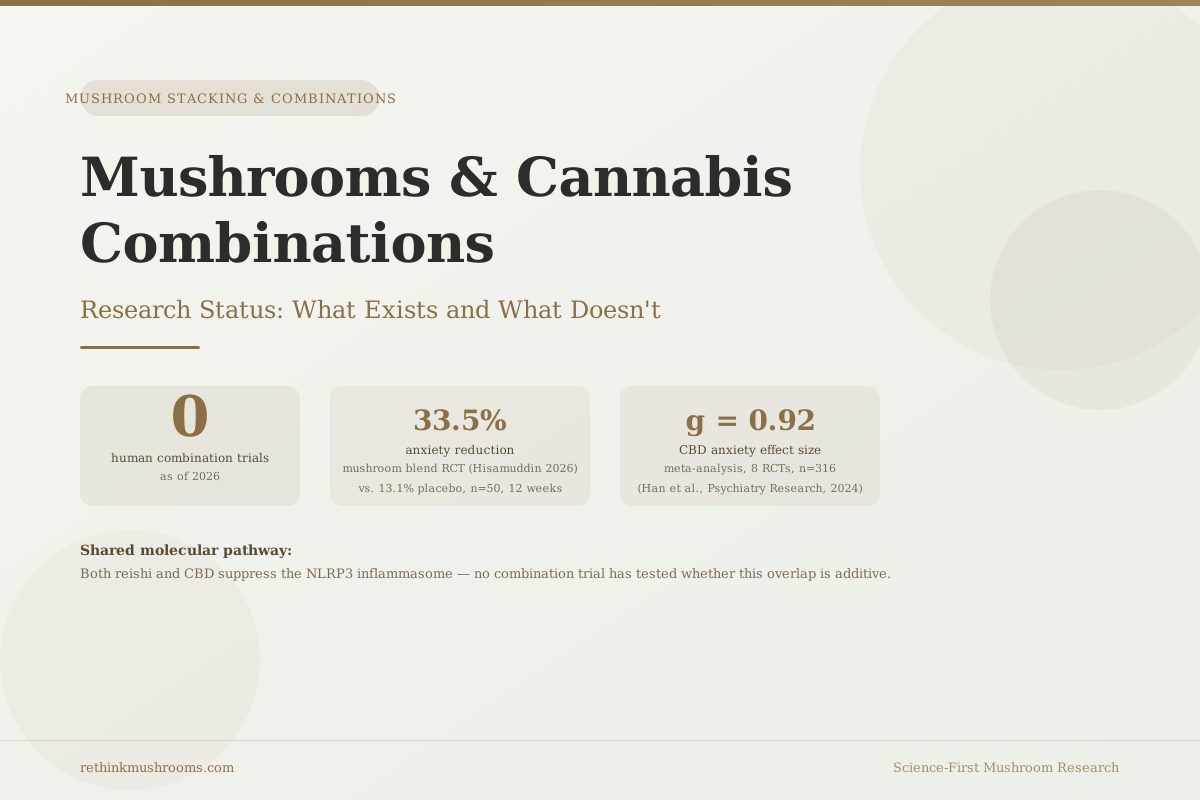
No clinical trial has ever tested functional mushrooms and cannabis together. A mushroom blend RCT reduced anxiety 33.5%; a 2024 CBD meta-analysis found a large effect size independently.
Hisamuddin et al., Brain and Behavior, 2026; Han et al., Psychiatry Research, 2024
33.5%
anxiety reduction in mushroom blend RCT, n=50 (Hisamuddin 2026)
g = 0.92
CBD anxiety effect size across 8 RCTs (Han 2024)
Zero
human trials testing the two together
Hisamuddin et al., Brain and Behavior, 2026; Han et al., Psychiatry Research, 2024
 View as image ↗
The market for functional mushroom and cannabis combination products has grown dramatically over the past five years. Products blending reishi, lion's mane, or cordyceps with CBD are sold at mainstream retailers. Supplement stacks pairing the two are a standard recommendation on wellness podcasts and social media. The implied message is consistent: these two categories work synergistically. The research reality is different. As of 2026, no human clinical trial has tested functional mushrooms and cannabis combinations together. For a broader view of how mushrooms combine with other supplements, see our guide to combining medicinal mushrooms.
This article maps what the research actually shows: what each arm demonstrates independently, what shared biological pathways make the combination rationale coherent, and what evidence gaps remain.
Key Takeaways
- No published human clinical trial has tested functional mushrooms and cannabis (or CBD) as a combination as of 2026; any claimed synergy is currently theoretical
- A 2026 mushroom blend RCT (Hisamuddin et al., n=50, 12 weeks) reduced anxiety scores by 33.5% vs. 13.1% in placebo and improved sleep quality by 11.1% vs. 1.0% in placebo
- A 2024 meta-analysis of 8 CBD anxiety RCTs (Han et al., n=316) found a large effect size (Hedges' g = 0.92) for CBD on anxiety reduction, though with significant heterogeneity
- A 2024 systematic review of CBD anxiety RCTs (Coelho et al.) confirmed CBD reduces anxiety across GAD, SAD, and PTSD through serotonin 5-HT1A agonism and CB1 receptor modulation
- The scientific rationale for combining mushrooms and CBD rests on a shared molecular pathway: both suppress the NLRP3 inflammasome and NF-kappaB inflammatory signaling (Chu et al., 2024)
- No known acute safety interactions between functional mushrooms and CBD have been documented in the research literature, but both may affect liver enzyme activity relevant to drug metabolism
The Honest Starting Point: Zero Human Trials for Mushroom-Cannabis Combinations
As of 2026, no published human clinical trial has tested a mushroom-and-cannabis combination as a treatment for any health condition. This is the foundational fact that almost every competitor in this space fails to disclose clearly.
The reasons for this gap are not mysterious. Clinical trials are expensive and time-consuming. Regulatory complexity around cannabis products creates additional barriers for researchers. And the product market, driven by consumer demand rather than research, has moved faster than the science.
What exists instead is substantial, high-quality evidence for each component separately, and a mechanistically coherent argument for why the combination is plausible. Neither of those is the same as evidence that combining them works, but they do establish that the hypothesis is worth taking seriously.
The most rigorous way to evaluate functional mushrooms and cannabis combinations research is to map what each arm shows independently, identify where their mechanisms overlap, and be explicit about what remains unknown.
The Mushroom Side: What Two 2026 Trials Found
The mushroom arm of this comparison has moved significantly in 2026. Two major publications give the clearest picture yet of what functional mushrooms can do in humans.
The first is Hisamuddin et al.'s randomized, double-blind, placebo-controlled trial published in Brain and Behavior in 2026.[1] The study recruited 50 participants and ran for 12 weeks, using a commercial mushroom blend (Restake) as the intervention.
The results were the strongest human evidence for functional mushrooms and anxiety-sleep outcomes published to date. Participants in the mushroom group saw HAM-A anxiety scores drop by 33.5% compared to 13.1% in the placebo group. Pittsburgh Sleep Quality Index (PSQI) scores improved by 11.1% vs. 1.0% in placebo. C-reactive protein (a marker of systemic inflammation) dropped by 6.3% in the mushroom group while rising 4.9% in placebo.
The second 2026 contribution is Pozzobon et al.'s systematic review and meta-analysis of reishi triterpene research published in Pharmaceuticals.[2] This analysis pooled preclinical studies and confirmed that reishi's ganoderic acid compounds consistently suppress inflammatory signaling through NF-kappaB pathways, providing the biochemical foundation for the anti-inflammatory effects observed in clinical studies.
For context on the full evidence base for reishi, Ahmad et al.'s 2021 comprehensive review in Phytotherapy Research synthesized the anxiolytic, anti-inflammatory, immunomodulatory, and sleep-promoting evidence across both preclinical and clinical work.[3] It remains the definitive single-species reference document for reishi's known mechanisms.
The Cannabis Side: What Two 2024 Reviews Found for CBD
The CBD anxiety literature matured significantly with two major reviews in 2024.
Han et al.'s meta-analysis in Psychiatry Research pooled data from 8 randomized controlled trials totaling 316 participants and calculated a large effect size for CBD on anxiety reduction: Hedges' g of -0.92 with a 95% confidence interval of -1.80 to -0.04.[4]
An effect size of 0.92 is considered large by Cohen's conventions. For context, this is comparable to effect sizes seen with first-line anxiolytic medications in equivalent meta-analyses. The limitation Han identified is that the confidence interval is wide and the trials used heterogeneous doses and populations, which means the effect estimate carries uncertainty.
Separately, Coelho et al. published a systematic review in Life in 2024 that examined CBD's mechanisms in anxiety conditions including generalized anxiety disorder, social anxiety disorder, and PTSD.[5] The review confirmed that CBD's anxiolytic effects operate through two primary receptor mechanisms: partial agonism at the serotonin 5-HT1A receptor and negative allosteric modulation at CB1 receptors. Adverse effects were minimal compared to placebo across the trials reviewed.
Together, Han 2024 and Coelho 2024 establish that CBD has a credible, replicated clinical signal for anxiety reduction. This is the foundation needed to evaluate whether combining it with mushrooms could add anything beyond what either does alone.
The Shared Pathway: Why the Combination Is Biologically Coherent
The scientific case for why mushrooms and CBD might work well together rests on a specific molecular overlap that most market-facing content never names explicitly.
Both reishi and CBD suppress the NLRP3 inflammasome. The NLRP3 inflammasome is a cellular structure that activates inflammatory signaling in response to stress, infection, or metabolic disruption. Overactivation of this pathway is linked to anxiety, depression, and chronic inflammatory conditions.
Chu et al.'s 2024 systematic review in Inflammation Research focused specifically on CBD's anti-inflammatory mechanism and concluded that NLRP3 inhibition is the primary pathway through which CBD reduces inflammation.[6] This is the same pathway suppressed by reishi's ganoderic acid triterpenes, as documented in the Pozzobon 2026 meta-analysis.
This overlap means that if both compounds reach their target tissues, they may be suppressing inflammation through the same mechanism. Whether that produces additive, synergistic, or simply redundant effects is unknown; no study has tested this in humans. But it's a more specific mechanistic rationale than the generic "both reduce inflammation" claim that product marketing typically offers.
The serotonin pathway adds a second potential overlap. CBD's anxiolytic effects include partial agonism at the 5-HT1A serotonin receptor, per Coelho et al. Ahmad et al.'s 2021 comprehensive review of reishi documents sleep-promoting and anxiolytic activities that also involve serotonin-related signaling as part of the species' established mechanisms.[3] Whether the two serotonin-adjacent mechanisms compound each other, or operate independently without meaningful interaction, is another open question.
For a closer look at mushroom-to-mushroom synergy mechanisms, see our article on which mushrooms work best together.
Why No Human Trials Exist Yet: The Research Gap Is Not Accidental
The absence of human combination trials reflects structural factors in pharmaceutical and supplement research.
Clinical trials for supplement combinations face challenges that single-ingredient trials don't. Regulatory pathways are less defined. Dosing rationale is harder to defend without prior combination data. Funding sources are primarily private (supplement companies) rather than public (NIH, academic grants), which creates bias toward proprietary blends rather than rigorously standardized interventions.
Cannabis-related research faces additional barriers in many jurisdictions, including Schedule I classification for cannabis in the U.S. federal system, which complicates import, use, and IRB approval even for CBD products that are commercially legal.
The result is a market that is effectively operating ahead of the science. Combination products are sold, purchased, and reviewed by consumers based on individual-arm research and anecdotal reports. This isn't fraudulent: the individual-arm evidence is real, and no acute safety interaction has been documented. But it's also not the same as tested and proven.
The Safety Question: What's Known and What Isn't
No human study in the published literature documents a specific adverse interaction between functional mushrooms and CBD. That's a meaningful observation: it suggests the combination doesn't have an obvious acute harm signal that would have emerged from case reports or clinical observations.
The more relevant safety consideration is pharmacological rather than acute. Both CBD and some mushroom compounds are processed by liver enzymes called cytochrome P450 enzymes (specifically CYP3A4 and CYP2C19 isoforms). Medications metabolized by these same enzymes (including many common prescription drugs) could theoretically be affected by competition for these enzymes. This is a general metabolic consideration that applies to many herbal and botanical supplements, not a specific interaction unique to mushroom-CBD combinations.
For people taking prescription medications, this enzyme competition is worth being aware of, even though no published study has documented a specific mushroom-CBD-drug interaction to date.
For a broader discussion of safety when combining multiple mushroom supplements, see our article on whether you can take too many mushrooms at once.
What Consumers Are Actually Using: The Anecdotal Landscape
Anecdotal reports from people using mushroom-CBD combinations consistently describe three types of experiences: anxiety reduction, improved sleep onset, and a subjective sense of calm that users describe as distinct from either compound alone.
These reports are not clinical evidence. They're subject to placebo effects, variable product quality, inconsistent dosing, and the general problem that self-report is unreliable for subjective states. But they do represent a signal that warrants systematic investigation, and they're consistent with the mechanistic rationale from the preclinical data.
The pattern in supplement research historically is that consumer use precedes clinical investigation by years to decades. The Hisamuddin 2026 mushroom blend RCT is notable precisely because it represents rigorous testing catching up to a product that consumers have been using for years. Similar research catching up on mushroom-CBD combinations is likely to follow, but the timeline is uncertain.
For a deeper exploration of the anxiolytic pathways that mushrooms and CBD share, see our article on mushrooms and CBD anti-inflammatory and anxiolytic potential. For a look at the entourage effect concept applied to this combination, see the entourage effect: mushrooms and cannabinoids.
The Evidence Gap Is the Story: Why This Matters for Consumers
The most useful thing this research status map can tell a consumer is exactly this: you have two ingredients with meaningful independent evidence, a credible but unproven rationale for combining them, and no clinical trial data for the combination itself.
That's not a reason to dismiss the combination. It's a reason to evaluate it clearly rather than through the lens of products that imply more certainty than the evidence supports.
Reishi's 2026 RCT data and CBD's 2024 meta-analysis data are both substantive. If either compound addresses what a person is looking for independently, the combination doesn't add something proven on top. If the mechanistic rationale (shared NLRP3/NF-kappaB suppression, serotonin pathway proximity) turns out to produce additive effects in a future clinical trial, that would be a meaningful discovery. Until that trial exists, the honest answer is that no one knows.
The mushroom and CBD research landscapes are evolving fast. The Hisamuddin 2026 trial and the Pozzobon 2026 meta-analysis represent the current frontier for mushroom evidence. The Han 2024 meta-analysis represents the clearest quantitative estimate for CBD's anxiety effects in humans. Combination trial data, when it eventually arrives, will be evaluated against these baselines.
For a broader overview of how mushrooms pair with each other and with other supplements, see our guide to combining medicinal mushrooms. For those specifically interested in mushrooms and CBD for sleep, see our article on reishi and CBD for sleep. For the general question of what mushrooms and CBD can do together, see mushrooms and CBD: can they work together.
The Bottom Line
As of 2026, no human clinical trial has tested functional mushrooms and cannabis combinations. The independent evidence bases are substantial: a mushroom blend RCT reduced anxiety by 33.5% in 12 weeks (Hisamuddin et al., 2026), while a CBD meta-analysis of 8 RCTs found a large effect size on anxiety (Hedges' g = 0.92, Han et al., 2024). Both reishi and CBD suppress the NLRP3 inflammasome and interact with serotonin pathways, giving the combination coherent biological rationale. No acute safety interactions have been documented, though both may affect liver enzyme activity relevant to drug metabolism. The research gap between the market for these products and the clinical evidence for their combination is the defining feature of this field in 2026.
Frequently Asked Questions
Sources & References
- 1. Source details for this reference are not yet available.
- 2. Source details for this reference are not yet available.
- 3. Source details for this reference are not yet available.
- 4. Source details for this reference are not yet available.
- 5. Source details for this reference are not yet available.
- 6. Source details for this reference are not yet available.