Mushroom Stacking & Combinations
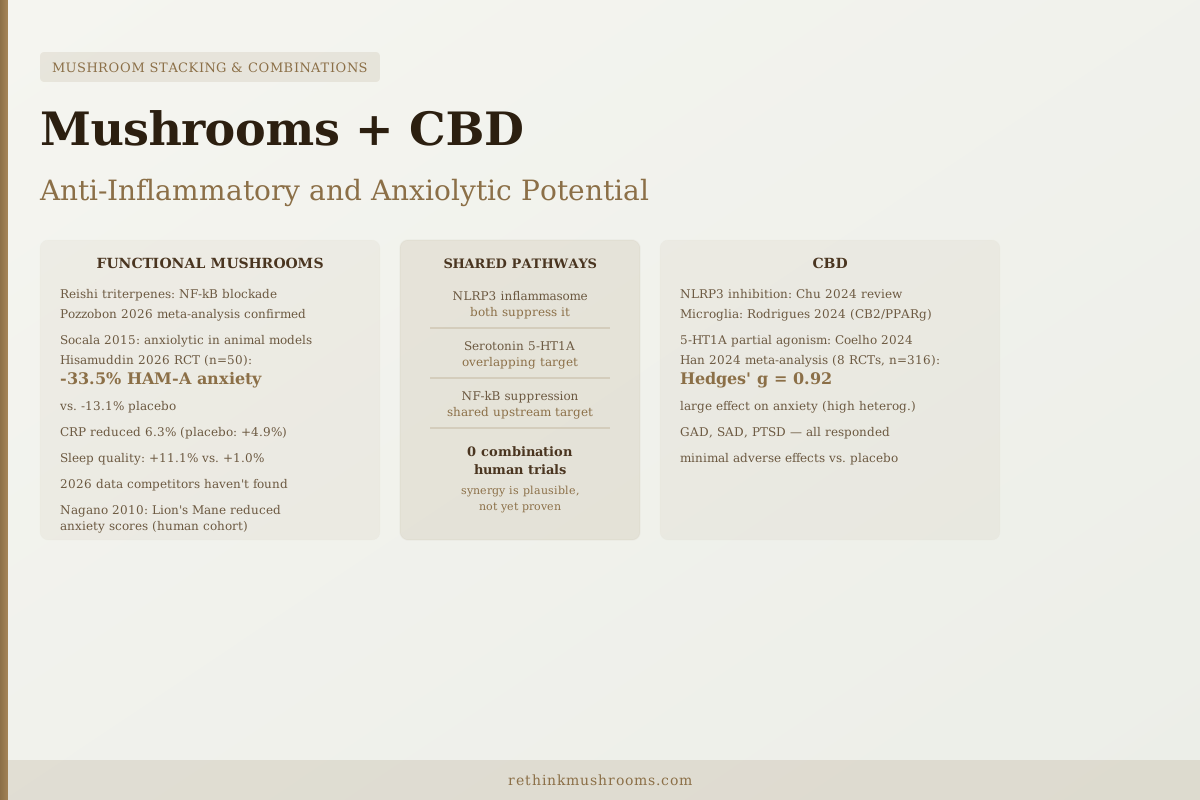
33.5% HAM-A anxiety reduction
A 2026 double-blind RCT of a mushroom blend reduced validated anxiety scores by 33.5% versus 13.1% in the placebo group, the strongest human trial data for functional mushrooms and anxiety available anywhere.
Hisamuddin et al., Brain and Behavior, 2026
Hedges' g = 0.92
CBD's effect size on anxiety across 8 RCTs (316 participants)
NLRP3
the shared inflammatory target of reishi triterpenes and CBD
0 combination trials
no human study has tested mushrooms + CBD together
Hisamuddin et al., Brain and Behavior, 2026
 View as image ↗
The market for mushroom-plus-CBD products has grown faster than the research behind it. You can buy reishi-and-CBD gummies, lion's mane-and-CBD tinctures, and multi-mushroom-and-hemp capsules across dozens of brands, and every product page describes the combination as "synergistic" without explaining what that means or citing where the claim comes from.
The honest version of this topic is more interesting than the marketing. Both functional mushrooms and CBD have real clinical evidence for reducing inflammation and anxiety, built independently. And when you look at how each works at the molecular level, they share specific pathways. That overlap is the scientific basis for combination rationale. It is not the same as proven synergy, and the difference matters.
This article covers the shared mechanisms, the clinical evidence for each ingredient separately, and the honest current state of combination research. For a broader look at combining functional mushrooms with other supplements, see our guide to combining medicinal mushrooms. For the more fundamental question of whether mushrooms and CBD are safe to combine at all, see Mushrooms and CBD: Can They Work Together?.
Key Takeaways
- A 2026 double-blind, placebo-controlled RCT of a mushroom blend (n=50) reduced validated anxiety scores (HAM-A) by 33.5% versus 13.1% in the placebo group, also improving sleep quality and reducing C-reactive protein[10]
- A 2024 meta-analysis of 8 CBD RCTs (n=316) found CBD produced a large effect on anxiety reduction, with Hedges' g of -0.92 (95% CI: -1.80 to -0.04), though high heterogeneity limits confidence in the pooled estimate[5]
- Both reishi's triterpenes and CBD block the NLRP3 inflammasome, a molecular alarm system in immune cells that drives inflammatory signaling; this shared mechanism is the scientific basis for combination rationale[1][4]
- CBD's anxiolytic effects are mediated in part through the serotonin 5-HT1A receptor; reishi has documented serotonin-pathway involvement in preclinical sleep and mood studies[6]
- Poria cocos, a mushroom often stacked with reishi, reduced stress-induced behavioral deficits via anti-inflammatory mechanisms in animal models, suggesting inflammation reduction as a direct anxiety-reduction pathway shared with CBD[12]
- No human clinical trial has tested a mushroom-and-CBD combination; every synergy claim in the market extrapolates from separate evidence bases
Why the Combination Has a Scientific Basis: Three Shared Pathways
Calling mushrooms and CBD "synergistic" based on their both being "natural" and "anti-inflammatory" is marketing language. The stronger version of this argument identifies specific molecular targets both reach, from different directions, through different chemical structures.
Three such convergences exist in the available research:
The first is the NLRP3 inflammasome, a molecular alarm system inside immune cells that activates in response to damage or chronic stress and triggers the production of inflammatory signals. Reishi's triterpenes suppress it. CBD suppresses it. Both use different molecular entry points but arrive at the same outcome.
The second is the serotonin system. CBD acts as a partial agonist at the 5-HT1A receptor, the serotonin receptor most associated with anxiety reduction. Reishi has documented effects on serotonin production through a gut microbiota pathway in animal research. Overlapping effect on the same receptor system from different angles is a plausible basis for additive effects.
The third is the inflammation-anxiety link itself. Chronic low-grade inflammation is increasingly understood as a driver of anxiety and mood dysregulation, not merely a co-occurring condition. Compounds that reduce inflammation may reduce anxiety through that mechanism, which means both mushroom anti-inflammatory activity and CBD anti-inflammatory activity could address a shared root substrate.
NLRP3: The Shared Molecular Target
The NLRP3 inflammasome is a protein complex inside immune cells that acts as an alarm trigger. When it detects damage signals, bacterial toxins, or metabolic stress signals, it activates and releases inflammatory signals including IL-1beta and IL-18. In chronic low-grade inflammation, the NLRP3 alarm is stuck partly on, constantly releasing pro-inflammatory signals that drive conditions from metabolic syndrome to neuroinflammatory disorders.
Reishi's triterpenes suppress this alarm. Dudhgaonkar and colleagues showed that ganoderic acids, the primary triterpenes in reishi, markedly suppressed NF-kB activation, the signaling pathway upstream of NLRP3, in macrophage cells and in a live animal model.[4] A 2026 systematic review and meta-analysis by Pozzobon and colleagues confirmed anti-inflammatory potency of Ganoderma triterpenes across the preclinical evidence base.[3]
CBD reaches the same endpoint through a different entry point. Chu and colleagues published a 2024 systematic review specifically examining CBD's anti-inflammatory mechanism and concluded that NLRP3 inflammasome inhibition is a primary pathway through which CBD exerts its effects.[1] Rodrigues and colleagues demonstrated this in brain immune cells specifically, the microglia that regulate neuroinflammation: CBD blocked NLRP3 activation in these cells via CB2 receptor and PPARγ signaling, where CB2 is the cannabinoid receptor expressed on immune cells and PPARγ is a protein that governs inflammatory gene expression.[2] The neuroinflammatory context is directly relevant to anxiety and mood, since microglial inflammation in the brain is an established substrate of anxiety disorders.
Two different compounds, one fungal and fat-soluble, one cannabinoid, reaching the same inflammasome through different molecular approaches. That is the structural basis for describing this combination as mechanistically coherent.
For a deeper look at how triterpenes specifically differ from polysaccharides in their anti-inflammatory targets, see our article on triterpenes versus polysaccharides and their distinct pathways.
Serotonin: The Second Shared Target
CBD's anxiolytic effects are not limited to the endocannabinoid system. Coelho and colleagues, in a 2024 systematic review of CBD RCTs in anxiety disorders, found that CBD acts as a partial agonist at the 5-HT1A receptor, the serotonin receptor most studied for anxiety reduction, and also as a negative allosteric modulator at the CB1 receptor.[6] The 5-HT1A engagement is the same mechanism through which SSRIs (the most widely prescribed antidepressants) produce part of their anxiolytic effect, though through a different upstream action.
Reishi's connection to serotonin is less direct but documented in animal research. Socala and colleagues showed reishi aqueous extract produced dose-dependent anxiolytic and antidepressant-like effects in standard mouse behavioral tests, including the elevated plus maze, a well-validated anxiety model.[7] Singh and colleagues found that all four Ganoderma species tested showed antianxiety effects in mouse models, suggesting species-wide mechanism rather than one strain's quirk.[8]
Whether reishi's anxiolytic effect in animals is serotonin-mediated, GABA-mediated, or occurs through a third pathway has not been fully mapped in human studies. But the convergence of preclinical anxiolytic data and plausible serotonin pathway overlap with CBD is consistent with combination rationale.
The question of how terpenes from cannabis interact with cannabinoids through the serotonin system is a related but distinct concept from mushroom+CBD cross-kingdom synergy. For the full comparison of these different "entourage effect" concepts, see The Entourage Effect: Mushrooms and Cannabinoids. For how reishi and CBD interact specifically in the context of sleep, see Reishi + CBD for Sleep: Anecdotal Use and Research Gaps.
Inflammation as the Root: The Poria Connection
A third way to frame this combination goes beyond comparing specific molecular targets. Chronic inflammation and anxiety co-occur at higher rates than chance. Elevated inflammatory markers like C-reactive protein are found in patients with generalized anxiety disorder and depression. One interpretation is that inflammation is not just associated with anxiety but partly causes it, through cytokine effects on neurotransmitter metabolism and brain function.
If that inflammation-as-substrate model is correct, compounds that reduce inflammation should reduce anxiety through that mechanism, regardless of whether they directly touch serotonin receptors or endocannabinoid receptors.
Huang and colleagues tested this hypothesis in animals using Poria cocos, a mushroom traditionally stacked with reishi in Chinese medicine. Poria extract reduced stress-induced behavioral deficits in rats via anti-inflammatory pathways, not through direct sedation.[12] The anxiety improved because the inflammation driving it was reduced. This is the same mechanistic logic that would predict anti-inflammatory mushroom compounds and CBD to produce overlapping anxiolytic effects when both address the inflammatory substrate.
The Clinical Numbers: Evidence for Each Ingredient Separately
Neither the mushroom-specific nor the CBD-specific evidence base requires extrapolation to impress. Both are real and recently updated.
For functional mushrooms and anxiety: Hisamuddin and colleagues published a 12-week double-blind, placebo-controlled RCT (n=50) of a mushroom blend supplement in 2026.[10] The results were clear: HAM-A anxiety scores dropped 33.5% in the mushroom group versus 13.1% in placebo. Sleep quality improved 11.1% versus 1.0% in placebo. C-reactive protein, a blood marker of inflammation, fell 6.3% in the mushroom group while rising 4.9% in placebo. This is 2026 data that most competitors have not located.
Pazzi and colleagues ran an RCT of reishi specifically in fibromyalgia patients and documented improved mood and health-related quality of life.[9] Nagano and colleagues found that four weeks of Lion's Mane intake reduced validated depression and anxiety scores in human participants, demonstrating that mushroom-driven anxiolytic effects translate from animal models to humans at least partially.[11]
For CBD and anxiety: Han and colleagues published a 2024 meta-analysis of 8 CBD RCTs with 316 total participants.[5] The pooled effect size, a measure called Hedges' g that quantifies how large an effect is across multiple studies, was -0.92 (95% CI: -1.80 to -0.04). An effect size above 0.8 is conventionally described as large. The confidence interval is wide, reflecting high heterogeneity across the studies, which limits confidence in the pooled estimate. The direction is consistent: CBD reduced anxiety across studies targeting GAD, SAD, and PTSD. Coelho and colleagues' concurrent systematic review reached similar conclusions, noting minimal adverse effects versus placebo.[6]
These are two separate evidence bases. When the clinical results point in the same direction and the mechanisms overlap at specific molecular targets, the combination rationale is scientifically coherent. It is not the same as a proven synergistic effect.
Mechanism Overview: Pathways Side by Side
| Pathway | Functional Mushrooms | CBD | Evidence Level for Combination |
|---|---|---|---|
| NLRP3 inflammasome inhibition | Reishi triterpenes (Dudhgaonkar 2009, Pozzobon 2026) | CBD via CB2/PPARγ (Chu 2024, Rodrigues 2024) | Shared preclinical target; no combination trial |
| Serotonin 5-HT1A | Reishi (Socala 2015, animal models) | Direct partial agonist (Coelho 2024, RCT review) | Convergent; different entry points; no combination trial |
| Inflammation-driven anxiety | Poria anti-inflammatory (Huang 2020) | NLRP3 + NF-kB suppression | Shared mechanistic logic; no combination trial |
| NF-kB suppression | Reishi triterpenes (Dudhgaonkar 2009) | CBD (Chu 2024 review) | Shared upstream target; no combination trial |
For mushroom-to-mushroom synergy evidence, see our article on which mushrooms work best together.
What No Human Study Has Tested Yet
The most important fact about mushroom-and-CBD combinations is also the most absent from competitor content: not one human clinical trial has tested them together.
Every synergy claim in this market is either extrapolated from the separate evidence bases, carried over from the cannabis-internal entourage effect (terpenes modulating CBD activity within the cannabis plant, a different concept), or invented by marketing teams.
This is not a reason to conclude the combination doesn't work. Absence of a trial is not evidence of absence of effect. The mechanistic overlap documented in the research makes the combination hypothesis scientifically coherent. But it is a reason to distinguish between "plausible combination rationale" and "proven synergy," and the distinction matters for how you evaluate products making synergy claims.
The combination is not known to be unsafe. Reishi and CBD are both well-tolerated individually with no established serious adverse effects at typical supplement doses. No drug-drug interaction has been documented between them. People taking medications metabolized by liver enzymes (specifically CYP3A4 and CYP2C19, which process many pharmaceuticals) should be aware that both CBD and reishi may affect those pathways, which could alter blood levels of co-administered drugs.
The research on combination effects that the field still needs is a head-to-head comparison: functional mushroom blend plus CBD versus either alone versus placebo, with validated anxiety and inflammatory biomarker outcomes over 8-12 weeks. The individual arms of that trial already exist in the literature. The combination arm has not yet been funded.
For a comprehensive view of where all mushroom-cannabis combination research currently stands, see Functional Mushrooms and Cannabis Combinations: Research Status.
The Bottom Line
Functional mushrooms and CBD share three specific molecular pathways relevant to inflammation and anxiety: NLRP3 inflammasome inhibition, serotonin system overlap, and an anti-inflammatory mechanism that addresses anxiety's inflammatory substrate. The clinical evidence for each ingredient separately is real and recently updated: a 2026 mushroom blend RCT showed 33.5% HAM-A anxiety reduction, and a 2024 CBD meta-analysis found a large effect size across 8 RCTs. No human trial has tested the combination. The synergy case is mechanistically coherent and clinically plausible based on the independent evidence bases; it is not proven. That honest distinction is the one no competitor makes, and it is the most useful thing to know before evaluating mushroom-and-CBD combination products.
Frequently Asked Questions
Sources & References
- 1. Source details for this reference are not yet available.
- 2. Source details for this reference are not yet available.
- 3. Source details for this reference are not yet available.
- 4. Source details for this reference are not yet available.
- 5. Source details for this reference are not yet available.
- 6. Source details for this reference are not yet available.
- 7. Source details for this reference are not yet available.
- 8. Source details for this reference are not yet available.
- 9. Source details for this reference are not yet available.
- 10. Source details for this reference are not yet available.
- 11. Source details for this reference are not yet available.
- 12. Source details for this reference are not yet available.