Mushroom Stacking & Combinations
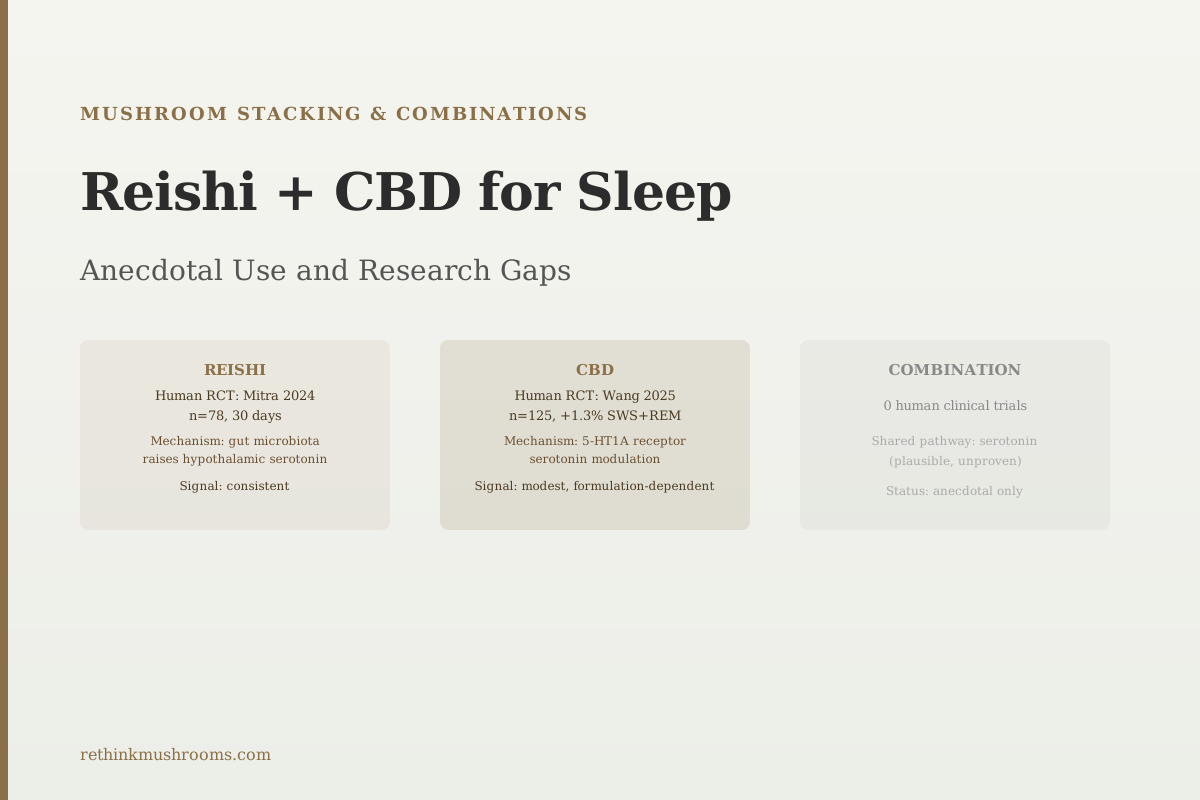
78 participants
In 78 female college students, 30 days of reishi supplementation significantly improved anxiety, depression, and sleep quality vs. placebo, the clearest human trial data yet for reishi as a sleep and stress aid.
Mitra et al., Int J Med Mushrooms, 2024
n=125
participants in the Wang 2025 CBD+terpene sleep RCT: 1.3 percentage points more SWS+REM vs. placebo (P=0.03)
0
human clinical trials have tested reishi and CBD together for sleep
Serotonin
the shared downstream pathway: reishi raises it via gut microbiota; CBD modulates it at the 5-HT1A receptor
Mitra et al., Int J Med Mushrooms, 2024
 View as image ↗
Reishi mushroom and CBD are both sold as sleep aids, often in the same product. Both have genuine human trial data showing effects on sleep and anxiety. What they do not have is a single published clinical trial testing the combination. That gap matters for understanding what the "reishi CBD sleep" category of products is and is not built on.
This article maps the reishi sleep evidence, the CBD sleep evidence, and the honest state of the combination. For the broader context on how functional mushrooms and CBD interact biochemically, see Combining Medicinal Mushrooms: The Ultimate Stacking Guide.
Key Takeaways
- Reishi promotes sleep via gut microbiota remodeling that raises serotonin levels in the brain's sleep-regulating center; this mechanism was documented in animal models (Yao et al., Scientific Reports, 2021)
- A 30-day RCT (n=78) found daily reishi supplementation significantly improved validated anxiety, depression, and sleep quality scores vs. placebo at 1,000mg per day (Mitra et al., Int J Med Mushrooms, 2024)
- CBD combined with a terpene formulation increased slow-wave and REM sleep by 1.3 percentage points vs. placebo in 125 adults with insomnia (P=0.03); plain CBD at 150mg improved sleep efficiency in a pilot study but primarily through psychological rather than direct hypnotic effects (Wang et al., JCSM, 2025; Narayan et al., JCSM, 2024)
- Reishi and CBD share serotonin 5-HT1A as a downstream target: reishi increases serotonin availability; CBD modulates the serotonin receptor directly; this convergence makes combination plausibility scientifically coherent
- No human clinical trial has tested reishi and CBD together for sleep; all combination claims are currently extrapolated from each ingredient's separate evidence base
- Poria cocos, a related medicinal mushroom, enhances sleep through GABA modulation (the same calming pathway that CBD acts through), adding a second convergence point beyond serotonin (Shah et al., Biomolecules & Therapeutics, 2014)
The Evidence at a Glance: Reishi, CBD, and the Combination Compared
| Reishi | CBD | Reishi + CBD | |
|---|---|---|---|
| Human RCTs for sleep/anxiety | Mitra 2024 (n=78, 30 days, sig. improvement) | Wang 2025 (n=125, +1.3% SWS+REM); Narayan 2024 (n=30, improved efficiency) | None (no published trials) |
| Animal/preclinical models | Yao 2021 (gut microbiota → serotonin); Socala 2015 (anxiolytic in mice) | NLRP3 inhibition, CB2 receptor, GABAA modulation | Not tested |
| Primary mechanism | Gut microbiota remodeling → hypothalamic serotonin | 5-HT1A partial agonism + NLRP3 inhibition | Shared serotonin target; GABA overlap; theoretical synergy |
| Evidence ceiling | Clinical signal in small RCT + strong preclinical | Clinical signal in small-to-moderate RCTs | Anecdotal only |
This table captures the honest position. Each ingredient has something. The combination category is, so far, empty.
How Reishi Promotes Sleep: The Gut Microbiota Pathway Researchers Identified
The popular explanation for reishi's sleep effect focuses on its calming, adaptogenic properties. The more specific answer comes from a 2021 mouse study in Scientific Reports.
Yao and colleagues administered reishi to mice and then tracked what happened in two places simultaneously: the gut and the hypothalamus, the brain region that governs sleep-wake cycles.[1] Reishi changed the composition of the microbial community in the gut. That shift in the gut microbiome produced a downstream rise in serotonin levels in the hypothalamus. More serotonin in the hypothalamus is associated with longer and deeper sleep.
Serotonin is the brain's mood and sleep regulator. When the body converts serotonin into melatonin, it prepares for sleep. Reishi appears to increase the serotonin pool the hypothalamus works with.
The study also found that disrupting the gut microbiome with antibiotics blocked reishi's sleep-promoting effect entirely. That is how researchers confirmed the mechanism: the gut bacteria are not a side effect of reishi. They are the mechanism.
This is a mouse study. The gut microbiota pathway is not yet confirmed in humans. But it is a specific, testable mechanism (not a vague "adaptogenic" effect), and it points directly at the same serotonin system that CBD and other sleep interventions act on.
Earlier animal work showed that reishi extract produced dose-dependent reductions in anxiety and depression-like behaviors in standard mouse tests, including the forced swim test and the elevated plus maze.[3] The anxiolytic effect appears to be a species-wide property, not specific to one preparation.
Reishi in Human Trials: Consistent Signals Across Two Different Populations
Moving from mice to humans, the pattern holds. Two different RCTs, in two very different populations, show similar results.
Mitra and colleagues ran a 30-day double-blind trial with 78 female college students, giving half the group 1,000mg of reishi daily and half a placebo.[2] The reishi group showed significant improvements on validated scales for anxiety, depression, vitality, and positive well-being. Sleep quality was among the outcomes that improved.
The study population was healthy young adults under academic stress, not patients with diagnosed sleep disorders. That is important context. Reishi appeared to benefit sleep and stress in a non-clinical population, which suggests the effect is not limited to people with severe sleep pathology.
The second human trial tested a different population entirely. Pazzi and colleagues gave reishi to women with fibromyalgia (a chronic pain condition that consistently disrupts mood and sleep) and measured quality of life outcomes in a randomized controlled design.[9] The reishi group showed improved mood and health-related quality of life compared to placebo.
Two RCTs, one in healthy stressed students and one in women with chronic pain, both pointing in the same direction. The signals are consistent. The sample sizes are small. The absolute effect sizes are not reported with enough detail in the brief to make firm claims about magnitude. What the data shows is that reishi produces measurable improvements in anxiety and mood in people across a range of stress burdens, and that sleep improves as a downstream result.
CBD for Sleep: Why the Formulation Matters More Than the Dose Alone
CBD's sleep evidence is more developed and more complicated. Two 2024-2025 trials illustrate the complexity.
Wang and colleagues ran the larger, more rigorous of the two: a double-blind, placebo-controlled, randomized crossover trial in 125 adults with insomnia.[5] Participants received either CBD 300mg combined with a terpene formulation, or placebo. The combination increased the proportion of time spent in slow-wave and REM sleep by 1.3 percentage points compared to placebo. The difference was statistically significant at P=0.03.
That result is modest in absolute terms. A 1.3-point increase in slow-wave and REM sleep may not produce a dramatic change in how someone feels the next morning. But it is real, it is statistically significant, and it came from a formulation that included specific terpenes alongside the CBD.
Narayan and colleagues ran the smaller of the two trials: a pilot RCT of 30 participants with moderate-to-severe insomnia who received 150mg of CBD nightly for two weeks.[4] CBD improved sleep efficiency and general well-being compared to placebo. But most objective sleep metrics (the readings from sleep monitors) were similar in both groups. Narayan's conclusion was that CBD's sleep benefit operated more through psychological mechanisms than direct hypnotic effects on sleep architecture.
Taken together, these two trials suggest something practical: CBD at a typical consumer dose may improve how people subjectively experience sleep without dramatically altering the underlying sleep architecture. When combined with terpenes that modulate the endocannabinoid and serotonin systems, the effect on measurable sleep stages becomes stronger. The combination formula matters.
Terpenes like linalool and beta-caryophyllene enhance CBD's anxiolytic effects by modulating both the endocannabinoid system and the serotonin 5-HT1A receptor.[7] This is why the Wang 2025 formulation outperformed what a plain CBD trial at similar doses would likely produce. For the full story on how terpene-cannabinoid combinations work, see The Entourage Effect: Mushrooms and Cannabinoids.
The Shared Serotonin Connection: Why the Combination Has Biological Plausibility
The interesting thing about laying the reishi and CBD evidence side by side is where the mechanisms converge.
Reishi promotes sleep, at least in animal models, by raising serotonin availability in the hypothalamus.[1] CBD reduces anxiety and promotes sleep partly by activating the 5-HT1A serotonin receptor in the brain.[7] The 5-HT1A receptor is one of the brain's main serotonin targets. Reishi makes more serotonin available. CBD activates the receptor that serotonin binds to.
This means both compounds arrive at the same downstream destination, but from different entry points. One increases the signal. The other makes the receiver more sensitive. Whether those two effects add up, stack multiplicatively, or one simply saturates what the other already achieves is not known. That is the combination research question that has not been answered.
The Ferber 2020 review established this serotonin pathway as central to how terpenes enhance CBD's anxiolytic effects in the cannabis context.[7] The logic that a compound acting on the same pathway from the mushroom side could produce synergy is coherent. But the logic of converging on a shared pathway does not guarantee additive effects in humans. It is a hypothesis, not a finding.
For the mechanistic detail on how reishi's anti-inflammatory compounds interact with CBD's shared NF-kB pathway, see Mushrooms and CBD: Can They Work Together?.
Two More Mushrooms That Matter for Sleep: Lion's Mane and Poria
Reishi is not the only mushroom in this conversation. Two others appear in the evidence base for sleep and anxiety in ways that add relevant context.
Lion's Mane improved mood and sleep in overweight patients in a cohort study, via a mechanism that has nothing to do with serotonin.[6] Vigna and colleagues found that Lion's Mane elevated BDNF, a protein that supports brain cell growth and repair. BDNF is associated with improved resilience to stress and better mood regulation. Lion's Mane appears to improve sleep by improving the brain's underlying stress tolerance, not by directly sedating.
That is a separate pathway from both reishi and CBD. If reishi, CBD, and Lion's Mane were combined, they would theoretically target sleep via three distinct mechanisms simultaneously: serotonin availability (reishi), serotonin receptor activation (CBD), and BDNF-mediated stress resilience (Lion's Mane). The compounding of independent mechanisms could matter or could produce diminishing returns. It has not been tested.
Poria cocos, a mushroom long used in traditional Chinese medicine for calming effects, adds a fourth candidate mechanism. A compound derived from Poria called pachymic acid makes the brain's main calming system work more effectively.[8] That calming system is GABA. Sleep medications like benzodiazepines work by enhancing GABA activity. Pachymic acid appears to do something similar through a different biochemical route.
CBD also acts on the anxiety-GABA axis, through indirect mechanisms involving the endocannabinoid system. Poria's direct GABA enhancement and CBD's indirect GABA-adjacent effects represent a second potential convergence point alongside serotonin.
For the Poria evidence on anxiety specifically, see Poria for Anxiety: Calming Effects in Traditional Medicine.
Zero Combination Trials: The Honest State of the Research
No published human clinical trial has tested reishi and CBD together for sleep. This includes every combination product on the market; all of them are built on extrapolation from the individual ingredient evidence, not tested combination effects.
That is not unusual in supplement research. The individual ingredient evidence often develops years or decades before anyone funds a combination trial. The market for products outpaces the research infrastructure every time.
What does exist is a coherent mechanistic argument: reishi and CBD converge on serotonin from different directions, and both have individual RCT signals for anxiety and sleep. That argues for the combination being worth studying, not for the combination being proven.
The absence of combination data also means the dose question has no answer. How much reishi and how much CBD to use together, whether the timing relative to sleep matters, whether one ingredient's presence changes the other's pharmacokinetics; none of these questions have been tested.
What the Mitra 2024 trial used for reishi was 1,000mg daily for 30 days.[2] The Wang 2025 trial used 300mg CBD with a terpene formulation.[5] These are the individual dose parameters from the best-available trials. Whether they translate to combination use is not established.
For a broader look at how mushroom combinations are typically evaluated for safety, see Which Mushrooms Work Best Together? Synergy Research. For the practical timing question on reishi specifically, see How Long Does Reishi Take to Improve Sleep?.
The Bottom Line
Reishi and CBD both have genuine human RCT data supporting effects on sleep and anxiety when used separately. Reishi promotes sleep via a gut microbiota pathway that raises serotonin; CBD modulates the serotonin receptor directly. The shared downstream target makes combination plausibility scientifically coherent. But no human trial has tested the combination. Every reishi-CBD sleep product on the market is built on inference from individual ingredient research, not combination data.
Frequently Asked Questions
Sources & References
- 1. Source details for this reference are not yet available.
- 2. Source details for this reference are not yet available.
- 3. Source details for this reference are not yet available.
- 4. Source details for this reference are not yet available.
- 5. Source details for this reference are not yet available.
- 6. Source details for this reference are not yet available.
- 7. Source details for this reference are not yet available.
- 8. Source details for this reference are not yet available.
- 9. Source details for this reference are not yet available.