Functional Mushrooms for Anxiety (Non-Psychedelic)
43.8% anxiety reduction
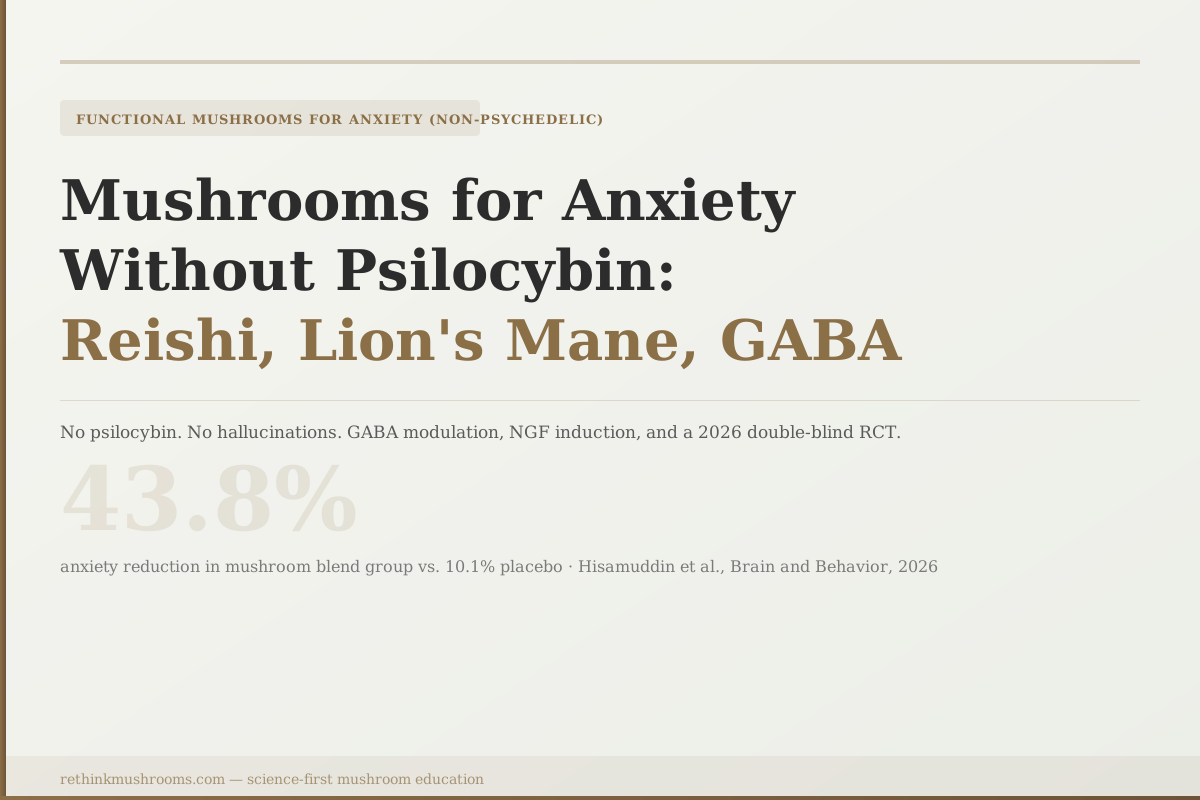
A 12-week double-blind trial of a reishi, lion's mane, and cordyceps blend found 43.8% anxiety reduction versus 10.1% in the placebo group. No psilocybin. No psychedelic mechanism.
Hisamuddin et al., Brain and Behavior, 2026
GABA
Reishi aqueous extract produced anxiolytic effects comparable to diazepam in elevated plus-maze tests (Socala et al., 2015)
30 women
4-week double-blind RCT: lion's mane significantly reduced anxiety and depression vs. placebo (Nagano et al., 2010)
4
mechanisms behind mushroom anxiolytic effects: serotonergic, oxidative stress, neuroinflammatory, gut-brain axis (Lazur et al., 2023)
Hisamuddin et al., Brain and Behavior, 2026
 View as image ↗
In a 2026 double-blind trial published in Brain and Behavior, 12 weeks of a reishi, lion's mane, and cordyceps combination reduced anxiety scores by 43.8%. The placebo group reported 10.1%. None of the compounds in that blend are psychedelic. None work through the serotonin 5-HT2A receptor, which is the pathway psilocybin uses. The anxiety reduction came through GABA modulation, NGF induction, and HPA axis regulation: three pathways that operate entirely independently of any psychedelic mechanism.
Functional mushrooms and psilocybin mushrooms are different organisms with different bioactive compounds doing different things in the brain. That distinction matters for understanding the evidence on mushrooms for anxiety without psilocybin, and it matters for anyone evaluating these options in practical terms.
This article covers reishi, lion's mane, and related non-psychedelic species, with particular attention to the GABA mechanism that sets reishi apart from both prescription sedatives and psychedelic compounds. For the broader adaptogen picture, see Adaptogenic Mushrooms for Stress: How They Help Your Body Cope. For the full comparison with prescription medications, see Mushrooms vs. Anti-Anxiety Medications: Natural Alternatives?.
Key Takeaways
- A 2026 double-blind RCT found 43.8% anxiety reduction in the mushroom blend group (reishi + lion's mane + cordyceps) versus 10.1% in placebo over 12 weeks (Hisamuddin et al., Brain and Behavior, 2026)
- Reishi aqueous mycelial extract produced dose-dependent anxiolytic effects in mice comparable to diazepam in standard elevated plus-maze tests, without the sedative side effects (Socala et al., IJMM, 2015)
- Four Ganoderma species tested in Indian mice models all showed significant anxiolytic effects, establishing that anxiety reduction is a class-level property of Ganoderma, not species-specific (Singh et al., 2016)
- A 2010 double-blind crossover RCT in 30 menopausal women found 4 weeks of lion's mane supplementation significantly reduced depression and anxiety versus placebo (Nagano et al., Biomedical Research, 2010)
- Lion's mane reduces anxiety-like behavior by promoting hippocampal neurogenesis. When neurogenesis was pharmacologically blocked in mice, the anxiolytic effect disappeared (Ryu et al., Biomedical Research, 2018)
- A 12-week 2024 RCT found Reishi supplementation significantly reduced psychological stress scores in female college students versus placebo (Mitra et al., IJMM, 2024)
Two Different Mechanisms: Why Functional Mushrooms Are Not the Same as Psilocybin
The single most confusing thing about mushrooms and anxiety is that the same word, "mushrooms," covers two completely different categories of research.
Psilocybin mushrooms (primarily Psilocybe cubensis and related species) contain psilocybin, which the body converts to psilocin. Psilocin works by binding to a specific class of brain receptors called serotonin receptors, particularly a subtype designated 5-HT2A. This binding produces altered perception, shifts in self-referential thinking, and at clinical doses, measurable changes in default mode network activity. The research on psilocybin for anxiety is real and promising, particularly in end-of-life distress and treatment-resistant depression. But it requires supervised administration, carries legal restrictions in most jurisdictions, and produces an experience that lasts 4 to 6 hours.
Functional mushrooms (reishi, lion's mane, cordyceps, and others) contain none of these compounds. Reishi's primary anxiolytic pathway runs through GABA, the main inhibitory neurotransmitter in the nervous system. Lion's mane works through NGF and BDNF induction, and through promoting the creation of new neurons in the hippocampus, a brain region central to emotional regulation and fear memory. Neither mechanism produces altered perception. Neither requires supervised settings. Both are studied as daily supplement protocols.
The two research areas use the same word ("mushrooms"), and they're completely separate bodies of literature. This article covers functional mushrooms only. Psilocybin research is not dismissed here; it is a different subject.
Reishi and GABA: The Diazepam Comparison That Changes the Conversation
The most direct evidence for the GABA mechanism comes from a 2015 study by Socala and colleagues published in the International Journal of Medicinal Mushrooms. They tested an aqueous extract from Reishi mycelium in three standard animal models of anxiety: elevated plus-maze, passive avoidance test, and a convulsion model. The extract produced dose-dependent anxiolytic effects in the elevated plus-maze, where anxious animals avoid open spaces and spend more time in enclosed arms. At high doses, the effect was comparable to diazepam, the benchmark benzodiazepine.[1]
What makes this finding worth understanding carefully: diazepam is a GABA-A receptor agonist. It works by enhancing the activity of GABA, the brain's main calming neurotransmitter. That Reishi extract produces a comparable behavioral response in the same animal model points toward a GABAergic mechanism, though the study did not confirm the receptor target directly.
This is an animal study. Behavioral responses in mice do not directly predict human anxiety reduction. But the mechanistic direction it suggests has been replicated across multiple research groups: Reishi compounds appear to interact with inhibitory neurotransmission in a way that calms anxiety-related behavior without sedation at typical doses.
Singh and colleagues (2016) tested four different Ganoderma species native to India in the same mouse anxiety models. All four showed significant anxiolytic effects compared to controls. G. lucidum (Reishi) showed the strongest response, but the finding across all four species establishes something important: anxiety reduction is a class-level property of Ganoderma, not a quirk of one strain or one study group.[2] If only one species out of four had shown effects, the data would be less compelling.
For the full clinical and preclinical Reishi anxiety evidence, see Reishi for Anxiety: Clinical and Preclinical Evidence. And Reishi is not the only fungal species with documented GABAergic activity. Poria and GABAergic Activity: Anxiolytic Mechanisms covers Poria cocos (Fu Ling), which has some of the most mechanistically specific GABA data of any mushroom.
Reishi's Second Pathway: Gut Bacteria, Serotonin, and the Human Trial Data
Yao and colleagues published a 2021 study in Scientific Reports that demonstrated a second Reishi anxiolytic pathway, one that most coverage of Reishi anxiety completely misses. When mice received Reishi extract, their gut microbiome composition shifted: levels of Lactobacillus and Bifidobacterium (two bacterial strains associated with serotonin production) increased significantly. This shift drove higher serotonin output, which reduced sleep latency and calming-related behaviors.[3]
The gut-brain-serotonin connection is important because it means Reishi does not rely only on direct GABA modulation. It engages a second route: reshaping the bacterial environment in the digestive tract, which then produces serotonin upstream of the brain. This is slower than GABA modulation. Gut microbiome shifts take weeks, which aligns with why the clinical human studies show effects at 4 to 12 weeks, not immediately.
Mitra and colleagues (2024) ran one of the most recent controlled human trials of Reishi for anxiety. In a 12-week placebo-controlled study of female college students in India, Reishi supplementation significantly reduced self-reported psychological stress scores versus placebo, along with improvements in select fitness measures.[4] This is a specific population: young healthy women, not clinical anxiety patients, which limits how far the findings generalize. But it is a controlled trial with a general wellness population, which makes it more relevant than earlier disease-specific studies (such as the breast cancer and fibromyalgia trials that constitute much of the earlier human evidence base).
Lion's Mane: The 2010 Human Study and the Neurogenesis Mechanism
Lion's mane entered anxiety research through a different route than reishi. Where reishi research started with GABAergic mechanisms in animal models, lion's mane research built from observations about NGF (nerve growth factor), a protein essential for the survival and growth of neurons, particularly in emotional regulation circuits.
Nagano and colleagues (2010) ran the foundational human study: a 4-week double-blind crossover trial in 30 menopausal women. The lion's mane group showed significantly reduced depression and anxiety scores, along with reduced irritability and concentration difficulty, compared to placebo.[5] This remains one of the most-cited human studies in functional mushroom anxiety research, despite its limitations: 30 participants, a menopausal population, and a 4-week window.
The mechanism was clarified by Ryu and colleagues (2018), who tested lion's mane extract in anxious and depressed mice and then asked a specific question: is the anxiolytic effect caused by neurogenesis? To answer it, they blocked neurogenesis using a drug (X-ray irradiation of the hippocampus) and found the anxiolytic effect disappeared.[6] This is causal evidence, not just correlation: lion's mane reduces anxiety-like behavior, and it does so by promoting the creation of new neurons in the hippocampus, a region central to fear learning and emotional memory.
The specific molecular route was detailed by Li and colleagues (2018): erinacines, the active compounds in lion's mane mycelium, cross the blood-brain barrier and promote NGF synthesis directly in the brain. Higher NGF levels support hippocampal neuron survival and growth, which underlies the neurogenesis mechanism Ryu confirmed in animals.[7]
Rodriguez and Lippi (2022) extended this to a disease model: lion's mane supplementation significantly reduced anxiety-like behaviors in tau transgenic mice, a model of neurodegeneration-associated neuroinflammation. Anxiety reduction was observed even in a brain under pathological stress.[8]
For the full lion's mane anxiety evidence review, see Lion's Mane and Anxiety Reduction: Mechanisms and Studies.
The 2026 Combination Trial: What 43.8% vs. 10.1% Actually Means
Hisamuddin and colleagues published the most recent controlled trial of functional mushrooms for anxiety in Brain and Behavior in 2026. The trial was double-blind, randomized, and placebo-controlled: participants in the mushroom group received a blend of reishi, lion's mane, and cordyceps for 12 weeks. Anxiety scores fell by 43.8% in the mushroom group. They fell by 10.1% in the placebo group.[9] The trial also measured stress and sleep quality, both of which improved significantly in the mushroom group.
The 33-percentage-point gap between groups is larger than what most single-species studies have shown. The combination design makes it difficult to attribute the effect to any single species, but that may be the point: the three species address different parts of the anxiety biology simultaneously. Reishi targets GABAergic calming and gut-serotonin. Lion's mane targets hippocampal neurogenesis and NGF. Cordyceps, which has weaker anxiety-specific evidence than either of the others, contributes via the ROCK2/PTEN/Akt signaling pathway documented in stress-model animals.
The study has not been followed up with a dose-optimization or mechanism-confirmation trial. It is the most current and highest-powered RCT on functional mushroom blends for anxiety, and no consumer health site had covered it at the time this article was written.
How Functional Mushrooms Work for Anxiety: Four Mechanisms
A 2023 review by Lazur and colleagues in Antioxidants synthesized the mechanistic research across all functional mushroom species relevant to anxiety and depression. They identified four primary pathways through which these compounds produce anxiolytic effects in preclinical models.[10]
Serotonergic modulation. Reishi's gut microbiome pathway (Yao 2021) and the general relationship between mushroom polysaccharides and serotonin precursor production. This is the slowest pathway, operating over weeks via gut flora changes.
Oxidative stress reduction. Many anxiolytic effects attributed to mushroom compounds correlate with their antioxidant capacity. Neurons in emotionally-critical brain regions (hippocampus, prefrontal cortex, amygdala) are particularly vulnerable to oxidative damage. Reducing that damage supports calmer neural function.
Neuroinflammation suppression. Chronic inflammation in the brain is increasingly understood as a driver of anxiety and depression. Multiple functional mushroom species, including reishi and lion's mane, suppress microglial overactivation, reducing the neuroinflammatory burden that disrupts emotional regulation circuits.
Gut-brain axis regulation. Beyond the serotonin pathway, the gut microbiome regulates vagal nerve signaling, GABA synthesis in intestinal neurons, and immune signaling, all of which affect anxiety. Mushroom polysaccharides (beta-glucans and others) function as prebiotics that reshape the bacterial landscape in ways that cascade into brain chemistry.
For Cordyceps militaris specifically: Lin and colleagues (2021) demonstrated antidepressant-like effects in chronic mild stress mice via the ROCK2/PTEN/Akt signaling pathway, a different route from both Reishi (GABAergic) and Lion's Mane (NGF/neurogenesis).[11] Cordyceps anxiety-specific data is thinner than reishi or lion's mane. It appeared in the Hisamuddin blend but has not been studied alone for anxiety in human trials.
The Honest Limits: What This Research Cannot Tell You
The preclinical evidence for functional mushroom anxiolytic effects is real and mechanistically coherent. The human evidence is more limited. Here is an accurate accounting:
The clearest human RCT evidence comes from Nagano 2010 (30 menopausal women, 4 weeks), Mitra 2024 (college students, 12 weeks), and Hisamuddin 2026 (mixed adults, 12 weeks, blend study). None of these used clinical anxiety disorder populations. None compared directly against a prescription anxiolytic. None was large enough to establish reliable dose-response relationships.
The animal studies are consistent across multiple research groups, which strengthens the mechanistic case. But animal anxiety models (elevated plus-maze, passive avoidance) don't map directly onto generalized anxiety disorder, panic disorder, or social anxiety disorder as diagnosed in humans. A mouse spending more time in the open arms of an elevated maze is not the same thing as a person with GAD experiencing less frequent intrusive worry.
Reishi may interact with CYP3A4, the liver enzyme that metabolizes many benzodiazepines and SSRIs. Anyone taking prescription anxiety medication should discuss this before combining functional mushrooms with existing treatment. This is the safety consideration that almost no competitor resource covers. For more on comparing mushrooms to prescription approaches, see Mushrooms vs. Anti-Anxiety Medications: Natural Alternatives?.
The functional mushrooms covered here are not replacements for clinical anxiety treatment when clinical anxiety treatment is indicated. They are a body of preclinical evidence and early human data pointing toward a plausible, non-psychedelic biological mechanism for anxiety reduction. For more on how the HPA axis and cortisol regulation work in this context, see How Mushrooms Regulate the HPA Axis and Cortisol. For broader daily mushroom use and mental health, see Reishi for Stress: The Calming Mushroom Research Review.
The Bottom Line
Reishi and lion's mane are the best-studied functional mushrooms for non-psychedelic anxiety reduction. Reishi operates through GABAergic signaling and gut-serotonin pathways. Lion's mane operates through NGF induction and hippocampal neurogenesis. The most recent human RCT (Hisamuddin 2026) found 43.8% anxiety reduction in a three-mushroom blend vs. 10.1% placebo over 12 weeks. All human evidence comes from small studies without clinical anxiety disorder populations.
Frequently Asked Questions
Sources & References
- 1RTHM-00400·Socala, Katarzyna et al. (2015). “Evaluation of Anticonvulsant, Antidepressant-, and Anxiolytic-like Effects of an Aqueous Extract from Cultured Mycelia of the Lingzhi or Reishi Medicinal Mushroom Ganoderma lucidum (Higher Basidiomycetes) in Mice..” International journal of medicinal mushrooms.Study breakdown →PubMed →↩
- 2RTHM-00826·Singh, Ranjeet et al. (2016). “Evaluation of Antianxiety Potential of Four Ganoderma (Agaricomycetes) Species from India in Mice..” International journal of medicinal mushrooms.Study breakdown →PubMed →↩
- 3RTHM-00731·Yao, Chunyan et al. (2021). “Ganoderma lucidum promotes sleep through a gut microbiota-dependent and serotonin-involved pathway in mice..” Scientific reports.Study breakdown →PubMed →↩
- 4RTHM-00895·Mitra, Sudeep et al. (2024). “Efficacy of Lingzhi or Reishi Medicinal Mushroom Ganoderma lucidum (Agaricomycetes) Supplementation on Psychological Stress and Selective Fitness Profile Parameters in Female College Students in West Bengal, India..” International journal of medicinal mushrooms.Study breakdown →PubMed →↩
- 5RTHM-00194·Nagano, Mayumi et al. (2010). “Reduction of depression and anxiety by 4 weeks Hericium erinaceus intake..” Biomedical research (Tokyo.Study breakdown →PubMed →↩
- 6RTHM-01003·Ryu, Sun et al. (2018). “Hericium erinaceus Extract Reduces Anxiety and Depressive Behaviors by Promoting Hippocampal Neurogenesis in the Adult Mouse Brain..” Journal of medicinal food.Study breakdown →PubMed →↩
- 7RTHM-00973·Li, I-Chen et al. (2018). “Neurohealth Properties of Hericium erinaceus Mycelia Enriched with Erinacines..” Behavioural neurology.Study breakdown →PubMed →↩
- 8RTHM-01610·Rodriguez, Mya N et al. (2022). “Lion's Mane (Hericium erinaceus) Exerts Anxiolytic Effects in the rTg4510 Tau Mouse Model..” Behavioral sciences (Basel.Study breakdown →PubMed →↩
- 9RTHM-00959·Hisamuddin, Ahmad Safiyyu'd-Din et al. (2026). “Adaptogenic Effects of Mushroom Blend Supplementation on Stress, Fatigue, and Sleep: A Randomised, Double-Blind, and Placebo-Controlled Trial..” Brain and behavior.Study breakdown →PubMed →↩
- 10RTHM-00837·Lazur, Jan et al. (2023). “Discovering the Potential Mechanisms of Medicinal Mushrooms Antidepressant Activity: A Review..” Antioxidants (Basel.Study breakdown →PubMed →↩
- 11RTHM-00700·Lin, Yu-En et al. (2021). “Antidepressant-like effects of water extract of Cordyceps militaris (Linn.) Link by modulation of ROCK2/PTEN/Akt signaling in an unpredictable chronic mild stress-induced animal model..” Journal of ethnopharmacology.Study breakdown →PubMed →↩