Mushrooms & Mental Health
43.8% anxiety reduction
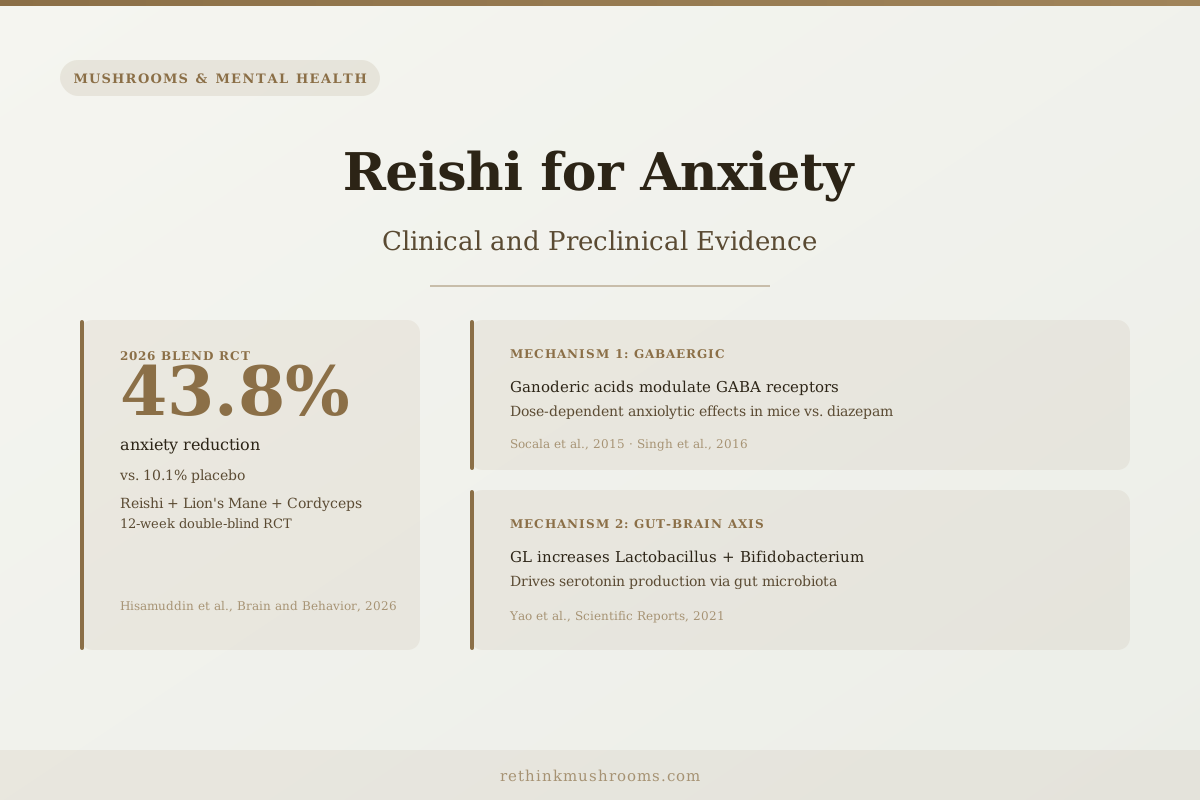
A 2026 double-blind RCT found a Reishi + Lion's Mane + Cordyceps blend produced a 43.8% reduction in anxiety scores over 12 weeks, compared to 10.1% in the placebo group; this is the strongest human trial evidence for functional mushrooms in anxiety to date.
Hisamuddin et al., Brain and Behavior, 2026
2 mechanisms
GABAergic modulation and gut microbiota-serotonin pathway
12 weeks
duration of Mitra 2024 stress RCT in college students, showing significant reduction
4 species
of Ganoderma all showed significant anxiolytic effects vs. control (Singh 2016)
Hisamuddin et al., Brain and Behavior, 2026
 View as image ↗
The short answer is that reishi shows consistent anxiolytic effects in animal models, two distinct human clinical trials in disease-specific populations, one recent trial in healthy college students, and a role in the strongest functional mushroom blend RCT published to date. The evidence is not large or definitive, but it points in one direction.
What makes reishi's anxiety research more interesting than most supplement research is the mechanism specificity. Reishi doesn't just work through the vague "adaptogen" category. Research has identified two specific pathways: direct GABAergic modulation (the same neurotransmitter system that benzodiazepines act on, through different molecular routes), and an indirect gut-microbiota pathway that drives serotonin synthesis. Most competitor articles cite one of these; neither cites both.
This is a cluster article in the Functional Mushrooms for Anxiety series. For the broader overview of functional mushrooms and anxiety, see functional mushrooms for anxiety: what the research shows. For the pillar on adaptogenic mushrooms and stress, see adaptogenic mushrooms for stress: how they help your body cope.
Key Takeaways
- Mitra et al. (2024) found that 12 weeks of reishi supplementation significantly reduced psychological stress scores in female college students versus placebo; this is the most recent controlled human trial for reishi and stress/anxiety[1]
- Socala et al. (2015) found that reishi aqueous mycelial extract produced dose-dependent anxiolytic effects in mice on elevated plus-maze tests, with effects at high doses comparable to diazepam; this is preclinical evidence, not a clinical comparison[2]
- Yao et al. (2021) identified a second, distinct reishi anxiety mechanism: GL modulates gut microbiota (increasing Lactobacillus and Bifidobacterium), which drives serotonin production and reduces sleep latency in mice; this gut-brain axis pathway is separate from the GABAergic mechanism[4]
- Hisamuddin et al. (2026) published the first double-blind RCT of a mushroom blend for anxiety: Reishi + Lion's Mane + Cordyceps produced a 43.8% anxiety score reduction over 12 weeks versus 10.1% in the placebo group; reishi was one component[7]
- Cha et al. (2024) in Neuroscience and Biobehavioral Reviews concluded that mushroom consumption is associated with improved mood and reduced anxiety across the lifespan, with the strongest evidence for H. erinaceus and G. lucidum specifically[8]
- The three human trials for reishi-specific anxiety effects used disease-specific populations (breast cancer, fibromyalgia) or a general student population; no large general-population RCT has been completed
Does Reishi Help with Anxiety? The Evidence in 50 Words
Reishi (Ganoderma lucidum) may reduce anxiety through two mechanisms: ganoderic acids modulate the GABA neurotransmitter system (the same signaling network that benzodiazepines target), and GL compounds shift gut microbiota composition in ways that increase serotonin production. Most evidence is from animal studies. Three small human trials show anxiety-relevant benefits. One 2026 blend RCT produced a 43.8% anxiety reduction versus 10.1% placebo.
Mechanism 1: The GABAergic Pathway
GABA (gamma-aminobutyric acid) is the brain's primary inhibitory neurotransmitter. It slows neural firing, reduces the brain's overall excitatory activity, and produces calming effects when its receptors are activated. This is the target of benzodiazepines (diazepam, lorazepam, alprazolam), which work by enhancing GABA receptor sensitivity.
Reishi's connection to GABA comes from Socala and colleagues' 2015 study, which tested aqueous mycelial extract of Ganoderma lucidum in mice across multiple behavioral assays for anxiety and depression.[2] The elevated plus-maze is the standard preclinical test for anxiety: anxious animals prefer the closed arms, while anxiolytic compounds shift preference toward the open arms. GL extract produced significant dose-dependent anxiolytic effects compared to control animals. At higher doses, the magnitude of effect was comparable to diazepam in the same assay.
Two things this finding is, and two it is not:
It IS: dose-dependent evidence that GL compounds act on anxiety-relevant neural pathways in mice. It IS: the most mechanistically specific preclinical evidence linking reishi to the GABA system.
It is NOT: a clinical comparison to benzodiazepines in humans. Mouse elevated plus-maze results do not translate directly to human anxiety treatment. It is NOT: a demonstration that reishi acts as a GABA receptor agonist (the specific mechanism may involve ganoderic acid modulation of GABA receptor activity or upstream effects).
Singh and colleagues (2016) extended this finding across four Indian Ganoderma species, all of which produced significant anxiolytic effects compared to control animals in mouse models.[6] G. lucidum showed the strongest effect among the four. This matters because it establishes that anti-anxiety activity is a consistent class-level property of Ganoderma, not an artifact of one specific strain or preparation.
For more on how reishi's GABA-related effects compare to those of Poria, another mushroom with well-documented GABAergic activity, see Poria and GABAergic activity: anxiolytic mechanisms. For the cortisol and HPA axis side of the story, see how mushrooms regulate the HPA axis and cortisol.
Mechanism 2: The Gut-Serotonin Pathway
The second mechanism is less intuitive but well-documented in the reishi research. Yao and colleagues (2021) investigated how reishi supplementation reduces sleep latency in mice and found the answer was not direct neurological activity but gut microbiota modification.[4]
GL altered the gut microbiome composition: Lactobacillus and Bifidobacterium populations increased significantly. These bacteria are involved in serotonin biosynthesis, as roughly 90% of the body's serotonin is produced in the gut by enterochromaffin cells whose activity is influenced by microbiome composition. The increased microbial activity drove elevated serotonin production, which reduced sleep latency via the gut-brain axis.
Serotonin is also the neurotransmitter most commonly targeted by pharmaceutical anxiety treatments (SSRIs increase serotonin availability at neural synapses). The gut-brain axis pathway is not identical to SSRI action, but it converges on serotonin availability as a common downstream effect.
This means reishi may affect anxiety through two pharmacologically distinct pathways operating simultaneously: direct GABAergic modulation (fast-acting, similar mechanism family to benzodiazepines) and gut microbiota-mediated serotonin production (slower, similar downstream target to antidepressants). No competitor article has presented both mechanisms together.
The gut-brain pathway also explains why sleep improvements and anxiety reductions are often reported together in reishi research. They share a common upstream mechanism in microbiota composition.
The Human Clinical Evidence: Three Reishi Trials
Mitra et al. (2024) is the most recent controlled human trial for reishi and psychological stress.[1] Female college students received reishi supplementation for 12 weeks in a controlled trial design. Psychological stress scores were significantly reduced versus the placebo group. Select fitness parameters also improved. The population is healthy rather than clinically anxious, which gives the finding broader applicability than the disease-specific trials below.
Pazzi et al. (2020) examined the effect of GL supplementation in women with fibromyalgia.[3] Compared to an exercise control, GL improved depression scores, anxiety scores, and health-related quality of life. Fibromyalgia is a condition characterized by chronic pain and significant psychological burden, including anxiety. The finding that reishi improved anxiety in this population is clinically meaningful for that group. The limitation is specificity: fibromyalgia-associated anxiety may respond differently to GL than anxiety in people without chronic pain.
Zhao et al. (2012) remains the earliest controlled human evidence.[5] In 48 breast cancer patients undergoing endocrine therapy, 4 weeks of reishi spore powder significantly reduced fatigue, anxiety, depression, and appetite loss compared to placebo. This was a pilot clinical trial in an oncology population, and disease-specific findings are difficult to generalize to general anxiety. But it established a consistent signal: reishi reduces anxiety-relevant scores in controlled human studies.
Taken together, these three trials represent a consistent direction. None alone would be convincing. Three studies across different populations (healthy students, fibromyalgia, breast cancer patients) all showing the same direction is more compelling than any single trial.
Cha and colleagues' 2024 review in Neuroscience and Biobehavioral Reviews synthesized the mushroom and mental health evidence across the lifespan, concluding that G. lucidum was among the two species with the strongest evidence for mood and anxiety improvement, alongside H. erinaceus.[8] Publishing in the highest-impact journal in behavioral neuroscience brings credibility that supplement brand white papers cannot replicate.
The Blend RCT: The Strongest Human Data
The most compelling human evidence for functional mushrooms and anxiety uses reishi as a component, not in isolation.
Hisamuddin and colleagues' 2026 double-blind, placebo-controlled RCT tested a combination of Reishi, Lion's Mane, and Cordyceps in a 12-week adaptogen trial.[7] The anxiety outcome: 43.8% reduction in anxiety scores in the mushroom group versus 10.1% in the placebo group. The trial also showed significant improvements in stress and sleep quality.
The 43.8% versus 10.1% comparison is striking. A 4-fold greater reduction in anxiety scores than placebo in a double-blind design is a meaningful effect size for a nutritional intervention. Most supplement research does not produce numbers this clean.
The important caveat: the trial used a blend, not reishi alone. The anxiety reduction cannot be attributed exclusively to reishi. Lion's Mane has independent anxiety-relevant evidence (NGF and hippocampal neurogenesis pathways), and Cordyceps has preclinical antidepressant data. The blend effect may be additive, synergistic, or dominated by one component. The study cannot answer this.
The blend RCT result is useful as a statement about what functional mushrooms in combination can do. It is not evidence for what reishi alone produces in human anxiety. The human evidence base specifically for reishi remains the three smaller trials described above.
What "Reishi for Anxiety" Means in Practice
The animal data is consistent across multiple species, multiple labs, and multiple behavioral assays. The human data points in the same direction but is limited in scale and population specificity. Two honest interpretations of the current evidence:
Optimistic reading: Three human trials, a large blend RCT, and robust animal mechanism data suggest reishi genuinely has anxiolytic activity. The GABAergic and gut-serotonin mechanisms are pharmacologically plausible and distinct from each other. The Cha 2024 review from a major neuroscience journal confirms the signal. This is a plant compound worth further investigation.
Conservative reading: The human trials are small, disease-specific populations, or a student sample. None has used clinically defined anxiety (GAD, panic disorder) as the diagnostic criterion. Effect sizes are not established for a general anxious population. No large-scale, clinically powered RCT exists.
Both readings are honest. The evidence is suggestive, not definitive.
Timing, Duration, and the Dosing Question
The PAA questions about timing and dosing deserve honest answers, even where the research is thin.
How long does reishi take to work for anxiety? The Mitra 2024 trial showed effects over 12 weeks. The Zhao 2012 trial showed effects over 4 weeks. The Hisamuddin 2026 blend trial ran 12 weeks. The consistent pattern: effects appear within 4-12 weeks of regular supplementation, not within hours or days. This aligns with mechanisms that require microbiome modification (weeks) or gradual GABAergic adaptation rather than acute receptor binding.
How much reishi should you take for anxiety? The human trials used varying doses. The Zhao 2012 trial used reishi spore powder at a dose derived from traditional protocols. The Mitra 2024 and Pazzi 2020 trials used GL supplementation without specifying dose parameters in the brief data. The Socala 2015 preclinical data showed dose-dependent effects. A dose standard for anxiety specifically does not exist in the clinical trial record.
Does reishi affect cortisol? The HPA (hypothalamic-pituitary-adrenal) axis regulates the body's cortisol stress response. GL compounds modulate HPA axis activity in preclinical models; the Mitra 2024 trial showing reduced "psychological stress" in students likely involves cortisol pathway effects, though the study did not measure cortisol directly. For a dedicated exploration of the HPA axis mechanism, see reishi for stress: the calming mushroom research review.
Can reishi help with panic attacks? No study has specifically tested reishi for panic disorder or panic attacks. The GABAergic mechanism is pharmacologically relevant to panic (benzodiazepines are first-line for acute panic), but the animal and human evidence does not include panic disorder populations.
For the comparison between reishi and Lion's Mane on anxiety mechanisms, the different neural pathways (GABAergic/HPA for reishi vs. NGF/neurogenesis for Lion's Mane) make them potentially complementary rather than interchangeable, see Lion's Mane and anxiety reduction: mechanisms and studies and mushrooms for anxiety without psilocybin: Reishi, Lion's Mane, and GABA research.
The Bottom Line
Reishi's anxiety evidence rests on two specific mechanisms (GABAergic modulation and gut-serotonin production), three small controlled human trials across different populations, and a 2026 blend RCT producing a 43.8% anxiety score reduction. The animal data is consistent and mechanistically detailed. The human data is limited in scale and population specificity. No large general-population RCT for reishi-specific anxiety exists. The signal is real; the evidence ceiling is visible.
Frequently Asked Questions
Sources & References
- 1RTHM-00895·Mitra, Sudeep et al. (2024). “Efficacy of Lingzhi or Reishi Medicinal Mushroom Ganoderma lucidum (Agaricomycetes) Supplementation on Psychological Stress and Selective Fitness Profile Parameters in Female College Students in West Bengal, India..” International journal of medicinal mushrooms.Study breakdown →PubMed →↩
- 2RTHM-00400·Socala, Katarzyna et al. (2015). “Evaluation of Anticonvulsant, Antidepressant-, and Anxiolytic-like Effects of an Aqueous Extract from Cultured Mycelia of the Lingzhi or Reishi Medicinal Mushroom Ganoderma lucidum (Higher Basidiomycetes) in Mice..” International journal of medicinal mushrooms.Study breakdown →PubMed →↩
- 3RTHM-00648·Pazzi, Francesco et al. (2020). “Ganoderma lucidum Effects on Mood and Health-Related Quality of Life in Women with Fibromyalgia..” Healthcare (Basel.Study breakdown →PubMed →↩
- 4RTHM-00731·Yao, Chunyan et al. (2021). “Ganoderma lucidum promotes sleep through a gut microbiota-dependent and serotonin-involved pathway in mice..” Scientific reports.Study breakdown →PubMed →↩
- 5RTHM-00276·Zhao, Hong et al. (2012). “Spore Powder of Ganoderma lucidum Improves Cancer-Related Fatigue in Breast Cancer Patients Undergoing Endocrine Therapy: A Pilot Clinical Trial..” Evidence-based complementary and alternative medicine : eCAM.Study breakdown →PubMed →↩
- 6RTHM-00826·Singh, Ranjeet et al. (2016). “Evaluation of Antianxiety Potential of Four Ganoderma (Agaricomycetes) Species from India in Mice..” International journal of medicinal mushrooms.Study breakdown →PubMed →↩
- 7RTHM-00959·Hisamuddin, Ahmad Safiyyu'd-Din et al. (2026). “Adaptogenic Effects of Mushroom Blend Supplementation on Stress, Fatigue, and Sleep: A Randomised, Double-Blind, and Placebo-Controlled Trial..” Brain and behavior.Study breakdown →PubMed →↩
- 8RTHM-00868·Cha, Sara et al. (2024). “A review of the effects of mushrooms on mood and neurocognitive health across the lifespan..” Neuroscience and biobehavioral reviews.Study breakdown →PubMed →↩