Oyster Mushroom & Cancer
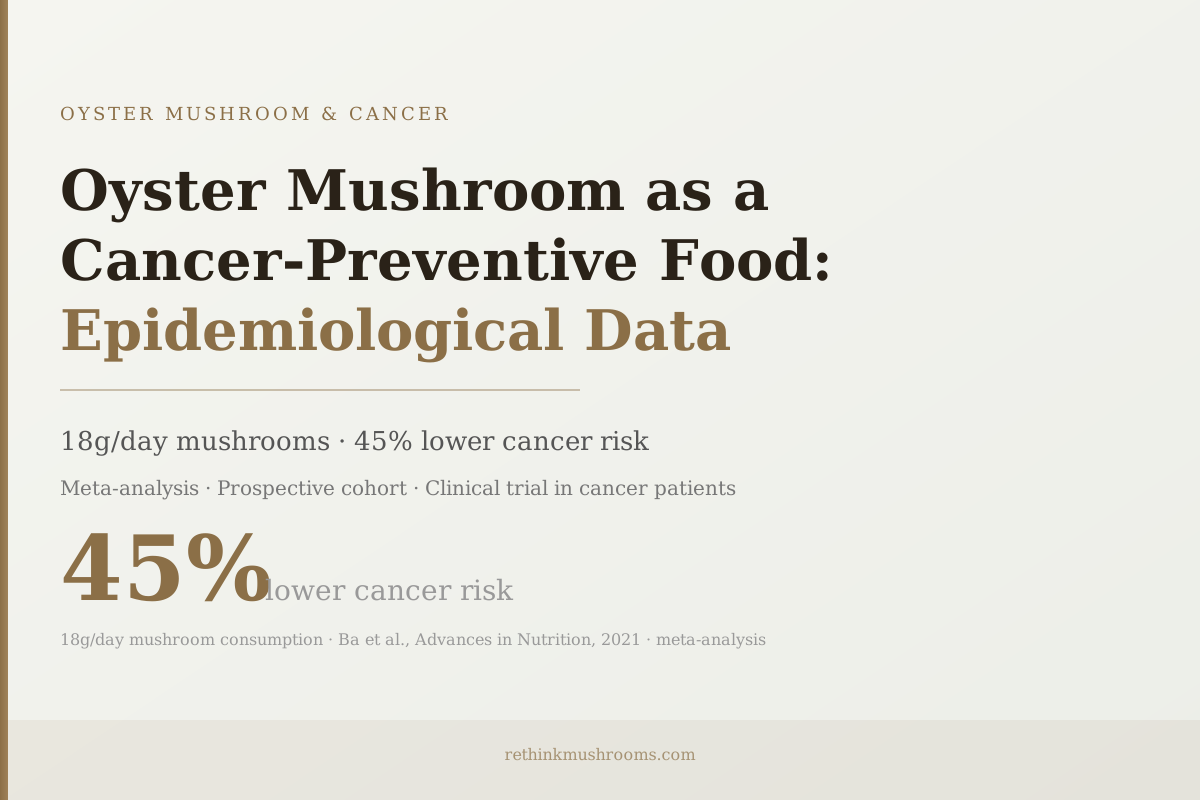
45% lower cancer risk
A 2021 meta-analysis found individuals eating 18 grams of mushrooms daily had 45% lower cancer risk compared to non-consumers, with breast cancer showing the strongest site-specific association. Oyster mushrooms contain among the highest ergothioneine concentrations of any culinary species.
Ba et al., Advances in Nutrition, 2021
18g/day
mushroom amount associated with 45% lower cancer risk, roughly one-eighth of a cup cooked
Ergothioneine
the antioxidant oyster mushrooms concentrate more than most other culinary species
Spacek 2022
the only clinical trial of oyster mushroom extract in cancer patients, showing immune enhancement in breast cancer
Ba et al., Advances in Nutrition, 2021
 View as image ↗
In 2021, a meta-analysis published in Advances in Nutrition pulled together the population data on mushroom consumption and cancer risk and found that people eating 18 grams of mushrooms per day, roughly a small handful or one-eighth of a cup cooked, had 45% lower cancer risk compared to people who ate no mushrooms.[1] That number is striking. It is also observational data, which means it describes an association rather than proving that mushrooms caused the lower risk. Correlation is not causation, and honest epidemiology requires stating that clearly upfront. But a 45% association from a meta-analysis of observational studies is a large enough signal to merit a serious look at what the data shows, what its limitations are, and why oyster mushrooms in particular may be relevant. This article is part of the broader guide to what oyster mushrooms are and why they're studied.
Key Takeaways
- A 2021 meta-analysis of observational studies found 18g/day mushroom consumption associated with 45% lower cancer risk versus non-consumers; breast cancer showed the strongest site-specific association[1]
- Two large U.S. prospective cohort studies (Lee et al., 2019) found an inverse association between mushroom consumption and cancer risk, particularly for breast cancer, adding prospective cohort design strength to the epidemiological base[2]
- Oyster mushrooms are among the richest culinary sources of ergothioneine, the antioxidant hypothesized to underpin much of the population-level cancer risk association in mushroom eaters
- Spacek et al. (2022) ran the only clinical trial of oyster mushroom extract in actual cancer patients: Pleurotus ostreatus beta-glucan significantly enhanced immune parameters in breast cancer patients receiving endocrine therapy[3]
- The epidemiological data is dose-responsive (more mushrooms, lower risk) and consistent across studies, which strengthens the association but still cannot establish causation without randomized trials
- A comprehensive 2025 review positions oyster mushrooms as one of the most evidence-rich species for complementary cancer applications, across both population and laboratory evidence[4]
The 45% Figure: What the Meta-Analysis Actually Measured
Ba and colleagues (2021) conducted a systematic review and meta-analysis of observational studies examining the relationship between mushroom consumption and cancer risk.[1] Their headline finding: individuals eating approximately 18 grams of mushrooms daily had 45% lower cancer risk compared to those who ate no mushrooms.
Population data suggests a dose-dependent relationship between mushroom consumption and lower cancer risk. A 2021 meta-analysis found 18 grams of mushrooms daily (about one-eighth of a cup cooked) associated with 45% lower cancer risk. Oyster mushrooms contain among the highest concentrations of ergothioneine of any culinary species, the antioxidant thought to underpin much of this population-level protection.
A few clarifications on what this number represents:
It is an observational association. The studies in the meta-analysis observed what people ate and what cancers they developed, without randomly assigning mushroom consumption. People who eat more mushrooms may also differ in other ways: diet quality, income, physical activity, healthcare access. The meta-analysis adjusted for confounders where data allowed, but observational studies can never fully rule out unmeasured confounding.
Breast cancer had the strongest association. When the researchers broke the data down by cancer type, breast cancer showed the most statistically robust site-specific association with mushroom consumption. This is consistent with other lines of evidence, including mechanistic research on oyster mushroom and breast cancer cell lines, which is covered in the research on oyster mushroom and breast and colon cancer cells.
The dose is small. Eighteen grams per day is a very modest amount. One small white button mushroom weighs roughly 15-20 grams. The data suggests even small, consistent mushroom consumption is associated with the risk reduction. This makes the epidemiological effect more plausible as a real dietary phenomenon, not an extreme supplemental dose.
It is mushrooms generally, not oyster mushrooms specifically. The meta-analysis did not separate oyster mushrooms from other species. The association applies to mushroom consumption broadly. Why oyster mushrooms may be particularly relevant within that association is addressed in the ergothioneine section below.
The Prospective Cohort Data: Lee 2019
Observational evidence comes in different strengths. A meta-analysis of cross-sectional studies (which assess diet and disease status at a single point in time) is weaker than one incorporating prospective cohort studies, which follow people over time and observe who develops cancer after reporting their baseline diet.
Lee and colleagues (2019) published two large U.S. prospective cohort studies specifically on mushroom consumption and cancer risk.[2] Both cohorts found an inverse association between mushroom consumption and cancer risk, with breast cancer again showing the strongest site-specific signal. Prospective cohort data cannot establish causation, but it is more resistant to recall bias and reverse causation than cross-sectional designs.
The convergence matters: the Ba 2021 meta-analysis finding and the Lee 2019 prospective cohort findings point in the same direction across different study populations, different time periods, and different methodological designs. When multiple study types show consistent associations, the evidence base is more robust than any single study alone.
Why Oyster Mushrooms Specifically? The Ergothioneine Argument
Mushroom consumption broadly is associated with lower cancer risk. Oyster mushrooms are relevant specifically because of ergothioneine.
Ergothioneine is a sulfur-containing amino acid that the human body cannot synthesize. Unlike other antioxidants that the body can produce internally (glutathione, for example) or obtain from many plant foods (vitamin C, E), ergothioneine is almost entirely diet-derived, and mushrooms are the dominant dietary source by a wide margin. The human body maintains a dedicated cellular transporter (OCTN1) specifically for ergothioneine, suggesting it treats the compound as a nutrient of particular importance.
Oyster mushrooms (Pleurotus ostreatus) contain among the highest ergothioneine concentrations of any culinary mushroom species. The concentrations vary by growing conditions and mushroom variety, but oyster mushrooms consistently rank near the top when species are compared for ergothioneine content.
The cancer-protective hypothesis for ergothioneine involves several mechanisms: it reduces oxidative DNA damage (one of the primary causes of oncogenic mutations), it may inhibit certain inflammatory signaling pathways associated with cancer initiation and progression, and its concentration in cells under oxidative stress suggests it plays a protective role precisely where cancer-initiating damage is most likely to occur. The full mechanistic picture for ergothioneine in cancer prevention is covered in ergothioneine in oyster mushrooms: the longevity antioxidant you can eat.
The epidemiological finding that breast cancer has the strongest mushroom-cancer association is consistent with ergothioneine's protective mechanisms: estrogen-driven cancers are associated with elevated oxidative stress in breast tissue, where an antioxidant that specifically accumulates under oxidative stress would theoretically be most protective.
This is a mechanistic hypothesis building on epidemiological data, not proven causation. But it is a coherent biological story connecting the population-level association to a plausible molecular explanation.
The Beta-Glucan Angle: Immune Enhancement in Cancer Patients
The Ba 2021 meta-analysis and Lee 2019 cohort studies address cancer prevention at the population level. Spacek and colleagues (2022) addressed a different question: can oyster mushroom compounds support immune function in people who already have cancer?[3]
Their clinical trial tested beta-glucan derived from Pleurotus ostreatus in patients with endocrine-dependent (hormone receptor positive) breast cancer receiving standard endocrine therapy. The finding: oyster mushroom beta-glucan significantly immunomodulated immune parameters in the cancer patients.
This is the only published clinical trial of oyster mushroom extract in cancer patients. Several important caveats apply:
The study measured immune function, not cancer outcomes. The trial documented changes in immune cell activity and immune system parameters. It did not measure tumor response, disease progression, or survival. Immune enhancement in cancer patients is clinically relevant, but "changed immune parameters" is not the same as "reduced cancer."
The population was receiving standard therapy. All patients were on endocrine therapy for hormone receptor positive breast cancer. The beta-glucan was tested as an adjunct, not as a standalone treatment. The immune enhancement observed was on top of conventional therapy.
It was a single trial. No independent replication has been published. Clinical trials in cancer patients are expensive and difficult to run; a single study is not sufficient to draw strong conclusions.
What Spacek 2022 does establish: oyster mushroom beta-glucan is safe to administer to cancer patients receiving standard therapy, and it produces measurable changes in the immune system in that context. It is the human clinical bridge between laboratory anti-cancer research and real cancer patients, even if it does not yet answer questions about cancer outcomes.
For the broader question of how mushroom polysaccharides activate immune cells relevant to cancer, how mushroom sugars activate cancer-fighting immune cells covers the beta-glucan immune activation mechanisms in depth.
How Epidemiological Evidence Connects to Cancer Biology
The epidemiological findings and the laboratory research on oyster mushroom anti-cancer compounds are separate bodies of evidence that point in a consistent direction.
Population studies show that people who eat more mushrooms, including oyster mushrooms, have lower cancer risk, with the strongest associations for breast cancer. Laboratory studies show that oyster mushroom compounds, including polysaccharides, lectins, ergothioneine, and lovastatin, directly inhibit cancer cell proliferation through multiple mechanisms.
Neither body of evidence alone is sufficient to claim that oyster mushrooms prevent cancer. The epidemiological data shows association, not causation. The laboratory data shows activity in cells, not in humans with cancer. But the convergence of population-level associations and mechanistic biological plausibility is stronger evidence than either alone.
Sreedharan and colleagues published a comprehensive 2025 review positioning oyster mushrooms within the complementary cancer therapy landscape.[4] Their conclusion: Pleurotus ostreatus is among the most evidence-rich mushrooms for cancer-related research, with multiple distinct compound classes demonstrating anti-cancer activity across cell culture, animal model, and (in Spacek 2022) human evidence. They describe the current evidence as supportive of further clinical investigation rather than clinical application.
That framing is accurate. The data justifies continued research and supports including oyster mushrooms in a diet already populated with vegetables, legumes, and other cancer-associated protective foods. It does not support claims that oyster mushrooms treat or prevent cancer at a dose achievable through ordinary dietary intake.
The Dose Question: What 18 Grams per Day Looks Like
The 18 grams per day in the Ba 2021 meta-analysis is the consumption level associated with 45% lower cancer risk. In practical terms:
One medium white button mushroom weighs roughly 15-20 grams. A small handful of raw oyster mushrooms is typically 20-30 grams. One cup of coarsely chopped raw oyster mushroom is approximately 70-80 grams. Mushrooms shrink significantly when cooked due to water loss, so one-eighth of a cup of cooked oyster mushroom is roughly 18 grams.
This is a very achievable dietary amount, not a supplemental dose. Adding a small serving of oyster mushrooms two to three times per week would average to roughly 18 grams per day when spread across a week. The population-level data does not suggest that extraordinary quantities are required for the associated risk reduction.
The consistent daily consumption pattern may matter more than occasional large servings. Ergothioneine accumulates in tissues over time; the cancer-protective benefit of ergothioneine is likely a function of sustained exposure rather than peak concentration.
For the broader context on how daily mushroom consumption relates to cancer risk reduction across species, daily mushroom consumption and cancer risk reduction covers the full epidemiological landscape.
The Bottom Line
A 2021 meta-analysis found 18g/day mushroom consumption associated with 45% lower cancer risk, with breast cancer showing the strongest site-specific association (Ba et al., Advances in Nutrition). Two U.S. prospective cohort studies (Lee et al., 2019) corroborate the finding. Oyster mushrooms are specifically relevant due to high ergothioneine content. The only cancer patient clinical trial (Spacek et al., 2022) found oyster mushroom beta-glucan immunomodulates immune function in breast cancer patients. The association is consistent and biologically plausible; randomized intervention trials on cancer outcomes do not yet exist.
Frequently Asked Questions
Sources & References
- 1RTHM-00671·Ba, Djibril M et al. (2021). “Higher Mushroom Consumption Is Associated with Lower Risk of Cancer: A Systematic Review and Meta-Analysis of Observational Studies..” Advances in nutrition (Bethesda.Study breakdown →PubMed →↩
- 2RTHM-01080·Lee, Dong Hoon et al. (2019). “Mushroom Consumption and Risk of Total and Site-Specific Cancer in Two Large U.S. Prospective Cohorts..” Cancer prevention research (Philadelphia.Study breakdown →PubMed →↩
- 3RTHM-01617·Spacek, Jan et al. (2022). “Immunomodulation with β-glucan from Pleurotus ostreatus in patients with endocrine-dependent breast cancer..” Immunotherapy.Study breakdown →PubMed →↩
- 4RTHM-02186·Sreedharan, Priya Lakshmi et al. (2025). “The Emerging Role of Oyster Mushrooms as a Functional Food for Complementary Cancer Therapy..” Foods (Basel.Study breakdown →PubMed →↩