Oyster Mushroom (Pleurotus ostreatus)
Galactose — the sugar POL recognizes
Perduca et al. (2020) in Glycobiology solved the 3D structure of the oyster mushroom lectin (POL) and characterized its carbohydrate binding using melibiose, confirming galactose-type specificity — and reported that POL has antiproliferative effects against human cancer cell lines. Cancer cells frequently overexpress galactose- and GalNAc-terminated structures (tumor-associated carbohydrate antigens), which is the proposed basis for a galactose-binding lectin engaging tumor cells preferentially.
Perduca et al., Glycobiology, 2020
Antitumor in mice
Wang et al. (2000) isolated the oyster lectin (POL) and found highly potent antihepatoma and antisarcoma activity — POL prolonged survival in mice bearing hepatoma H-22 and sarcoma S-180, the founding activity study
Normal cells spared
Jedinak & Sliva (2008) found an oyster mushroom water extract suppressed MCF-7 and MDA-MB-231 breast cancer cells while leaving normal MCF-10A cells unaffected
No human trials
nearly all evidence is cell culture; Wang (2000) is the one animal study — no human clinical trial of an isolated oyster mushroom lectin extract exists
Perduca et al., Glycobiology, 2020
 View as image ↗
In cancer drug development, targeting is the defining challenge. Conventional chemotherapy kills rapidly dividing cells — which includes tumor cells, but also bone marrow cells, hair follicles, and gut lining cells. The side effects aren't incidental; they're a direct consequence of poor selectivity. The ideal cancer compound would kill tumor cells while leaving normal cells intact.
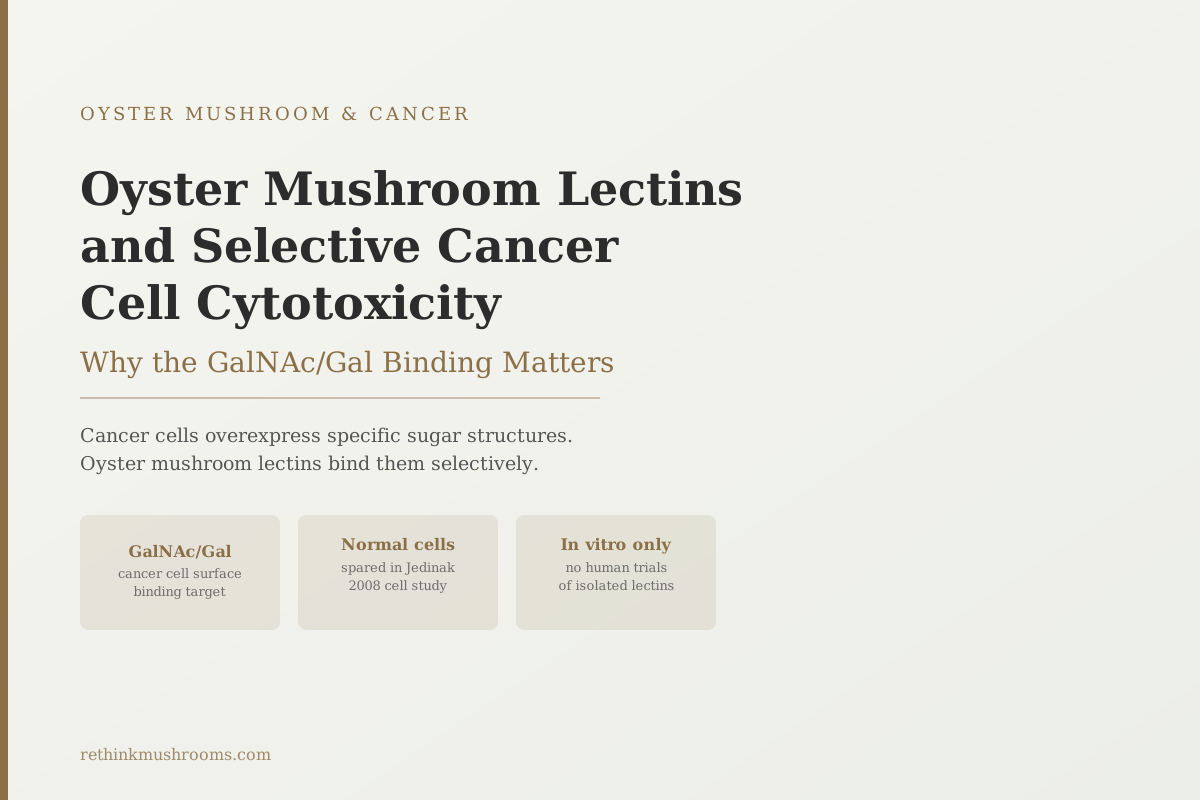
Lectins from oyster mushrooms show signs of selective activity against cancer cells in laboratory experiments. The isolated lectin POL (Pleurotus ostreatus lectin) prolonged survival in mice bearing liver cancer (hepatoma) and sarcoma tumors. Separately, whole oyster mushroom extract suppressed breast and colon cancer cell lines in culture while sparing normal cell lines run in the same experiment. The proposed explanation is structural: oyster mushroom lectins recognize galactose-type carbohydrate patterns, and cancer cells frequently overexpress galactose- and GalNAc-terminated structures on their surfaces compared with normal cells — so a galactose-binding lectin would be expected to engage tumor cells more readily. That mechanistic bridge is reasoned from the binding chemistry, not yet demonstrated directly for POL on cancer-cell glycans.
For the full cancer research overview across compound classes (polysaccharides, lectins, ergothioneine, lovastatin), see oyster mushroom and cancer research. For the complete overview of oyster mushroom biology and health applications, see what is the oyster mushroom?.
Key Takeaways
- Perduca et al. (2020) in Glycobiology solved POL's 3D structure and characterized its carbohydrate binding with melibiose, confirming galactose-type specificity, and reported that POL has antiproliferative effects against human cancer cell lines — providing a structural basis for the proposed selectivity, though the paper did not itself test cancer-versus-normal cell selectivity
- Wang et al. (2000) isolated POL and reported "highly potent antihepatoma and antisarcoma activities" — POL prolonged survival in tumor-bearing mice and its binding was inhibited most strongly by the galactose disaccharide melibiose, establishing both antitumor activity and galactose specificity
- Singh et al. (2020) in a systematic review of mushroom lectins in biomedical research confirmed Pleurotus lectins among the most studied for anti-cancer applications, with documented anticancer, antiviral, antimicrobial, and immunomodulatory activities
- Jedinak and Sliva (2008) demonstrated selectivity functionally with a whole-mushroom water extract (not isolated lectin): it suppressed MCF-7 and MDA-MB-231 breast cancer cells and HT-29 and HCT-116 colon cancer cells without affecting normal MCF-10A breast cells or FHC colon cells
- Oyster mushroom lectins are fundamentally different from "dietary lectins" in foods like raw kidney beans — they bind to different carbohydrate structures, operate at different concentrations, and are not associated with the gut irritation caused by plant lectin overconsumption
- Nearly all evidence is in vitro cell culture; the one animal study is Wang (2000) in tumor-bearing mice, and no human clinical trial has tested an isolated oyster mushroom lectin extract for cancer treatment
The Cancer Cell Recognition Problem
The immune system normally identifies damaged or abnormal cells by their surface molecules. Cancer cells are modified versions of the body's own cells, which means they share most surface proteins with normal tissue. This molecular similarity is why the immune system often fails to recognize early cancer cells as threats — and why many cancer drugs damage normal tissue alongside tumors.
One difference between cancer cells and normal cells, however, is their carbohydrate coat. All mammalian cells display carbohydrate chains on their surface proteins and lipids — these glycan structures serve as a molecular address, used for cell recognition and signaling. During malignant transformation, cancer cells frequently change their surface glycan patterns, overexpressing certain carbohydrate structures that appear at much lower levels on normal cells.
These cancer-associated carbohydrate structures are called tumor-associated carbohydrate antigens, or TACAs. Among the most commonly overexpressed are glycoconjugates terminated with GalNAc (N-acetylgalactosamine) and Gal (galactose) — two types of sugar units that form recognizable patterns on cancer cell surfaces.
Proteins that recognize and bind specific carbohydrate patterns are called lectins. Lectins are found across biology — in viruses, bacteria, plants, and fungi — and they're defined not by what they do but by what they bind: specific sugar sequences. A lectin that binds galactose-type structures on cell surfaces will preferentially interact with cells that overexpress those structures. Cancer cells that overexpress galactose/GalNAc-terminated antigens become preferential targets.
What Oyster Mushroom Lectins Are (and Aren't)
Before describing the cancer research, it's worth addressing a source of confusion: the association between "lectins" and the digestive complaints documented for raw legumes like kidney beans.
Raw kidney beans contain phytohemagglutinin (PHA), a lectin that binds to sugar structures on intestinal cell surfaces and can cause agglutination (cell clumping), gut irritation, and nausea when consumed in large amounts uncooked. This is the basis for the "lectins are harmful" narrative in some nutritional circles.
Oyster mushroom lectins are different in two ways. First, they bind to different carbohydrate structures. PHA binds to glycoproteins abundant on gut cells; oyster mushroom POL is a galactose-recognizing lectin, and galactose-terminated structures are more abundant on many cancer cell surfaces. Second, they're present in trace amounts in the whole mushroom — a typical serving of oyster mushrooms delivers a minuscule fraction of the lectin concentrations used in laboratory cancer studies. The anti-cancer research uses concentrated extracts or isolated proteins, not whole mushroom consumption.
Oyster mushroom POL is not a dietary lectin in the public health sense of the term. It's a fungal protein being studied as a potential anti-cancer compound class. These are different categories.
Fact Check
'Lectins are harmful, so oyster mushroom lectins must be bad'
The claim
“Because lectins in foods like raw kidney beans cause gut irritation, the lectins in oyster mushrooms are also something to avoid.”
Popular 'anti-lectin' diet messaging that treats all lectins as a single harmful category.
What research shows
Context DependentThe word 'lectin' names a binding behavior, not a single molecule. Kidney-bean phytohemagglutinin binds gut-cell glycoproteins and can agglutinate cells when eaten raw in quantity; oyster mushroom POL is a galactose-binding fungal protein present in trace amounts in the whole mushroom.
Anti-cancer POL research uses concentrated or isolated protein at lab concentrations — not amounts obtainable from eating cooked oyster mushrooms. Different sugar target, different concentration, different context.
Wang et al., Biochem Biophys Res Commun, 2000; general glycobiology
The Structural Basis for Selectivity
In 2020, Perduca and colleagues published a structural analysis of POL — the primary Pleurotus ostreatus lectin — in Glycobiology, a specialized journal focused on carbohydrate biology.[1]
The study solved POL's 3D structure and characterized its carbohydrate binding at the molecular level. The lectin is a homodimer, and each monomer carries two calcium-dependent carbohydrate-binding sites. Perduca's team characterized the interaction using melibiose (a galactose-α-1,6-glucose disaccharide), which — together with the earlier hemagglutination-inhibition data from Wang et al. (2000), where melibiose, lactose, and D-galactose all blocked binding — establishes POL as a galactose-recognizing lectin. The paper also reported that POL "exhibits in vitro antiproliferative effects against human cancer cell lines."
POL Binding Specificity
Galactose Sugars Block POL — Which Is Why It's a Galactose Lectin
Wang et al. (2000) mapped POL's sugar preference by testing which sugars could switch off its cell-clumping (hemagglutinating) activity. The sugars that worked were led by melibiose — a galactose disaccharide — and every strong inhibitor is galactose-containing. This is the direct evidence that POL recognizes galactose-type structures, later confirmed structurally with melibiose by Perduca et al. (2020).
Melibiose
Gal-α-1,6-Glc
Lactose
Gal-β-1,4-Glc
D-Galactose
free galactose
α-Methyl-D-galactopyranoside
galactoside
N-Acetylneuraminic acid
sialic acid
Raffinose
contains galactose
Inulin
fructan
Why it matters: POL is often described as binding “GalNAc/Gal.” The measured evidence is galactose (Gal) recognition — the link to GalNAc-terminated tumor antigens (Tn and T antigens) is a mechanistic inference from glycobiology, not a binding constant reported for POL. The distinction matters for calibrating how established the cancer-targeting mechanism actually is.
Source: Wang H, Gao J, Ng TB (2000), Biochem Biophys Res Commun 275:810–816 [ref 2]; structural confirmation with melibiose in Perduca et al. (2020), Glycobiology [ref 1]. Bar lengths encode the reported ordering of inhibitory potency (melibiose most potent), not quantitative IC50 values.
Galactose-type recognition is what connects POL to cancer biology. Several tumor-associated carbohydrate antigens — including the Tn antigen (GalNAc-terminated) and T antigen (Gal-β-1,3-GalNAc) — are galactose- and GalNAc-terminated structures overexpressed in many breast, colon, and liver cancers. A lectin that binds galactose-type sugars would, in principle, engage cells displaying more of these structures. That is the proposed mechanistic link: if cancer cells overexpress galactose/GalNAc-terminated antigens relative to normal cells, a galactose-binding lectin like POL should bind them more avidly, and surface binding can trigger downstream effects including apoptosis (programmed cell death), immune cell recruitment, and disruption of cell-surface signaling.
Two cautions are worth stating plainly. First, Perduca et al. characterized galactose binding (via melibiose), not GalNAc binding directly — the GalNAc/TACA connection is a mechanistic inference from glycobiology, not a POL–tumor-glycan interaction the paper measured. Second, the paper did not test cancer-versus-normal selectivity; it reported antiproliferative activity against cancer lines. The clearest functional selectivity data come from Jedinak and Sliva's whole-extract experiment below, and the selectivity is a difference of degree rather than an absolute on/off effect.
The Activity Evidence: Antihepatoma and Antisarcoma
Wang and colleagues (2000) were among the first to characterize POL's anti-cancer activity.[2] Their study, published in Biochemical and Biophysical Research Communications, isolated a dimeric lectin from Pleurotus ostreatus fruiting bodies, mapped its sugar specificity by hemagglutination inhibition (melibiose was the most potent inhibitor, followed by lactose and D-galactose — a galactose signature), and then tested its antitumor activity in living animals.
The finding that gave this lectin its continued research interest: "highly potent antihepatoma and antisarcoma activities." Notably, this was an in vivo result — POL was administered to mice bearing sarcoma S-180 and hepatoma H-22 tumors, and treated animals showed prolonged survival and reduced tumor-driven body-weight change. Hepatoma is liver cancer; sarcoma is cancer of connective tissue (bone, muscle, cartilage). Both are difficult-to-treat malignancies. This animal-level antitumor activity, combined with POL's galactose-binding mechanism, made it a candidate for the follow-up structural and functional studies that followed.
Singh et al. (2020) placed this work in the broader context of mushroom lectins in a systematic review published in the International Journal of Biological Macromolecules.[3] The review identified Pleurotus lectins among the most studied mushroom lectins for anti-cancer applications. Beyond anticancer activity, mushroom lectins also showed antiviral, antimicrobial, mitogenic, and immunomodulatory properties in reviewed studies — suggesting multiple biomedical applications for the same compound class.
The review noted that structure–activity relationships in mushroom lectins are emerging: different binding specificities produce different activities, and galactose-recognizing lectins (like POL) are among those associated with anti-tumor activity. This structural pattern offers a rational, if still preliminary, basis for predicting which lectin compounds might show cancer-cell activity.
Cancer Cell Selectivity Confirmed in Breast and Colon Models
The most cited functional study of oyster mushroom cancer selectivity comes from Jedinak and Sliva (2008), published in the International Journal of Oncology.[4]
The study tested a water extract of P. ostreatus against four cancer cell lines and two normal cell lines:
Breast cancer: MCF-7 (hormone receptor-positive) and MDA-MB-231 (triple-negative, the most aggressive subtype).
Colon cancer: HT-29 and HCT-116.
Normal cells: MCF-10A (normal breast epithelial cells) and FHC (normal colon cells).
The extract suppressed proliferation in all four cancer lines. Importantly, it did not significantly inhibit the normal cell lines. MCF-10A and FHC maintained their growth rates under the same concentrations that killed cancer cells.
Jedinak & Sliva (2008) · International Journal of Oncology
- Population
- Human breast (MCF-7, MDA-MB-231) and colon (HT-29, HCT-116) cancer cell lines vs. normal MCF-10A breast and FHC colon cells
- Intervention
- Whole Pleurotus ostreatus water extract (not isolated lectin)
- Comparator
- Normal cell lines exposed at the same concentrations
- Finding
- Suppressed all four cancer lines with G0/G1 cell-cycle arrest, via p53-dependent (breast) and p53-independent (colon) pathways, while normal breast and colon cells were not significantly inhibited.
preliminary In vitro only; whole extract rather than purified lectin, so the effect cannot be attributed to POL specifically.
Jedinak A, Sliva D (2008), Int J Oncol [ref 4]
This is the functional demonstration of selectivity: the extract suppresses cancer cells and spares normal cells at the same dose. One caveat is important — Jedinak and Sliva used a whole water extract, not the isolated lectin, so beta-glucans and other bioactive components are present alongside any lectin. The Perduca 2020 structural work offers a proposed molecular reason a lectin fraction could contribute — the galactose-binding specificity of lectins like POL would give them higher affinity for the galactose/GalNAc-terminated patterns overexpressed on cancer-cell surfaces — but attributing the extract's selectivity specifically to POL remains an inference, not a measured result.
The Jedinak study also identified that the mechanism differs between cancer types. In MCF-7 breast cancer cells, the extract activated p53 (the tumor suppressor protein that triggers cell death in damaged cells) and p21 (a cell cycle checkpoint protein). In HT-29 colon cancer cells, the activity occurred through a p53-independent pathway — meaning the mushroom compounds worked even in cells where the p53 pathway was non-functional. This matters because many cancers have mutated p53 and are resistant to p53-targeting therapies. For a dedicated look at the p53 mechanism specifically, see Pleurotus ostreatus and p53 tumor suppression.
The Evidence Limits
- Cell-culture studiescompleted
Perduca 2020 (antiproliferative effects on cancer lines) and Jedinak 2008 (selective suppression of breast and colon lines, normal cells spared)
- Animal studiescurrent
Wang 2000 — POL prolonged survival in mice bearing hepatoma H-22 and sarcoma S-180; a single early study
- Human trialsmissing
No trial has tested an isolated oyster mushroom lectin extract for cancer
- Large randomized trialsmissing
None
- Meta-analysesmissing
None
The evidence reaches cell-culture and one early mouse study. There is no human data. This is a biologically interesting mechanism to track, not a demonstrated therapy.
Wang 2000 [ref 2]; Perduca 2020 [ref 1]; Jedinak 2008 [ref 4]
The research described above is almost entirely in vitro — conducted in cell culture dishes. The one exception is Wang et al. (2000), who showed POL prolonged survival in tumor-bearing mice; that is an animal (in vivo) result, but it is a single early study, in mice, using implanted tumor lines rather than spontaneous human cancers. Everything else — the structural characterization (Perduca 2020) and the breast/colon selectivity (Jedinak 2008) — is cell culture. In vitro and early rodent cancer results frequently fail to translate to clinical outcomes. Cancer biology in a dish, or in an implanted-tumor mouse, is different from spontaneous cancer in a person: human tumors have their own blood supplies, immune microenvironments, neighboring tissues, and pharmacokinetic constraints that these models only partly replicate.
No human clinical trial has tested an isolated oyster mushroom lectin extract for cancer treatment. The human cancer evidence for oyster mushrooms involves beta-glucan polysaccharides (not lectins) in immune function studies — see oyster mushroom as a cancer-preventive food for the epidemiological and clinical evidence.
Lectins as pharmaceutical candidates face additional challenges: they're proteins, which means they may be degraded in the digestive tract before reaching tumor tissue. Drug delivery for lectin-based cancer compounds remains an active area of research. The anti-cancer lectins in oyster mushrooms represent a biologically interesting mechanism, not an established treatment.
What the research supports: POL from P. ostreatus is a galactose-recognizing lectin with antitumor activity in mice and antiproliferative effects on cancer cells, and a whole oyster mushroom extract suppresses breast and colon cancer lines while sparing normal cells in culture. The proposed selectivity has a coherent structural rationale — cancer cells overexpress galactose/GalNAc-terminated antigens that a galactose-binding lectin would engage. This is a biologically coherent line of research worth tracking — not a clinical recommendation.
Safety
ModerateThis is not a cancer treatment
Concern
The oyster mushroom lectin cancer evidence is preclinical — cell cultures plus one early mouse study. Isolated 'lectin' or 'oyster mushroom' extracts marketed as cancer cures have no human evidence, and relying on them can delay effective, evidence-based care.
What the research says
Enjoy oyster mushrooms as a nutritious food. Do not use lectin or mushroom extracts to treat or prevent cancer, and never substitute them for oncology care.
Particularly relevant for: Anyone with a cancer diagnosis, or considering supplements during cancer treatment
What to do
Discuss any mushroom supplement with your oncologist first — some can interact with treatment or bloodwork.
This article; general clinical guidance — not medical advice
For the broader anti-cancer evidence base including polysaccharides, immune modulation, and epidemiological data across mushroom species, see how mushroom sugars activate cancer-fighting immune cells and daily mushroom consumption and cancer risk reduction. For the complete companion article on lectins including their structure and general activity, see oyster mushroom lectins and anti-cancer activity.
The Bottom Line
Oyster mushroom lectin POL is a galactose-recognizing protein, and the proposed reason it shows activity against cancer cells is that tumors frequently overexpress galactose- and GalNAc-terminated surface antigens. POL had antihepatoma and antisarcoma activity in tumor-bearing mice (Wang 2000); its galactose binding was structurally characterized via melibiose, alongside antiproliferative effects on cancer lines (Perduca 2020); and functional selectivity — breast and colon cancer cells suppressed, normal cells spared — was shown for a whole oyster mushroom extract (Jedinak 2008). Nearly all evidence is in vitro apart from Wang's mouse study; no human lectin-specific cancer trials exist, and the specific attribution of selectivity to POL remains a mechanistic inference.
Frequently Asked Questions
Sources & References
- 1RTHM-01275·Perduca, Massimiliano et al. (2020). “Structure and properties of the oyster mushroom (Pleurotus ostreatus) lectin..” Glycobiology.Study breakdown →PubMed →↩
- 2RTHM-00074·Wang, H et al. (2000). “A new lectin with highly potent antihepatoma and antisarcoma activities from the oyster mushroom Pleurotus ostreatus..” Biochemical and biophysical research communications.Study breakdown →PubMed →↩
- 3RTHM-01287·Singh, Ram Sarup et al. (2020). “Mushroom lectins in biomedical research and development..” International journal of biological macromolecules.Study breakdown →PubMed →↩
- 4RTHM-00257·Jedinak, Andrej et al. (2008). “Pleurotus ostreatus inhibits proliferation of human breast and colon cancer cells through p53-dependent as well as p53-independent pathway..” International journal of oncology.Study breakdown →PubMed →↩