Microdosing & Neuroplasticity
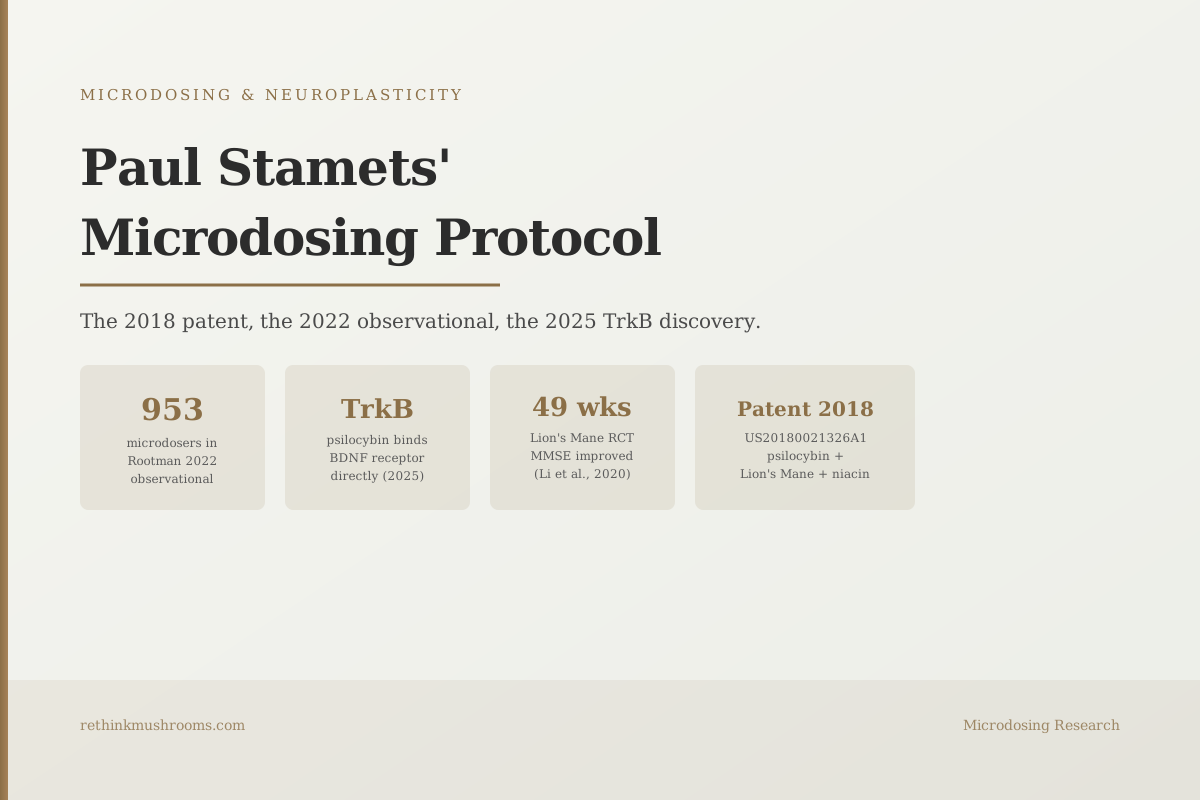
953 microdosers in the only observational study
The Rootman 2022 study directly tested the Stamets Stack: adding Lion's Mane and niacin to psilocybin produced no additional mood benefit, but did improve psychomotor performance in adults over 55.
Rootman et al., Scientific Reports, 2022
2018 patent
US20180021326A1: Stamets' formal claim for psilocybin + Lion's Mane + niacin combinations
TrkB binding
psilocybin's neuroplasticity works through BDNF receptor, not the hallucinogenic receptor (Sonda, 2025)
49 weeks
Lion's Mane RCT duration showing MMSE improvement in Alzheimer's patients (Li et al., 2020)
Rootman et al., Scientific Reports, 2022
 View as image ↗
In 2018, Paul Stamets filed a patent. Patent number US20180021326A1 claimed that combinations of tryptamine compounds (including psilocybin and psilocin) with Lion's Mane mushroom compounds (erinacines and hericenones) and optionally niacin could be used for "neuroregeneration" and the treatment of neurological and psychiatric conditions.
This was the Stamets Stack before the public called it that. The underlying question of what the science actually says about this combination still doesn't have a clean answer.
This article covers what Stamets actually claimed in his patent, the mechanism he proposed, what the only published observational study of the stack found, and where 2025 research leaves his core hypothesis. For the broader guide to combining medicinal mushrooms, see combining medicinal mushrooms: the ultimate stacking guide.
Key Takeaways
- Paul Stamets patented a psilocybin + Lion's Mane + niacin combination in 2018, claiming it promoted "epigenetic neurogenesis"; the stack formula predates most public discussion of microdosing by several years
- The only published study directly examining the Stamets Stack (Rootman et al., 2022, n=953) found NO additional mood benefit from adding Lion's Mane and niacin to psilocybin over psilocybin alone
- The same Rootman study found the Stack was associated with greater psychomotor improvements in adults over 55, a finding that was not Stamets' primary claim but is the only direct positive evidence for the combination
- A 2025 review (Sonda et al.) synthesized emerging evidence that psilocybin's active metabolite also binds TrkB (the BDNF receptor) through a nonserotonergic route distinct from the hallucinogenic 5-HT2A pathway, which creates a new mechanistic basis for why Lion's Mane's NGF compounds might synergize with psilocybin
- Lion's Mane alone has real clinical evidence: Li et al. (2020) ran a 49-week double-blind RCT and found significant MMSE improvements in mild Alzheimer's patients
- Psilocybin has strong standalone evidence for depression (Davis et al., JAMA Psychiatry, 2021); the combination's synergy remains a hypothesis, not a tested finding
Who Paul Stamets Is and Why His Credibility Matters
Paul Stamets is a mycologist and author who has spent decades studying fungi and their medicinal applications. His books, particularly "Mycelium Running" (2005) and "Fantastic Fungi" (2019, the documentary basis), established him as the most publicly recognized figure in medicinal mushroom research in the English-speaking world. He founded Fungi Perfecti, a mushroom cultivation company, and has held a research fellowship at the University of the Carpathian region.
His public profile means that when he proposes something, a large audience pays attention. His science background means his proposals tend to have at least a mechanistic rationale, even when the clinical evidence is thin. That combination, credibility plus early-stage evidence, is exactly the context needed for reading his microdosing protocol claims.
The 2018 Patent: What It Actually Claimed
The patent filed in 2018 (US20180021326A1) made specific claims that are worth reading directly rather than through the lens of popular retelling.
The core claim: formulations of a tryptamine compound (psilocybin, psilocin, or related compounds) combined with a non-psychoactive mushroom extract containing erinacines or hericenones (the neuroactive compounds in Lion's Mane), used to treat or prevent neurological conditions including traumatic brain injury, nerve damage, mood disorders, and age-related cognitive decline.
The role of niacin (vitamin B3) in the patent is described as a peripheral vasodilator. The proposed function: niacin causes the characteristic "flush" (reddening of the skin from capillary dilation), and Stamets proposed this vasodilation would help transport the active compounds, including Lion's Mane components, more effectively across biological membranes including the blood-brain barrier.
The phrase Stamets uses for the proposed mechanism is "epigenetic neurogenesis." The idea is that the combination promotes new neural growth and synaptic connections at an epigenetic level, meaning changes in gene expression rather than DNA sequence.
This is a mechanistic hypothesis based on known properties of the individual compounds. It is not a clinical finding. The patent was granted based on the novelty of the combination claim, not on clinical trial data supporting it.
The Stamets Protocol: How It Differs From Fadiman's
The "Fadiman protocol," named for psychedelic researcher James Fadiman, is the most commonly referenced microdosing schedule: one day on (typically 0.1-0.3g dried psilocybin mushrooms), two days off, repeat.
Stamets' protocol differs in two ways: the schedule and the additions.
The Stamets schedule is four days on, three days off. This differs from Fadiman's on the grounds that a slightly longer active period may produce more sustained effects before the break.
The additions are the stack components: Lion's Mane mushroom extract (typically 50-200mg) and niacin (typically 100-200mg), taken alongside the psilocybin microdose.
Neither schedule has been tested in a controlled trial to determine which is more effective or safer. Both are based on practitioner observation and user self-reporting, with the Fadiman protocol having slightly more documentation through the researcher's structured observational work.
Legal & medical context
ModeratePsilocybin is a Schedule I controlled substance, and the Stamets Stack is not a validated treatment
Concern
Psilocybin remains illegal to possess under US federal law and in most jurisdictions. The dosing figures described here reflect what practitioners report using, not a clinically established protocol. No randomized controlled trial has tested the safety or efficacy of the combined psilocybin + Lion's Mane + niacin stack.
What the research says
The strongest evidence in this area comes from psilocybin and Lion's Mane studied separately, at doses and under supervision that differ substantially from at-home microdosing. The combination itself has only one observational study, which was null on its primary mood outcome.
What to do
Treat this article as a summary of the research, not medical advice. Anyone considering interventions for a mood, cognitive, or neurological condition should consult a qualified clinician and be aware of the legal status where they live.
US federal Controlled Substances Act (psilocybin, Schedule I); Rootman et al., Scientific Reports, 2022
The Only Study That Directly Tested the Stack: Rootman 2022
In 2022, Rootman and colleagues published a longitudinal observational study of 953 psilocybin microdosers, published in Scientific Reports.[1] It is the only published study that directly compared outcomes between people using psilocybin alone versus people using the Stamets Stack combination of psilocybin with Lion's Mane and niacin.
The primary finding on mood: the stack did NOT produce additional mood improvements over psilocybin alone. Both groups showed small-to-medium improvements in mood and mental health metrics at one month. Adding Lion's Mane and niacin to psilocybin did not amplify those improvements.
The secondary finding: in adults over 55 specifically, the stack was associated with greater improvements in psychomotor performance compared to psilocybin alone. Psychomotor performance includes coordination, reaction time, and fine motor control.
Several caveats apply. This was an observational study using self-reported data from volunteers. There was no randomization and no placebo control. People who chose to use the full stack may have differed from people who used psilocybin alone in ways that affected outcomes. The psychomotor finding was secondary and should be interpreted as hypothesis-generating, not confirmatory.
Still, this is the evidence base for the Stamets Stack as a combination. It is limited, and the primary mood outcome was null.
The full evidence-critical analysis, covering what the Stamets Stack claims versus what the research shows, is in The Stamets Stack: what the protocol claims vs. evidence.
The 2025 Discovery That Changed How We Understand the Mechanism
In 2025, Sonda and colleagues published a review in Trends in Pharmacological Sciences that significantly updated the mechanistic understanding of how psilocybin produces neuroplasticity.[2]
The previous understanding: psilocybin activates 5-HT2A (serotonin) receptors in the cortex, which initiates cascades involving BDNF (brain-derived neurotrophic factor) and mTOR signaling, which promotes synaptic growth and dendritic spine formation.
The newer thread of evidence the review integrates: psilocybin's active metabolite (psilocin) also binds TrkB directly, and TrkB is the primary receptor for BDNF. This binding is described within the transmembrane region of TrkB and is mechanistically separate from the 5-HT2A hallucinogenic pathway. The review's synthesis is that a meaningful share of psilocybin's neuroplasticity and antidepressant-like effects depend on TrkB engagement rather than solely on the 5-HT2A pathway that produces the hallucinogenic experience. This remains an emerging framework, not a settled consensus.
Why this matters for the Stamets Stack: Lion's Mane compounds (erinacines and hericenones) promote the synthesis of NGF (nerve growth factor). NGF acts through TrkA receptors, which are closely related to TrkB. BDNF acts through TrkB. Both are neurotrophins, and the TrkA/TrkB receptor family is the pathway through which neurotrophic factors drive neural growth and synaptic formation.
If psilocybin creates a plasticity state by binding TrkB, and Lion's Mane stimulates NGF which acts through related receptors and downstream pathways, there is a plausible mechanistic basis for synergy that was not visible when Stamets filed his patent. His hypothesis that the compounds work together on neural growth pathways is more scientifically defensible in 2025 than it was in 2018, even though no clinical trial has tested the combination.
For a deeper look at psilocybin's TrkB mechanism and what it means for neuroplasticity, see how the Stamets Stack theoretically enhances neuroplasticity.
For the connection between Lion's Mane's specific compounds and neuroplastic effects, see hericenones and erinacines: Lion's Mane's brain-boosting compounds and Lion's Mane and BDNF: what the research shows.
Lion's Mane Without Psilocybin: 49 Weeks of Clinical Data
An important piece of context for evaluating Stamets' stack is the question of whether Lion's Mane alone has real clinical cognitive effects.
Li and colleagues ran a 49-week double-blind, placebo-controlled RCT of Erinacine A-enriched Lion's Mane mycelium in patients with mild Alzheimer's disease, published in Frontiers in Aging Neuroscience in 2020.[3]
The treated group showed significantly improved scores on the Mini-Mental State Examination (MMSE), a validated cognitive assessment, over the placebo group at the end of the 49-week trial. This is a high-quality clinical finding from a long-duration double-blind RCT in a disease population.
This study does not prove Lion's Mane improves cognition in healthy people or that it synergizes with psilocybin. But it does establish that Lion's Mane compounds can produce detectable cognitive effects in a clinical population. It is one of the strongest arguments for including Lion's Mane in any neurological protocol, independent of psilocybin.
For the full question of what Lion's Mane plus niacin provides without psilocybin, see Stamets Stack without psilocybin: does Lion's Mane and niacin still work?.
Psilocybin's Standalone Evidence: The JAMA Trial
Psilocybin's standalone evidence has grown substantially since Stamets filed his patent. The most rigorous evidence comes from a 2021 randomized clinical trial published in JAMA Psychiatry by Davis and colleagues.[4]
In that trial, psilocybin-assisted therapy produced significant, rapid reductions in depression severity in patients with major depressive disorder. The effects persisted at 4-week follow-up. This was a randomized controlled design, not an observational study.
This establishes that psilocybin at clinical doses has real, measurable effects on brain function and depression. The Stack's psilocybin component is not speculative in its standalone effects. The question the Rootman 2022 observational study addressed was whether adding Lion's Mane and niacin to psilocybin microdoses (much lower than clinical doses) produces synergistic effects. The answer from that study was: not for mood, possibly for psychomotor performance in older adults.
Where the Science Stands on Stamets' Protocol
The honest synthesis:
What is well-supported: Psilocybin at clinical doses produces real neuroplasticity and antidepressant effects (Davis 2021). Lion's Mane has clinical cognitive effects over long-term use (Li 2020). The mechanism Stamets proposed (psilocybin + NGF/BDNF pathway compounds) has plausible scientific support based on the 2025 TrkB discovery (Sonda 2025).
What is not supported: The specific combination does not demonstrably improve mood outcomes over psilocybin alone, based on the one available observational study (Rootman 2022). Niacin's specific role in the stack has no published mechanistic validation in this context.
What is unknown: Whether microdoses of psilocybin produce the structural plasticity changes observed at clinical doses (the Shao et al. 2021 dendritic spine data used psilocybin at 1 mg/kg in mice, much higher than typical microdoses)[5]. Whether the combination specifically produces synergistic effects on neural growth markers. Whether the psychomotor finding in older adults replicates in a controlled trial.
Stamets' contribution to the field is the hypothesis itself, formalized in a patent at a time when most of this research had not yet been conducted. The research landscape in 2025 is substantially more supportive of his mechanism rationale than the evidence available in 2018. The combination as a whole, however, remains an interesting hypothesis with partial support, not a tested and validated protocol.
What the evidence actually supports
The Stamets Stack, rung by rung
The parts are well-studied; the combination is not. Evidence weakens as you move from individual compounds to the synergy Stamets patented.
Each component, on its own
Strong clinical evidenceDavis et al., 2021 · JAMA Psychiatry
Randomized, waiting-list-controlled trial in adults with major depressive disorder. Psilocybin-assisted therapy produced significant, rapid reductions in depression severity, sustained at 4-week follow-up.
Li et al., 2020 · Frontiers in Aging Neuroscience
49-week double-blind, placebo-controlled RCT of erinacine A-enriched Lion’s Mane mycelium in mild Alzheimer’s disease. Significant improvement in Mini-Mental State Examination (MMSE) scores over placebo.
The proposed mechanism
Plausible, mostly preclinicalShao et al., 2021 · Neuron
A single dose of psilocybin (1 mg/kg, mice) drove ~10% increases in dendritic spine size and density in frontal cortex within 24 hours, still present one month later.
Sonda et al., 2025 · Trends in Pharmacological Sciences
Review synthesizing emerging evidence that psilocin also binds TrkB — the BDNF receptor — through a nonserotonergic route distinct from the 5-HT2A pathway, offering a basis for synergy with Lion’s Mane’s NGF-stimulating compounds.
The combination itself
One observational study — null on the primary outcomeRootman et al., 2022 · Scientific Reports
Naturalistic observational study of 953 microdosers. Adding Lion’s Mane and niacin to psilocybin produced NO additional mood benefit over psilocybin alone; psychomotor gains were specific to older adults. No randomization, no placebo control.
The synergy claim
Hypothesis — not testedStamets, 2018 · US Patent US20180021326A1
No randomized controlled trial has tested the Stamets Stack combination for its claimed synergistic "neuroregeneration." The patent rests on the mechanistic rationale of its individual components, not on clinical trial data.
Sources: Davis (2021); Li (2020); Shao (2021); Sonda (2025); Rootman (2022); Stamets patent US20180021326A1 (2018)
The Bottom Line
Paul Stamets patented a psilocybin plus Lion's Mane plus niacin combination in 2018, proposing "epigenetic neurogenesis" as the mechanism. The only observational study of the stack (Rootman et al., 2022, n=953) found no mood improvement over psilocybin alone, but did show psychomotor gains in adults over 55. A 2025 review (Sonda et al.) found psilocybin directly binds the BDNF receptor TrkB independently of its hallucinogenic pathway, which creates a mechanistic basis for synergy with Lion's Mane's NGF compounds that Stamets did not have available when he filed his patent. Each component has standalone evidence; the combination has observational data but no RCT.
Frequently Asked Questions
Sources & References
- 1RTHM-01611·Rootman, Joseph M et al. (2022). “Psilocybin microdosers demonstrate greater observed improvements in mood and mental health at one month relative to non-microdosing controls..” Scientific reports.Study breakdown →PubMed →↩
- 2RTHM-02182·Sonda, Sonia et al. (2025). “Emerging mechanisms of psilocybin-induced neuroplasticity..” Trends in pharmacological sciences.Study breakdown →PubMed →↩
- 3RTHM-00631·Li, I-Chen et al. (2020). “Prevention of Early Alzheimer's Disease by Erinacine A-Enriched Hericium erinaceus Mycelia Pilot Double-Blind Placebo-Controlled Study..” Frontiers in aging neuroscience.Study breakdown →PubMed →↩
- 4RTHM-00682·Davis, Alan K et al. (2021). “Effects of Psilocybin-Assisted Therapy on Major Depressive Disorder: A Randomized Clinical Trial..” JAMA psychiatry.Study breakdown →PubMed →↩
- 5RTHM-01434·Shao, Ling-Xiao et al. (2021). “Psilocybin induces rapid and persistent growth of dendritic spines in frontal cortex in vivo..” Neuron.Study breakdown →PubMed →↩