Psilocybin Drug Interactions
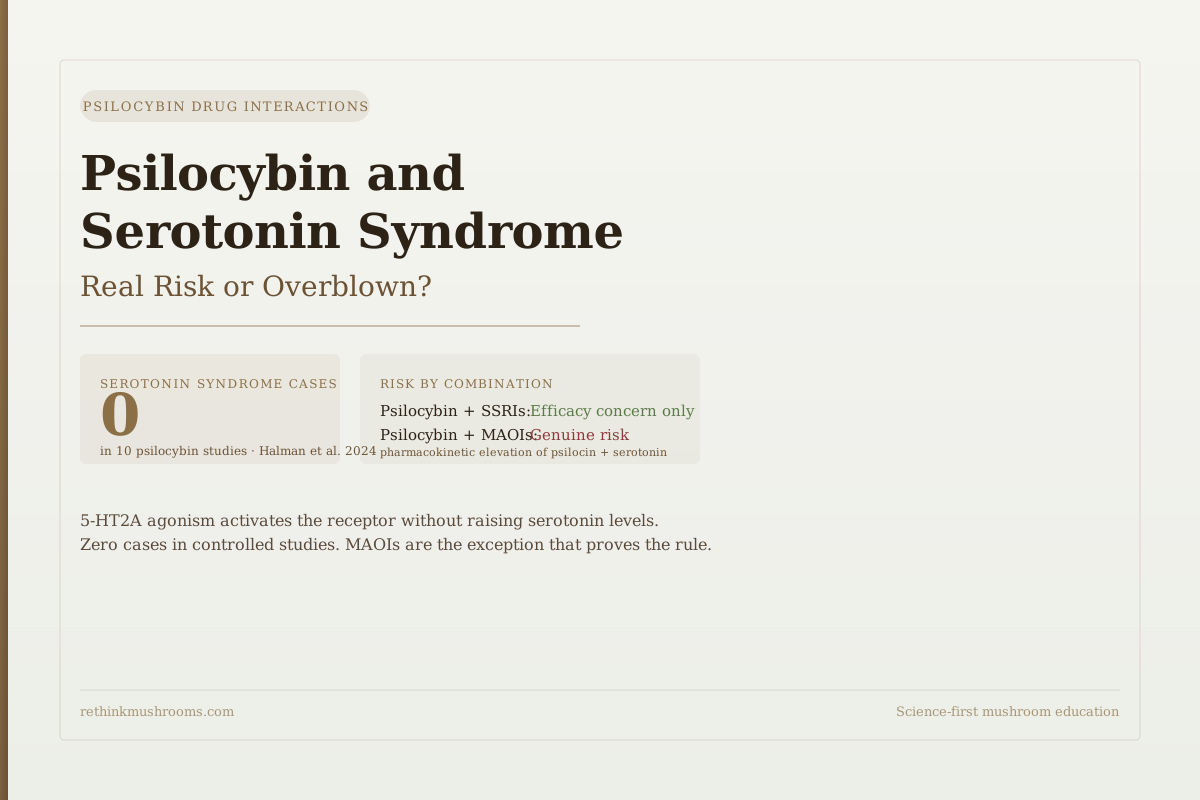
0 serotonin syndrome cases across 10 psilocybin studies
Halman and colleagues reviewed 52 studies on psychedelic drug interactions in 2024. Across all 10 psilocybin-specific studies with concurrent serotonergic medications, not a single case of serotonin syndrome occurred.
Halman et al., Journal of Psychopharmacology, 2024
5-HT2A agonist
psilocybin activates the receptor — it does not raise serotonin levels
Serotonin ≠ more
receptor agonism and serotonin excess are different mechanisms
MAOIs
the genuine high-risk category — raise psilocin AND serotonin simultaneously
Halman et al., Journal of Psychopharmacology, 2024
 View as image ↗
The concern is understandable. Both psilocybin and antidepressants like SSRIs act on the serotonin system. The term "serotonin syndrome" suggests that combining serotonin-affecting drugs produces a toxic cascade. Many people who are interested in psilocybin therapy are also on SSRIs. The interaction question matters.
The pharmacology, however, does not support the common fear. Psilocybin is a 5-HT2A receptor agonist. It activates a serotonin receptor. It does not raise serotonin levels in the synapse. Serotonin syndrome requires too much serotonin in the synapse — not activation of a specific receptor downstream of serotonin. These are different things.
The clinical record matches the pharmacology. Halman and colleagues reviewed all published data on psychedelic drug interactions in 2024, covering 52 studies.[1] Across the 10 studies specifically on psilocybin with concurrent serotonergic medications, not a single case of serotonin syndrome was reported. The combination was common enough in the data to observe the event if it occurred with any meaningful frequency. It did not.
This article explains the pharmacological reason why, what the clinical evidence shows, and where the genuine risk does exist.
For the full safety picture on psilocybin, see How Safe Is Psilocybin? The Complete Safety Research.
Key Takeaways
- Serotonin syndrome requires excess serotonin in the synapse; psilocybin activates the 5-HT2A receptor but does not raise serotonin levels — these are mechanistically distinct
- Halman et al. 2024 reviewed 52 drug interaction studies including 10 psilocybin-specific studies: no cases of serotonin syndrome
- Carhart-Harris et al. 2023 administered psilocybin to patients on concurrent SSRIs in a clinical trial with no serotonin syndrome events
- Jolliff et al. 2024 analyzed 200+ self-reported SSRI plus psilocybin experiences; the main adverse effect was blunted psilocybin effect, not toxicity
- MAOIs are the genuine exception: by inhibiting the enzyme that breaks down psilocin, they elevate both psilocin levels and synaptic serotonin simultaneously
- LSD carries more theoretical serotonin syndrome risk than psilocybin due to additional pharmacological activity beyond 5-HT2A agonism
What Serotonin Syndrome Is and How It Actually Happens
Serotonin syndrome is a drug toxicity reaction caused by too much serotonin activity in the central and peripheral nervous systems. The syndrome ranges from mild (tremor, diarrhea, increased reflexes) to severe (hyperthermia, muscle rigidity, seizures, and, rarely, death). It is a spectrum, not a single event.
The mechanism requires excess serotonin in the synapse — the tiny gap between neurons where chemical signals pass. Three pharmacological routes can produce this excess:
The first is increased serotonin synthesis or release. Amphetamines and MDMA work this way — they cause neurons to release serotonin from their storage vesicles, flooding the synapse with more serotonin than normal firing would produce.
The second is inhibited serotonin reuptake. SSRIs work this way — they block the transporter that clears serotonin from the synapse after it fires, so serotonin lingers and accumulates. At therapeutic doses, this is the intended effect. At much higher levels, or in combination with serotonin releasers, it can contribute to serotonin excess.
The third is inhibited serotonin breakdown. Monoamine oxidase inhibitors (MAOIs) work this way — they block the enzyme (MAO) that metabolizes serotonin after it has been recaptured by the neuron. Less breakdown means more accumulation.
Serotonin syndrome typically requires multiple routes operating simultaneously — a releaser plus a reuptake inhibitor, for example, or a releaser plus an MAO inhibitor. Single-mechanism exposure rarely causes the full syndrome at therapeutic doses.
Notice what is absent from this list: receptor agonism. A drug that binds and activates a serotonin receptor does not increase synaptic serotonin. It activates downstream signaling without changing how much serotonin is in the synapse. This is the critical pharmacological distinction.
Why Psilocybin Cannot Cause Serotonin Syndrome by Itself
Psilocybin is metabolized to psilocin in the body. Psilocin is a direct agonist at the 5-HT2A receptor — a serotonin receptor subtype highly concentrated in the cortex. When psilocin binds this receptor, it activates the same downstream signaling that serotonin activates, without requiring serotonin itself.
This means psilocybin bypasses the synapse entirely. The synaptic serotonin concentration is not changed by psilocybin. The number of serotonin molecules available is not changed. The reuptake mechanism still functions normally. The MAO enzyme still breaks down serotonin normally.
The serotonin system is activated at the receptor level, but the conditions that cause serotonin syndrome — excess synaptic serotonin from overloaded release, blocked reuptake, or impaired breakdown — are not met.
This is why psilocybin cannot cause serotonin syndrome by itself, regardless of dose. The mechanism is simply not present.
The Clinical Record: What 10 Studies Found
The pharmacological reasoning is supported by the clinical data.
Halman and colleagues published the most comprehensive systematic review of psychedelic drug interactions available in 2024, covering 52 studies: 32 on LSD, 10 specifically on psilocybin, and additional studies on other psychedelics.[1] They identified various interaction effects in these studies — including attenuation of psychedelic effects by SSRIs and potentiation by some compounds. Across all included studies, the serious adverse events were limited to a small number of case reports in uncontrolled settings. No serotonin syndrome was reported in any included psilocybin study.
The clinical trial conducted by Carhart-Harris and colleagues in 2023 administered psilocybin to patients who were taking a concurrent SSRI for treatment-resistant depression.[2] This is exactly the combination that generates the most concern — psilocybin plus an SSRI in the same session. The study found that psilocybin's antidepressant effects were attenuated (patients still responded, but less strongly than non-SSRI users). The safety profile was maintained. No serotonin syndrome events occurred.
This clinical trial is important for the serotonin syndrome question because it represents a controlled, observed setting where the combination was deliberately administered and monitored. If the combination produced a meaningful rate of serotonin syndrome at clinical doses, this study would have detected it.
The effects that did occur in the trial were the expected ones: reduced psilocybin intensity, not toxicity.
Real-World Data: What Reddit Reports About SSRI Plus Psilocybin Reveal
Jolliff and colleagues analyzed Reddit posts describing the combined use of SSRIs and psilocybin mushrooms in 2024, examining more than 200 user-reported experiences.[3]
The most common adverse outcome in naturalistic settings, where users were not screened or monitored, was blunted psilocybin effect. The majority of people combining SSRIs with psilocybin reported a weaker or absent psychedelic experience. A minority reported no change in effect. Severe adverse events, including anything resembling serotonin syndrome, were rare.
This naturalistic dataset covers a different population than clinical trials — self-administering users without medical supervision, not screened for contraindications, combining substances in uncontrolled environments. Even in this setting, serotonin toxicity was not a primary or common outcome.
The Reddit data is low-quality evidence by clinical standards, but it provides a real-world adverse event signal from a much larger population than any clinical trial. The signal it produces for serotonin syndrome is weak. The signal it produces for blunted effect is strong.
For a detailed look at SSRI and psilocybin efficacy interactions, see Psilocybin and SSRIs: Will Antidepressants Block the Effect?.
When the Risk Is Real: MAOIs Are a Different Category
The low serotonin syndrome risk from psilocybin plus SSRIs does not mean all combinations are equivalently safe. MAO inhibitors present a genuinely different risk profile.
The reason involves psilocin metabolism. After psilocybin is converted to psilocin in the body, psilocin is broken down by monoamine oxidase A (MAO-A), the same enzyme that metabolizes serotonin and other monoamines. When MAO-A is inhibited, psilocin is not metabolized at its normal rate. It remains in circulation longer and at higher concentrations than normal doses produce.
This creates a two-pronged problem. First, elevated psilocin concentrations produce a more intense and prolonged experience than the dose was intended to create — unpredictably so. Second, MAO-A inhibition raises synaptic serotonin levels independently of psilocybin, because MAO normally breaks down serotonin after reuptake. An MAO-A inhibitor combined with a serotonin-releasing or serotonin-active drug creates the conditions for serotonin toxicity that SSRIs and psilocybin together do not.
The MAO inhibitors used as antidepressants, including phenelzine, tranylcypromine, and isocarboxazid (all irreversible MAO-A inhibitors), and moclobemide (a reversible MAO-A inhibitor), represent the highest-risk category among psychiatric medications combined with psilocybin. The Halman 2024 systematic review identifies MAOIs as carrying the most significant interaction concern in the psychedelic drug interaction literature.[1]
MAO-B inhibitors used in Parkinson's disease, such as selegiline and rasagiline, primarily target dopaminergic metabolism and carry lower serotonin risk at therapeutic doses. At higher doses, MAO-B inhibitors lose their selectivity and begin inhibiting MAO-A as well.
For a detailed look at the MAOI interaction specifically, see Psilocybin and MAOIs: The Dangerous Combination. For the broader drug interaction picture, see Psilocybin Drug Interactions: A Complete Guide and Psilocybin and Lithium: The Dangerous Interaction.
LSD vs. Psilocybin: A Meaningful Pharmacological Difference
It is worth noting that the serotonin syndrome risk discussion around psychedelics often conflates LSD with psilocybin. The two drugs have meaningfully different pharmacological profiles.
LSD has partial serotonin releasing activity and binds a broader range of receptors than psilocybin. Some pharmacological analyses suggest LSD may carry more theoretical serotonin syndrome risk than psilocybin. The Halman 2024 review covered 32 LSD studies alongside 10 psilocybin studies — and the interaction profiles are not identical between the two drugs.[1]
Psilocybin's activity is more focused. Its primary target is the 5-HT2A receptor; it has limited serotonin releasing activity. This pharmacological focus is part of why the clinical and real-world data on psilocybin plus SSRIs looks so consistently benign from a serotonin syndrome perspective.
For questions about psilocybin and psychosis risk, see Family History of Psychosis and Psilocybin: Risk Assessment.
The Bottom Line
Psilocybin cannot cause serotonin syndrome by itself, because it activates the 5-HT2A receptor without raising synaptic serotonin levels — the mechanism required for serotonin toxicity. The clinical evidence matches: Halman et al. 2024 reviewed 10 psilocybin studies with concurrent serotonergic medications and found zero serotonin syndrome cases. Carhart-Harris et al. 2023 confirmed no serotonin syndrome events when psilocybin was administered with SSRIs in a clinical trial. The real risk is with MAO inhibitors, which elevate both psilocin levels and synaptic serotonin by blocking the enzyme that metabolizes both. SSRIs combined with psilocybin are primarily a question of efficacy (blunted effect), not safety.
Frequently Asked Questions
Sources & References
- 1RTHM-01899·Halman, Andreas et al. (2024). “Drug-drug interactions involving classic psychedelics: A systematic review..” Journal of psychopharmacology (Oxford.Study breakdown →PubMed →↩
- 2. Source details for this reference are not yet available.
- 3. Source details for this reference are not yet available.