Psilocybin & Opioid Use Disorder
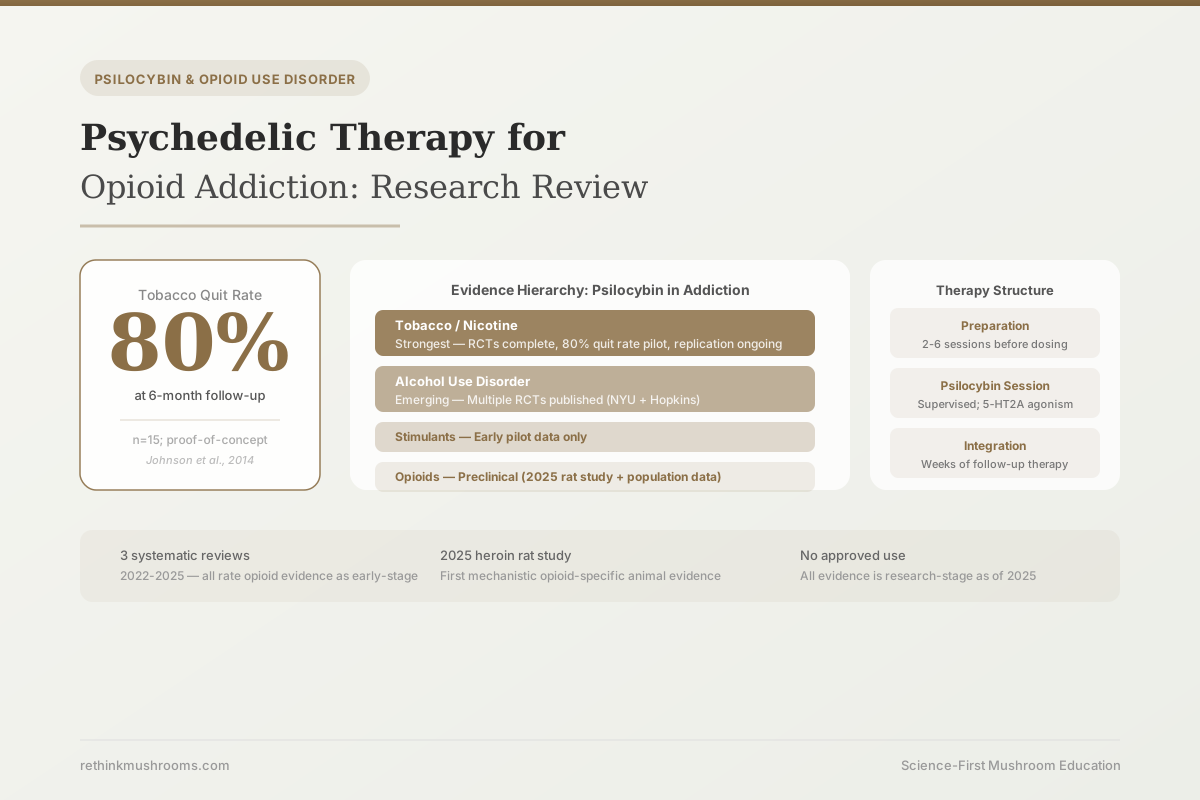
80% abstinent
In the 2014 Johns Hopkins tobacco cessation pilot, 12 of 15 participants were abstinent at six-month follow-up after psilocybin-assisted therapy, the most striking addiction outcome in the clinical literature and the proof-of-concept that underpins opioid research interest.
Johnson et al., 2014
3 evidence tiers
tobacco (strongest), alcohol (emerging), opioids (preclinical): the hierarchy that defines where psilocybin research actually stands
2025
year of the first heroin-specific mechanistic animal study, the most recent advance in opioid addiction research
No approved use
psilocybin has no regulatory approval for any addiction indication as of 2025; all evidence is research-stage
Johnson et al., 2014
 View as image ↗
There is a counterintuitive hierarchy at the center of psychedelic addiction research. The addiction that kills the most people, opioid use disorder, has the weakest evidence for psilocybin as a treatment. Tobacco, which causes more total deaths over a lifetime but far fewer acute overdoses, has the strongest. This is not a failure of priority. It reflects how clinical research works: psilocybin was first tested in the areas where researchers had the most confidence in mechanisms and the easiest-to-measure outcomes, and those happened to be tobacco and alcohol. The opioid question is urgent but newer. Understanding this hierarchy accurately is essential for anyone trying to evaluate whether psilocybin holds promise for opioid use disorder. Three systematic reviews published between 2022 and 2025 have mapped this landscape consistently, and their conclusions paint a clear picture of what is established, what is emerging, and what remains to be tested.[2][3][4] For the foundational alcohol trial results that established psilocybin as a clinical addiction treatment, see psilocybin for alcohol addiction: the NYU clinical trial results.
Key Takeaways
- Psilocybin's addiction evidence spans three distinct tiers: tobacco cessation has the strongest clinical data (80% abstinence at 6 months in the 2014 Johns Hopkins pilot), alcohol has emerging RCT evidence, and opioid use disorder has only preclinical animal data and population surveys as of 2025
- The Johns Hopkins 2014 tobacco pilot (Johnson et al.) was the first clinical study to establish that psilocybin could interrupt an entrenched addiction pattern, with 12 of 15 participants abstinent at six months
- Three systematic reviews (2022-2025) consistently identify opioid-specific clinical evidence as very limited, with all clinical conclusions about psilocybin and OUD rated as requiring dedicated trials before they can be drawn
- A 2025 rat study found psilocybin reduced heroin-seeking behavior and modulated inflammatory gene expression in reward circuits, the first mechanistic animal evidence specifically targeting opioid addiction biology
- Psilocybin-assisted therapy is not simply a pharmacological intervention: controlled trials pair the drug session with extensive psychological preparation and integration work, which appears to be necessary for addiction outcomes
- No psychedelic compound has FDA approval for any addiction indication; all evidence discussed here is research-stage
Why Psilocybin Enters the Addiction Research Picture: A Non-Substance-Specific Mechanism
The reason psilocybin is being studied across such different addictions, tobacco, alcohol, and opioids, is that its proposed mechanism targets something they all share rather than anything specific to one substance.
All addictive disorders, despite their pharmacological differences, involve a common neurological architecture. Habitual drug-seeking behavior becomes encoded in striatal circuits that operate automatically, below conscious deliberation. The brain's default mode network, which governs self-referential thinking and the construction of identity-based behavior, organizes itself around the addiction. Drug use becomes part of who the person understands themselves to be, which is one reason behavioral change feels like an identity threat rather than a simple behavioral adjustment. Craving responses become cued by environments, people, and objects associated with past use in ways that bypass conscious resistance.
Psilocybin disrupts default mode network activity temporarily through 5-HT2A receptor agonism. During that disruption, the normal self-referential patterns that maintain the addiction narrative become less fixed. The period following a psilocybin session involves heightened neuroplasticity, an increased capacity for the brain to form new patterns. The clinical hypothesis is that this window, properly supported with psychological preparation and integration, allows habitual behavior patterns that have become rigid to be reconsidered and reorganized.[3]
This mechanism does not care whether the substance involved is nicotine, alcohol, or heroin. The habitual architecture it targets is present in all of them. What differs is the degree of physical dependence, the availability of existing treatments, and how much human clinical research has been done. Those differences explain the evidence hierarchy, not a difference in whether the mechanism is theoretically applicable.
The Evidence Hierarchy: Tobacco, Alcohol, and Opioids Are Not Equal
The clearest way to understand the current research landscape is through an evidence hierarchy. Multiple systematic reviews place the evidence this way:
| Addiction Type | Evidence Level | Key Data |
|---|---|---|
| Tobacco/nicotine | Strongest clinical | 80% abstinence at 6 months (Johns Hopkins pilot, n=15, 2014); multiple larger trials underway |
| Alcohol | Emerging clinical | Multiple RCTs showing significant reduction in heavy drinking; NYU and Johns Hopkins trials |
| Stimulants (cocaine, methamphetamine) | Preliminary | Early-phase pilots; limited data |
| Opioids | Preclinical | 2025 rat study; population surveys; no completed human RCT |
The hierarchy reflects timing more than mechanism. Tobacco was studied first because it is common, legal, easy to measure (exhaled carbon monoxide, self-report), and has existing cessation treatments to compare against. Alcohol followed because similar reasons apply. Opioids present additional complexity: stronger physical dependence, more severe withdrawal requiring medical management, a higher-stakes population in terms of overdose risk during any treatment gap, and the pharmacological layer of MAT (medication-assisted treatment) that any psilocybin trial would need to account for in its design.
The 2022 systematic review of psilocybin's therapeutic potential was among the first to document this hierarchy explicitly, noting that evidence quality was highest for smoking cessation and emerging for alcohol, while opioid-specific data was absent from controlled trials.[2] The 2023 and 2025 systematic reviews confirmed this picture with the addition of the first preclinical opioid data.[3][4]
The Tobacco Data: 80% Abstinence at Six Months
The single most cited number in psilocybin addiction research comes from the 2014 Johns Hopkins pilot study of psilocybin for tobacco cessation.[1]
Johnson and colleagues enrolled 15 adult smokers who had been unable to quit despite prior attempts. Participants received two or three sessions of psilocybin-assisted therapy over a structured protocol that included preparation sessions before the drug sessions and integration sessions afterward. At six-month follow-up, 12 of the 15 participants (80%) were biochemically verified abstinent from tobacco. This was not self-report; abstinence was confirmed with exhaled carbon monoxide and cotinine levels.
For context: the best pharmacological interventions for smoking cessation (varenicline, bupropion) produce six-month quit rates of roughly 15-30% in clinical trials. The 80% figure from the Johns Hopkins pilot exceeded that by a substantial margin. It was a small sample, uncontrolled (no placebo group), and the participants were highly motivated. All of those limitations are real. But a preliminary study does not need to be definitive to be important. The 2014 pilot established that psilocybin could produce dramatic, sustained interruption of an entrenched addiction behavior in humans. Every subsequent addiction research program, including the opioid work, builds on that proof of concept.[1]
The 2023 systematic review on psilocybin's therapeutic effect in addiction cited the tobacco data as the strongest clinical foundation in the addiction literature, while consistently noting that generalization to opioids requires dedicated trials rather than extrapolation.[3]
What Three Systematic Reviews Conclude About Opioid-Specific Evidence
The most direct way to understand where the opioid evidence sits is to follow what systematic reviewers have concluded across three independent analyses.
The 2022 broad systematic review of psilocybin's therapeutic potential covered evidence across all clinical indications, including substance use disorders. For opioids specifically, the review found no completed controlled trials and limited published data, placing opioid use disorder at the earliest possible stage of the evidence pipeline alongside a general framework for why psilocybin might help once trials are conducted.[2]
The 2023 systematic review by Tian and colleagues focused specifically on psilocybin's therapeutic effects in addiction. The pattern was consistent: opioid-specific clinical data was very limited, the review concluded that clinical recommendations for psilocybin in OUD could not yet be made, and the research was characterized as requiring dedicated phase 2 trials before efficacy claims could be evaluated.[3]
The 2025 systematic review of psilocybin for substance use disorders provides the most current picture, incorporating the 2025 heroin rat study as the most recent evidence addition.[4] This review represents the current scientific consensus on where psilocybin research in addiction stands.
All three reviews, independently conducted over a three-year span, reached the same conclusion about opioids: clinically promising based on mechanism and analogy to other addiction evidence; evidence-empty in terms of controlled human trials. That consistency across independent assessments is itself meaningful information.
The Most Recent Advance: The 2025 Heroin Rat Study
In 2025, the first animal study specifically designed to examine psilocybin's effects on heroin addiction biology was published, moving the opioid evidence base from theoretical to mechanistic.[5]
Male rats with established heroin self-administration behavior received psilocybin treatment. Heroin-seeking behavior was reduced after treatment. The study also examined gene expression in the nucleus accumbens and the prefrontal cortex, the brain regions most directly involved in opioid reward processing and decision-making. Psilocybin modulated inflammatory gene expression in both regions, pointing to a neurobiological mechanism for the behavioral change rather than a non-specific sedation or avoidance effect.[5]
The preclinical label applies fully here. Rats are not humans, heroin rat models do not replicate the full complexity of opioid use disorder in a person with chronic pain history and social context, and animal data frequently does not translate into human trials. But the study provides something the field lacked entirely: direct mechanistic evidence that psilocybin has a measurable effect on opioid addiction biology specifically, not just addiction in general. That is a meaningful step in the evidence chain.
For the detailed analysis of the 2025 rat study findings, see psilocybin for opioid use disorder: can it help the opioid crisis?. For the connection between chronic pain and opioid dependence and how psilocybin might address both, see psilocybin and pain perception: a dual approach to opioid dependence.
How Psilocybin-Assisted Therapy Works: Why Structure Matters as Much as the Drug
An important point about the addiction evidence that the bare statistics do not convey: psilocybin-assisted therapy is not simply the administration of a drug. Every clinical trial that has shown addiction outcomes, including the tobacco pilot, has paired the drug session with substantial psychological support.
The standard structure across trials involves three phases. In the preparation phase, which typically spans two to six sessions before any drug is taken, participants work with trained therapists to examine their relationship with the substance, explore their motivations for change, and develop a set of intentions for the drug session. In the drug session itself, participants take psilocybin in a carefully prepared physical environment with two therapists present for support. In the integration phase, which follows the session over subsequent weeks, therapists help participants interpret and apply the insights, emotional experiences, and perceptual shifts that occurred during the session.
The mystical experience, a sense of unity, profound meaning, and ego dissolution that psilocybin reliably produces at therapeutic doses, appears to be one of the mediating factors in addiction outcomes. The intensity and completeness of this experience has been correlated with treatment response in the alcohol and tobacco data. The hypothesis is that the experience of depersonalization, a temporary dissolution of the habitual self-narrative, creates the psychological opening that allows addictive behavior patterns to be released rather than just suppressed.[3]
This means that clinical translation to opioid use disorder involves more than just running a pharmacokinetic trial. It requires designing a therapeutic protocol appropriate for a population with complex trauma histories, active physical dependence that must be managed through MAT, and higher acute risk than the tobacco or alcohol populations studied so far. The protocol design for opioid trials is itself a research question, not a settled matter. For more on the therapeutic mechanism and how the mystical experience connects to addiction recovery, see the mystical experience and addiction recovery: why it matters. For the neuroscience of how psilocybin disrupts habitual addiction patterns, see how psilocybin breaks addiction: the neuroscience explained.
The Bottom Line
Psychedelic-assisted therapy research for addiction follows a three-tier evidence hierarchy: tobacco cessation has the strongest data (80% abstinence in the 2014 Johns Hopkins pilot), alcohol has emerging RCT evidence from multiple trials, and opioid use disorder remains at the preclinical stage with a 2025 rat study and population surveys as the primary evidence base. Three independent systematic reviews published 2022 to 2025 consistently reach the same conclusion: psilocybin's mechanism is theoretically applicable to opioid addiction, but no controlled human trial has been completed, and clinical conclusions for OUD cannot yet be drawn. The evidence base is moving, but it has further to travel for opioids than for any other addiction type currently being studied.
Frequently Asked Questions
Sources & References
- 1. Source details for this reference are not yet available.
- 2. Source details for this reference are not yet available.
- 3. Source details for this reference are not yet available.
- 4. Source details for this reference are not yet available.
- 5. Source details for this reference are not yet available.