Psilocybin & Opioid Use Disorder
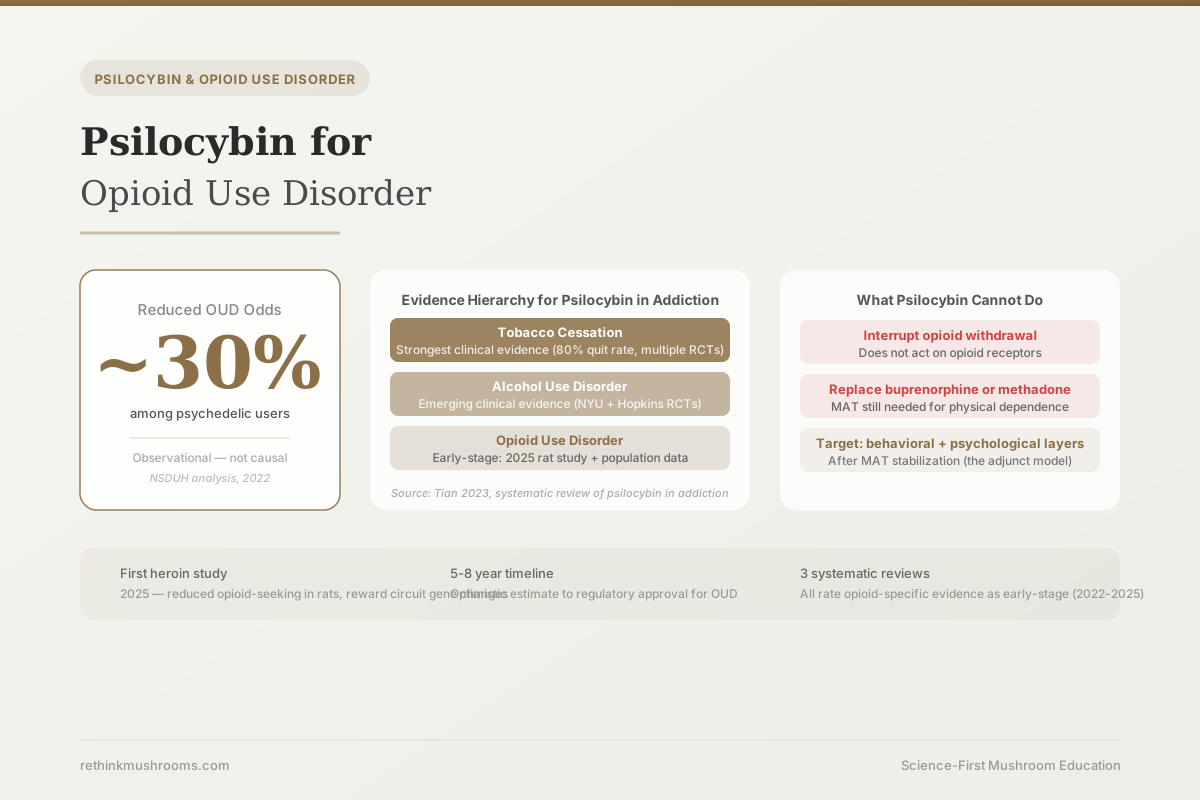
~30% reduced odds
People who had used psilocybin showed approximately 30% reduced odds of developing opioid use disorder (adjusted odds ratio 0.70) in a 2022 National Survey on Drug Use and Health analysis, representing the most cited population-level signal in the psilocybin-OUD research literature.
Jones et al., National Survey on Drug Use and Health analysis, 2022
2025
year of the first animal study specifically targeting psilocybin's effect on heroin-seeking behavior: reduced opioid-seeking and inflammatory gene changes in reward circuits
3 research reviews
published 2022 to 2025 assess psilocybin's potential across substance use disorders; all rate opioid-specific clinical evidence as limited
No Phase 3
as of 2025, no Phase 3 randomized trial has been completed specifically for psilocybin and opioid use disorder
Jones et al., National Survey on Drug Use and Health analysis, 2022
 View as image ↗
Psilocybin is being investigated as a potential treatment for opioid use disorder, one of the most resistant forms of addiction and the central driver of the drug overdose crisis. The interest is not arbitrary. Psilocybin has already shown meaningful clinical results for alcohol dependence and tobacco cessation, two other deeply entrenched addictions that conventional treatments struggle with. The question is whether those findings translate to opioids, and the honest answer in 2025 is that the evidence is very early. A 2025 systematic review on psilocybin for substance use disorders represents the most comprehensive current summary of what exists.[2] A 2025 animal study provided the first mechanistic data specifically targeting opioid addiction biology.[1] Human clinical trials are underway but have not reported results. This article covers what the research shows, what it does not, and what psilocybin can and cannot do in the context of opioid addiction. For psilocybin's most established addiction evidence, the pillar article psilocybin for alcohol addiction: the NYU clinical trial results covers the clinical foundation this field builds on.
Key Takeaways
- A 2022 analysis of National Survey on Drug Use and Health data found lifetime psilocybin use associated with approximately 30% reduced odds of developing opioid use disorder (adjusted odds ratio 0.70); this is observational data and does not establish causation, and no other classic psychedelic showed the same association
- The 2025 heroin rat study was the first mechanistic animal research specifically targeting psilocybin's effect on opioid addiction biology, finding reduced heroin-seeking behavior and inflammatory gene changes in the nucleus accumbens and prefrontal cortex
- Three research reviews published between 2022 and 2025 all conclude that opioid-specific clinical evidence for psilocybin is limited and mostly preclinical, while tobacco cessation and alcohol use disorder have the strongest clinical data
- Psilocybin does not act on opioid receptors, cannot substitute for medication-assisted treatment during withdrawal, and is not being proposed as a replacement for buprenorphine or methadone
- Current medication-assisted treatments for OUD are effective at preventing overdose and maintaining stability but address physical receptor dependence rather than the psychological and behavioral dimensions of addiction; psilocybin research targets those dimensions specifically
- Clinical trials are underway at multiple institutions, but regulatory approval for psilocybin in OUD is a minimum of five to eight years away under optimistic projections
Why Opioid Addiction Is Especially Hard to Treat: The Problems Medication Misses
Opioid use disorder is pharmacologically distinct from most other addictions in a way that matters for understanding what psilocybin might and might not offer.
Opioids create physical receptor dependence rapidly. With regular use, the brain's opioid receptors downregulate, requiring increasingly large doses to produce the same effect. When opioids are removed, withdrawal begins within hours: severe anxiety, nausea, muscle cramps, insomnia, and a subjective experience that people with OUD consistently describe as worse than they could have imagined. This physical withdrawal is not a character failing. It is a biological outcome of receptor sensitization that is consistent across individuals and species.
Medication-assisted treatment (MAT) addresses this by substituting a controlled opioid agonist (methadone) or partial agonist (buprenorphine) for the uncontrolled drug. Both work. They reduce overdose mortality, reduce criminal justice involvement, improve employment, and allow people to stabilize their lives. The evidence base for MAT is robust.
What MAT does not address is the psychological and behavioral architecture of addiction. The habitual behavior patterns cued by environments, people, and objects associated with past drug use. The self-narrative that addiction constructs, in which drug use feels necessary and identity-defining. The processing of trauma, pain, or psychological distress that may underlie or sustain the substance use. These dimensions can be addressed through behavioral therapies, and many treatment programs combine MAT with counseling. But behavioral therapy outcomes for OUD are variable, the process is lengthy, and many people with OUD have limited access to sustained therapeutic support.
This is where psilocybin's proposed mechanism becomes relevant. Not as a replacement for MAT during withdrawal management, but as a potential tool for the psychological and behavioral dimensions of addiction that medication alone cannot reach.[3]
Two layers, two tools
Why Psilocybin Is Studied Alongside MAT, Not Instead of It
Opioid use disorder has a physical layer and a psychological layer. They respond to different tools, which is why the clinical hypothesis places psilocybin after medication-assisted treatment, not in place of it.
Physical dependence layer
Addressed by medication-assisted treatment
Established, first-line
Biology
Opioid receptor desensitization and withdrawal
Tool
Methadone (agonist) or buprenorphine (partial agonist)
Acts on
Opioid receptors
Evidence
Robust: reduces overdose mortality and stabilizes lives
Behavioral & psychological layer
Targeted by psilocybin research
Investigational, early evidence
Biology
Habit patterns, craving, self-narrative, reward-circuit dysfunction
Tool
Psilocybin-assisted therapy (studied as an adjunct)
Acts on
Serotonin 2A receptors, not opioid receptors
Evidence
Preclinical and population signals only; no completed opioid trial
The proposed sequence is medication-assisted treatment first to stabilize physical dependence, then psilocybin-assisted sessions for the behavioral and psychological dimensions. No completed trial has yet tested this in opioid patients.
Sources: Meshkat et al., Neuroscience & Biobehavioral Reviews 2025 (RTHM-02148, PMID 40245969); Floris et al., Molecular Psychiatry 2025 (RTHM-02082, PMID 39433903)
Why Researchers Are Looking at Psilocybin: What the Alcohol and Smoking Evidence Predicts
The rationale for investigating psilocybin in opioid use disorder does not begin with opioid data. It begins with tobacco and alcohol, where human clinical evidence is meaningfully stronger.
A Johns Hopkins tobacco cessation pilot study reported that 12 of 15 participants (80%) were biologically confirmed abstinent at six-month follow-up, a rate that substantially exceeds the sub-35% figures typically reported for other behavioral and pharmacological smoking treatments, though the open-label design means it cannot establish efficacy on its own.[6] For alcohol use disorder, a double-blind randomized controlled trial led by NYU researchers found that two high-dose psilocybin sessions paired with psychotherapy produced statistically significant reductions in the percentage of heavy drinking days compared with an active placebo.[7] These findings suggest psilocybin can interrupt addictive behavior patterns across different substances and different pharmacological profiles of dependence.
The proposed mechanism is not substance-specific. Psilocybin is thought to work by temporarily disrupting default mode network activity, allowing a period of heightened neuroplasticity in which habitual patterns can be examined and potentially reorganized. The default mode network is the brain system involved in self-referential thinking, rumination, and the construction of habitual identity-based behavior. Addiction, particularly at the stage of chronic use, operates heavily through this system. The drug use becomes automatic, expected, and identity-adjacent. Psilocybin disrupts the automatic quality of that narrative, creating a window for different choices.[5]
If this mechanism is what drives psilocybin's effectiveness in tobacco and alcohol, it should theoretically apply to opioids as well. The addiction mechanism the treatment targets (habitual behavior, craving, self-narrative) is not exclusive to any single substance. The question is whether the additional complexity of opioid physical dependence changes the clinical picture, and whether opioid users can benefit from psilocybin-assisted sessions after the physical withdrawal layer has been addressed through MAT.
For a deeper look at the neuroplasticity and craving mechanisms, see how psilocybin breaks addiction: the neuroscience explained and psilocybin and craving reduction: mechanisms of action.
The 2025 Rat Study: Heroin-Seeking Reduction and Reward Circuit Changes
In 2025, the first animal study specifically designed to examine psilocybin's effects on heroin-seeking behavior was published, providing the first mechanistic data for opioids specifically.[1]
Floris et al. (2025) · Molecular Psychiatry
- Population
- Male rats with established heroin self-administration
- Intervention
- Psilocybin
- Comparator
- Serotonin 2A receptor antagonist / vehicle controls
- Finding
- Psilocybin reduced heroin-seeking behavior and modulated inflammatory gene expression in the nucleus accumbens and prefrontal cortex, the reward and decision-making regions central to addiction.
preliminary Preclinical rodent data; not yet replicated in humans and no opioid clinical outcomes exist.
Floris et al., Molecular Psychiatry, 2025 (RTHM-02082, PMID 39433903)
Male rats with established heroin self-administration behavior were treated with psilocybin. After treatment, heroin-seeking behavior was reduced. This is the most direct preclinical evidence available that psilocybin has a measurable effect on opioid-specific addiction biology, as distinct from its broader behavioral effects.
The study also examined gene expression in two brain regions central to addiction: the nucleus accumbens and the prefrontal cortex. The nucleus accumbens processes reward and drives opioid-seeking behavior; chronic opioid exposure creates neuroinflammation in this region that sustains cravings and disrupts normal reward processing. The prefrontal cortex governs decision-making and impulse control; opioid addiction progressively impairs prefrontal function, making it harder to override drug-seeking impulses. Psilocybin modulated inflammatory gene expression in both regions.[1]
This is preclinical data from a rodent model, and translation to human clinical outcomes is not yet replicated in humans. But it provides something the field previously lacked: mechanistic animal evidence that psilocybin specifically affects the neurobiology of opioid addiction, not just general behavioral flexibility.
The Population Signal: ~30% Lower OUD Odds Among People Who Had Used Psilocybin
Before any controlled trial existed for psilocybin and OUD, researchers examined the relationship between psychedelic use and opioid disorder risk in population data.
A 2022 analysis of National Survey on Drug Use and Health data (2015 to 2019, more than 214,000 respondents) found that people who had used psilocybin showed approximately 30% reduced odds of developing opioid use disorder (adjusted odds ratio 0.70). Notably, this association held for psilocybin specifically and not for the other classic psychedelics examined in the same analysis.[4]
This is observational data and cannot establish causation. People who use psychedelics are not a random sample of the population. They differ systematically from non-users in ways that could independently influence OUD risk: different patterns of substance use, different socioeconomic backgrounds, different psychological profiles, and different relationships with rule-following behavior. A 30% reduced odds finding from a population survey is a hypothesis-generating signal, not proof that psilocybin prevents opioid addiction.
What it does provide is population-level evidence that the relationship between psychedelic use and reduced opioid disorder risk is large enough to be detectable in national survey data, consistent enough to survive the noise of population heterogeneity, and worth examining rigorously in controlled trials. The finding is also consistent with the clinical evidence from alcohol and tobacco, where controlled trials have shown psilocybin can reduce substance use. It is the kind of signal that motivates clinical research, not the kind that justifies clinical recommendations.
Where the Opioid Evidence Actually Sits in 2025: Preclinical and Early
Three research reviews spanning 2022 to 2025 have examined the evidence for psilocybin across substance use disorders, and their conclusions about opioids are consistent.
The 2022 broad systematic review of psilocybin's therapeutic potential identified the evidence hierarchy across addiction types: tobacco and smoking cessation had the most mature clinical data; alcohol had emerging randomized controlled trial evidence; opioid use disorder had population-level observational data and no controlled trials.[5]
A 2023 mini-review on the neurobiology of treating substance use disorders with classical psychedelics reinforced the same picture from the mechanistic side: psychedelics drive changes in gene expression and neuroplasticity in prefrontal and reward circuits that are broadly shared across addictions, but the review emphasized that these biological mechanisms are not yet fully elucidated and that opioid-specific translation remained largely theoretical and preclinical.[3]
The 2025 systematic review of psilocybin for substance use disorders represents the most current comprehensive assessment.[2] The 2025 heroin rat study added the first mechanistic preclinical evidence specifically targeting opioids, which moves the evidence base forward without yet constituting clinical data.
Clinical trials are underway. The 2025 systematic review catalogued 26 psilocybin trials for substance use disorders registered on ClinicalTrials.gov, and multiple academic medical centers have proposed or initiated psychedelic addiction research.[2] None have published primary outcome data for opioid use disorder specifically as of 2025. The pipeline is real; the evidence is not yet there.
- Animal studiescompleted
A 2025 rat study found psilocybin reduced heroin-seeking and modulated reward-circuit inflammatory gene expression.
- Early human trialscurrent
Phase 1/2 trials are recruiting, but no opioid-specific primary outcomes have been published as of 2025.
- Phase 3 RCTmissing
No Phase 3 randomized trial has been completed for opioid use disorder.
- Meta-analysismissing
Not yet possible without completed controlled opioid trials.
For opioid use disorder specifically, the evidence sits at the preclinical-to-early-trial stage. The strongest signals are population data (roughly 30% lower OUD odds among lifetime psilocybin users) and one 2025 animal study; no controlled human trial has reported opioid outcomes.
Jones et al., 2022 (RTHM-02275); Floris et al., 2025 (RTHM-02082); Meshkat et al. systematic review, 2025 (RTHM-02148)
For the full research review including evidence hierarchy across all psychedelic compounds and addiction types, see psychedelic-assisted therapy for opioid addiction: research review.
What Psilocybin Cannot Do for Opioid Addiction (and the 5-Year Timeline for Answers)
Because psilocybin has generated considerable public interest as a potential treatment for the opioid crisis, the honest limitations deserve explicit statement.
Psilocybin does not act on opioid receptors. It cannot interrupt physical withdrawal. Someone in acute opioid withdrawal needs opioid receptor management, which means buprenorphine, methadone, or in some cases naloxone. Psilocybin's serotonergic mechanism has no direct effect on the physical symptoms that make opioid withdrawal medically and experientially severe.
Safety
CriticalPsilocybin is not a treatment for opioid withdrawal or overdose
Concern
Psilocybin acts on serotonin 2A receptors, not opioid receptors. It cannot reverse an overdose, cannot ease acute withdrawal, and is not an approved treatment for opioid use disorder.
What the research says
Opioid overdose is reversed with naloxone. Withdrawal and dependence are managed with buprenorphine or methadone under medical supervision. Psilocybin for opioid use disorder remains investigational and is only being studied under controlled clinical trial conditions.
Particularly relevant for: Anyone using opioids or in withdrawal
What to do
If you or someone you know is struggling with opioid use, contact a licensed clinician or the SAMHSA National Helpline at 1-800-662-4357. This article is educational and is not medical advice.
Meshkat et al. systematic review, 2025 (RTHM-02148); Floris et al., 2025 (RTHM-02082)
Psilocybin is not being proposed as a replacement for medication-assisted treatment. The clinical hypothesis, where it is articulated in the research literature, is that psilocybin could serve as an adjunct to MAT: used after physical stabilization has been achieved through conventional treatment, targeting the behavioral and psychological layers that medication alone cannot address. The sequence would be MAT first to manage physical dependence, then psilocybin-assisted sessions to address habit patterns, craving, and the psychological dimensions of addiction.[2]
Fact Check
Myth vs. evidence
The claim
“Psilocybin could replace methadone or buprenorphine for opioid addiction.”
Popular framing of psychedelics as a cure for the opioid crisis
What research shows
UnsupportedPsilocybin does not act on opioid receptors and cannot manage physical dependence or withdrawal. Researchers position it as a possible adjunct to medication-assisted treatment, not a substitute.
The clinical hypothesis is sequential: medication-assisted treatment first to stabilize physical dependence, then psilocybin-assisted therapy to target the behavioral and psychological layers of addiction. No completed trial has tested this in opioid patients.
Meshkat et al. systematic review, 2025 (RTHM-02148)
Even in this model, psilocybin requires more than a pharmacological intervention. The clinical trials that have shown efficacy for alcohol and tobacco pair the drug sessions with substantial psychological preparation and integration. The disruption of habitual self-narrative and the period of heightened plasticity that make psilocybin work are not purely pharmacological. It depends on what the person does with the experience. For a complex, high-stakes condition like OUD, the quality of that psychological support would matter considerably.
On timing: the path from current evidence to approved treatment requires at least one successful phase 2 trial demonstrating efficacy signals, then a phase 3 trial with a large population specifically defined by OUD diagnosis, followed by FDA review. Under optimistic projections with strong funding and clean results, that is a five-to-eight-year process from today. Under realistic projections that account for the complexity of OUD as a trial population, it is likely longer.
For the comparison between psilocybin and ibogaine, which does act on opioid receptors and has a different evidence base, see ibogaine vs. psilocybin for opioid addiction: different approaches. For the mechanisms by which psilocybin might break addiction cycles in general, see psilocybin and opioid use disorder: can psychedelics break the cycle?. For the pain-OUD connection and the dual-approach hypothesis, see psilocybin and pain perception: a dual approach to opioid dependence.
The Bottom Line
Psilocybin research for opioid use disorder is at an early stage: the primary evidence consists of population-level observational data showing roughly 30% reduced OUD odds among lifetime psilocybin users, a 2025 animal study finding reduced heroin-seeking behavior in rats, and three research reviews that consistently rate opioid-specific clinical evidence as limited and preclinical. Human clinical trials are underway but have not reported results. Psilocybin does not act on opioid receptors and is not a replacement for medication-assisted treatment; the clinical hypothesis places it as an adjunct therapy targeting the behavioral and psychological dimensions of addiction after physical stabilization through conventional treatment.
Frequently Asked Questions
Sources & References
- 1RTHM-02082·Floris, Gabriele et al. (2025). “Psilocybin reduces heroin seeking behavior and modulates inflammatory gene expression in the nucleus accumbens and prefrontal cortex of male rats..” Molecular psychiatry.Study breakdown →PubMed →↩
- 2RTHM-02148·Meshkat, Shakila et al. (2025). “Efficacy and safety of psilocybin for the treatment of substance use disorders: A systematic review..” Neuroscience and biobehavioral reviews.Study breakdown →PubMed →↩
- 3RTHM-01811·Urban, Marvin M et al. (2023). “Mini-review: The neurobiology of treating substance use disorders with classical psychedelics..” Frontiers in neuroscience.Study breakdown →PubMed →↩
- 4. Source details for this reference are not yet available.
- 5RTHM-00760·Goel, Dev B et al. (2022). “Potential Therapeutic Effects of Psilocybin: A Systematic Review..” Cureus.Study breakdown →PubMed →↩
- 6RTHM-00328·Johnson, Matthew W et al. (2014). “Pilot study of the 5-HT2AR agonist psilocybin in the treatment of tobacco addiction..” Journal of psychopharmacology (Oxford.Study breakdown →PubMed →↩
- 7RTHM-00746·Bogenschutz, Michael P et al. (2022). “Percentage of Heavy Drinking Days Following Psilocybin-Assisted Psychotherapy vs Placebo in the Treatment of Adult Patients With Alcohol Use Disorder: A Randomized Clinical Trial..” JAMA psychiatry.Study breakdown →PubMed →↩