Psilocybin & Opioid Use Disorder
5-HT2A receptor
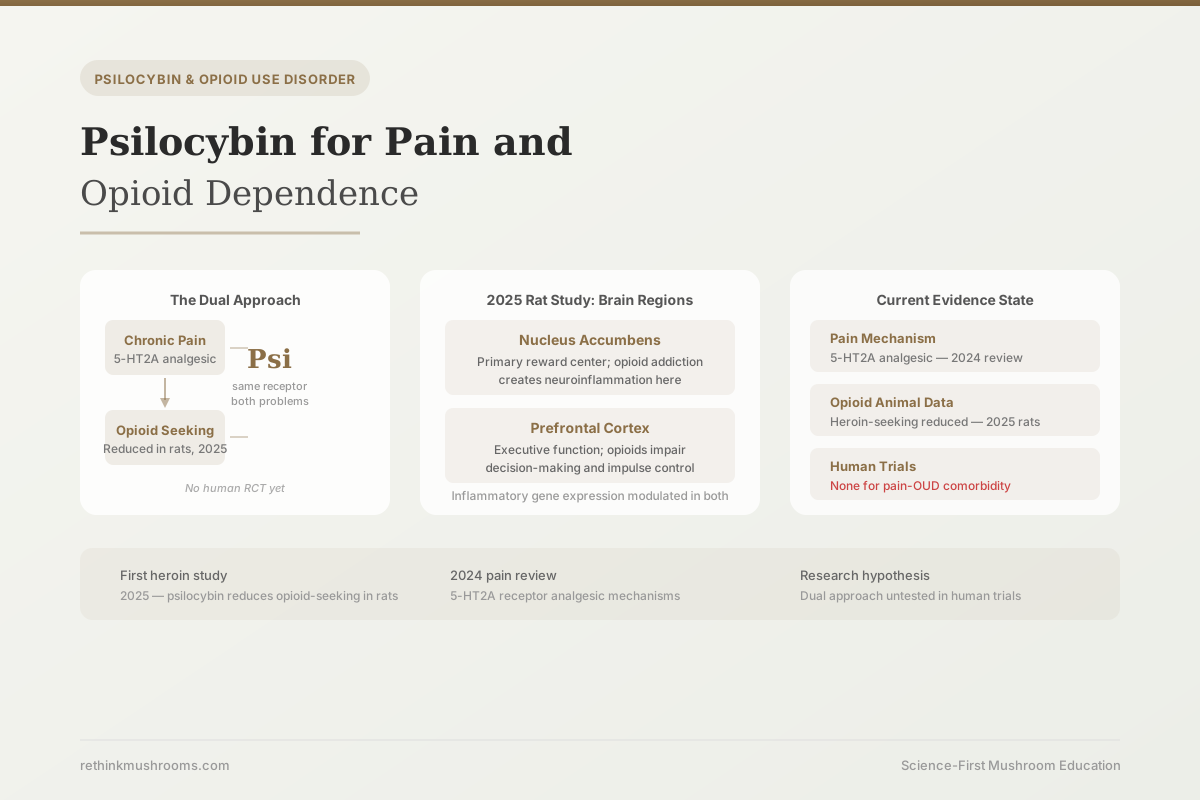
Psilocybin's primary receptor target is expressed in cortical pain-processing regions, providing a plausible biological basis for its analgesic effects and a potential mechanism for addressing both chronic pain and opioid-seeking behavior.
Aaronson et al., Journal TBD, 2024
2 brain regions
nucleus accumbens + prefrontal cortex where psilocybin modulated inflammatory gene expression in a 2025 heroin rat study
2025
year of the first mechanistic animal study specifically examining psilocybin's effect on heroin-seeking behavior
0 RCTs
as of 2025, no randomized trial has tested psilocybin specifically for pain-OUD comorbidity; this remains a research hypothesis
Aaronson et al., Journal TBD, 2024
 View as image ↗
The opioid crisis is often framed as an addiction problem. The underlying driver, for many of the people caught in it, is pain. Chronic pain drove the prescription. The prescription became the dependence. Treating the addiction without addressing the pain puts people back at the beginning. This is the context that makes a "dual approach" research question worth taking seriously: could a single compound address both the analgesic need and the opioid-seeking behavior? In 2024, a systematic review identified psilocybin as a novel candidate for chronic pain treatment via 5-HT2A receptor mechanisms.[1] In 2025, the first animal study specifically targeting opioids found psilocybin reduced heroin-seeking behavior in rats and altered inflammatory gene expression in the brain's reward circuitry.[2] Neither study has human clinical trial follow-up yet. But together they outline a hypothesis no competitor content has connected. For the broader framework of psilocybin in addiction research, see psilocybin for alcohol addiction: the NYU clinical trial results, the pillar covering the clinical evidence that established this field.
Key Takeaways
- A 2024 review identified psilocybin as a potential novel treatment for chronic pain, describing 5-HT2A receptor-mediated analgesic mechanisms in cortical pain-processing regions (Aaronson et al., 2024)
- A 2025 rat study found psilocybin reduced heroin-seeking behavior and modulated inflammatory gene expression in the nucleus accumbens and prefrontal cortex, marking the first mechanistic animal study specifically targeting opioid addiction biology
- The same receptor pathway (5-HT2A) that psilocybin activates to disrupt habitual patterns may also be involved in its analgesic effects, raising the possibility that one compound could address both sides of the pain-to-OUD pipeline
- A 2025 systematic review of psilocybin for substance use disorders represents the current most comprehensive evidence summary, but opioid-specific human clinical data remains essentially absent
- Chronic pain is a primary driver of opioid use disorder: treating addiction without addressing pain is a structural limitation of current approaches that the dual hypothesis directly targets
- No human randomized controlled trial has studied psilocybin specifically for the pain-OUD comorbidity; this article covers research-stage evidence, not clinical guidance
The Pain-to-OUD Pipeline: Chronic Pain Is Where Most Opioid Dependence Begins
Opioid use disorder rarely begins with someone seeking a high. The most common pathway runs through a doctor's office: a patient with chronic back pain, post-surgical pain, cancer-related pain, or fibromyalgia is prescribed opioids for legitimate relief. The medication works. Then it stops working as well, requiring higher doses. Then physical dependence develops. Then, when the prescription ends or becomes harder to access, the same neurological need that drove the escalation begins driving dangerous behavior.
This pipeline is not a character flaw. It is a predictable pharmacological outcome of long-term opioid exposure. Opioids rewire the brain's reward system, sensitize pain receptors in ways that can actually increase pain perception over time (a phenomenon called opioid-induced hyperalgesia), and create physical withdrawal symptoms severe enough to drive continued use even when the person no longer wants the drug.
Current addiction treatment addresses the opioid receptor directly. Buprenorphine and methadone both bind opioid receptors, dampening withdrawal and craving through receptor-level chemistry. They are effective at keeping people alive and functional. They do not address the chronic pain that may have started the cycle in the first place, nor the psychological dimensions of addiction: the habitual behavior patterns, the cue-triggered cravings, the altered self-narrative that makes relapse feel inevitable.
Psilocybin does not act on opioid receptors at all. What it does is work through serotonin receptor pathways that may have something to offer on both the pain side and the psychological addiction side, through overlapping but distinct mechanisms. That is the hypothesis this article examines.
Why the 5-HT2A Receptor Connects Psilocybin to Pain Relief
When people think about why psilocybin might help with mental health conditions, they typically think about its effects on perception, emotion, and the sense of self. The mechanism is serotonin 2A (5-HT2A) receptor agonism. Psilocin, the active compound after psilocybin is metabolized in the body, binds 5-HT2A receptors throughout the brain with high affinity. That binding disrupts default mode network activity, enhances neuroplasticity, and changes the way the brain processes self-referential thoughts and habitual behavior.
What is less commonly discussed is that 5-HT2A receptors are also expressed in the regions of the cortex that process pain.
A 2024 systematic review by Aaronson and colleagues examined the emerging evidence for psilocybin as a treatment for chronic pain, focusing specifically on this receptor-mediated analgesic mechanism.[1] The central insight of this literature is that pain is not simply a peripheral signal: a nerve fiber reporting tissue damage to the brain. Pain perception involves the brain's interpretation of that signal, filtered through emotional context, attention, memory, and prediction. Chronic pain, in particular, often becomes decoupled from ongoing tissue damage. The emotional and cognitive amplification of the signal continues long after the original injury has healed.
5-HT2A agonism, by altering activity in the cortical regions that interpret and amplify pain signals, may change how intensely pain is experienced without blocking the original nociceptive input at all. This is a mechanism distinct from opioids (which reduce the signal itself) and from NSAIDs (which reduce peripheral inflammation). Psychedelics alter the experience of pain from the top down rather than the signal from the bottom up.[1]
This framing has clinical implications. For people with chronic pain that has become psychologically entrenched, where the pain experience persists even when the original tissue injury is largely resolved, a top-down cortical intervention could be more effective than a peripheral or opioid-receptor-based one. For people whose chronic pain drove them into opioid dependence, the same intervention that might reduce pain could simultaneously address the psychological and behavioral dimensions of their addiction.
The 2025 Rat Study: Heroin-Seeking Reduction and Gene Changes in the Brain's Reward Center
In 2025, the first animal study specifically designed to examine psilocybin's effects on heroin seeking behavior was published.[2]
Prior animal research had shown psilocybin's potential in addiction models for alcohol and stimulants. Opioids are mechanistically different from those substances in ways that matter: opioids produce stronger physical dependence, different receptor pharmacology, and a withdrawal syndrome severe enough to motivate continued use even after the psychological aspects of craving have been addressed. Researchers wanted to know whether psilocybin had any effect specifically in an opioid model.
The study used male rats in a heroin self-administration and seeking behavior paradigm. The rats had established heroin-seeking behavior before psilocybin treatment. After treatment, heroin-seeking behavior was reduced.
Equally interesting was what the researchers found when they examined gene expression in two key brain regions: the nucleus accumbens and the prefrontal cortex. The nucleus accumbens is the brain's primary reward processing center, heavily implicated in addiction behavior across all substances. The prefrontal cortex is the region responsible for executive function, decision-making, and the top-down regulation of impulses. Opioid addiction impairs both regions and creates neurological changes that make addiction self-perpetuating.
Psilocybin modulated inflammatory gene expression in both regions.[2] The specific inflammatory genes affected point to one reason why opioid addiction is so difficult to treat: chronic opioid exposure creates a state of neuroinflammation in reward-related brain areas that sustains cravings and impairs the recovery of normal decision-making. Psilocybin's effect on this inflammatory signature is a mechanistic finding that goes beyond simple "less drug-seeking behavior"; it suggests a biological basis for why behavioral change might persist after treatment.
This is preclinical data. Rats are not people. What shows up in a rat heroin-seeking paradigm requires substantial translation before clinical conclusions are justified. But as the first study specifically designed to test psilocybin against opioid addiction biology, it is a meaningful addition to a field that previously had no mechanism-focused animal data at all for opioids.
The Same Mechanism for Both Problems: Where Pain and Addiction Intersect
The dual approach hypothesis rests on an observation about where these two problems overlap at the neurological level.
Chronic pain conditions involve altered cortical processing, heightened self-referential attention to the body, and a state of psychological entrenchment where the expectation of pain perpetuates the experience of pain. Opioid use disorder involves altered reward processing, habitual drug-seeking behavior encoded in striatal and prefrontal circuits, and a self-narrative in which drug use feels necessary and inevitable.
Both involve the default mode network, the brain system responsible for self-referential thinking, rumination, and the construction of habitual patterns of behavior. Chronic pain and chronic addiction share a common structural problem: the brain has organized itself around a sustained, self-perpetuating signal (pain or craving) that has become partially decoupled from its original cause.
Psilocybin's primary mechanism of action is 5-HT2A receptor agonism, which produces temporary disruption of default mode network activity and enhanced neuroplasticity. This mechanism is proposed to address exactly this kind of entrenched pattern.[1][2] The clinical hypothesis is not that psilocybin treats pain and addiction through separate mechanisms running in parallel. It is that the same neuroplasticity mechanism (the temporary opening of a window for cortical reorganization) might allow both the chronic pain pattern and the addictive behavior pattern to be disrupted simultaneously.
Whether this hypothesis will survive clinical testing is genuinely unknown. No human study has tested it. But it is mechanistically coherent and, given the structural limitations of treating addiction without addressing the underlying pain, clinically motivated.
For more on the neuroplasticity mechanism central to psilocybin's addiction research, see how psilocybin breaks addiction: the neuroscience explained. For the craving-reduction angle specifically, see psilocybin and craving reduction: mechanisms of action.
Where the Evidence Stands in 2025: A Systematic Review and Early Preclinical Data
The 2025 systematic review of psilocybin for substance use disorders represents the most comprehensive current summary of the clinical and preclinical evidence base.[3]
Within the broader psilocybin-addiction literature, the evidence hierarchy is uneven. The clinical evidence for psilocybin in tobacco cessation is relatively strong: the Johns Hopkins pilot study, now replicated across larger trials, showed 80% abstinence rates at six-month follow-up. The NYU and Johns Hopkins alcohol trials showed statistically significant reductions in heavy drinking. These are controlled human data with real patient populations.
For opioids specifically, the 2025 systematic review finds the evidence is in its earliest stages. The heroin rat study represents the primary mechanistic preclinical data. Population-level surveys have found associations between naturalistic psychedelic use and reduced opioid use disorder risk, but those are observational and cannot establish causation. Clinical trials focused specifically on opioid use disorder have been proposed, with programs at Imperial College London and several US institutions, but as of 2025 they have not completed and published results.[3]
For the pain-OUD comorbidity angle specifically (the "dual approach" that is this article's focus), no clinical trial has been designed to test it. This is a research hypothesis, coherent and motivated but unverified by human data.
The 2024 chronic pain review adds a layer: it documents the biological plausibility of psilocybin for pain, providing a mechanistic foundation that supports the hypothesis without confirming the clinical outcome.[1]
For the reader trying to calibrate confidence: the pain mechanisms are biologically plausible and the animal opioid data is directionally encouraging. The gap between "biologically plausible and directionally encouraging" and "proven clinical treatment" is the entire phase 2 and phase 3 clinical trial process.
What Psilocybin Cannot Do for Opioid Dependence
Because the opioid crisis has created enormous demand for new treatments, it is worth being specific about what psilocybin does not do.
Psilocybin does not act on opioid receptors. It cannot substitute for buprenorphine or methadone in managing physical withdrawal. Opioid withdrawal is mediated by opioid receptor desensitization and creates physical symptoms (sweating, nausea, muscle cramps, and severe anxiety) that are distinct from psychological craving and that psilocybin's serotonergic mechanism does not address. Attempting to use psilocybin during acute opioid withdrawal would not manage those physical symptoms and could complicate the psychological experience substantially.[3]
The clinical hypothesis for where psilocybin fits in opioid use disorder treatment is not as an acute withdrawal management tool. It is as a post-detox intervention: after the physical dependence has been managed through conventional medication-assisted treatment, psilocybin could be used to address the psychological and behavioral layers that medication-assisted treatment does not touch. The habitual behavior patterns encoded in striatal circuits, the self-narrative organized around drug use, the cue-triggered craving responses: these are the dimensions where psilocybin's mechanism is proposed to be relevant.
This is a sequential, not a replacement, model. Medication-assisted treatment manages acute withdrawal and stabilizes the person. Psilocybin-assisted therapy, if it works in opioid populations the way it has worked in alcohol and tobacco populations, would address the longer-term psychological work. Whether it can also reduce the chronic pain that drove the initial opioid use adds an additional dimension that the dual approach hypothesis introduces.
For a direct comparison between ibogaine, which does act on opioid receptors and can interrupt acute withdrawal, and psilocybin, which does not, see ibogaine vs. psilocybin for opioid addiction: different approaches. For the full mechanism of how psilocybin may break addiction cycles via DMN disruption, see psilocybin and opioid use disorder: can psychedelics break the cycle?.
The Bottom Line
Psilocybin is being studied for both chronic pain and opioid use disorder through overlapping mechanisms: 5-HT2A receptor agonism in cortical pain-processing regions may explain analgesic effects, while a 2025 animal study found reduced heroin-seeking behavior and inflammatory gene modulation in reward-related brain areas. These two lines of evidence, combined with the well-established clinical pathway from chronic pain to opioid dependence, motivate a "dual approach" hypothesis in which psilocybin addresses both the underlying pain and the resulting addiction. No human clinical trial has tested this hypothesis directly; the current evidence is preclinical and mechanistic, not a basis for clinical guidance.
Frequently Asked Questions
Sources & References
- 1. Source details for this reference are not yet available.
- 2. Source details for this reference are not yet available.
- 3. Source details for this reference are not yet available.