Psilocybin & Opioid Use Disorder
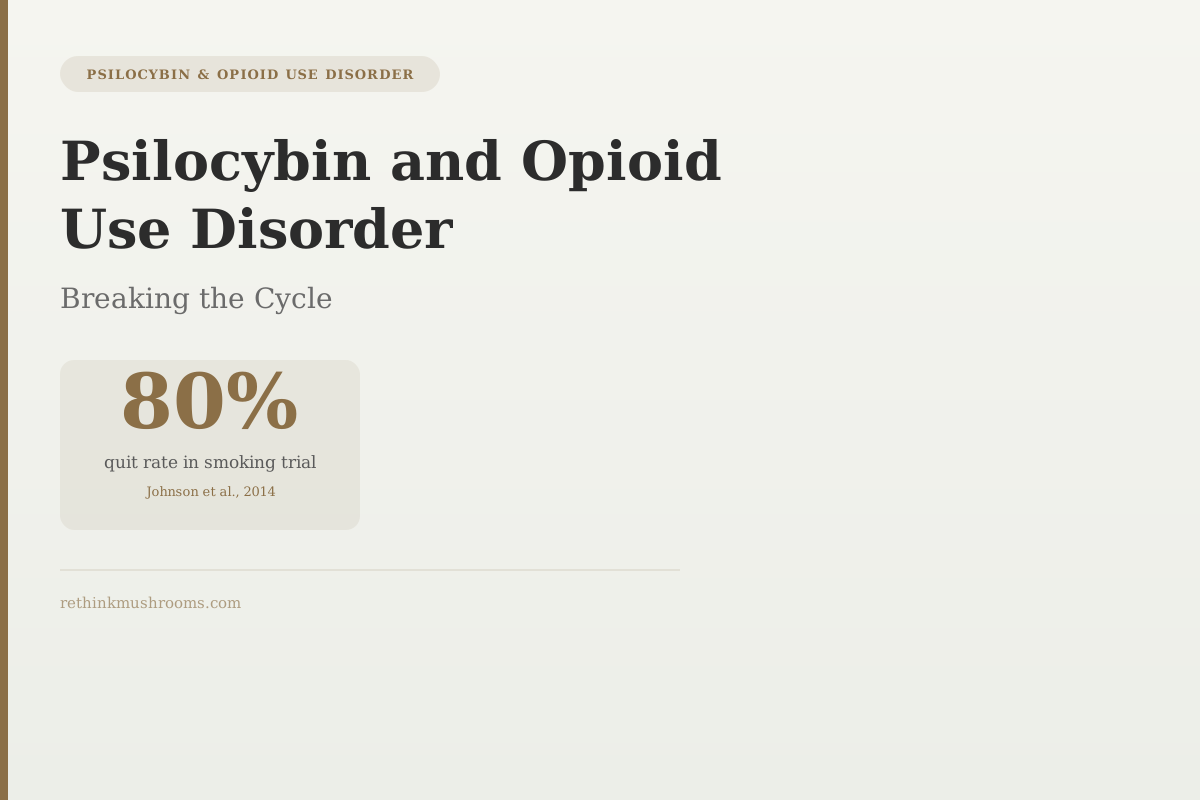
80% quit rate
In the strongest addiction trial ever run with psilocybin, 80% of heavy smokers were still abstinent at 6 months after two to three sessions. Researchers studying opioid use disorder are watching that number carefully.
Johnson et al., 2014
30%
reduced odds of developing OUD among psychedelic users (national survey data)
2025
first study showing psilocybin reduces heroin-seeking in animal models
3
interacting cycles in opioid addiction — psilocybin may address two of them
Johnson et al., 2014
 View as image ↗
More than 80,000 Americans died of opioid overdoses in 2022. The medications we have — methadone, buprenorphine, naltrexone — are genuinely effective, but they address one part of opioid addiction while leaving other parts largely untreated. People complete detox, manage withdrawal, and still relapse. The reason is that opioid addiction does not run on one mechanism. It runs on three interacting cycles, and the medications that handle physical dependence do not fully address the behavioral and psychological cycles that pull people back.
That gap is where psilocybin opioid use disorder research is beginning. The evidence is early — mostly animal studies and population surveys, with clinical trials underway but not yet completed. But the mechanistic logic is specific: psilocybin may address exactly the cycles that current medications miss. This article examines what the research actually shows, what psilocybin cannot do for opioid addiction, and what a combined treatment model might eventually look like.
Psilocybin has its strongest addiction evidence in alcohol and smoking cessation. For the foundation of how psilocybin works across addiction broadly, see the NYU alcohol trial and what it showed about addiction recovery.
Key Takeaways
- Opioid addiction operates through three interlocking cycles: physical dependence, habitual drug-seeking behavior, and psychological craving — psilocybin has proposed mechanisms for cycles two and three, but not cycle one
- Psilocybin does NOT act on opioid receptors and does NOT treat acute withdrawal — it is not a replacement for medication-assisted treatment
- A 2025 animal study found psilocybin reduced heroin-seeking behavior in male rats and altered inflammatory gene expression in the brain's reward center and decision-making region — the first study examining psilocybin specifically against opioid addiction biology
- Johnson et al. (2014) found 80% of heavy smokers were still abstinent six months after psilocybin-assisted treatment — the strongest existing evidence that psilocybin can break an established addiction cycle
- National survey data shows psychedelic use is associated with approximately 30% reduced odds of developing an opioid use disorder, though this is observational and cannot establish causation
- A 2025 systematic review found psilocybin's evidence base for addiction is growing, but opioid-specific clinical trial data remains very limited
The Three-Cycle Model: What Makes Opioid Addiction So Hard to Break
To understand where psilocybin fits, it helps to understand why opioid addiction is uniquely resistant to treatment.
When a person uses opioids regularly, three distinct processes take hold in the brain simultaneously. Each is real, each is measurable, and each requires a different intervention to address.
Cycle one: physical dependence. Opioids bind to specific receptors on brain cells, called mu-opioid receptors, that normally respond to the body's natural pain-relief chemicals. With repeated use, the brain adapts: it reduces the sensitivity of those receptors and produces fewer of its own natural opioids. The person now needs opioid drugs just to feel normal. When the drug is removed, the receptors are still recalibrated for opioid input that isn't coming — producing withdrawal symptoms ranging from severe discomfort to medically dangerous distress. This cycle is managed, effectively, by medications like buprenorphine and methadone, which bind to the same receptors and prevent withdrawal.
Cycle two: habitual drug-seeking behavior. Separate from physical dependence, opioid use encodes automatic behavioral patterns in a part of the brain called the dorsal striatum, which is the brain's habit-encoding region. Drug-seeking becomes automatic: triggered by environmental cues, times of day, emotional states, and social contexts associated with past use. These automatic patterns persist long after physical withdrawal is complete. This is why detox alone rarely prevents relapse — the behavioral program remains even after the receptor dependence is gone.
Cycle three: psychological craving. The brain's self-referential circuit, called the default mode network, becomes oriented around opioid use as a primary goal. The person doesn't just habitually seek drugs; they obsessively think about them, anticipate them, and experience intense discomfort when unable to use. This psychological cycle operates partly through the brain's reward anticipation system and partly through habitual patterns of self-referential thinking that keep opioid use central in the person's mental life.
Current medications address cycle one well. They address cycles two and three inadequately. That is the problem psilocybin researchers are trying to solve.
For a deeper account of how psilocybin disrupts habitual behavior and craving at the neurological level, see How Psilocybin Breaks Addiction: The Neuroscience Explained.
What Psilocybin Cannot Do — and Why That Honesty Matters
Before covering what psilocybin might offer, it's worth stating clearly what it cannot do for opioid addiction.
Psilocybin does not act on opioid receptors. It works through the serotonin system, specifically by activating a receptor called 5-HT2A. It has no direct action on the mu-opioid receptors that drive physical dependence and withdrawal. Taking psilocybin during active opioid withdrawal would not relieve withdrawal symptoms. It is not a detox agent.
Psilocybin cannot replace medication-assisted treatment. Methadone and buprenorphine are lifesaving medications for opioid use disorder. They reduce overdose deaths, reduce illicit opioid use, and improve quality of life. If psilocybin eventually proves useful in opioid treatment, it would complement MAT, not replace it — used after the physical dependence phase has been managed, not instead of managing it.
This matters for understanding the research claims. When a study shows psilocybin reduced heroin-seeking in rats, or that psychedelic users had lower rates of opioid use disorder, those findings speak to cycles two and three — the behavioral and psychological cycles. They say nothing about whether psilocybin can substitute for the receptor-level work that buprenorphine performs.
For the specific comparison between ibogaine (which does act on opioid receptors and can interrupt withdrawal) and psilocybin, see Ibogaine vs. Psilocybin for Opioid Addiction: Different Approaches.
The 2025 Heroin Study: Reduced Drug-Seeking in the Rat Model
The most direct animal evidence for psilocybin's potential in opioid use disorder comes from a 2025 study examining psilocybin's effect on heroin-seeking behavior in male rats.[1]
The study found that psilocybin reduced heroin-seeking behavior in rats. It also found that psilocybin altered the expression of inflammatory genes in two specific brain regions: the nucleus accumbens, which is the brain's reward center and the primary site where opioids produce their euphoric effects, and the prefrontal cortex, which is the brain's decision-making region and one of the areas most disrupted by chronic opioid use.
The inflammatory gene finding is significant because neuroinflammation in the reward circuit is increasingly recognized as a driver of addiction maintenance. Opioid use produces inflammatory responses in the reward system that reinforce drug-seeking by altering how the brain processes reward signals. That psilocybin modulated this inflammatory gene expression — rather than simply sedating the rats or producing non-specific behavioral suppression — suggests it may be engaging the addiction biology specifically, not just producing a general behavioral effect.
This is animal data. Results in rats do not reliably translate to effects in humans. Rats do not experience the psychological dimension of addiction the way humans do. The study does not tell us whether psilocybin would reduce heroin-seeking in people, at what dose, over what time course, or in what treatment context. What it does is provide a specific mechanistic target for future human research: the inflammatory response in the reward circuit.
For the craving reduction angle — how psilocybin may alter the psychological pull of addiction — see Psilocybin and Craving Reduction: Mechanisms of Action.
The Tobacco Precedent: The Best Evidence That Psilocybin Can Break Addiction
The strongest existing evidence that psilocybin can break an established addiction cycle comes not from opioid research but from a 2014 pilot study of heavy tobacco smokers.[5]
Johnson and colleagues at Johns Hopkins enrolled 15 people who had smoked an average of 19 cigarettes per day for over 31 years and had already failed multiple quit attempts. Participants received two to three psilocybin sessions alongside cognitive-behavioral therapy. At six months, 12 of 15 participants (80%) were biochemically confirmed as abstinent. For comparison, varenicline, the most effective approved smoking cessation medication, achieves roughly 30% abstinence at six months.
The tobacco study is relevant to opioid research because it establishes something important: psilocybin can, in some populations and some addiction patterns, dramatically interrupt cycles two and three — the habitual behavior and psychological craving cycles. The smokers weren't physically dependent on nicotine in the receptor-sensitization sense that opioid users are, but they had deeply encoded habits and strong psychological cravings that had resisted other treatments for decades.
The difference with opioids is that cycle one — physical receptor dependence — adds a layer that tobacco addiction does not have. A treatment model for opioids would need to address physical dependence first, and then psilocybin might address what remains. Whether it would work as well against the behavioral and psychological cycles of opioid addiction as it did against tobacco is the central open question.
The naturalistic data adds a population-level signal. Analysis of National Survey on Drug Use and Health data found that people who had used psychedelics were approximately 30% less likely to develop an opioid use disorder than non-users, controlling for other variables.[4] This is observational data — it can't establish whether psychedelic use caused the reduced risk, or whether people who use psychedelics differ from non-users in ways that independently reduce addiction risk. But as a population-level signal, it is consistent with the hypothesis that psychedelics may have a protective effect against the development of addictive patterns.
Where Opioid Evidence Sits in the Psilocybin Addiction Literature
Opioid use disorder is the most urgent addiction problem in the United States and among the least studied in psilocybin research. It's worth understanding why.
A 2025 systematic review of psilocybin's efficacy and safety across substance use disorders found that the evidence base is growing — but that opioid-specific clinical data remains very limited compared with the evidence for alcohol and tobacco.[2] A 2023 systematic review confirmed the same picture: psilocybin has plausible mechanisms for addiction broadly, but the opioid-specific evidence base is mostly preclinical, with clinical trials underway but not yet reporting results.[3]
The reason opioid research lags is partly historical. Psilocybin-addiction research began with tobacco (easier to study: clear outcome measure, no physical dependence complicating the protocol) and moved to alcohol (large existing treatment-seeking population, Phase 2 trial infrastructure). Opioids came next on the priority list, but the clinical trial infrastructure had to be built from scratch, the participant safety protocols are more complex (participants often need to be stabilized on MAT before enrollment), and regulatory navigation is more challenging.
Several trials are now underway. Imperial College London is running an NIHR-funded psilocybin trial for OUD. Research teams at University of Wisconsin-Madison and the University of Pennsylvania Center for Substance Abuse are also in the pipeline. Results from these trials would represent the first human clinical evidence for psilocybin in opioid use disorder specifically.
For the full research review across all addiction types and psychedelic compounds, see Psychedelic-Assisted Therapy for Opioid Addiction: Research Review.
What a Psilocybin Opioid Treatment Model Might Look Like
Based on the existing evidence and the three-cycle model above, researchers have hypothesized how psilocybin might fit into an opioid treatment protocol. This is a speculative clinical framework, not an established practice — but it clarifies what the research is building toward.
Phase one: physical stabilization. The patient is first stabilized on medication-assisted treatment, managing opioid receptor dependence through buprenorphine or methadone. Physical withdrawal is addressed before psilocybin enters the picture. Skipping this phase would not make psilocybin more effective and would introduce unnecessary medical risk.
Phase two: psilocybin session with therapeutic support. After physical stabilization, a psilocybin session is conducted in a supported clinical environment with preparation beforehand and integration sessions afterward. The session targets cycles two and three: habitual behavior and psychological craving. The proposed mechanisms here involve the disruption of self-referential thought patterns through modulation of the default mode network, increased neuroplasticity that may allow the brain to form new patterns around the addiction behavior, and the insight-generating properties of the psychedelic experience that have predicted outcomes in addiction trials.
The role of the mystical or deeply meaningful experience produced by psilocybin — which has been a predictor of outcomes in both the tobacco and alcohol trials — would likely play a role in OUD treatment as well, for the same reasons it matters in other addiction contexts. For a closer look at this mechanism, see The Mystical Experience and Addiction Recovery: Why It Matters.
Phase three: ongoing support and relapse prevention. Integration sessions after psilocybin, continued MAT as appropriate, and behavioral support would address the months-long period in which new patterns need to solidify before old cue-triggered habits fully recede.
This model is speculative. Clinical trials are testing whether any of these phases work together as hypothesized. Whether psilocybin adds meaningful benefit over MAT alone, what the optimal dose and number of sessions would be, and which patients respond are all unanswered questions.
For the specific angle of chronic pain as a driver of opioid dependence, and psilocybin's potential to address both simultaneously, see Psilocybin and Pain Perception: A Dual Approach to Opioid Dependence.
The Bottom Line
Opioid use disorder involves three interacting cycles, and psilocybin has proposed mechanisms for two of them: the habitual behavior cycle and the psychological craving cycle. It does not address physical opioid receptor dependence and is not a replacement for medication-assisted treatment. The current evidence base includes one 2025 heroin animal study showing reduced drug-seeking behavior, population data showing reduced odds of OUD among psychedelic users, and the strongest psilocybin addiction result on record from a tobacco cessation trial. Clinical trials specifically for opioid use disorder are underway but have not yet reported results.
Frequently Asked Questions
Sources & References
- 1. Source details for this reference are not yet available.
- 2. Source details for this reference are not yet available.
- 3. Source details for this reference are not yet available.
- 4. Source details for this reference are not yet available.
- 5. Source details for this reference are not yet available.