Reishi & Cardiovascular Health
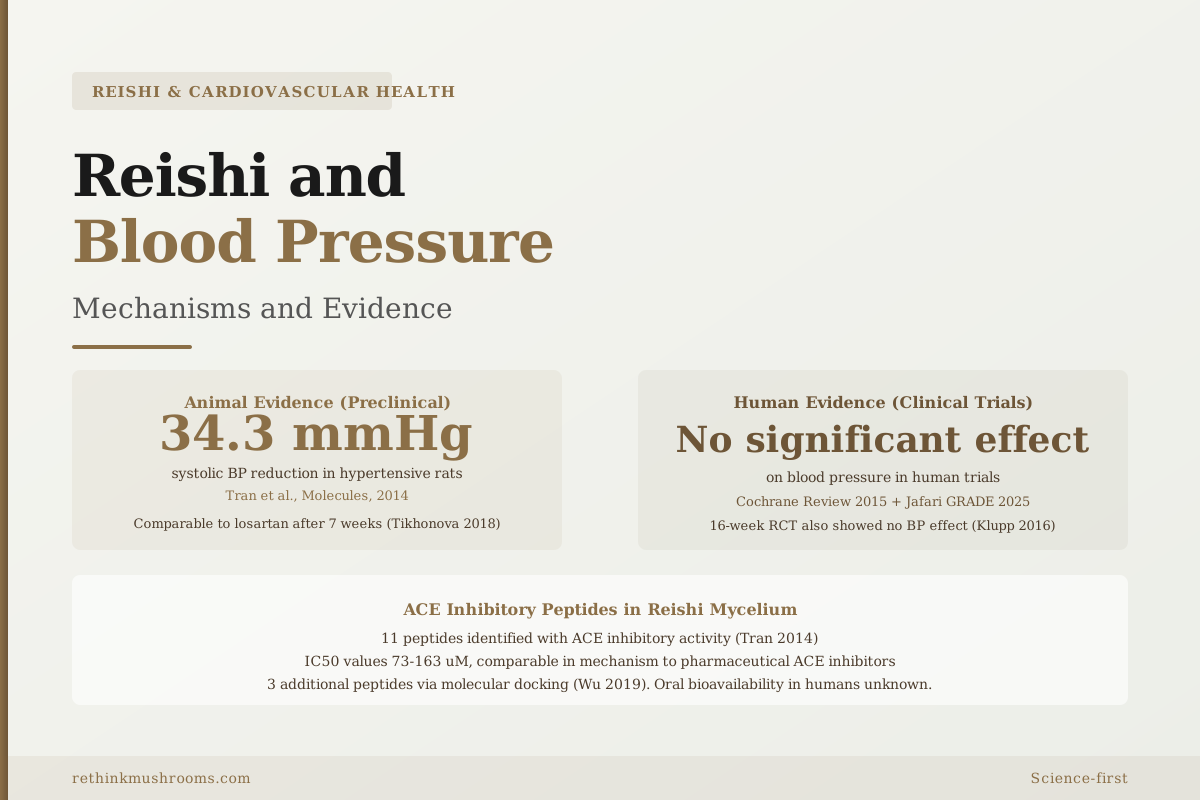
34.3 mmHg
A 2014 study identified ACE inhibitory peptides in Reishi extract that reduced systolic blood pressure by 34.3 mmHg (19.5%) in hypertensive rats within 4 hours, a striking preclinical finding that has not yet been replicated in human trials.
Tran et al., Molecules, 2014
11
ACE inhibitory peptides identified in Reishi autodigested extract by Tran et al. 2014
0
significant blood pressure effects found in human clinical trials per 2025 GRADE meta-analysis
7 weeks
duration of Tikhonova 2018 Reishi treatment that produced losartan-comparable BP reduction in hypertensive rats
Tran et al., Molecules, 2014
 View as image ↗
Reishi mushroom contains peptides that inhibit angiotensin-converting enzyme, the same enzyme targeted by ACE inhibitor drugs like lisinopril, ramipril, and enalapril. This is not a vague pharmacological claim. Researchers have isolated, named, and structurally characterized specific peptides from Reishi mycelium with IC50 values comparable to pharmaceutical ACE inhibitors.
In animal models of hypertension, Reishi extracts have reduced systolic blood pressure by amounts that, if replicated in humans, would be clinically meaningful. One hypertensive rat study reported BP reduction comparable to losartan, a widely prescribed angiotensin receptor blocker.
Then the clinical trials arrive, and the picture changes.
The 2015 Cochrane systematic review of available randomized controlled trials concluded that Reishi does not significantly reduce blood pressure in humans. The 2025 GRADE meta-analysis, the most methodologically rigorous clinical analysis published, confirmed no significant effect on blood pressure in human trials. The mechanism is real. The translation to humans, so far, is not.
This article traces both sides: what the preclinical data shows and why it is genuinely interesting, and what the clinical data shows and why it represents the honest current ceiling of the evidence. It also covers the drug interaction risk that no other Reishi content addresses.
For broader context on Reishi's cardiovascular mechanisms, see the Reishi and heart health overview and the complete Reishi pharmacology guide. For the specific compounds driving these effects, see Reishi bioactive compounds: triterpenes, polysaccharides, and sterols. For the pillar overview of Reishi research, see what is Reishi mushroom.
Key Takeaways
- Reishi mycelium contains at least 11 peptides with ACE inhibitory activity; 4 showed IC50 values of 73-163 μM, comparable to pharmaceutical ACE inhibitors in mechanism, per Tran et al. 2014
- A 2018 study found that 7 weeks of Reishi supplementation in hypertensive rats produced blood pressure reduction comparable to losartan, a standard antihypertensive drug
- The 2015 Cochrane systematic review found no significant effect of Reishi on blood pressure in human clinical trials
- The 2025 Jafari GRADE meta-analysis, the most current and methodologically rigorous clinical review, confirmed no significant blood pressure effect in humans at tested doses
- The 2016 Klupp double-blind RCT specifically found no significant effect on blood pressure in 16 weeks of Reishi supplementation in metabolic syndrome patients
- People taking antihypertensive medications (ACE inhibitors, ARBs, beta-blockers) should be aware that Reishi's preclinical ACE inhibitory activity could theoretically produce additive blood pressure-lowering effects
How Reishi Affects Blood Pressure: The ACE Inhibitory Peptide Mechanism
Angiotensin-converting enzyme (ACE) is a protein in blood vessel walls that converts angiotensin I to angiotensin II. Angiotensin II constricts blood vessels, which raises blood pressure. ACE inhibitor drugs (a class that includes lisinopril, ramipril, and enalapril) block this conversion, reducing vascular constriction and lowering blood pressure. They are among the most prescribed cardiovascular medications worldwide.
Reishi mycelium contains peptides that inhibit ACE through the same competitive mechanism.
A 2014 study by Tran and colleagues isolated an auto-digested extract from Reishi and identified 11 peptides with ACE inhibitory activity.[1] Four of these peptides showed potent inhibitory activity, with IC50 values (the concentration needed to inhibit the enzyme by 50%) ranging from 73.1 to 162.7 μM. These are meaningful values: they place these peptides in the same mechanistic category as pharmaceutical ACE inhibitors, though at higher concentrations than single-molecule drugs.
The same study tested the auto-digested extract in spontaneously hypertensive rats, animals genetically predisposed to high blood pressure. Within 4 hours of oral administration, systolic blood pressure dropped by 34.3 mmHg, a reduction of 19.5%. In hypertension research, a 10+ mmHg systolic reduction is considered clinically significant.
A 2019 study by Wu and colleagues identified three additional antihypertensive peptides in Reishi mycelium with potent ACE inhibitory activity.[5] Wu's team used molecular docking analysis to show that these peptides share structural features with the active sites of ACE inhibitor drugs, providing a mechanistic explanation for why they inhibit ACE specifically rather than as a general effect.
This is not speculative pharmacology. The peptides are real, isolated, characterized, and structurally analogous to drug active sites. The question is whether they survive oral digestion and reach the bloodstream at sufficient concentrations to produce a clinically relevant effect in humans. That question has been studied. The results diverge significantly from the animal data.
In Hypertensive Rats, Reishi Reduced Blood Pressure Comparably to Losartan
The Tran 2014 finding was notable for its acute magnitude (34.3 mmHg within 4 hours). Tikhonova and colleagues extended the timeline.
A 2018 study by Tikhonova et al. administered Reishi to the ISIAH rat strain, a genetically hypertensive model used specifically for cardiovascular drug testing, for 7 weeks.[4] The blood pressure reduction produced by 7 weeks of Reishi treatment was comparable to losartan, an angiotensin receptor blocker (ARB) used as the gold-standard comparator drug in hypertension studies.
Losartan is a widely prescribed antihypertensive medication. A Reishi extract producing equivalent BP reduction to losartan in a controlled animal model is a remarkable preclinical finding. The Tikhonova study also found neurometabolic effects alongside the BP reduction, suggesting Reishi's cardiovascular action may involve both peripheral (vessel wall) and central (neurological) pathways.
This animal evidence, taken together, forms a mechanistically coherent and quantitatively meaningful case for Reishi's antihypertensive potential. The ACE inhibitory peptides provide a specific mechanism. Two independent animal studies show blood pressure reductions of clinical magnitude. The data supports the hypothesis.
What animal data cannot answer is whether the same effect occurs in humans, at the doses tested, using available supplement formulations.
The Human Evidence: Two Clinical Reviews Found No Significant Effect
The human clinical data tells a different story.
The 2015 Cochrane systematic review by Klupp and colleagues evaluated all available randomized controlled trials of Reishi for cardiovascular risk factors.[2] The Cochrane review is the highest-quality systematic review format, using pre-registered methods and strict inclusion criteria. Its conclusion was direct: the evidence does not support the use of Reishi for treatment of cardiovascular risk factors, including blood pressure, in people with type 2 diabetes.
The 2016 double-blind randomized controlled trial by Klupp et al. provided the most directly relevant single clinical study.[3] This 16-week RCT enrolled people with metabolic syndrome (a population with elevated cardiovascular risk factors including high blood pressure) and compared Reishi supplementation to placebo. After 16 weeks, Reishi did not significantly affect blood pressure compared to placebo. The null result was consistent across multiple cardiovascular measures including lipid profiles.
The most current clinical evidence comes from Jafari and colleagues' 2025 GRADE meta-analysis of Reishi clinical trials.[6] GRADE is a framework for rating confidence in evidence that accounts for study quality, consistency of results, and risk of bias. The 2025 Jafari analysis, the most methodologically rigorous evaluation of the full human trial evidence, found that Reishi produced modest significant effects on antioxidant markers and heart rate. No significant effect on blood pressure. No significant effect on lipid profiles. No significant effect on inflammatory markers.
This is the honest current ceiling of human evidence: Reishi's antihypertensive effect does not appear in human clinical trials at the doses and durations that have been tested.
Why the Animal Data Hasn't Translated to Human Trials
The gap between striking animal results and null human results is common in pharmacology, and it usually has specific explanations. Several are plausible for Reishi's blood pressure data.
Peptide bioavailability. The ACE inhibitory peptides identified in the Tran 2014 and Wu 2019 studies are short protein fragments. Oral peptides face digestion in the stomach and small intestine, which can cleave them into inactive fragments before they reach the bloodstream. The auto-digested extract used in the Tran study was pre-digested to mimic gastrointestinal processing, which is why it showed activity. But the concentrations reaching blood vessel walls in vivo may still be insufficient for clinical BP reduction.
Formulation differences. The peptide-rich extracts used in the animal studies are not standard commercial Reishi supplements, which typically contain fruiting body or spore material standardized to polysaccharide or triterpene content, not to ACE inhibitory peptide concentration. The active peptides come from mycelium, not fruiting body. This means most commercial preparations may contain little of the peptide fraction shown active in animal studies.
Population and dose. The Cochrane review and Klupp RCT enrolled people with type 2 diabetes or metabolic syndrome, who are typically on multiple medications including antihypertensives. These populations present a higher baseline complexity than the animal models. The doses used in human trials may also not correspond to the doses producing effects in animal models when adjusted for body weight and bioavailability.
These explanations are hypotheses, not established facts. The honest answer is that we do not know precisely why animal results have not translated. What we know is that the human trials have been conducted and the effect has not appeared.
Taking Reishi With Blood Pressure Medications: A Safety Note
This section covers safety information that no other widely available Reishi content addresses clearly.
If you are taking medications for high blood pressure, including ACE inhibitors (lisinopril, ramipril), angiotensin receptor blockers (losartan, valsartan), beta-blockers (metoprolol, atenolol), or calcium channel blockers (amlodipine, diltiazem), combining them with Reishi raises a specific concern.
Reishi contains compounds with preclinical ACE inhibitory activity and produced blood pressure reductions in animal models. While human trials have not shown this effect at tested doses, the mechanism is real. If ACE inhibitory peptides from Reishi did reach clinically relevant concentrations in combination with pharmaceutical antihypertensives, the combined effect could lower blood pressure beyond the therapeutic target, causing hypotension (dangerously low blood pressure) with symptoms including dizziness, fainting, and falls.
This is not a documented clinical interaction from human case reports. It is a theoretical risk based on mechanism, and the human trial data suggests it may be lower than the animal data implies. But for someone managing hypertension with medication, it is the kind of theoretical additive effect worth discussing with a prescribing clinician before starting Reishi.
The same logic applies to anyone who also takes antiplatelet drugs (aspirin, clopidogrel) or anticoagulants (warfarin, apixaban): Reishi has documented antiplatelet effects from a 1990 clinical study and subsequent in vitro research. Additive antiplatelet effects could theoretically increase bleeding risk, though again this has not been documented in human interaction studies.
These cautions are not reasons to avoid Reishi. They are the honest safety framing that anyone considering Reishi alongside cardiovascular medications should understand.
For how Reishi compares to other cardiovascular interventions and full cluster context, see the Reishi and cholesterol article, atherosclerosis article, and Reishi and homocysteine article.
The Bottom Line
Reishi mycelium contains peptides with ACE inhibitory activity and produced blood pressure reductions comparable to standard antihypertensive drugs in animal models of hypertension. However, the 2015 Cochrane review, 2016 double-blind RCT, and 2025 GRADE meta-analysis (the three most rigorous available evaluations) found no significant effect on blood pressure in human clinical trials. The mechanism is coherent but has not translated to human outcomes at tested doses and formulations. People taking antihypertensive medications should be aware of the theoretical additive risk from Reishi's ACE inhibitory activity.
Frequently Asked Questions
Sources & References
- 1RTHM-00352·Tran, Hai-Bang et al. (2014). “Hypotensive effects and angiotensin-converting enzyme inhibitory peptides of reishi (Ganoderma lingzhi) auto-digested extract..” Molecules (Basel.Study breakdown →PubMed →↩
- 2RTHM-00380·Klupp, Nerida L et al. (2015). “Ganoderma lucidum mushroom for the treatment of cardiovascular risk factors..” The Cochrane database of systematic reviews.Study breakdown →PubMed →↩
- 3RTHM-00429·Klupp, Nerida L et al. (2016). “A double-blind, randomised, placebo-controlled trial of Ganoderma lucidum for the treatment of cardiovascular risk factors of metabolic syndrome..” Scientific reports.Study breakdown →PubMed →↩
- 4. Source details for this reference are not yet available.
- 5RTHM-00596·Wu, Qiang et al. (2019). “Isolation and Characterization of Three Antihypertension Peptides from the Mycelia of Ganoderma Lucidum (Agaricomycetes)..” Journal of agricultural and food chemistry.Study breakdown →PubMed →↩
- 6RTHM-02098·Jafari, Ali et al. (2025). “The Nutritional Significance of Ganoderma lucidum on Human Health: A GRADE-Assessed Systematic Review and Meta-Analysis of Clinical Trials..” Food science & nutrition.Study breakdown →PubMed →↩