Reishi and Cardiovascular Health
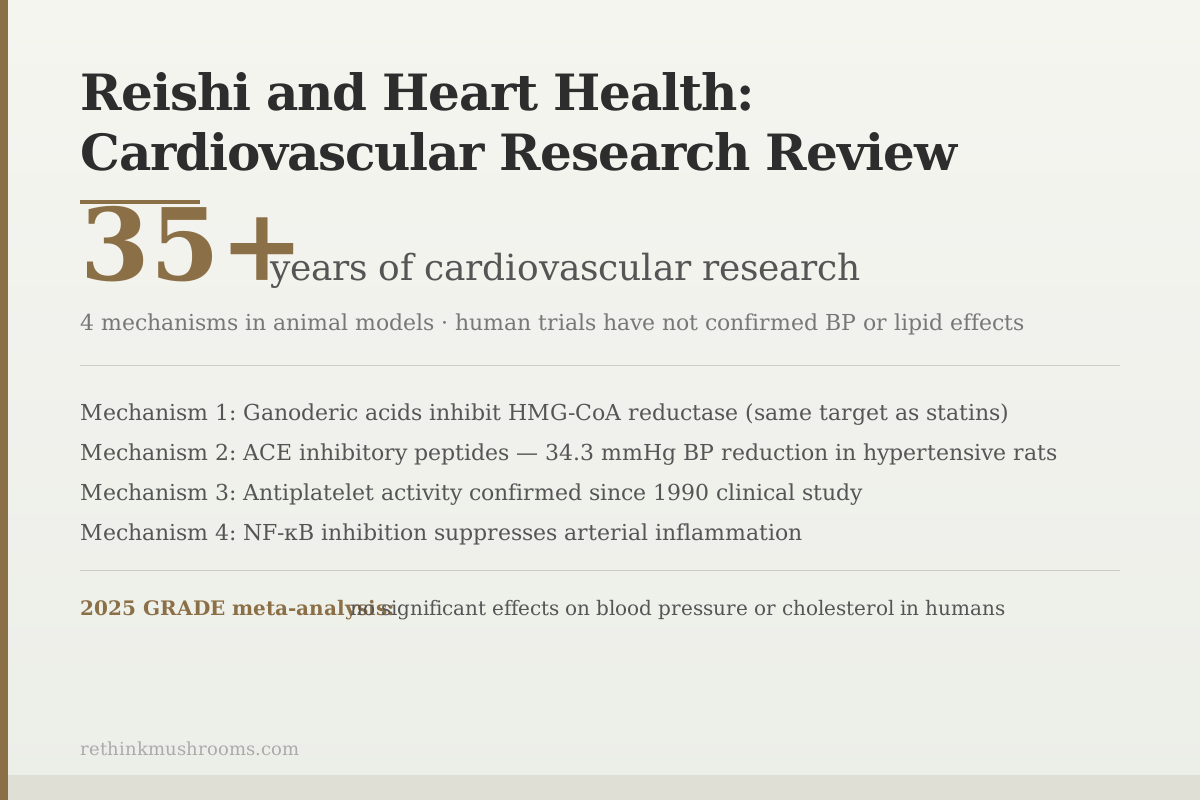
35+ years
Reishi's cardiovascular research dates to a 1990 landmark study on platelet aggregation. Four distinct mechanisms have been identified in animal models. The 2025 GRADE meta-analysis found no significant effects on blood pressure or cholesterol in humans.
Jafari et al., Food Science & Nutrition, 2025
4 mechanisms
lipid, blood pressure, antiplatelet, anti-inflammatory (all shown preclinically)
Null in humans
2025 GRADE meta-analysis: no significant BP or lipid effects at tested doses
Drug interactions
potential interactions with warfarin and ACE inhibitors via preclinical mechanisms
Jafari et al., Food Science & Nutrition, 2025
 View as image ↗
The research question is simple: does Reishi (Ganoderma lucidum) benefit the heart? The answer is harder to give clearly because the preclinical evidence and the human clinical evidence point in different directions.
Animal and laboratory studies have identified four distinct cardiovascular mechanisms: Reishi's triterpenes inhibit cholesterol synthesis enzymes; its peptides inhibit the enzyme that raises blood pressure; its compounds reduce platelet clumping; and its polysaccharides suppress arterial inflammation. These are not speculative mechanisms; they are specific molecular interactions that have been confirmed in multiple labs over three decades.
Human clinical trials have not validated those mechanisms at the level of measurable outcomes. The most comprehensive human evidence synthesis to date, a 2025 GRADE meta-analysis by Jafari and colleagues, found no significant effect of Reishi supplementation on blood pressure, LDL cholesterol, HDL cholesterol, or inflammatory markers.[1]
This article covers both: the mechanisms, and why the human trials have not yet confirmed them. For the foundational overview of Reishi as a species, see What Is Reishi Mushroom? The Science Behind the Mushroom of Immortality.
If you only read one thing
Reishi has four cardiovascular mechanisms confirmed in animal and lab research, but the most rigorous human evidence to date, a 2025 GRADE-assessed meta-analysis, found no significant effect on blood pressure or cholesterol at the doses tested in clinical trials. The mechanisms are real; the human clinical payoff has not yet been demonstrated.
Key Takeaways
- The 2025 Jafari GRADE meta-analysis, the most current and methodologically rigorous human evidence synthesis, found no significant effect on blood pressure or lipid profile at doses tested in clinical trials
- Animal studies show consistent lipid-lowering effects; a 2023 meta-analysis of animal studies confirmed significant LDL, total cholesterol, and triglyceride reductions (Aref 2023)
- Reishi's ganoderic acid A inhibits HMG-CoA reductase, the same enzyme statins block, in molecular docking studies (Sui 2025)
- Reishi mycelium contains peptides with ACE inhibitory activity comparable in mechanism to blood pressure drugs; a hypertensive rat model showed 34.3 mmHg systolic reduction (Tran 2014)
- The 1990 Tao study established antiplatelet activity in both animal models and a controlled clinical study; Reishi has 35+ years of cardiovascular research
- The preclinical-clinical gap likely reflects dose standardization problems and short trial durations rather than absence of a real mechanism
The Honest Answer First: What Human Trials Show
The most current human evidence comes from three sources: a 2025 GRADE-assessed meta-analysis, a 2015 Cochrane review, and a 2016 double-blind RCT.
The Jafari 2025 meta-analysis pooled clinical trial data with GRADE methodology (Grading of Recommendations, Assessment, Development and Evaluations, a standardized system for rating evidence quality) and found that Reishi produced modest significant effects on antioxidant markers and resting heart rate, but no significant effect on blood pressure, LDL cholesterol, HDL cholesterol, total cholesterol, or inflammatory markers in humans.[1]
The 2016 Klupp RCT, a 16-week double-blind placebo-controlled trial in people with metabolic syndrome, reached the same conclusion: Reishi supplementation did not significantly affect LDL cholesterol, blood pressure, or other primary cardiovascular risk factors compared to placebo.[2]
The 2015 Cochrane review by the same team was also explicit: "evidence from a small number of RCTs does not support the use of G. lucidum for treatment of cardiovascular risk factors in people with type 2 diabetes mellitus."[3]
One partial positive signal exists. The Chu 2012 British Journal of Nutrition controlled trial found improvements in antioxidant status and some lipid markers with Reishi supplementation, suggesting that in some populations or formulations, effects may be detectable.[4] But this sits against the weight of null results from larger and more recent analyses.
Why the gap between compelling preclinical mechanisms and null clinical results? The likely explanations: standardized preparations with confirmed ganoderic acid and active peptide content were not used in most trials; trial durations ranged from four to sixteen weeks, which may be insufficient; and the doses tested may not deliver sufficient active compounds to reach the target tissues. These are solvable methodological problems, not evidence that the mechanisms don't exist.
Fact Check
Myth vs. evidence
The claim
“Reishi lowers blood pressure and cholesterol in people who take it”
Extrapolated from animal lipid studies and lab mechanism data
What research shows
UnsupportedThe 2025 Jafari GRADE meta-analysis, the most rigorous human synthesis to date, found no significant effect of Reishi on blood pressure, LDL, HDL, total cholesterol, or inflammatory markers at the doses tested in clinical trials.
Animal models show consistent lipid lowering and a hypertensive-rat study showed a large blood pressure drop, but those results have not transferred to humans, likely because of dose, formulation, and trial-duration differences rather than absence of a mechanism.
Jafari et al., Food Science & Nutrition, 2025 (GRADE-assessed meta-analysis)
35 Years of Research: The Historical Context
Reishi's cardiovascular research program did not begin in the supplement era. It began in 1990 with a study by Tao and Feng in the Journal of Tongji Medical University that tested Ganoderma lucidum's effect on platelet aggregation in both animal experiments and a controlled clinical study. The results: Reishi inhibited platelet clumping through a mechanism that has since been confirmed repeatedly in laboratory settings.[5]
Platelet aggregation matters because clumps of platelets are a primary driver of blood clots, including the arterial clots that cause heart attacks and strokes. A compound that reliably reduces platelet clumping has a plausible heart-protective mechanism.
That 1990 study launched three and a half decades of cardiovascular research on Reishi. Today the research includes molecular docking studies, animal lipid models, hypertensive rat trials, in vitro platelet screening across multiple species, and multiple human clinical trials. The research is not shallow, even if the human clinical outcomes have been elusive.
- Cell & molecular (docking)completed
Ganoderic acid A binds HMG-CoA reductase; ACE-inhibitory peptides identified
- Animal modelscompleted
2023 animal meta-analysis: significant LDL, total cholesterol, triglyceride reductions; 34.3 mmHg systolic drop in hypertensive rats
- Small human trialscompleted
Mixed: Chu 2012 showed antioxidant/lipid signals; Klupp 2016 RCT found no significant cardiovascular effect
- Large confirmatory RCTmissing
No adequately powered, standardized-dose RCT on cardiovascular events exists
- Meta-analysis (humans)current
2025 GRADE meta-analysis: no significant effect on blood pressure or lipid profile at tested doses
The preclinical rungs are well populated and consistent. The human rungs are sparse, and the apex human synthesis is null for blood pressure and lipids, which is why Reishi's cardiovascular role remains a research question rather than an established benefit.
Synthesis across Sui 2025, Tran 2014, Aref 2023, Chu 2012, Klupp 2016, and Jafari 2025
Mechanism 1: How Reishi Targets the Same Enzyme as Statins
Statins, the most commonly prescribed cholesterol medications, work by blocking an enzyme called HMG-CoA reductase. This is the enzyme the liver uses to produce cholesterol. Block the enzyme, and less cholesterol gets made.
A 2025 comprehensive review of Ganoderic Acid A by Sui and colleagues confirmed through molecular docking studies that Reishi's primary triterpene compound, Ganoderic Acid A, binds to the active site of HMG-CoA reductase in a way that should inhibit the enzyme's function.[6] This is not a speculative mechanism: it is a specific molecular interaction confirmed computationally.
A 2023 meta-analysis of animal studies by Aref and colleagues, covering multiple controlled experiments, found significant reductions in total cholesterol, LDL cholesterol, and triglycerides in animals given Reishi, with HDL increases as well.[7] These effects were consistent across animal models. They have not been confirmed in humans at the doses used in current trials.
Reishi also contains polysaccharides that appear to promote reverse cholesterol transport, the process by which cholesterol is removed from arterial walls and returned to the liver for processing. This is a second, distinct lipid mechanism that operates separately from the HMG-CoA reductase pathway. For the compound-level detail on ganoderic acids and how they differ from polysaccharides, see Ganoderic Acids: The Unique Triterpenes in Reishi.
For a deeper analysis of the cholesterol evidence specifically, including why human trials have not confirmed the animal results, see Reishi and Cholesterol: Does It Lower LDL?.
Mechanism 2: Blood Pressure via ACE Inhibitory Peptides
Angiotensin-converting enzyme, known as ACE, is a protein that converts an inactive hormone into angiotensin II, which raises blood pressure by constricting blood vessels. ACE inhibitors, a major class of blood pressure medications, work by blocking this conversion.
A 2014 study by Tran and colleagues identified 11 peptides in Reishi's auto-digested extract with ACE inhibitory activity. Four of these showed potency values in the range typically seen in pharmaceutical ACE inhibitors. In spontaneously hypertensive rats, the extract lowered systolic blood pressure by 34.3 mmHg, a 19.5% reduction, within four hours.[8]
This is one of the more striking pieces of preclinical cardiovascular evidence for any mushroom compound. A reduction of more than 34 mmHg in a hypertensive animal model, via a mechanism structurally similar to a major drug class, is not a trivial finding.
Tran et al. (2014) · Molecules
- Population
- Spontaneously hypertensive rats
- Intervention
- Reishi (Ganoderma) auto-digested extract containing ACE-inhibitory peptides
- Comparator
- Untreated hypertensive baseline
- Finding
- 11 ACE-inhibitory peptides identified; 4 with pharmaceutical-range potency. Systolic blood pressure fell 34.3 mmHg (a 19.5% reduction) within four hours of dosing.
narrow-scope A large effect, but in an animal model; human trials have not reproduced a significant blood pressure reduction at supplement doses.
Tran et al., Molecules, 2014
Again, the human clinical evidence has not confirmed blood pressure effects at the doses used in trials. The Jafari 2025 meta-analysis found no significant blood pressure reduction in humans.[1] The ACE inhibitory peptides may not survive digestion in sufficient quantity, or the doses may not be calibrated to deliver active peptide concentrations to systemic circulation.
For the full blood pressure evidence picture, see Reishi and Blood Pressure: Mechanisms and Evidence.
Mechanism 3: Antiplatelet Effects Confirmed in Both Lab and Clinic
The platelet story has the most historical depth. Tao and Feng's 1990 controlled clinical study remains the starting point: antiplatelet activity confirmed in human subjects, not just in animals or cell cultures.[5]
A 2019 in vitro screening by Poniedziałek and colleagues tested eight edible mushroom species against human platelet aggregation and blood coagulation. Ganoderma lucidum was among the most active species at inhibiting platelet aggregation.[9] The same research group noted, however, that at 1.5g over four weeks in human subjects, Reishi showed no noticeable effects on hemostasis measures, an important caveat that prevents overstating the clinical significance.
The antiplatelet mechanism is nonetheless the cardiovascular mechanism with the longest evidence history and the only one with any clinical human data supporting it.
Mechanism 4: Arterial Inflammation Suppression
Atherosclerosis, the buildup of plaque in arterial walls that precedes most heart attacks, is not simply a cholesterol problem. It is an inflammatory process. Cholesterol deposits trigger immune responses in arterial walls; inflammation drives plaque growth and instability.
Reishi's polysaccharides suppress NF-κB, the molecular signaling pathway that acts as the master switch for inflammation in most cells. A 2014 review by Bhardwaj and colleagues documented Reishi's suppression of TNF-α, IL-1β, and IL-6 via this mechanism. These three cytokines (inflammatory signaling proteins) are primary drivers of arterial plaque progression.[10]
A 2024 review by Ma and colleagues in Heliyon specifically examined Ganoderma lucidum polysaccharides and atherosclerosis, identifying three molecular pathways: Nrf2/HO-1 activation (reducing oxidative damage to arterial walls), TLR4/NF-κB inhibition (reducing inflammatory plaque progression), and LXRα-ABCA1/ABCG1 activation (promoting reverse cholesterol transport from arterial macrophages).[11]
All of this is preclinical. No human trial has specifically tested Reishi's effect on atherosclerotic plaque progression. For the complete atherosclerosis mechanism review, see Ganoderma lucidum and Atherosclerosis Prevention.
What the Evidence Means for People Taking Heart Medications
This section addresses a safety question that most Reishi content skips: what happens when someone taking cardiovascular medications also takes Reishi?
Safety
ModerateReishi may compound the effects of blood thinners and blood pressure drugs
Concern
Reishi's preclinical antiplatelet activity could add to the bleeding risk of warfarin, clopidogrel, or aspirin, and its ACE-inhibitory peptides could add to the blood-pressure-lowering effect of ACE inhibitors (lisinopril, enalapril, ramipril). These are theoretical, mechanism-based concerns, not confirmed clinical interactions.
What the research says
The interactions have not been quantified in humans at supplement doses, and no large post-market safety surveillance exists. A 2023 systematic review of Ganoderma spore products reported generally favorable short-term safety with no severe adverse events.
Particularly relevant for: People taking anticoagulant, antiplatelet, or ACE-inhibitor cardiovascular medications
What to do
Talk to your physician or pharmacist before combining Reishi with prescription cardiovascular medication. This article is not medical advice.
Chan et al., 2021; Thuy et al., 2023
The antiplatelet mechanism creates a theoretical interaction concern with anticoagulant and antiplatelet medications, including warfarin, clopidogrel, and aspirin. Reishi's preclinical antiplatelet activity means that combining it with these medications could increase bleeding risk beyond what either produces alone. A comprehensive 2021 review by Chan and colleagues on Reishi's cardiovascular and metabolic effects acknowledged this interaction risk based on the mechanistic evidence.[12]
The ACE inhibitory peptide mechanism raises a second theoretical concern: people taking ACE inhibitor blood pressure medications (lisinopril, enalapril, ramipril) may experience additive blood pressure-lowering effects from Reishi supplementation. Whether this occurs in practice at supplement doses is not established by clinical data, but the preclinical peptide evidence supports the theoretical concern.
The statin interaction is more indirect: some research suggests Reishi compounds may affect liver enzyme activity (CYP3A4), and statins are metabolized by this pathway. The clinical significance in humans is not established from available data.
These are theoretical concerns derived from mechanism data, not established clinical interactions. The absence of large-scale post-market safety surveillance for Reishi means the actual interaction rates in humans are unknown. A 2023 systematic review of Ganoderma spore products by Thuy and colleagues noted that safety data across studies was generally favorable, though most trials were short-term and not powered to detect rare adverse events.[13]
For the broader pharmacology behind how Reishi's compounds interact with these pathways, see The Pharmacology of Ganoderma lucidum: How Reishi Works.
The Bottom Line
Reishi has four distinct cardiovascular mechanisms confirmed in animal and laboratory research: cholesterol synthesis inhibition via ganoderic acids (HMG-CoA reductase), blood pressure reduction via ACE inhibitory peptides, platelet aggregation inhibition, and arterial inflammation suppression. Human clinical trials, including a 2025 GRADE meta-analysis and a 2015 Cochrane review, have not confirmed significant effects on blood pressure or lipid profile at currently tested doses. The research is 35 years old and mechanistically compelling; the human clinical validation is not yet there. People taking cardiovascular medications should be aware of theoretical interaction concerns arising from Reishi's antiplatelet and ACE peptide mechanisms.
Frequently Asked Questions
Sources & References
- 1RTHM-02098·Jafari, Ali et al. (2025). “The Nutritional Significance of Ganoderma lucidum on Human Health: A GRADE-Assessed Systematic Review and Meta-Analysis of Clinical Trials..” Food science & nutrition.Study breakdown →PubMed →↩
- 2RTHM-00429·Klupp, Nerida L et al. (2016). “A double-blind, randomised, placebo-controlled trial of Ganoderma lucidum for the treatment of cardiovascular risk factors of metabolic syndrome..” Scientific reports.Study breakdown →PubMed →↩
- 3RTHM-00380·Klupp, Nerida L et al. (2015). “Ganoderma lucidum mushroom for the treatment of cardiovascular risk factors..” The Cochrane database of systematic reviews.Study breakdown →PubMed →↩
- 4RTHM-00247·Chu, Tanya T W et al. (2012). “Study of potential cardioprotective effects of Ganoderma lucidum (Lingzhi): results of a controlled human intervention trial..” The British journal of nutrition.Study breakdown →PubMed →↩
- 5RTHM-00011·Tao, J et al. (1990). “Experimental and clinical studies on inhibitory effect of ganoderma lucidum on platelet aggregation..” Journal of Tongji Medical University = Tong ji yi ke da xue xue bao.Study breakdown →PubMed →↩
- 6RTHM-02188·Sui, Qi et al. (2025). “Ganoderic acid A: an in-depth review of pharmacological effects and molecular docking analysis..” Journal of ethnopharmacology.Study breakdown →PubMed →↩
- 7RTHM-01656·Aref, Maryam et al. (2023). “Effect of Ganoderma lucidum on serum lipid profiles: A systematic review and meta-analysis on animal studies..” Journal of research in medical sciences : the official journal of Isfahan University of Medical Sciences.Study breakdown →PubMed →↩
- 8RTHM-00352·Tran, Hai-Bang et al. (2014). “Hypotensive effects and angiotensin-converting enzyme inhibitory peptides of reishi (Ganoderma lingzhi) auto-digested extract..” Molecules (Basel.Study breakdown →PubMed →↩
- 9RTHM-01114·Poniedziałek, Barbara et al. (2019). “The Effect of Mushroom Extracts on Human Platelet and Blood Coagulation: In vitro Screening of Eight Edible Species..” Nutrients.Study breakdown →PubMed →↩
- 10RTHM-00578·Bhardwaj, Neha et al. (2014). “Suppression of inflammatory and allergic responses by pharmacologically potent fungus Ganoderma lucidum..” Recent patents on inflammation & allergy drug discovery.Study breakdown →PubMed →↩
- 11RTHM-01944·Ma, YiZheng et al. (2024). “Research progress of Ganoderma lucidum polysaccharide in prevention and treatment of Atherosclerosis..” Heliyon.Study breakdown →PubMed →↩
- 12RTHM-01332·Chan, Sze Wa et al. (2021). “The beneficial effects of Ganoderma lucidum on cardiovascular and metabolic disease risk..” Pharmaceutical biology.Study breakdown →PubMed →↩
- 13RTHM-01802·Thuy, Nguyen Huu Lac et al. (2023). “Pharmacological Activities and Safety of Ganoderma lucidum Spores: A Systematic Review..” Cureus.Study breakdown →PubMed →↩