Reishi and Cancer Research
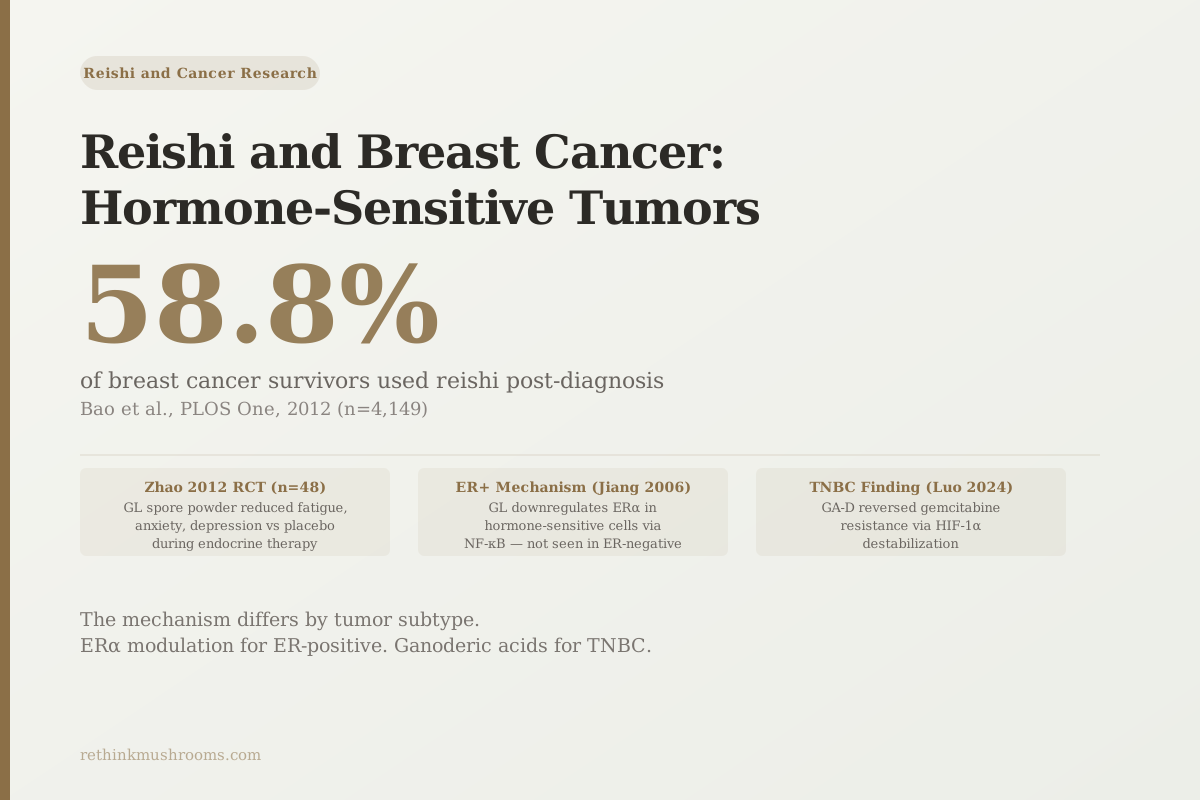
58.8% of breast cancer survivors used reishi
In the Shanghai Breast Cancer Survival Study — 4,149 women tracked after breast cancer diagnosis — 58.8% reported using Ganoderma lucidum within six months, making it one of the most common supplements in this population. The research behind that practice is more nuanced than most summaries suggest.
Bao et al., PLOS One, 2012
RCT, n=48
GL spore powder significantly reduced fatigue, anxiety, and depression in breast cancer patients on endocrine therapy (Zhao 2012)
ERα target
reishi extract specifically downregulates estrogen receptor alpha in ER-positive breast cancer cells, not ER-negative (Jiang 2006)
2024
ganoderic acid D reversed gemcitabine resistance in triple-negative breast cancer cells via HIF-1α destabilization (Luo 2024)
Bao et al., PLOS One, 2012
 View as image ↗
More than half of breast cancer survivors in a 4,149-person Chinese cohort study reported using Ganoderma lucidum — reishi mushroom — within six months of their diagnosis.[2] That level of use far exceeds what the clinical evidence base would suggest is warranted, and yet the evidence is more interesting than most summaries acknowledge.
This article covers what the research actually shows: one actual randomized controlled trial in breast cancer patients, population-level data on mushroom intake and breast cancer risk, subtype-specific mechanisms that differ between ER-positive and triple-negative tumors, and an honest mixed result from that large Shanghai cohort. For an introduction to reishi mushroom and its compounds, see the reishi overview. For the broader cancer adjunct evidence across cancer types, see Ganoderma lucidum as a Cancer Adjunct: Clinical Evidence.
Key Takeaways
- The only randomized controlled trial of reishi specifically in breast cancer patients (Zhao 2012, n=48) found GL spore powder at 1,000mg/day for 4 weeks significantly reduced cancer-related fatigue, anxiety, depression, and improved sleep quality in women on endocrine therapy
- A large Shanghai cohort (Bao 2012, n=4,149) found reishi use was associated with better social well-being but poorer physical well-being — a mixed result that most summaries of reishi-breast cancer research omit
- In ER-positive (estrogen-receptor-positive) breast cancer cells, GL extract specifically downregulates ERα protein — the receptor that drives hormone-sensitive tumor growth — via NF-κB inhibition (Jiang 2006); this mechanism is not seen in ER-negative cells
- For triple-negative breast cancer (which lacks estrogen receptor), ganoderic acids target different pathways: JAK2/STAT3 suppression (Yang 2018, GA-A) and AP-1/NF-κB invasion inhibition (Jiang 2008)
- A 2024 study found ganoderic acid D reversed resistance to gemcitabine (a chemotherapy drug) in triple-negative breast cancer cells by blocking HIF-1α, a protein that enables cancer cells to survive in low-oxygen conditions (Luo 2024)
- GL spore products have a documented hepatotoxicity risk at high doses; safety assessment should include liver function monitoring for extended use during cancer treatment
The Zhao 2012 RCT: The Only Controlled Trial in Breast Cancer Patients
The most important clinical data point in the reishi-breast cancer evidence base is a 2012 randomized controlled trial by Zhao and colleagues, published in Evidence-Based Complementary and Alternative Medicine.[1]
The trial enrolled 48 breast cancer patients who were actively receiving endocrine therapy — hormone-blocking treatment (tamoxifen or aromatase inhibitors) used for ER-positive breast cancer. Participants were randomized to GL spore powder at 1,000mg per day or placebo for four weeks.
The primary outcomes were cancer-related fatigue, anxiety, depression, sleep quality, and appetite. All were measured using the EORTC QLQ-C30, a validated quality-of-life questionnaire used widely in oncology clinical trials.
In the GL group: fatigue improved significantly. Anxiety and depression scores both decreased significantly. Sleep quality and appetite improved. None of these outcomes improved significantly in the placebo group.
This is a meaningful result because cancer-related fatigue is one of the most debilitating aspects of breast cancer treatment and one of the least well-addressed by conventional medicine. Endocrine therapy specifically causes significant fatigue, mood disruption, and sleep problems in many patients, and these persist for months or years. A supplement-level intervention producing measurable improvements on validated outcomes in a randomized trial is worth taking seriously, even if the sample size is small.
The limitations are real. Forty-eight participants is a small trial. Four weeks is a short observation window. The study did not measure cancer recurrence, survival, or tumor biomarkers. It establishes that GL spore powder can improve quality of life outcomes in this patient population, not that it affects disease course.
No safety concerns emerged during the trial. GL spore powder was well-tolerated across all participants.
The Shanghai Cohort: 4,149 Women, Mixed Results
A 2012 study from the Shanghai Breast Cancer Survival Study by Bao and colleagues provides a larger but more complicated picture.[2]
The cohort tracked 4,149 breast cancer survivors and found that 58.8% had used GL within six months of their diagnosis. That proportion reflects widespread use in the Chinese oncology setting, where GL is a routine supplement rather than an alternative treatment.
The QOL analysis found: GL users scored higher on social well-being compared to non-users. But GL users also scored lower on physical well-being. Overall quality of life showed no significant association with GL use.
This mixed result is worth unpacking. One interpretation is that GL supported the social aspects of recovery — patients felt better able to engage with family, work, and relationships — without improving the physical symptoms of fatigue, pain, and treatment side effects. Another is that women with more severe physical symptoms were more likely to reach for supplements, creating a selection effect that makes GL users look worse physically even if the supplement itself isn't causing that.
What this data does clearly is complicate the claim that reishi reliably improves quality of life in breast cancer survivors. The Zhao 2012 RCT is more persuasive on specific outcomes (fatigue, anxiety) in a defined population (actively on endocrine therapy). The Bao 2012 observational data covers a much wider, more heterogeneous group and finds less consistent benefit.
How Reishi Acts on ER-Positive Breast Cancer Cells
ER-positive breast cancer — the most common subtype, accounting for roughly 70% of breast cancers — has estrogen-receptor-positive tumor cells. These cells carry estrogen receptors (specifically ERα, estrogen receptor alpha) that bind estrogen and use it as a growth signal. Endocrine therapy works by either blocking this receptor (tamoxifen) or reducing the amount of estrogen available to bind it (aromatase inhibitors). The receptor is the therapeutic target.
A 2006 in vitro study by Jiang and colleagues found that GL extract suppresses the proliferation of both ER-positive (MCF-7) and ER-negative (MDA-MB-231) breast cancer cells.[3] But the mechanism differed between the two cell types in a significant way.
In ER-positive MCF-7 cells specifically, GL extract decreased ERα protein expression. It did this via NF-κB inhibition — NF-κB is a signaling protein that normally promotes cancer cell survival and drives ERα gene expression in hormone-sensitive tumors. By suppressing NF-κB, GL reduces the amount of estrogen receptor the cell produces.
In ER-negative cells, this mechanism was not observed. The cells responded to GL through different pathways.
This subtype specificity is the key finding for ER-positive breast cancer. If reishi can downregulate the very receptor that endocrine therapy is targeting, it may work in a complementary direction to tamoxifen and aromatase inhibitors. Taken together with the Zhao 2012 RCT finding that GL was beneficial in women on endocrine therapy, this mechanistic piece suggests a coherent biological story — though the clinical question of whether ERα downregulation by GL is meaningful alongside established endocrine therapy remains unanswered.
A 2020 comprehensive review of mushroom compounds in breast cancer by Wong and colleagues confirmed that GL's estrogen receptor modulation is among the most distinctive mechanisms in the breast cancer mushroom literature, differentiating reishi from other medicinal mushrooms whose breast cancer evidence focuses on immune activation alone.[11]
Reishi and Triple-Negative Breast Cancer
Triple-negative breast cancer (TNBC) lacks estrogen receptor, progesterone receptor, and HER2 overexpression. Standard targeted therapies, including endocrine therapy and HER2-targeted drugs, don't work. The ERα downregulation mechanism from Jiang 2006 is not applicable here.
Ganoderic acids — the triterpene compounds from reishi — target different pathways in TNBC cells.
A 2008 in vitro study by Jiang and colleagues found that ganoderic acids GA-Me and GA-T suppressed the growth and invasion of MDA-MB-231 TNBC cells by inhibiting AP-1 (a transcription factor complex that drives invasion gene expression) and NF-κB signaling, reducing MMP-9 activity — an enzyme cancer cells use to break through surrounding tissue during metastasis.[4]
A 2018 study by Yang and colleagues examined GA-A specifically in MDA-MB-231 TNBC cells.[5] GA-A inhibited cell proliferation, migration, and invasion via JAK2/STAT3 signaling suppression (JAK2 is a kinase that activates STAT3, a transcription factor that promotes cancer cell survival). The inhibition was confirmed in a mouse xenograft model — tumors in GA-A-treated mice grew significantly less than controls.
The 2024 Luo study is the most recent and mechanistically significant.[6] Luo and colleagues tested ganoderic acid D against gemcitabine-resistant TNBC cells. Gemcitabine resistance is a major clinical problem — TNBC cells that develop resistance to gemcitabine (a commonly used chemotherapy drug) are very difficult to treat. The resistance mechanism often involves HIF-1α, a protein that activates survival genes when oxygen is low, which also drives the metabolic shift to aerobic glucose consumption that resistant cancer cells rely on.
GA-D destabilized HIF-1α protein, blocking this survival pathway and re-sensitizing the resistant TNBC cells to gemcitabine. All of this is preclinical — cell line and mouse model data. But it represents an actionable mechanistic hypothesis for a population with very limited treatment options. For a full comparison of ganoderic acid mechanisms across cancer types, see Ganoderic Acids and Cancer: Specific Anti-Tumor Research.
Population-Level Evidence: Mushroom Intake and Breast Cancer Risk
Two epidemiological data points give context for the population-level picture.
The Shin 2010 case-control study enrolled 362 breast cancer cases and 362 matched controls and found that higher mushroom intake was associated with reduced breast cancer risk (relative risk 0.66; 95% confidence interval 0.45–0.95).[7] The protective association was strongest for premenopausal women with ER-positive/PR-positive tumors — hormone-sensitive cancers — which connects logically to the ER modulation mechanism from Jiang 2006.
The Ba 2021 meta-analysis of 17 observational studies found higher mushroom consumption was associated with lower overall cancer risk (odds ratio 0.66; 95% confidence interval 0.55–0.80), with the strongest association for breast cancer among the cancer types examined.[8]
Both findings span multiple mushroom types, not reishi specifically. The OR 0.66 is a consistent signal across the observational literature, but observational data cannot establish that mushroom consumption causes cancer risk reduction. Dietary confounders, health behaviors, and selection effects are all present. For dedicated coverage of the mushroom consumption and cancer risk meta-analysis evidence, see Reishi and Cancer: What 50 Years of Research Tells Us.
Safety During Breast Cancer Treatment
For breast cancer patients considering reishi during treatment, the safety profile differs somewhat from general-population use.
The 2023 systematic review of GL spore pharmacology by Thuy and colleagues identified hepatotoxicity (liver toxicity) as the primary safety concern with GL spore products at high doses or with prolonged use.[9] Spore-based products have a different compound concentration profile than fruiting body extracts; the higher triterpenoid content in some spore preparations may account for the liver-related signal. The Zhao 2012 RCT used 1,000mg of spore powder for four weeks without hepatotoxicity events, suggesting the dose and duration used in that trial is within the safe range.
The 2016 Cochrane review of 5 RCTs (n=373) confirmed a general safety profile for GL in cancer patients at standard doses, without major adverse events across included studies.[10]
One practical consideration for breast cancer patients specifically: reishi's immune-activating properties could theoretically interact with immunosuppressive treatments if prescribed after transplant or for autoimmune complications. For patients on standard endocrine therapy (tamoxifen, letrozole, anastrozole), no pharmacokinetic interactions have been documented, and the Zhao 2012 RCT was conducted in precisely this setting without adverse interactions observed.
Any extended use of GL supplements during active cancer treatment warrants liver function monitoring, particularly with spore-based preparations at higher doses. For additional safety context on individual ganoderic acid compounds, see Ganoderic Acid A, B, and Beyond: Individual Compound Research.
For comparison, the immune-based breast cancer evidence for turkey tail mushroom (PSK/PSP) takes a different mechanistic path — one focused on NK cell and macrophage activation rather than estrogen receptor modulation.
The Bottom Line
Reishi mushroom has a specific breast cancer evidence base that is narrower than general summaries suggest. The only RCT in breast cancer patients (Zhao 2012, n=48) showed GL spore powder improved fatigue, anxiety, and depression in women on endocrine therapy. The larger Shanghai cohort (Bao 2012, n=4,149) found mixed QOL results. In vitro, GL specifically downregulates ERα in ER-positive breast cancer cells via NF-κB, a mechanism absent in ER-negative cells. For triple-negative breast cancer, ganoderic acids target JAK2/STAT3 and invasion pathways, with the most recent finding showing GA-D may reverse gemcitabine resistance via HIF-1α destabilization. The evidence is mechanistically coherent but limited in clinical scale; liver function monitoring is warranted with spore preparations at extended doses.
Frequently Asked Questions
Sources & References
- 1. Source details for this reference are not yet available.
- 2. Source details for this reference are not yet available.
- 3. Source details for this reference are not yet available.
- 4. Source details for this reference are not yet available.
- 5. Source details for this reference are not yet available.
- 6. Source details for this reference are not yet available.
- 7. Source details for this reference are not yet available.
- 8. Source details for this reference are not yet available.
- 9. Source details for this reference are not yet available.
- 10. Source details for this reference are not yet available.
- 11. Source details for this reference are not yet available.