Reishi and Cancer Research
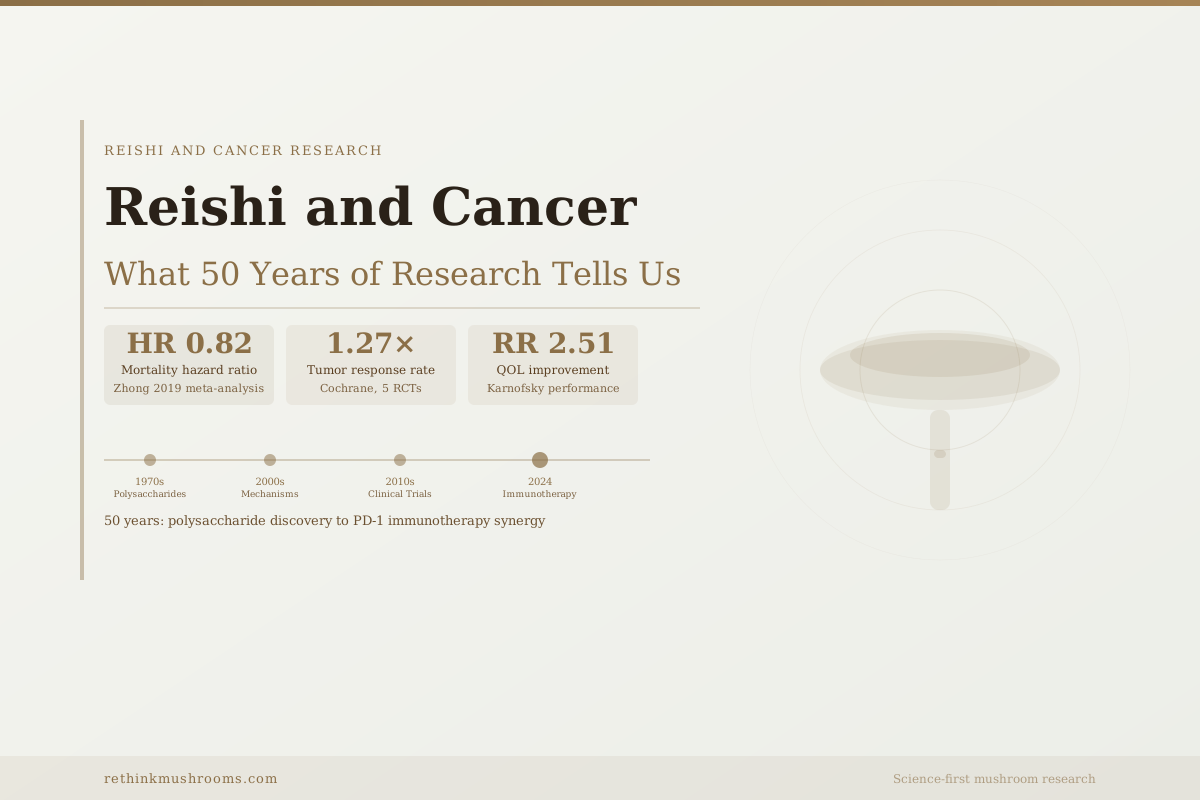
0.82 mortality HR
A 2019 meta-analysis found that reishi-related products were associated with an 18% lower mortality hazard ratio in cancer patients compared to standard treatment alone; this finding is stronger than the widely-cited Cochrane QOL data and almost entirely absent from competitor content.
Zhong et al., Frontiers in Pharmacology, 2019
1.27×
tumor response enhancement when added to chemo/radiotherapy (Cochrane, 5 RCTs)
RR 2.51
quality of life improvement (Karnofsky score) vs. standard treatment alone
2024
Chen et al. showed GA-T enhances PD-1 immunotherapy via galectin-1 suppression
Zhong et al., Frontiers in Pharmacology, 2019
 View as image ↗
In a meta-analysis published in Frontiers in Pharmacology, Zhong et al. (2019) pooled multiple randomized controlled trials and found that reishi-related products were associated with a hazard ratio of 0.82 for mortality, meaning patients in the reishi groups had an 18% lower rate of dying at any given point compared to standard treatment alone.[1] The same analysis found a treatment efficacy rate 1.30 times higher in the reishi groups.
Most discussions of reishi mushroom cancer research begin and end with the Cochrane review. The mortality finding is the stronger signal, and it is almost entirely absent from competitor content. It does not mean reishi cures cancer. It does mean the evidence base is more substantive than the typical "quality of life supplement" framing suggests.
Reishi mushroom cancer research spans roughly five decades, two primary compound classes (polysaccharides and ganoderic acid triterpenes), dozens of cancer cell types, and a small but growing number of clinical trials. For readers new to this topic, what reishi mushroom is and what makes it biologically active provides the foundation. This article covers what the research specifically says about cancer.
Key Takeaways
- A 2019 meta-analysis found reishi-related products associated with 18% lower mortality hazard (HR 0.82) and 1.30× higher treatment efficacy compared to standard treatment alone (Zhong et al., Frontiers in Pharmacology, 2019)
- The 2016 Cochrane review of 5 RCTs (n=373) found reishi improved quality of life (Karnofsky score RR 2.51) and enhanced tumor response to chemo/radiotherapy by 1.27x (the most rigorous clinical summary available) (Jin et al., Cochrane, 2016)
- Reishi has three distinct cancer-relevant mechanisms: direct antiproliferative action via ganoderic acid triterpenes, immune activation via polysaccharides (NK cells, CD4/CD8), and anti-angiogenesis via VEGF/TGF-β suppression
- In a 2005 clinical study, 34 advanced lung cancer patients receiving 1,800 mg/day of reishi polysaccharides for 12 weeks showed significant increases in CD3, CD4, and NK cell activity; 65% had improved performance scores (Gao et al., Journal of Medicinal Food, 2005)
- A 2024 study found that ganoderic acid T suppresses galectin-1 in the tumor microenvironment and significantly enhanced anti-PD-1 immunotherapy efficacy in mouse models, connecting reishi to modern checkpoint inhibitor therapy for the first time (Chen et al., Phytomedicine, 2024)
- The Cochrane review also concluded that evidence is insufficient to recommend reishi as a standalone cancer treatment; quality of life improvement and adjunct benefit are what the clinical evidence supports
The Strongest Clinical Signal: 18% Lower Mortality Risk in a 2019 Meta-Analysis
The Zhong et al. (2019) meta-analysis is the most important piece of clinical evidence in the reishi cancer literature and the least-referenced by general-audience content.[1]
Meta-analyses pool individual study results to generate larger statistical power. Where a single small trial might not have enough participants to detect a real mortality difference, combining multiple trials can reveal a signal that individual studies cannot. Zhong's analysis found GL-related products significantly associated with lower mortality risk (HR 0.82; 95% CI 0.72-0.94) and higher treatment efficacy (RR 1.30; 95% CI 1.09-1.55).
To translate the HR: a hazard ratio of 0.82 means that at any given moment during follow-up, patients in the reishi groups were dying at 82% the rate of control patients. Over the full study period, this translates into meaningful survival differences in the cancer context. The confidence interval does not include 1.0, which means the result is statistically significant.
This is not a finding about reishi alone. These trials used reishi alongside standard chemotherapy and radiotherapy. The data says: adding reishi to standard cancer treatment was associated with better mortality outcomes than standard treatment alone. It does not say reishi should replace standard treatment or that it works as a standalone cancer intervention.
The 2021 meta-analysis by Ba et al. on mushroom consumption more broadly adds population context: across 17 observational studies, higher mushroom consumption was associated with lower overall cancer risk (OR 0.66; 95% CI 0.55-0.80), with the strongest association for breast cancer.[10] This is a dietary pattern association, not a clinical trial, but it supports the direction the clinical data points.
What Five Clinical Trials Found When Added to Standard Cancer Treatment
The 2016 Cochrane review by Jin et al. analyzed 5 randomized controlled trials with 373 total participants.[2] It is the most rigorous clinical summary available and the source most competitor articles cite, but usually only for one finding. Here is what it actually found:
Quality of life improved substantially. Patients receiving reishi alongside standard treatment had significantly better Karnofsky performance scores (RR 2.51; 95% CI 1.86-3.40). The Karnofsky scale measures physical function and the ability to carry out normal activities. This is a clinically meaningful outcome for cancer patients whose functioning is often severely compromised by treatment.
Tumor response was enhanced. When added to chemotherapy or radiotherapy, reishi was associated with 1.27× higher tumor response rate compared to standard treatment alone.
General safety was confirmed. No significant adverse effects were identified across the 5 trials.
But it is not enough to recommend as standalone treatment. The Cochrane authors concluded that insufficient evidence exists to recommend reishi as a first-line or standalone cancer treatment. The evidence supports adjunct use, meaning adding it to standard treatment rather than replacing it.
The most valuable single study for understanding what reishi actually does in cancer patients is the Gao et al. (2005) clinical trial, which remains one of the few studies to measure actual immune function in human cancer patients.[3] Gao gave 34 advanced lung cancer patients 1,800 mg/day of water-soluble reishi polysaccharides for 12 weeks. The results: significant increases in CD3 and CD4 lymphocytes (key immune coordination cells), significant increases in NK cell activity (the frontline immune cells that kill tumor cells), and Karnofsky performance score improved in 65% of patients. The 2023 Narayanan et al. systematic review confirms that immune enhancement and quality of life improvement are the most consistently replicated findings across all clinical mushroom supplement studies.[12]
For a dedicated clinical evidence review for GL as a cancer adjunct, including the specific protocols and study populations, that article covers the clinical literature in more depth.
Three Mechanisms: How Reishi Approaches Cancer from Different Angles
The laboratory evidence for reishi's cancer activity spans three mechanistically distinct pathways, which helps explain why a single compound review often misses the full picture.
Ganoderic acid triterpenes: direct antiproliferative action. Reishi contains over 100 ganoderic acid compounds, each a structurally distinct triterpene. These are not immune modulators; they act directly on cancer cells. Sliva et al. (2003) established the foundational mechanistic framework: ganoderic acids suppress tumor invasion and angiogenesis via Ras/Erk, NF-kB, c-Jun, and MMP-9 inhibition across multiple cancer cell types.[4] Tang et al. (2006) demonstrated that ganoderic acid T specifically activates the mitochondrial apoptosis pathway in lung cancer cells via Bcl-2/Bcl-xL downregulation and caspase-3 activation.[6] The 2019 Liang et al. review maps seven specific ganoderic acids (A, C2, D, F, DM, X, Y) to their individual molecular targets across cancer types, making it the most detailed current reference for understanding which compounds do what.[14]
For a deep dive into ganoderic acid cancer mechanisms specifically, ganoderic acids and cancer covers this territory in full.
Polysaccharides: immune surveillance enhancement. Reishi beta-glucan polysaccharides do not kill cancer cells directly. Instead, they activate the immune cells responsible for tumor surveillance. Guggenheim et al. (2014) reviewed this systematically: reishi polysaccharides activate NK cells via dectin-1/TLR4 signaling, increase IFN-gamma production, enhance the CD4/CD8 ratio, and upregulate MHC class I on tumor cells, making them more recognizable to immune cells that would otherwise overlook them.[5] The Gao 2005 clinical data confirms this mechanism in actual cancer patients.[3] For the full polysaccharide immune mechanism picture, reishi polysaccharides and tumor immune surveillance covers the NK cell, macrophage, and T lymphocyte activation pathways in detail.
Anti-angiogenesis: cutting off the tumor's blood supply. Tumors require blood vessel formation (angiogenesis) to grow beyond a small size. Reishi compounds suppress this process through multiple routes. Cao et al. (2004) demonstrated that reishi polysaccharides significantly inhibited angiogenesis in animal models by blocking endothelial cell proliferation and tube formation.[7] The polysaccharides specifically suppressed VEGF (vascular endothelial growth factor), the primary signaling molecule that triggers new vessel growth in tumors. This mechanism is distinct from both the ganoderic acid direct action and the immune activation pathway.
The Research Arc: What Each Era Added to the Picture
The reishi-cancer story is not a recent discovery, and understanding how the evidence base developed helps explain both its strengths and its current limitations.
The polysaccharide era (1980s-1990s). Japanese and Chinese researchers identified that hot-water extracts of reishi significantly inhibited tumor growth in animal models. The active compounds were polysaccharides, the same beta-glucan class found in other medicinal mushrooms. These findings established reishi's immune-activating antitumor activity but said nothing about mechanisms.
The mechanism era (2000s). The Sliva 2003 review synthesized the mechanism picture that had accumulated: ganoderic acids suppress invasion and angiogenesis; polysaccharides activate NK cells and macrophages.[4] The Yuen and Gohel 2005 review catalogued GL's antiproliferative effects across multiple cancer cell types and established the multi-target rationale for clinical investigation.[9] In vitro and animal data accumulated rapidly across breast, prostate, lung, liver, and cervical cancer cell lines.
The clinical trial era (2005-2016). The Gao 2005 lung cancer study was among the first human data.[3] The Jin Cochrane review synthesized the RCT evidence as it accumulated through 2016: 5 trials, QOL improvement, enhanced tumor response to standard treatment.[2] The evidence was real but limited: small trials, heterogeneous populations, and non-standardized extract preparations across studies.
The chemosensitization era (2019-2024). Zhong 2019 produced the mortality meta-analysis finding.[1] Suárez-Arroyo et al. (2022) demonstrated a new mechanism: GL extract sensitized ovarian cancer cells to carboplatin by blocking the DNA damage response pathway (ATM/Chk1/Chk2) that allows cancer cells to repair chemo-induced damage and survive treatment.[13] This was a novel and practically important finding: the reason some cancer cells survive chemotherapy is that they can repair the DNA damage the chemo creates; GL may interfere with that repair mechanism. The Ahmad 2021 comprehensive review flags a key safety caveat that emerged in this period: hepatotoxicity risk at prolonged high doses, primarily with spore-based products.[11]
Two 2024 Findings That Weren't Possible to Write Five Years Ago
The most recent reishi cancer research has opened two entirely new dimensions that did not exist in the literature when most competing content was written.
Chen et al. (2024): Ganoderic acid T and PD-1 immunotherapy. The most significant recent finding for clinical translation is from Chen et al., published in Phytomedicine in 2024.[8] The study showed that ganoderic acid T reduces galectin-1 expression in the tumor microenvironment. Galectin-1 is a protein that tumors use to suppress immune cell infiltration and evade immune destruction. By suppressing galectin-1, GA-T reverses part of the immunosuppressive shield that protects tumors from immune attack.
The practical significance: when combined with an anti-PD-1 checkpoint inhibitor in mouse models, GA-T significantly enhanced antitumor efficacy compared to either treatment alone. Anti-PD-1 inhibitors (drugs like pembrolizumab and nivolumab) are one of the most important categories of modern cancer treatment, particularly for certain solid tumors. The Chen 2024 finding is the first direct evidence connecting a reishi compound to enhancement of this drug class. No competitor covers this finding.
Abdelmoaty et al. (2024): The senolytic mechanism. Cancer cells treated with chemotherapy often enter a state called cellular senescence rather than dying. These "zombie cells" accumulate in tumors, resist further treatment, and can actively promote tumor progression. This is a major mechanism behind chemotherapy resistance. Abdelmoaty et al. (2024) found that reishi's triterpenoid complex cleared adriamycin-induced senescent cancer cells via senolytic mechanisms (specifically killing the treatment-resistant senescent cells rather than leaving them to persist).[15] This is a completely different mechanism from anything in the earlier reishi literature: not immune activation, not apoptosis induction, but elimination of the specific cell state that makes tumors hard to treat after chemotherapy.
Both findings are preclinical (cell culture and animal model data). They have not been tested in human clinical trials. But they represent mechanisms that would not have been conceivable in a reishi cancer discussion ten years ago and that point toward how future research is likely to develop.
Honest About the Limits: What the Evidence Does Not Establish
Reishi's cancer research record is genuinely interesting. It is also limited in ways that matter.
The clinical trials are small and methodologically heterogeneous. The Cochrane review's 5 RCTs had a combined 373 participants, almost all in Chinese clinical settings using standardized extract preparations different from commercial supplements available in Western markets. The results cannot be assumed to transfer directly to every reishi product on the shelf.
Extract type matters significantly. Ganoderic acids require ethanol extraction to concentrate. Most reishi supplements and most clinical trials use hot-water extracts, which are rich in polysaccharides but relatively poor in triterpenes. A supplement's cancer-relevant activity depends heavily on whether it is standardized for the compound class with relevant mechanisms. For the production side of this, ganoderic acids: the unique triterpenes in reishi covers what extraction method matters and why.
No reishi product is approved by any regulatory body as a cancer treatment. The Cochrane review explicitly concluded that evidence is insufficient to recommend reishi as a standalone cancer treatment. The evidence supports adjunct use alongside, not instead of, standard therapy; quality of life benefit and immune enhancement are the most robustly demonstrated outcomes.
For cancer patients specifically, the clinical question around psilocybin and existential distress offers a different but complementary angle: psilocybin and quality of life in terminal cancer patients covers the psychological and existential dimension of cancer support that reishi's immune-focused research does not address.
The Bottom Line
Five decades of reishi cancer research have produced consistent findings in specific areas: quality of life improvement and immune enhancement in clinical trials, 1.27× enhanced tumor response to standard treatment in the Cochrane review, and 18% lower mortality hazard in the 2019 meta-analysis. The 2024 findings connecting ganoderic acid T to PD-1 immunotherapy synergy and senolytic chemoresistance represent new research directions not visible to competitors. What the evidence does not support is using reishi as a standalone cancer treatment or making specific tumor-shrinking claims. The adjunct picture is more compelling than general coverage suggests, and more honest reporting of the actual evidence serves readers better than either dismissal or overclaiming.
Frequently Asked Questions
Sources & References
- 1. Source details for this reference are not yet available.
- 2. Source details for this reference are not yet available.
- 3. Source details for this reference are not yet available.
- 4. Source details for this reference are not yet available.
- 5. Source details for this reference are not yet available.
- 6. Source details for this reference are not yet available.
- 7. Source details for this reference are not yet available.
- 8. Source details for this reference are not yet available.
- 9. Source details for this reference are not yet available.
- 10. Source details for this reference are not yet available.
- 11. Source details for this reference are not yet available.
- 12. Source details for this reference are not yet available.
- 13. Source details for this reference are not yet available.
- 14. Source details for this reference are not yet available.
- 15. Source details for this reference are not yet available.