Reishi and Cancer Research
3.91 percentage points
That is the pooled increase in CD3+ T cells across the five randomised trials of Ganoderma lucidum in cancer patients — the largest immune effect the human evidence has actually established. The mechanism story is far bigger than the human numbers.
Jin et al., Cochrane Database of Systematic Reviews, 2016
Binds dectin-1
Reishi beta-glucan binds the dectin-1 receptor on macrophages in culture (Batbayar 2011)
MHC I, in a dish
GL polysaccharides raise MHC class I on B16F10 mouse melanoma cells in vitro — never measured in humans (Sun 2012)
Two opposite trials
The same product at the same dose gave significant immune increases in 2003 and nothing in 2005 (Gao 2003, 2005)
Jin et al., Cochrane Database of Systematic Reviews, 2016
 View as image ↗
The immune system is supposed to catch cancer before it starts. Every day, cells throughout the body make copying errors, develop abnormal shapes, or start behaving in ways that don't match normal tissue. Most of the time, a network of specialized immune cells identifies these deviants and eliminates them before they can accumulate into anything dangerous. This process is called tumor immune surveillance, and its breakdown is central to why cancer develops: not because abnormal cells suddenly appear, but because the immune system has stopped catching them reliably. This article is part of the broader reishi mushroom science guide.
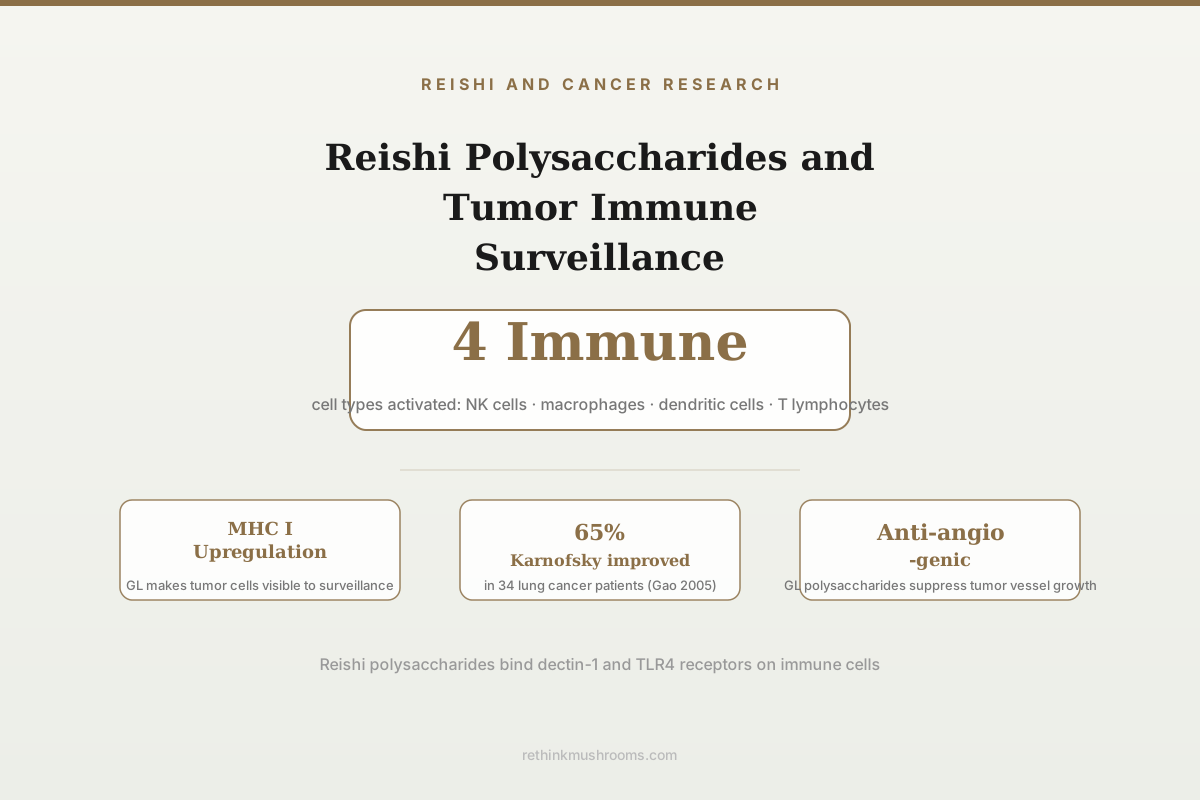
Reishi mushroom polysaccharides — sugar-chain compounds in the mushroom's cell walls and fruiting body — interact with several components of this surveillance system. In cell culture they bind dectin-1 on macrophages and shift Toll-like receptor expression; in a mouse melanoma line they raise the MHC class I markers that cancer cells use to hide; in mice they slow tumour growth and suppress new blood vessel formation. In people, the picture is thinner and less consistent than almost any source will tell you. This article covers both halves, because the gap between the mechanism and the human data is the most important thing to understand about this topic.
Key Takeaways
- Tumor immune surveillance is the ongoing process by which the immune system detects and eliminates abnormal cells; cancer develops partly because this surveillance breaks down — either because the immune system becomes less effective or because cancer cells evolve ways to evade detection
- Reishi beta-glucan has been shown to bind dectin-1 directly, and to increase TLR2, TLR4 and TLR6 expression, in mouse macrophages in culture; the authors of that work name dectin-1 and TLR-2/6, not TLR4, as the likely binding receptors[5]
- The strongest human evidence is the Cochrane review of five randomised trials: pooled increases of 3.91, 3.05 and 2.02 percentage points in CD3+, CD4+ and CD8+ cells, with NK activity only "marginally elevated" and no trial measuring long-term survival[7]
- Two uncontrolled trials of the same reishi product at the same dose reached opposite conclusions — significant immune increases in 34 advanced cancer patients in 2003, and no significant change in any of the same markers in 36 advanced lung cancer patients in 2005[2][3]
- MHC class I upregulation is the most mechanistically interesting finding: many cancers evade detection by reducing MHC I expression, and GL polysaccharides reverse this — but the evidence is one mouse melanoma cell line, in vitro, from one research group, and has never been measured in a human tumour[6]
- Cao et al. (2004) showed the effect is host-mediated rather than direct: GL polysaccharide peptide added straight to tumour cells did nothing, but serum from treated animals inhibited the same cells by 22–30%, and the compound suppressed new blood vessel formation[1]
- Polysaccharides and triterpenes work through different mechanisms in cancer: polysaccharides primarily act through the host immune system; triterpenes directly kill cancer cells or block their growth signals; both compound classes are present in whole reishi extracts but concentrated differently
Tumor Immune Surveillance: The System That Hunts Abnormal Cells
Every cancer starts as a single cell that has acquired mutations making it behave abnormally. The immune system's surveillance machinery is built to catch these cells early. NK cells (natural killer cells) patrol the bloodstream and tissues, scanning cells for abnormal surface patterns. Macrophages, large immune cells that digest foreign material, are present in nearly every tissue. Dendritic cells act as scouts that sample their local environment, collect information about abnormal cells, and travel to the lymph nodes to train T cells to recognize the specific threat.
When surveillance works, abnormal cells are eliminated before they divide enough times to form a tumor. When surveillance fails — either because the immune system is weakened by age, disease, or treatment, or because the cancer cells have evolved strategies to hide — abnormal cells survive long enough to establish themselves.
Cancer cells use several strategies to evade surveillance. They reduce expression of MHC class I molecules — surface markers that normally say "examine my contents" to passing immune cells. They produce immunosuppressive signaling molecules that tell immune cells to stand down. They recruit regulatory immune cells that dampen the activity of NK cells and T cells. Some cancers build an immunosuppressive environment within the tumor itself that actively repels immune attack.
Compounds that support tumor immune surveillance work by countering these evasion strategies: reactivating immune cells that have been suppressed, restoring the surface markers cancer cells have hidden, and strengthening the immune signals that coordinate the anti-tumor response. Whether reishi polysaccharides do this in a living human being is the question the rest of this article works through.
How Reishi Polysaccharides Reach the Immune System
The primary immunoactive compounds in reishi are beta-glucans — a family of sugar-chain molecules that form the structural scaffold of the mushroom's cell walls. Beta-glucans are not absorbed into the bloodstream in significant amounts as intact molecules. Instead, they interact with receptors on immune cells in the gut-associated lymphoid tissue and in the bloodstream.
The clearest receptor evidence comes from Batbayar and colleagues, who worked with reishi beta-glucan in RAW264.7 mouse macrophages.[5] The beta-glucan bound directly to dectin-1 — the receptor that specifically recognizes the structural pattern of fungal beta-glucans. Treatment also increased expression of TLR2, TLR4 and TLR6 (Toll-like receptors, a family of general pathogen alarms), and adding bacterial LPS pushed TLR4 and TLR6 higher still. The activated macrophages released TNF-α, IL-6, G-CSF and RANTES, along with nitric oxide and the enzyme that produces it.
It is worth being precise about what those authors concluded, because it differs from how this study is usually summarized: they named dectin-1 and TLR-2/6 as the likely binding receptors, not TLR4. Blocking NF-κB — the master inflammatory switch downstream of both receptor families — reduced the induction of IL-1, IL-6 and iNOS in a concentration-dependent manner, which is what pins the effect to that pathway rather than to something incidental.
Guggenheim's review of five medicinal mushrooms in integrative oncology adds a mouse tumour model in which reishi increased phagocytosis via TLR4, and records increased NK cell activity and IFN-γ across multiple reishi studies.[4] That review is candid about the balance of evidence: there is an abundance of in vitro work elucidating anticancer immunological mechanisms, and the human research is preliminary.
This specificity matters. GL polysaccharides do not simply "boost" the immune system in a general, non-specific way — they engage defined receptors. But engaging a receptor on a macrophage in a culture dish is several steps removed from changing the course of a tumour in a person, and the sections below keep those steps separate.
Mechanism, Labelled by Evidence Type
Six Arms of the Response, and Where Each Was Measured
The receptor story is usually drawn as one clean pathway. In the published record it is six separate observations made in three different kinds of system. The tag on each row is the part that changes how much weight it carries.
Macrophages
Cell cultureRoute
β-glucan binds dectin-1; TLR2/4/6 expression rises
What was measured
TNF-α, IL-6, G-CSF, RANTES, nitric oxide and iNOS released
Batbayar 2011 [5]
NK cells
Cell cultureRoute
Not directly mapped to a receptor for reishi
What was measured
Increased NK activity and IFN-γ reported across studies
Guggenheim 2014 [4]
Phagocytes (mouse tumour model)
AnimalRoute
TLR4
What was measured
Increased phagocytosis
Guggenheim 2014 [4]
Tumour cell surface
Cell cultureRoute
Gl-PS applied directly to cells
What was measured
MHC class I (H-2Kb/H-2Db) and B7-1/B7-2 upregulated
Sun 2012 [6]
Whole host (nude mice)
AnimalRoute
Serum transfer, not direct contact
What was measured
GLPP-treated serum inhibited tumour cell growth; GLPP alone did not
Cao 2004 [1]
T cells and NK cells (people)
HumanRoute
Oral Ganopoly, 5.4 g/day
What was measured
CD3 +3.91pp, CD4 +3.05pp, CD8 +2.02pp pooled; NK "marginally elevated"
Jin 2016 [7]
One place the systems disagree
Mouse macrophages exposed to reishi β-glucan in culture release more TNF-α[5]. Advanced cancer patients taking the same class of compound orally showed significantly lower plasma TNF-α after 12 weeks[2]. Both measurements are real; they are measuring a cell in a dish versus a whole person. Anyone who tells you reishi simply “raises” or “lowers” inflammation is picking one and hiding the other.
What this supports and what it does not
The receptor biology is real: reishi β-glucan demonstrably binds dectin-1 and shifts Toll-like receptor expression on macrophages. What has not been shown is that this chain runs end to end in a person — from an oral dose, through the gut, to a measurable change at a tumour. The one arm measured in people is the smallest one on this map: a two-to-four percentage point shift in circulating T-cell subsets.
Source: Cao 2004; Gao 2003; Guggenheim 2014; Batbayar 2011; Sun 2012; Jin 2016 (refs 1–7)
NK Cell Activation and the MHC Class I Question
Natural killer cells are the immune system's rapid-response kill squad for cancer. They don't need to be trained on a specific target — they kill by recognizing the absence of normal identity markers on cell surfaces, a pattern common to cancer cells that have downregulated their surface proteins.
Reishi's reported effect on NK cells runs through the innate receptor pathways described above, and increased NK activity and IFN-γ production appear repeatedly in the preclinical literature.[4] The more unusual finding concerns the other side of the interaction — not the immune cell, but the tumour cell it is inspecting.
Sun and colleagues incubated B16F10 mouse melanoma cells with GL polysaccharides and measured what happened to the cells' surface markers.[6] Both of the prominent mouse MHC class I molecules — H-2K(b) and H-2D(b) — increased, as did the costimulatory molecules B7-1 and B7-2, at protein level and at mRNA level. The treated cells then provoked more efficient anti-tumour cytotoxicity from immune cells. Because reduced MHC class I expression is one of the standard ways tumours make themselves invisible, a compound that pushes it back up is reversing a genuine immune escape mechanism.
That is a real and interesting result, and it is also the single easiest claim in this field to overstate. It was measured in one cell line, in a dish, by one research group, whose own abstract hedges that these molecules "may be enhanced" and that the effect "may favor cancer therapy." No study has measured MHC class I on a tumour in a living animal given reishi, and none has measured it in a human being. The ladder below is where that claim actually stops.
How Far the MHC I Finding Actually Reaches
A Real Mechanism, Measured in One Dish
“Reishi makes hidden cancer cells visible again” is the most quotable claim in this field. The finding underneath it is genuine and genuinely interesting — and it stops two rungs up a six-rung ladder. Each step below is what would have to be true for the popular version of the claim to hold.
Gl-PS raises MHC class I on a tumour cell line in a dish
Sun 2012 [6]H-2K(b) and H-2D(b) increased at both protein and mRNA level on B16F10 mouse melanoma cells, alongside the B7-1 and B7-2 costimulatory molecules.
Those treated cells are then killed more efficiently by immune cells
Sun 2012 [6]Gl-PS-treated B16F10 cells induced more efficient antitumor cytotoxicity, and in the companion paper promoted lymphocyte proliferation, CD69, FasL and IFN-γ.
The effect holds in a second, independent tumour cell line
No study locatedNot tested. Both papers reporting this finding use the same B16F10 line from the same laboratory group.
MHC class I rises on tumours in a living animal given reishi
No study locatedNot demonstrated. The cells were exposed to Gl-PS directly in culture — not through a digestive tract, a bloodstream, or a tumour microenvironment.
MHC class I rises on tumours in people taking reishi
No study locatedNo human study has measured tumour MHC class I expression before and after reishi supplementation.
Restoring MHC class I improves any patient outcome
No study locatedUntested end to end. This is the step that would turn an interesting mechanism into a reason to take something.
What this supports and what it does not
2 of 6 rungs have evidence, and both sit at the cell-culture level in a single mouse melanoma line studied by a single research group. That is enough to call MHC class I upregulation a plausible and worthwhile mechanism to investigate. It is not enough to say reishi restores immune visibility to tumours in people — that specific measurement has never been made in a human being.
Source: Sun et al., Journal of Drug Targeting, 2012 (ref 6)
What Happened When It Was Tried in People
Beyond the preclinical work, two trials gave a standardised reishi polysaccharide extract to cancer patients and measured immune markers before and after. They are the source of nearly every "reishi boosts immunity in cancer patients" claim online, and they disagree with each other.
Gao and colleagues reported the first in 2003.[2] Thirty-four patients with advanced-stage cancer received 1,800 mg of the extract three times daily — 5.4 grams per day — for 12 weeks, with 30 assessable at the end. Mean plasma IL-2, IL-6 and IFN-γ rose significantly; IL-1 and TNF-α fell significantly; the absolute number of CD56+ cells increased; and mean NK activity rose from 26.6% to 34.5%. Notably, CD3+, CD4+ and CD8+ counts were only marginally increased — not statistically significant — and the CD4:CD8 ratio was unchanged.
Two years later, the same lead author ran the same product at the same dose for the same duration in patients with advanced lung cancer.[3] Thirty-six were enrolled and 30 completed. This time, treatment did not significantly alter mitogen reactivity, CD3, CD4, CD8 or CD56 counts, plasma IL-2, IL-6 or IFN-γ, or NK activity. The authors noted the results were highly variable between individuals and suggested that only certain subgroups of patients might be responsive — a hypothesis for a future trial, not a finding.
Neither study had a placebo group or a control arm. That means neither the 2003 increases nor the 2005 null result can be cleanly separated from disease course, concurrent chemotherapy or radiotherapy, or ordinary biological variation. Presenting the 2003 numbers on their own, as most secondary sources do, turns a preliminary and unreplicated observation into something that sounds settled.
The Human Evidence, Both Halves
The Same Product, The Same Dose, Two Opposite Answers
Reishi immune-activation claims almost always trace back to a 2003 trial of Ganopoly in advanced cancer patients. Two years later the same lead author ran the same product at the same dose for the same duration in advanced lung cancer patients and found nothing significant. Both results are shown below, because citing only the first one is how a preliminary finding turns into a marketing claim.
Immune marker
Gao 2003 [2]
34 patients, mixed advanced cancer
Gao 2005 [3]
36 enrolled, advanced lung cancer
NK cell activity
26.6% → 34.5%No significant changeCD56+ (NK cell count)
IncreasedNo significant changeCD3+ T cells
Marginal onlyNo significant changeCD4+ helper T cells
Marginal onlyNo significant changeCD4:CD8 ratio
UnchangedNot reported as alteredIFN-γ
IncreasedNo significant changeIL-2
IncreasedNo significant changeTNF-α
DecreasedNo significant changePHA mitogen response
EnhancedNo significant change
Markers reaching significance
6 of 9
0 of 9
What was the same between the two trials
- Product — Ganopoly (GL polysaccharide extract)
- Dose — 1,800 mg × 3 daily = 5.4 g/day
- Duration — 12 weeks
- Lead author — Gao
- Design — Open-label, single-arm, no placebo
- Population — 2003: 34 entered / 30 assessable, mixed advanced cancer; 2005: 36 enrolled / 30 completed, advanced lung cancer
What this supports and what it does not
Neither trial had a placebo group or a control arm, so neither the 2003 increases nor the 2005 null result can be separated from disease course, concurrent chemotherapy or radiotherapy, and natural variation. What the pair does establish is that the effect is not reliable enough to reproduce in the same hands with the same product. The 2005 authors read their own data as suggesting that only certain subgroups of patients may respond — which is a hypothesis for a future controlled trial, not a finding. Any source quoting the 2003 numbers as established reishi immune activation is quoting half the record.
Source: Gao 2003; Gao 2005 (refs 2–3)
The Pooled Randomised Evidence
The way past two contradictory uncontrolled trials is to look at the randomised ones together. The Cochrane systematic review did exactly that, identifying five randomised controlled trials of Ganoderma lucidum in cancer patients.[7]
Pooled, reishi increased the percentage of CD3+ cells by 3.91 points (95% CI 1.92–5.90), CD4+ cells by 3.05 points (95% CI 1.00–5.11) and CD8+ cells by 2.02 points (95% CI 0.21–3.84). Leukocyte counts, NK cell activity and the CD4/CD8 ratio were described as marginally elevated, with no pooled figure given. Four of the five trials reported better quality of life than controls. Patients given reishi alongside chemotherapy or radiotherapy were more likely to respond than those given chemo- or radiotherapy alone, though the confidence interval around that estimate crosses 1.0; reishi used on its own did not produce the same tumour regression.
The reviewers were direct about the limitations. The methodological quality of the primary studies was "generally unsatisfying," results were inadequately reported in many respects, and no trial recorded long-term survival. Their conclusion was that there is not sufficient evidence to justify reishi as a first-line cancer treatment, while allowing that it could be considered as an adjunct to conventional treatment. Adverse events were minimal where reported — nausea and insomnia in one study, with no significant haematological or liver toxicity.
Pooled Randomised Evidence
What Five Randomised Trials Add Up To
The Cochrane review is the only place the randomised human data on reishi and immune markers has been pooled. Its T-cell findings are statistically significant and consistent in direction. They are also small — shown here on a fixed 0–10 percentage-point scale so the size is not exaggerated by the drawing.
Pooled increase in lymphocyte subset percentage (with 95% confidence interval)
CD3+ T cells
+3.91 pp (1.92–5.9) · P < 0.01
CD4+ helper T cells
+3.05 pp (1–5.11) · P < 0.01
CD8+ cytotoxic T cells
+2.02 pp (0.21–3.84) · P = 0.03
percentage points
Reported but never given a pooled number
- NK cell activity — "Marginally elevated" — no pooled estimate reported
- CD4/CD8 ratio — "Marginally elevated" — no pooled estimate reported
- Leukocyte count — "Marginally elevated" — no pooled estimate reported
Tumour response (adjunct only)
RR 1.50
95% CI 0.90–2.51 — the interval crosses 1.0. Seen only when added to chemo- or radiotherapy; reishi alone did not produce the same regression rate.
Quality of life
4 of 5 trials
Reported relatively improved quality of life versus controls.
Long-term survival
No trial recorded it
Survival was not an endpoint in any of the five included trials.
What this supports and what it does not
Five randomised trials, pooled, show small but statistically significant increases in three T-cell subsets and consistently better quality of life. They do not show a survival benefit, because no trial measured survival. The review authors judged the methodological quality of the primary studies “generally unsatisfying” and concluded there is not sufficient evidence to justify reishi as a first-line cancer treatment — while allowing that it could be considered as an adjunct alongside conventional care.
Source: Jin et al., Cochrane Database of Systematic Reviews, 2016 (ref 7)
Anti-Angiogenesis: Cutting the Tumor's Blood Supply
Immune surveillance is the primary focus of this article, but GL polysaccharides have a second anti-tumor mechanism worth understanding separately: suppression of angiogenesis.
Angiogenesis is the process by which tumors grow new blood vessels to supply themselves with nutrients and oxygen. Without new blood vessels, a tumor can grow to only a few millimeters before nutrients can no longer reach its center. Most tumors secrete chemical signals that tell the surrounding tissue to build new blood vessels into the tumor. This vascularization allows the tumor to grow beyond its initial size and eventually to spread.
Cao and colleagues demonstrated in 2004 that GL polysaccharide peptide (GLPP) inhibited the growth of Sarcoma 180 in mice by 35.2%, 45.2% and 61.9% at 50, 100 and 200 mg/kg, and suppressed angiogenesis — inhibiting the proliferation of human umbilical vein endothelial cells by 9.4%, 15.6% and 40.4% across a hundredfold concentration range, with a chick chorioallantoic membrane assay confirming reduced new vessel formation.[1] Endothelial cells are the cells that line blood vessels; blocking their proliferation prevents the new vessel formation that tumors depend on.
That study also contains the cleanest demonstration that this class of compound works through the host rather than on the tumour directly. GLPP added straight into the culture medium did not inhibit lung carcinoma cell proliferation at all. Serum drawn from GLPP-treated animals inhibited the same cells by 22.5% to 30.3%. Something the compound did to the animal — not something it did to the cancer cell — produced the effect. In nude mice, which lack functional T cells, GLPP failed to promote T-lymphocyte proliferation, which further ties the response to an intact host immune system.
Polysaccharides vs. Triterpenes: Two Jobs in Reishi's Cancer Activity
Reishi contains two major compound classes with cancer-relevant activity, and they work through fundamentally different mechanisms. Understanding which does what helps explain both the research data and what to look for in a product.
Polysaccharides (primarily beta-glucans) drive the immune and vascular effects described in this article: receptor-mediated macrophage and NK activation, MHC I upregulation in cell culture, and anti-angiogenesis. These effects work through the host immune system rather than directly on cancer cells. A 2020 narrative review by Jeitler and colleagues searched for controlled clinical trials of whole-spectrum medicinal mushroom preparations in cancer patients and found eight eligible studies; Ganoderma lucidum accounted for three of them, more than any other single species reviewed. The benefits that emerged most consistently across the mushrooms studied were improved quality of life and reduced adverse effects of conventional therapy, with positive effects on immune parameters also reported.[8]
Triterpenes (ganoderic acids and related compounds) have a different profile: they directly interfere with cancer cell growth, induce programmed cell death (apoptosis) in cancer cells, inhibit the signaling pathways that tell cancer cells to proliferate, and in some cases block hormone receptors that certain cancers depend on. These effects occur within the cancer cell itself, independent of the immune system. The detailed mechanistic breakdown of how these two compound classes differ is in How Reishi Triterpenes Differ from Polysaccharides in Mechanism. The full ganoderic acid compound profile is in Ganoderic Acids: The Unique Triterpenes in Reishi.
A comprehensive 2021 review by Ahmad and colleagues catalogued reishi's chemistry — polysaccharides, triterpenoids, sterols, the LZ-8 and LZ-9 proteins, nucleosides — and its reported pharmacological activity across cancer, inflammation, diabetes, neurodegeneration and immune disorders. Its central caution is the relevant one here: most of the underlying studies are preclinical and carry a number of drawbacks, and quality clinical data are urgently needed to support these activities for human use.[9] A 2025 review by Ren and colleagues updates the mechanistic picture, noting that immune activation was historically regarded as the sole route by which reishi exerts anticancer effects, whereas recent work extends the mechanisms to include induction of cell differentiation and inhibition of angiogenesis — while observing that few of reishi's bioactive compounds have been clinically validated as superior to existing therapies.[10]
What the Evidence Shows and What It Doesn't
The receptor biology is real and documented in peer-reviewed research. Reishi beta-glucan binds dectin-1 and shifts Toll-like receptor expression on macrophages, which then release inflammatory mediators.[5] The anti-angiogenic and host-mediated anti-tumour effects in mice are well-characterised and quantified.[1] The MHC class I finding is mechanistically important and underreported, and it sits entirely at the cell-culture level.[6]
What the evidence does not establish: that taking reishi polysaccharides measurably reduces tumor size in human cancer patients, extends survival, or replaces conventional cancer treatment. No trial in the Cochrane review measured long-term survival at all. The human immune effects that have been demonstrated are real but small — a few percentage points of T-cell subsets — and the two most-cited uncontrolled trials contradict each other. The most consistent human benefit across the literature is not tumour control but quality of life.
One further caution is worth stating plainly, because the preclinical literature cuts both ways on it. Mouse macrophages exposed to reishi beta-glucan in culture release more TNF-α[5]; advanced cancer patients taking the extract for 12 weeks showed significantly lower plasma TNF-α[2]. Reishi is better described as immunomodulatory — shifting immune signalling in context-dependent directions — than as a straightforward immune stimulant.
The Ganoderma lucidum as a Cancer Adjunct: Clinical Evidence article covers what the randomized controlled trial evidence specifically shows. The 50 Years of Reishi Cancer Research overview maps the full evidence trajectory. The broader context of daily mushroom consumption for cancer prevention is at Daily Mushroom Consumption and Cancer Risk Reduction.
This article is a summary of published research and is not medical advice. Reishi is not a treatment for cancer, and nothing here should be used to delay, replace or modify conventional oncology care. Reishi can interact with chemotherapy, immunosuppressants and anticoagulants, and immune-modulating supplements are not appropriate for everyone — particularly people on immunotherapy, transplant recipients, and those with autoimmune conditions. If you have cancer or are undergoing treatment, talk to your oncologist before taking any mushroom supplement.
The Bottom Line
Reishi polysaccharides interact with tumour immune surveillance through several mechanisms of differing evidence quality. Reishi beta-glucan binds dectin-1 and raises TLR2/4/6 expression on mouse macrophages in culture, triggering cytokine and nitric oxide release. GL polysaccharides upregulate MHC class I and costimulatory molecules on B16F10 mouse melanoma cells in vitro — reversing a common immune-evasion strategy, though this has never been measured in a living animal or a human. Cao et al. (2004) showed the anti-tumour effect is host-mediated: the compound did nothing applied directly to tumour cells, but serum from treated animals inhibited them by 22–30%, alongside clear anti-angiogenic activity. In humans the evidence is thinner and inconsistent: two uncontrolled trials of the same product at 5.4 g/day reached opposite conclusions in 2003 and 2005, and the Cochrane review of five randomised trials found pooled increases of only 3.91, 3.05 and 2.02 percentage points in CD3+, CD4+ and CD8+ cells, with quality of life improved in four of five trials and long-term survival never measured. Polysaccharides act through the host immune system; triterpenes act directly on cancer cells. No randomised trial has established reishi as a proven anti-tumour treatment.
Frequently Asked Questions
Sources & References
- 1RTHM-00067·Cao, Qi-Zhen et al. (2004). “Antitumor and anti-angiogenic activity of Ganoderma lucidum polysaccharides peptide..” Acta pharmacologica Sinica.Study breakdown →PubMed →↩
- 2RTHM-02360·Gao, Yihuai et al. (2003). “Effects of ganopoly (a Ganoderma lucidum polysaccharide extract) on the immune functions in advanced-stage cancer patients..” Immunological investigations.Study breakdown →PubMed →↩
- 3RTHM-00152·Gao, Yihuai et al. (2005). “Effects of water-soluble Ganoderma lucidum polysaccharides on the immune functions of patients with advanced lung cancer..” Journal of medicinal food.Study breakdown →PubMed →↩
- 4RTHM-00323·Guggenheim, Alena G et al. (2014). “Immune Modulation From Five Major Mushrooms: Application to Integrative Oncology..” Integrative medicine (Encinitas.Study breakdown →PubMed →↩
- 5RTHM-00378·Batbayar, Sainkhuu et al. (2011). “Medicinal mushroom Lingzhi or Reishi, Ganoderma lucidum (W.Curt.:Fr.) P. Karst., beta-glucan induces Toll-like receptors and fails to induce inflammatory cytokines in NF-kappaB inhibitor-treated macrophages..” International journal of medicinal mushrooms.Study breakdown →PubMed →↩
- 6RTHM-02361·Sun, Li-Xin et al. (2012). “Enhanced MHC class I and costimulatory molecules on B16F10 cells by Ganoderma lucidum polysaccharides..” Journal of drug targeting.Study breakdown →PubMed →↩
- 7RTHM-00788·Jin, Xingzhong et al. (2016). “Ganoderma lucidum (Reishi mushroom) for cancer treatment..” The Cochrane database of systematic reviews.Study breakdown →PubMed →↩
- 8RTHM-00622·Jeitler, Michael et al. (2020). “Significance of Medicinal Mushrooms in Integrative Oncology: A Narrative Review..” Frontiers in pharmacology.Study breakdown →PubMed →↩
- 9RTHM-01321·Ahmad, Rizwan et al. (2021). “Ganoderma lucidum (Reishi) an edible mushroom; a comprehensive and critical review of its nutritional, cosmeceutical, mycochemical, pharmacological, clinical, and toxicological properties..” Phytotherapy research : PTR.Study breakdown →PubMed →↩
- 10RTHM-02166·Ren, Sizhu et al. (2025). “A Review of Bioactive Components and Pharmacological Effects of Ganoderma lucidum..” Food science & nutrition.Study breakdown →PubMed →↩