Reishi (Ganoderma lucidum)
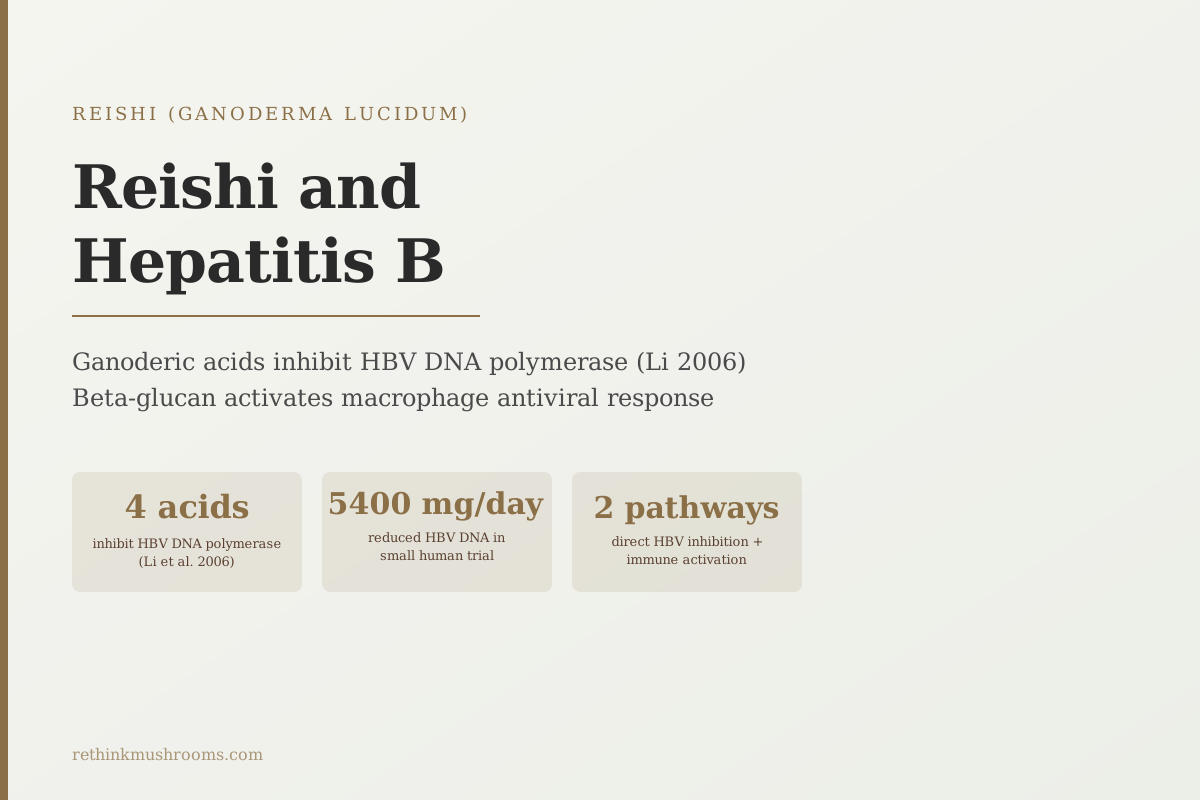
4 ganoderic acids inhibit HBV DNA polymerase
Li et al. (2006) identified four specific ganoderic acids — beta, gamma, delta, and epsilon — that directly inhibit the enzyme hepatitis B uses to copy its DNA, and reduce viral marker secretion in liver cell culture.
Li et al., Biochem Biophys Res Commun, 2006
5400 mg/day
reishi polysaccharide dose that reduced HBV DNA and viral markers at 12 weeks in a small human trial (per Ahmad et al., Nutrients, 2023)
2 pathways
direct HBV inhibition (ganoderic acids) and immune-mediated antiviral activation (beta-glucan via Dectin-1 receptor)
Unknown
interaction safety with nucleoside analogs (tenofovir, entecavir) — reishi + HBV antivirals has not been studied in clinical trials
Li et al., Biochem Biophys Res Commun, 2006
 View as image ↗
Hepatitis B virus (HBV) infects liver cells and, in its chronic form, drives decades of progressive liver damage. Roughly 296 million people worldwide live with chronic HBV infection. Over years to decades, the resulting inflammation causes liver fibrosis — scar tissue formation — that can progress to cirrhosis and substantially elevates the risk of hepatocellular carcinoma, the most common form of liver cancer.
Standard treatment for chronic HBV uses antiviral drugs called nucleoside analogs — medications like tenofovir and entecavir that block viral replication by competing with the building blocks the virus uses to copy its DNA. These drugs are effective at suppressing HBV and reducing disease progression, but do not eliminate the virus in most patients. Lifelong treatment is common.
Against this background, research published in 2006 identified that ganoderic acids — a class of bioactive compounds unique to Ganoderma lucidum (reishi) — directly inhibit the key enzyme hepatitis B virus uses to replicate its DNA.[1] That preclinical finding, and the subsequent body of mechanistic research, is the scientific basis for reishi's potential relevance in hepatitis B.
For the broader picture of reishi's liver effects across five conditions, see reishi for liver health: hepatoprotective research. For the reishi pillar overview, see what is reishi mushroom: the science behind the mushroom of immortality.
Key Takeaways
- Four ganoderic acids (beta, gamma, delta, epsilon) directly inhibit HBV DNA polymerase — the enzyme the virus uses to copy its DNA — and reduced HBsAg and HBeAg secretion (markers of viral activity) in hepatitis B liver cell culture (Li et al., Biochem Biophys Res Commun, 2006)
- A 2023 review (Ahmad et al., Nutrients) cites a small Phase I/II human trial where reishi polysaccharides at 5400 mg/day for 12 weeks reduced HBV DNA levels and HBeAg — the only available human evidence
- A second antiviral pathway operates through immune activation: Ganoderma beta-1,3/1,6 D-glucan activates macrophages via the Dectin-1 receptor, triggering innate antiviral immune responses that can limit viral replication indirectly
- A 2019 systematic review catalogued 12+ distinct ganoderic acids with hepatoprotective activity including antiviral effects against both HBV and HCV (Zhou et al., Biomedicine & Pharmacotherapy, 2019)
- Reishi should not replace approved HBV antiviral therapy; a 2023 spore safety review found generally good tolerability but rare quality-related hepatotoxicity cases are documented
- Interaction safety with nucleoside analog antivirals (tenofovir, entecavir) is unstudied — patients with chronic HBV on antiviral therapy should consult their physician before using reishi supplements
What Hepatitis B Does to the Liver
HBV is a DNA virus that infects hepatocytes — the primary cell type in the liver. Acute infection resolves on its own in most adults. In roughly 5% of adult infections and substantially more in infants, the immune system fails to clear the virus and infection becomes chronic.
In chronic HBV, the virus integrates into hepatocyte DNA and maintains ongoing production of viral proteins. The resulting immune response against infected cells drives chronic liver inflammation. Over years, this inflammation triggers hepatic stellate cell activation — the cells that produce scar tissue — leading to progressive fibrosis. At the far end of this process sits cirrhosis (severe, functionally impairing scarring) and dramatically elevated liver cancer risk.
Current antiviral drugs suppress viral replication effectively but cannot clear HBV from liver cells that already have viral DNA integrated. Long-term viral suppression — keeping HBV DNA levels undetectable in blood — is the treatment goal because it slows the fibrosis progression even without viral elimination.
This landscape shapes what "reishi might help with HBV" means in practice: the relevant questions are whether reishi compounds can reduce viral replication, whether they support the immune response against infected cells, and whether they can limit the liver damage that ongoing infection causes. The evidence addresses each of these to varying degrees.
The Direct Antiviral Mechanism: Ganoderic Acids and HBV DNA Polymerase
The first published evidence of direct antiviral activity came from Li and colleagues, publishing in Biochemical and Biophysical Research Communications in 2006.[1]
Their study used HepG2.2.15 cells — liver cells engineered to contain hepatitis B virus that are the standard laboratory model for HBV drug testing. The experimental question was whether ganoderic acids could interfere with viral replication in this system.
Four ganoderic acids — specifically ganoderic acid beta, gamma, delta, and epsilon — showed direct inhibitory activity against HBV DNA polymerase, the enzyme the virus uses to copy its genetic material during replication. Without functional DNA polymerase, the virus cannot replicate. The same four ganoderic acids also reduced secretion of HBsAg and HBeAg — two proteins the virus produces during active infection that serve as standard clinical markers of viral activity.
HBsAg (hepatitis B surface antigen) and HBeAg (hepatitis B e-antigen) are the laboratory measures clinicians use to assess HBV activity and treatment response. Their reduction in cell culture by ganoderic acids established a plausible antiviral mechanism rather than just general liver protection.
A 2019 systematic review by Zhou and colleagues in Biomedicine and Pharmacotherapy catalogued 12 or more distinct ganoderic acids with hepatoprotective activity, including antiviral effects against both HBV and HCV (hepatitis C).[3] The antiviral activity of ganoderic acids appears to operate primarily through enzyme inhibition rather than direct cell toxicity — a mechanistically interesting property because it suggests ganoderic acids could interfere with viral replication without simply killing liver cells.
All of this evidence is in vitro. Cell culture studies show what is chemically possible; they do not establish that the same concentrations of ganoderic acids are achievable in human liver tissue at any given oral dose, or that the inhibitory effect persists at clinically meaningful levels in a living system.
The Immune Pathway: Beta-Glucan, Dectin-1, and Macrophage Antiviral Activation
Ganoderic acids are not the only reishi compounds with potential antiviral relevance. A 2023 study published in Pharmaceutics tested a different class of reishi compounds: beta-1,3;1,6 D-glucans, the long polysaccharide chains that form a major structural component of the mushroom cell wall.[2]
The study found that Ganoderma beta-glucan activates macrophages through a receptor called Dectin-1. Dectin-1 is a pattern recognition receptor expressed on immune cells — specifically macrophages, dendritic cells, and neutrophils — that recognizes and binds fungal beta-glucan structures. When Dectin-1 is activated, it triggers macrophage immune responses including the production of cytokines and the activation of antiviral surveillance.
Macrophages in the liver (called Kupffer cells) are the immune system's first line of response to hepatic infections including HBV. Their activation status significantly influences whether viral infection is controlled or progresses. The Dectin-1-mediated activation pathway documented in the 2023 study represents a second mechanism by which reishi compounds could theoretically support antiviral immune activity in the liver.
This pathway is indirect compared to the ganoderic acid enzyme inhibition described by Li et al. It operates through immune enhancement rather than direct viral interference. In the context of HBV, which persists precisely because the immune system fails to fully clear it, immune activation is at least as relevant as direct antiviral activity.
The Limited Human Evidence
The preclinical antiviral data is the strong part of the story. Human clinical evidence is limited.
A 2023 review in Nutrients by Ahmad and colleagues — the most comprehensive recent synthesis of reishi's hepatoprotective mechanisms — documented one small Phase I/II clinical trial of reishi polysaccharides in hepatitis B patients.[4] In that trial, reishi polysaccharides administered at 5400 mg per day for 12 weeks produced measurable reductions in HBV DNA levels and HBeAg in the treated patients.
This trial — as described in the Ahmad 2023 review — is the only published human evidence for reishi's effects on hepatitis B viral markers. Several limitations apply. The trial was Phase I/II, meaning it was primarily designed to assess safety and generate preliminary efficacy signals rather than definitively establish treatment benefit. The sample size was small, the design details are not available from the review citation alone, and no Phase III confirmation study has been published.
What this evidence level supports: a signal worth following up in controlled trials. It is not sufficient to conclude that reishi reduces HBV viral load in patients or that it provides meaningful antiviral benefit as a clinical treatment.
What the Safety Picture Looks Like
A 2023 systematic review of pharmacological activities and safety specifically of Ganoderma lucidum spores found that reishi preparations are generally well-tolerated in human studies, with rare documented adverse events.[5] The cases of hepatotoxicity that appear in the literature — and that are cited in the NIH's LiverTox database — appear to be largely product-quality related: contamination, heavy metals from low-quality growing substrates, or preparation methods (whole dried powder vs. extracted formulations) that may behave differently pharmacologically.
The spore safety review noted that broken-spore preparations show better bioavailability and more predictable pharmacokinetics than unprocessed whole spore or raw powder preparations. This is practically relevant: the safety and efficacy profile of a well-manufactured reishi extract may differ meaningfully from a poorly characterized powder.
For patients with chronic HBV who are on antiviral therapy, the most important safety question — whether reishi interacts with nucleoside analog antivirals like tenofovir or entecavir — is unanswered. These drugs are processed by liver enzymes, and reishi compounds are known to modulate some liver enzyme activity. Whether any pharmacokinetic interaction occurs at standard supplement doses is unknown and has not been studied. Prescribing information for tenofovir and entecavir does not specifically address reishi because no interaction studies have been conducted.
The practical implication: HBV patients on antiviral treatment should discuss reishi use with the physician managing their hepatitis B care. The unknown interaction is the primary clinical concern, not any established evidence of harm.
For the full spectrum of reishi's liver effects including NAFLD, fibrosis, and alcohol-related damage, see reishi for liver health: hepatoprotective research. For the fibrosis angle specifically — relevant to HBV patients because fibrosis is the main long-term consequence of chronic HBV — see Ganoderma lucidum and liver fibrosis: can reishi help?. For another mushroom compound with liver-protective properties, see ergothioneine and liver health: hepatoprotective research.
The Bottom Line
Ganoderic acids from reishi inhibit HBV DNA polymerase and reduce HBsAg/HBeAg in liver cell culture (Li et al., 2006). Reishi beta-glucans provide a second antiviral pathway through Dectin-1-mediated macrophage activation. A small Phase I/II human trial cited in the Ahmad 2023 review found 5400 mg/day of reishi polysaccharides for 12 weeks reduced HBV DNA and HBeAg. The evidence base is preclinical and very preliminary for human HBV. Reishi should not replace antiviral medication, and interaction with nucleoside analogs is unstudied.
Frequently Asked Questions
Sources & References
- 1. Source details for this reference are not yet available.
- 2. Source details for this reference are not yet available.
- 3. Source details for this reference are not yet available.
- 4. Source details for this reference are not yet available.
- 5. Source details for this reference are not yet available.