Reishi for Liver Health
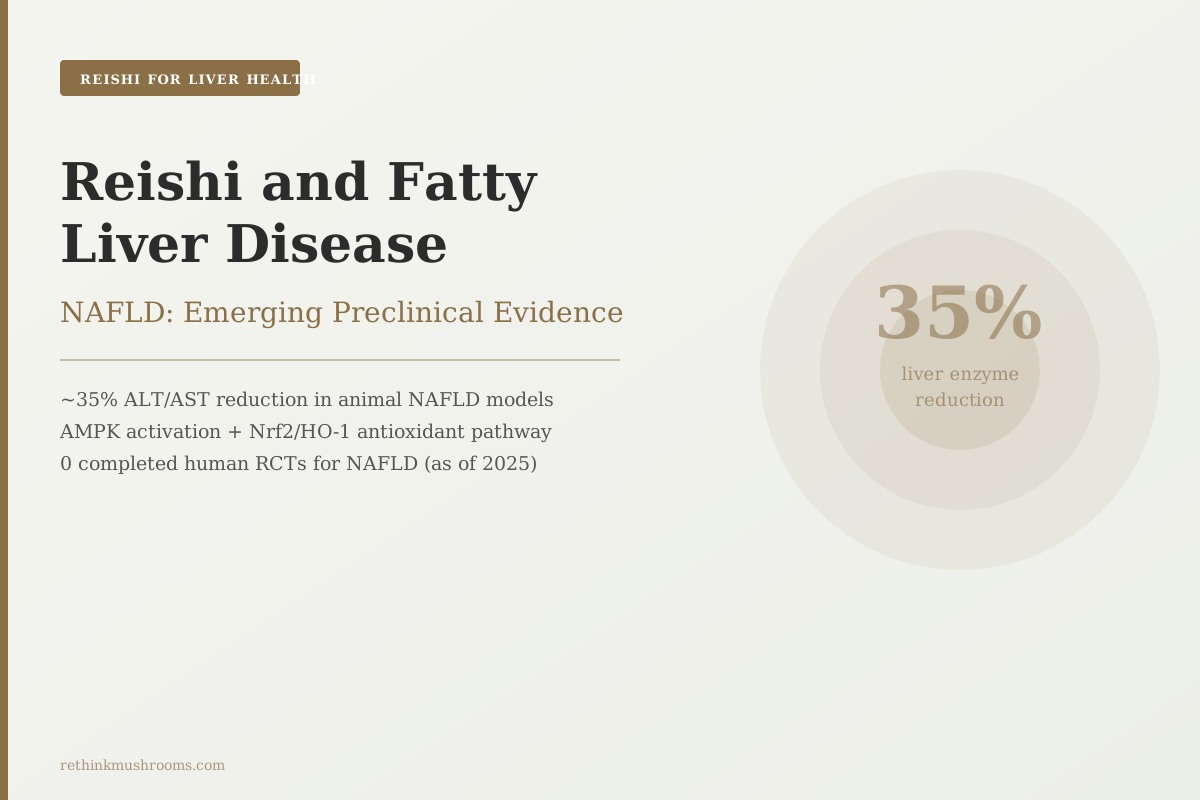
35% ALT/AST reduction
Reishi polysaccharide extract reduced liver enzyme elevations by approximately 35% in high-fat diet mice via AMPK activation and the Nrf2/HO-1 antioxidant pathway.
Jin et al., Evidence-Based Complementary and Alternative Medicine, 2020
0
completed human RCTs specifically for NAFLD using reishi (as of 2025)
150+
distinct ganoderic acids cataloged in reishi, several with liver-fat-regulating activity
2
independent 2020 animal studies showing GLP reduces hepatic triglyceride accumulation
Jin et al., Evidence-Based Complementary and Alternative Medicine, 2020
 View as image ↗
Non-alcoholic fatty liver disease (NAFLD) is now the most common liver condition worldwide, affecting roughly 25% of adults globally. It begins as fat accumulation in liver cells, progresses in some people to inflammation and scarring, and eventually (in a subset) to cirrhosis. Treatment options remain limited: weight loss is the most effective intervention, but few patients achieve and maintain it. This gap has driven substantial research into compounds that might reduce liver fat accumulation through biological mechanisms.
Reishi (Ganoderma lucidum) has been studied for this purpose in animal models. The headline finding: two independent 2020 studies found that reishi polysaccharide extract reduced liver fat accumulation, normalized liver enzymes, and improved insulin resistance in high-fat diet rodent models, through two distinct pathways. No human randomized controlled trial for NAFLD specifically has been completed as of 2025. The evidence is preclinical and mechanistically compelling, not clinically proven. For the broader overview of reishi and liver health, see What Is Reishi Mushroom? The Science Behind the Mushroom of Immortality.
Key Takeaways
- No completed human RCT has specifically tested reishi for NAFLD as of 2025; all direct NAFLD evidence is from animal models
- Jin et al. (2020) found reishi polysaccharide extract (GLP) enhanced AMPK activation in liver tissue, reduced serum ALT/AST by approximately 35%, and improved insulin resistance in high-fat diet mice via the Nrf2/HO-1 antioxidant pathway
- Zhu et al. (2020) independently found GLP reduced hepatic triglyceride accumulation, decreased oxidative stress markers (MDA and 4-HNE), and normalized liver histology in a separate high-fat diet mouse model
- A 2024 review cataloged 150+ distinct ganoderic acid compounds in reishi, several of which (including ganoderic acid A, B, C1, C2, G, H, and Me) regulate lipid metabolism pathways relevant to NAFLD
- A 2023 review in Nutrients identified NAFLD among the conditions for which reishi's Phase I/II liver enzyme modulation and Nrf2/HO-1 antioxidant activity provide mechanistic plausibility (Ahmad et al., 2023)
- The 2025 comprehensive pharmacological review of reishi confirms liver health as a well-studied target but acknowledges the absence of NAFLD-specific human trial data
What NAFLD Is, and Why Conventional Treatment Options Are Limited
Non-alcoholic fatty liver disease develops when excess fat accumulates in liver cells in people who drink little to no alcohol. It is closely linked to metabolic syndrome: obesity, type 2 diabetes, elevated triglycerides, and insulin resistance. In most people, NAFLD is relatively benign; in others, the fat accumulation triggers inflammation, a progression called NASH (non-alcoholic steatohepatitis), which can lead to liver fibrosis and ultimately cirrhosis.
The liver's job is to process nutrients arriving from digestion. When it is overwhelmed with excess calories over time, triglycerides begin accumulating inside liver cells. This is hepatic steatosis. As steatosis worsens, liver cells can become inflamed and eventually die, triggering the scarring response that characterizes NASH and fibrosis.
The progression from steatosis to NASH is driven primarily by two processes: oxidative stress and insulin resistance. Oxidative stress occurs when the liver generates more reactive oxygen species than its antioxidant defenses can neutralize, damaging liver cell membranes and DNA. Insulin resistance means liver cells stop responding normally to insulin, which increases fat deposition while reducing fat export. Compounds that address either or both processes have a rational basis for NAFLD research.
What makes NAFLD difficult to treat pharmacologically is the limited selection of approved therapies. In 2024, the FDA approved resmetirom (Rezdiffra) for biopsy-confirmed NASH with liver fibrosis, the first drug specifically approved for this indication. Access and cost remain limiting factors, as does the invasive liver biopsy required for diagnosis. For most people, the primary recommendation continues to be sustained weight loss through diet and exercise. Supplements and adjunct compounds are being actively studied in this context.
The AMPK Connection: How Reishi Polysaccharides Target Insulin Resistance in the Liver
The 2020 study by Jin and colleagues provides the most mechanistically specific reishi NAFLD data available.[1] It tested GLP (Ganoderma lucidum polysaccharide) in high-fat diet mice, a well-established animal model for NAFLD and metabolic syndrome.
The key finding: GLP enhanced AMPK activation in liver tissue. AMPK (AMP-activated protein kinase) is an enzyme that functions as a cellular energy sensor. When a cell's energy reserves are low, AMPK activates and instructs the cell to stop accumulating fat and start burning it. It also reduces the production of new triglycerides in the liver, one of the core metabolic processes gone wrong in NAFLD.
In NAFLD, AMPK activity tends to be suppressed, partly because the constant excess of available nutrients removes the signal that would normally turn it on. Activating AMPK through dietary compounds is an active area of metabolic drug research; metformin, the widely used diabetes medication with documented hepatoprotective effects, works partly through AMPK activation.
In the Jin study, GLP enhanced AMPK activation in liver tissue and this was accompanied by:
- Reduced serum ALT and AST (liver enzymes that rise when liver cells are damaged) by approximately 35%
- Improved insulin resistance, measured by HOMA-IR score, showing metabolic normalization
- Activation of the Nrf2/HO-1 pathway, the liver's main antioxidant defense system, which reduces the oxidative damage that drives NAFLD progression to NASH
The Nrf2/HO-1 pathway deserves explanation. Nrf2 is a transcription factor (a protein that switches other genes on or off) that, when activated, turns on hundreds of the liver's own antioxidant and protective genes. HO-1 (heme oxygenase-1) is one key downstream enzyme that is cytoprotective. Together, they represent the liver's primary internal defense against oxidative stress. Reishi polysaccharides appear to activate this pathway, which is why the protective effects aren't limited to lowering liver enzymes but extend to reducing the oxidative damage that drives inflammation and fibrosis.
Reducing Liver Fat Directly: The Steatosis Evidence
A second independent 2020 study by Zhu and colleagues tested GLP specifically for its effects on fat accumulation in liver cells.[2]
The Zhu study enrolled high-fat diet mice and found that GLP supplementation:
- Reduced hepatic triglyceride accumulation, the primary driver of steatosis, showing that GLP directly reduced fat deposition in liver cells
- Decreased MDA and 4-HNE, two established markers of lipid peroxidation, confirming reduced oxidative stress in liver tissue
- Normalized liver histology, meaning tissue examined under a microscope showed less steatosis than in the high-fat diet control group
The significance of two independent research groups, using different high-fat diet protocols and different outcome measures, arriving at consistent findings cannot be overstated. These are not replications of the same experiment. They are independent mechanistic confirmations pointing in the same direction. The consistency is what makes the preclinical case credible rather than a single anomalous result.
Neither study tells us how these findings translate to humans. The metabolic profile of a high-fat diet mouse, while useful for mechanism research, is not identical to a person with NAFLD associated with metabolic syndrome over decades. But both studies confirm the mechanism operates in a living organism, which is a meaningful step beyond purely cell-based research. The convergence of two independent 2020 studies using different experimental protocols is exactly the kind of replication signal that motivates human trials.
The Triterpenoid Angle: Ganoderic Acids and Lipid Metabolism
Reishi's liver-protective activity does not come only from polysaccharides. The triterpenoid fraction, specifically the ganoderic acids, also regulates lipid metabolism through pathways relevant to NAFLD.
A 2019 review by Zhou and colleagues cataloged more than 12 distinct ganoderic acids with hepatoprotective activity, documenting mechanisms that include modulation of Phase I and II liver detoxification enzymes, NF-kB inflammatory pathway suppression, antioxidant effects, antiviral activity, and lipid metabolism regulation.[4]
A 2024 review in Molecules expanded the catalog to 150 or more distinct ganoderic acid compounds and specifically identified ganoderic acids A, B, C1, C2, G, H, and Me as having liver-fat-regulating activity, including effects on the Nrf2/HO-1 antioxidant pathway and NF-kB inflammatory suppression directly relevant to NAFLD.[5]
This dual-compound picture matters. Reishi's hepatoprotective activity is not dependent on a single active compound through a single mechanism. The polysaccharide fraction (GLP) operates primarily through AMPK activation and antioxidant pathway induction. The triterpenoid fraction (ganoderic acids) operates through lipid metabolism regulation and inflammatory suppression. Together they address multiple contributing causes of NAFLD simultaneously, which is what a pharmaceutical would need to do to be effective in a condition with multiple overlapping mechanisms.
Supplement products that contain only one fraction may be less complete than whole-mushroom preparations or dual-extract products standardized for both polysaccharides and triterpenoids. This is a practical product-selection consideration that follows logically from the mechanistic data.
What Current Reviews Say About the Evidence Picture
A 2023 review published in Nutrients by Ahmad and colleagues synthesized reishi's hepatoprotective mechanisms across conditions including NAFLD, fibrosis, hepatitis B, and alcohol-induced damage, identifying six distinct mechanisms applicable across these conditions.[3] For NAFLD specifically, the Phase I/II enzyme modulation and Nrf2/HO-1 antioxidant activity are the most directly relevant.
The 2025 pharmacological review in Pharmacological Research is the most current comprehensive synthesis of the reishi evidence across organ systems, confirming liver health as one of reishi's most studied targets while acknowledging that the clinical evidence base from human trials remains limited.[6]
Both reviews arrive at consistent conclusions: the mechanistic case for reishi in NAFLD is strong, the preclinical evidence is consistent, and human trials are the missing link.
The Honest Gap: No Human NAFLD Trial Completed
The evidence described above is entirely preclinical: rodent models and mechanistic reviews. No randomized controlled trial has specifically enrolled NAFLD patients and tested reishi against a placebo for liver fat reduction, liver enzyme normalization, or fibrosis prevention.
This gap is real and matters for how the evidence should be interpreted. Animal models of NAFLD are useful for mechanistic research but do not always translate to clinical outcomes in humans. The metabolic dynamics in a mouse developing steatosis over weeks on a high-fat diet are not identical to those in a person who has been insulin-resistant for years.
Several factors make the absence of human data understandable without making it acceptable. NAFLD trials are expensive and slow because definitive endpoints (liver biopsy for histology, or long-term hard outcomes like cirrhosis) require years of follow-up and significant per-patient cost. Botanical compounds have no commercial sponsor with the resources to fund a Phase II or III NAFLD trial through to regulatory approval. Researcher interest exists; the funding infrastructure does not match.
What would be needed to change this picture: a funded investigator-initiated trial enrolling 100 or more NAFLD patients, randomizing to reishi extract vs. placebo for at least 6 months, and measuring liver fat by MRI-PDFF (which is non-invasive and is now the standard research endpoint replacing biopsy). Until such a trial is conducted, the best available statement remains: mechanistically plausible and preclinically consistent, but not clinically proven.
For how another mushroom compound addresses NAFLD through complementary pathways, see Ergothioneine and NAFLD: Fatty Liver Protection. For the broader reishi liver health picture across conditions, see Reishi for Liver Health: Hepatoprotective Research. For the fibrosis question (what happens when NAFLD advances), see Ganoderma lucidum and Liver Fibrosis: Can Reishi Help?. For liver protection from alcohol, see Reishi and Alcohol-Related Liver Damage: Preclinical Evidence.
The Bottom Line
Two independent 2020 preclinical studies found reishi polysaccharide extract reduces liver fat accumulation, lowers elevated liver enzymes by approximately 35%, and improves insulin resistance in high-fat diet rodent NAFLD models, via AMPK activation and the Nrf2/HO-1 antioxidant pathway. Ganoderic acid triterpenoids provide a complementary mechanism targeting lipid metabolism and inflammation. No human randomized controlled trial has specifically tested reishi for NAFLD. The mechanistic case is strong; the clinical evidence gap is real and unchanged by the preclinical findings.
Frequently Asked Questions
Sources & References
- 1. Source details for this reference are not yet available.
- 2. Source details for this reference are not yet available.
- 3. Source details for this reference are not yet available.
- 4. Source details for this reference are not yet available.
- 5. Source details for this reference are not yet available.
- 6. Source details for this reference are not yet available.