Auricularia Overview
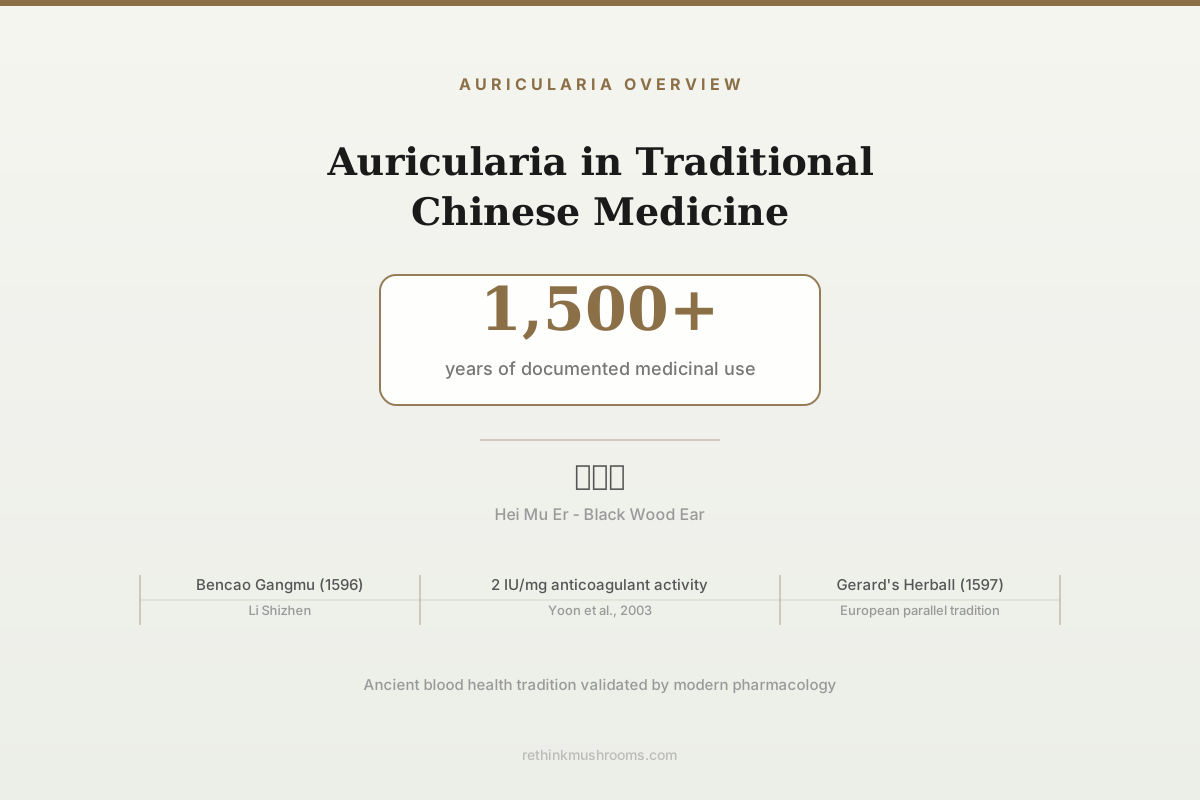
1,500+ years
Auricularia auricula has been documented in Chinese medical texts since at least the Tang Dynasty, with its anticoagulant and blood-thinning properties now validated by modern pharmacology.
Liu et al., J. Agric. Food Chem., 2021
Hei Mu Er
black wood ear in Chinese (黑木耳)
2 IU/mg
specific anticoagulant activity of purified polysaccharide
9 Studies
validating traditional blood health uses
Liu et al., J. Agric. Food Chem., 2021
 View as image ↗
Few medicinal mushrooms bridge the gap between ancient practice and modern pharmacology as directly as Auricularia auricula-judae. Known in Chinese as hei mu er (黑木耳, "black wood ear"), this gelatinous fungus appears in Chinese medical texts spanning centuries, prescribed primarily for blood-related conditions: bleeding hemorrhoids, uterine bleeding, blood in urine, and poor circulation. Modern research has identified the specific compounds behind these traditional applications, particularly acidic polysaccharides with measurable anticoagulant and antiplatelet activity. The traditional claim that wood ear "moves blood" turns out to be pharmacologically real. For an overview of Auricularia's place in global mushroom cultivation, see the companion article on Auricularia as the world's third-most cultivated mushroom.
Key Takeaways
- Auricularia auricula has been used in Chinese medicine for over 1,500 years, documented in texts including Li Shizhen's 1596 Bencao Gangmu (Compendium of Materia Medica) for blood conditions and yin nourishment (Liu et al., 2021)
- A purified polysaccharide from Auricularia showed specific anticoagulant activity of 2 IU/mg with an average molecular mass of 160 kDa, acting through antithrombin-mediated thrombin inhibition (Yoon et al., 2003)
- Hot water extracts inhibited both human and rat ADP-induced platelet aggregation, with adenosine content of 133-154 micrograms per gram of dry fungus contributing to the antiplatelet effect (Agarwal et al., 1982)
- Black tree fungus reduced total serum cholesterol and beta-lipoprotein in rabbits more effectively than aspirin in an atherosclerosis model (Fan et al., 1989)
- Auricularia polysaccharides improved heart antioxidant enzyme activities (SOD, GSH-Px, CAT) and left ventricular function parameters in aged mice (Wu et al., 2010)
- In 16th-century Europe, herbalist John Gerard independently prescribed Auricularia boiled in milk or steeped in beer for throat inflammations, representing a parallel ethnomedicinal tradition
The Chinese Medical Tradition
Auricularia auricula-judae holds a documented place in Chinese pharmacopeia stretching back centuries. Liu et al. (2021) noted in their comprehensive review that the application of Auricularia for health purposes "has a long tradition in Asia," with Chinese medical texts classifying it among the therapeutic fungi alongside lingzhi (reishi) and other medicinal species.[1]
The Bencao Gangmu (本草纲目, Compendium of Materia Medica), compiled by Li Shizhen and published in 1596, includes mu er (木耳, "wood ear") among its documented fungi. Li Shizhen's work synthesized earlier Chinese pharmacological knowledge from over 800 sources spanning centuries, and his inclusion of wood ear reflected an already established medical tradition rather than a new discovery. The Bencao Gangmu catalogued 1,892 drugs with approximately 11,000 formal prescriptions, and wood ear's entry documented its applications for blood conditions, hemorrhoids, and digestive health.
In traditional Chinese medicine theory, Auricularia is classified as sweet and neutral in nature. It enters multiple meridians: lung, stomach, liver, spleen, kidney, and large intestine. Its primary TCM functions center on nourishing yin, moistening dryness, promoting blood circulation, and stopping bleeding. This dual action of both moving blood (promoting circulation) and stopping blood (controlling hemorrhage) appears contradictory by Western pharmacological logic but makes sense within the TCM framework of restoring balance. A substance that normalizes blood function could theoretically address both stagnation and excess flow depending on the underlying pattern of disharmony.
The TCM application for respiratory conditions reflects the "moistening dryness" classification. Wood ear's gelatinous texture was interpreted through the doctrine of signatures as indicating an ability to moisten dry tissues. TCM practitioners prescribed it for persistent dry coughs and throat irritation, conditions categorized as lung yin deficiency. While the doctrine of signatures is not a reliable pharmacological predictor, Auricularia's mucopolysaccharide content does provide physical demulcent properties that could coat and soothe irritated mucous membranes.
European Parallel: John Gerard and Beyond
Auricularia developed an independent ethnomedicinal tradition in Europe, entirely separate from its Chinese lineage. The English herbalist John Gerard, writing in 1597, recommended A. auricula-judae prepared as a liquid extract by boiling the fruiting bodies in milk or steeping them in beer. The preparation was sipped slowly to treat sore throats. John Parkinson, writing in 1640, expanded the applications: the infusion was "good to gargle the Mouth or Throat in Quinsies, and other inflammations of the Mouth and Throat. And being infus'd in some proper Water, it is good in Diseases of the Eyes."
European folk medicine continued using Auricularia through the 19th century for sore throats, sore eyes, jaundice, and as an astringent. The fungus was known as fungus sambuca among herbalists, referencing the elder trees (Sambucus) on which it commonly grows in European forests.
The convergence of Chinese and European traditions on throat-related applications is notable. Both medical systems, with no documented exchange of pharmacological knowledge, independently identified Auricularia as therapeutically useful for throat and respiratory conditions. This cross-cultural agreement does not prove efficacy, but it does suggest that the mushroom's physical properties (its mucilaginous, demulcent quality) produce noticeable symptomatic effects across cultural contexts. Beyond Europe, tribal communities in various parts of India also used A. auricula-judae in traditional medicine, and certain Tzeltal communities in Mexico employed Auricularia species for anxiety-related conditions.[1]
Anticoagulant Validation: The Blood-Moving Claim
The most pharmacologically significant validation of TCM's blood-related claims came from Yoon et al. (2003), who isolated an acidic polysaccharide from Auricularia with measurable anticoagulant activity.[2]
The alkali extract showed the highest anticoagulant activity among water, alkali, and acid extraction methods. After purification by gel filtration chromatography, the polysaccharide had a specific anticoagulant activity of 2 IU/mg with an average molecular mass of approximately 160 kDa. The sugar composition included mannose, glucose, glucuronic acid, and xylose, but no sulfate esters.
The mechanism was specific: the polysaccharide catalyzed thrombin inhibition through antithrombin, but not through heparin cofactor II. This distinction matters because heparin, the pharmaceutical standard for anticoagulation, works through both antithrombin and heparin cofactor II. Auricularia's polysaccharide operates through only one of these pathways, making it mechanistically distinct from heparin.
The glucuronic acid residues proved essential for activity. When researchers chemically reduced the carboxyl groups on the glucuronic acid, anticoagulant activity disappeared entirely. This structure-activity relationship confirms that the anticoagulant effect is not a nonspecific property of any mushroom polysaccharide but requires specific acidic sugar residues in the polymer chain.[2]
In ex vivo tests, rats orally fed with the polysaccharide showed inhibition of platelet aggregation comparable to aspirin. This oral bioavailability finding is particularly relevant to the TCM context because it demonstrates that consuming Auricularia as a food or tea can deliver the active compound systemically.
Platelet Aggregation: The Earliest Modern Evidence
The first modern pharmacological validation of Auricularia's blood effects came from Agarwal et al. (1982), one of the earliest studies connecting a traditional mushroom food to measurable cardiovascular pharmacology.[3]
Hot water extracts of Mo-er (the Chinese culinary term for Auricularia) at a concentration of 1 gram per 15 mL of water strongly inhibited both human and rat ADP-induced platelet aggregation. HPLC analysis identified adenosine in two Auricularia varieties: A. auricula contained 133 micrograms per gram of dry fungus, and A. polytricha contained 154 micrograms per gram.
Adenosine is a known endogenous inhibitor of platelet aggregation that acts through A2 receptors on platelet surfaces, raising intracellular cAMP and suppressing activation. However, the researchers found that the extracts contained additional antiplatelet agents beyond adenosine, because the inhibitory activity exceeded what adenosine alone could account for. These unidentified compounds blocked platelet aggregation through a mechanism independent of the platelet cyclic AMP system.[3]
This 1982 study is historically significant because it provided the first quantitative evidence that the TCM practice of consuming wood ear for blood health had a measurable biochemical basis. The discovery of adenosine as a bioactive component, combined with unidentified co-active compounds, established that Auricularia's traditional reputation was not purely placebo or cultural artifact.
Atherosclerosis and Lipid Metabolism
Fan et al. (1989) tested edible black tree fungus against aspirin in a rabbit atherosclerosis model, directly comparing the mushroom to a pharmaceutical standard.[4]
The results showed that total serum cholesterol and beta-lipoprotein in the Auricularia-fed group decreased more than in the aspirin group and the untreated control group (P < 0.01). The study established that Auricularia's cardiovascular effects extend beyond anticoagulation to lipid metabolism, encompassing a broader cardiovascular profile consistent with its TCM classification as a blood-nourishing and circulation-promoting agent.
Chen et al. (2008) provided the mechanistic detail. Auricularia polysaccharides reduced blood lipid levels in ICR mice fed a cholesterol-enriched diet, with the effect mediated through increased lipoprotein lipase (LPL) activity.[5] LPL is the enzyme responsible for clearing triglyceride-rich lipoproteins from the bloodstream. By upregulating LPL activity, Auricularia polysaccharides accelerate the clearance of circulating lipids. This mechanism is pharmacologically distinct from statin drugs (which inhibit cholesterol synthesis) and provides a specific molecular pathway through which dietary Auricularia consumption could influence lipid metabolism.
Bian et al. (2020) advanced the anticoagulant research with optimized extraction methods. Using ultrasound-assisted extraction and response surface methodology, they characterized acidic polysaccharides from A. auricula-judae for functional food applications. All extracts prolonged blood clotting time compared to controls, confirming the anticoagulant activity with modern analytical methods.[6] For a deeper look at the specific compounds responsible for these effects, see the article on wood ear bioactive compounds.
Heart Protection in Aging
Wu et al. (2010) tested Auricularia polysaccharides against age-related cardiovascular decline, a condition that overlaps with the TCM concept of blood and qi deficiency in elderly patients.[7]
Chemical characterization revealed that the polysaccharides consisted primarily of glucose, mannose, and glucuronic acid in a molar ratio of 1.0:0.58:0.38, with a molecular weight of approximately 440 kDa and a triple-helix conformation in aqueous solution.
In aged mice, the polysaccharides improved multiple cardiovascular parameters. Blood and heart antioxidant enzyme activities increased: superoxide dismutase (SOD), glutathione peroxidase (GSH-Px), and catalase (CAT) all rose with treatment. Left ventricular function improved as measured by ejection fraction, fractional shortening, and cardiac output. Lipid peroxidation markers (malondialdehyde) decreased.
This study connects to the TCM concept of Auricularia as a tonic for the elderly. The traditional indication of using wood ear for "weakness" and "chronic disease" in aged populations aligns with measured improvements in cardiac antioxidant defense and ventricular function. The polysaccharide's triple-helix structure is a conformational feature shared with other bioactive mushroom polysaccharides (including lentinan from shiitake), suggesting a structural basis for biological activity.
Immunomodulatory Properties: Beyond Blood
Chen et al. (2020) systematically reviewed the broader biological activities of Auricularia polysaccharides, documenting antioxidant, hypoglycemic, hypolipidemic, anticoagulant, antitumor, and immunomodulatory effects.[8] This range of activities aligns with the TCM classification of Auricularia as affecting multiple meridians (lung, stomach, liver, spleen, kidney, large intestine), which in TCM theory predicts broad-spectrum effects across organ systems.
Bao et al. (2020) isolated and characterized a polysaccharide fraction from Auricularia that enhanced macrophage function in RAW264.7 cells, increasing NO production, phagocytic activity, and cytokine secretion (TNF-alpha and IL-6).[9] This immunomodulatory activity is consistent with the TCM use of Auricularia as a qi tonic, since immune defense in TCM theory falls under the domain of wei qi (defensive qi). For how this compares to polysaccharide immunology in other species, see the article on Agaricus blazei polysaccharide and TLR activation.
The hypoglycemic properties of Auricularia polysaccharides represent another area where modern research validates traditional use. Multiple studies in the database have documented blood sugar-lowering effects in diabetic mouse models, supporting the traditional application of wood ear for metabolic conditions.[8]
What TCM Got Right, and What Remains Unresolved
The traditional Chinese medical applications of Auricularia for blood-related conditions have been validated with unusual specificity. The "blood-moving" claim corresponds to documented anticoagulant and antiplatelet mechanisms. The cardiovascular benefits correspond to measured lipid-lowering and cardiac protective effects. The "yin-nourishing" and "dryness-moistening" classifications correspond to the mushroom's mucopolysaccharide content and demulcent properties.
What remains unresolved is dosing. TCM texts describe Auricularia in the context of dietary consumption and medicinal decoctions, but the dose-response relationships for specific pharmacological endpoints are poorly characterized in humans. The rat and mouse studies use purified polysaccharide fractions at defined concentrations, while traditional use involves consuming the whole mushroom in soups, stir-fries, or teas. Whether dietary quantities deliver pharmacologically meaningful doses of the active polysaccharides is an open question.
The anticoagulant finding carries a practical consideration: people already taking blood-thinning medications may experience additive effects from substantial Auricularia consumption. This interaction potential is not a traditional TCM consideration but becomes relevant when traditional foods are consumed alongside pharmaceutical anticoagulants. Understanding the naming history of wood ear mushroom provides additional context for navigating the diverse sources of ethnobotanical knowledge about this species.
The Bottom Line
Auricularia auricula has one of the longest documented histories of any medicinal mushroom, with Chinese medical texts spanning centuries prescribing it for blood conditions, circulatory health, and yin nourishment. Modern pharmacological research has validated the core traditional claims with unusual precision: purified polysaccharides demonstrate measurable anticoagulant activity (2 IU/mg) through antithrombin-mediated thrombin inhibition, and whole extracts inhibit platelet aggregation through both adenosine and unidentified co-active compounds. European herbalists independently developed therapeutic applications for the same species, focusing on throat and eye inflammations. The gap between traditional use and modern evidence lies primarily in human dosing data and the translation of purified-compound findings to whole-food consumption.
Frequently Asked Questions
Sources & References
- 1RTHM-00702·Liu, Enchao et al. (2021). “Review on Auricularia auricula-judae as a Functional Food: Growth, Chemical Composition, and Biological Activities..” Journal of agricultural and food chemistry.Study breakdown →PubMed →↩
- 2RTHM-00065·Yoon, Seon-Joo et al. (2003). “The nontoxic mushroom Auricularia auricula contains a polysaccharide with anticoagulant activity mediated by antithrombin..” Thrombosis research.Study breakdown →PubMed →↩
- 3RTHM-00002·Agarwal, K C et al. (1982). “Inhibition of human and rat platelet aggregation by extracts of Mo-er (Auricularia auricula)..” Thrombosis and haemostasis.Study breakdown →PubMed →↩
- 4RTHM-00009·Fan, Y M et al. (1989). “The effect of edible black tree fungus (Auricuaria auricula) on experimental atherosclerosis in rabbits..” Chinese medical journal.Study breakdown →PubMed →↩
- 5RTHM-00128·Chen, G et al. (2008). “Effect of polysaccharide from Auricularia auricula on blood lipid metabolism and lipoprotein lipase activity of ICR mice fed a cholesterol-enriched diet..” Journal of food science.Study breakdown →PubMed →↩
- 6RTHM-00609·Bian, Chun et al. (2020). “Extraction Optimization, Structural Characterization, and Anticoagulant Activity of Acidic Polysaccharides from Auricularia auricula-judae..” Molecules (Basel.Study breakdown →PubMed →↩
- 7RTHM-00201·Wu, Qin et al. (2010). “Chemical characterization of Auricularia auricula polysaccharides and its pharmacological effect on heart antioxidant enzyme activities and left ventricular function in aged mice..” International journal of biological macromolecules.Study breakdown →PubMed →↩
- 8RTHM-00611·Chen, Nana et al. (2020). “Polysaccharides from Auricularia auricula: Preparation, structural features and biological activities..” Carbohydrate polymers.Study breakdown →PubMed →↩
- 9RTHM-00607·Bao, Zhijie et al. (2020). “Isolation, purification, characterization, and immunomodulatory effects of polysaccharide from Auricularia auricula on RAW264.7 macrophages..” Journal of food biochemistry.Study breakdown →PubMed →↩