International Mushroom Regulation
2 regulatory bodies
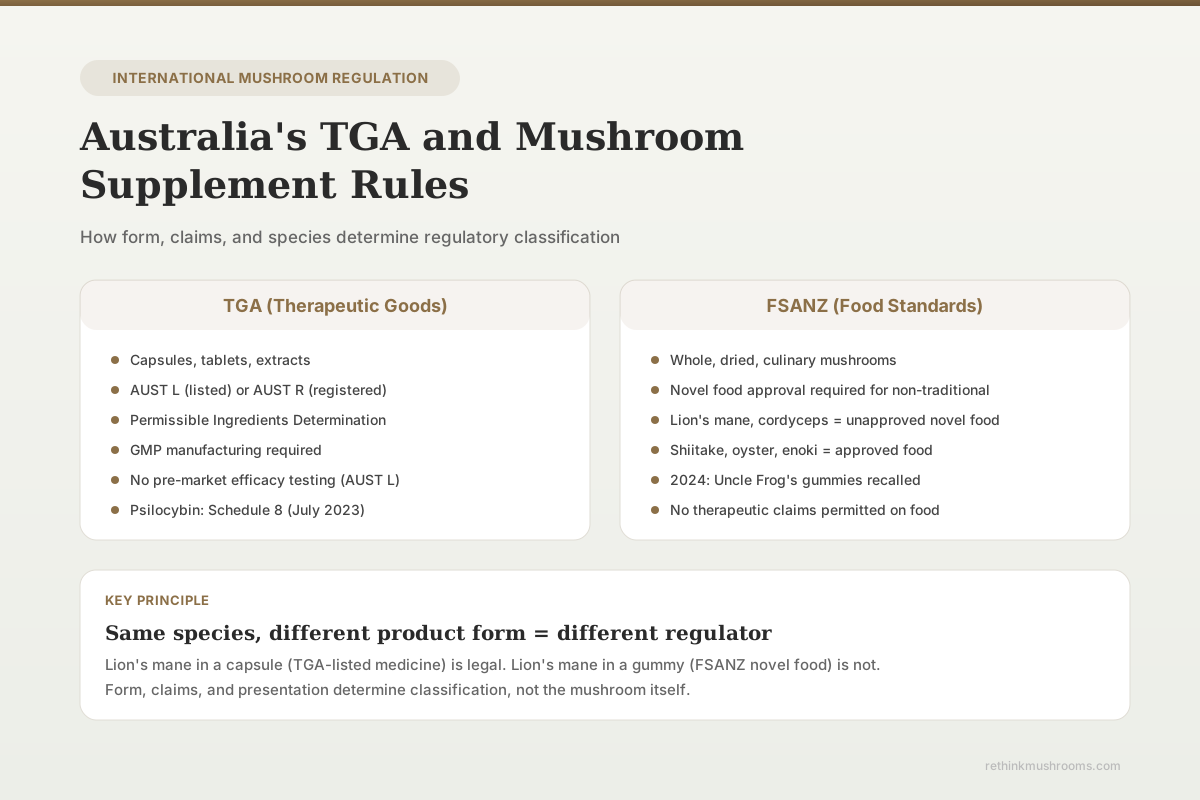
Mushroom products in Australia fall under either the TGA (therapeutic goods) or FSANZ (food), and the classification depends on form, claims, and species.
Therapeutic Goods Administration, Guidance on Mushroom Products, 2023
TGA + FSANZ
dual regulatory system
July 2023
psilocybin rescheduled
Capsule = medicine
form determines class
Therapeutic Goods Administration, Guidance on Mushroom Products, 2023
 View as image ↗
Australia regulates mushroom supplements through two separate agencies with fundamentally different frameworks. The Therapeutic Goods Administration (TGA) oversees products classified as medicines. Food Standards Australia New Zealand (FSANZ) governs products classified as food. The same mushroom species can fall under either regulator depending on its form, its claims, and how it is presented to consumers. This split creates a regulatory landscape that differs sharply from the US dietary supplement model and the EU novel food framework. For a comparison across markets, see our article on how international mushroom regulations differ from US rules.
Key Takeaways
- Mushroom products in capsule form or made via extraction processes are classified as therapeutic goods under Australian law, regardless of whether therapeutic claims are made
- The TGA's Permissible Ingredients Determination lists specific mushroom species allowed in listed medicines, including Ganoderma lucidum, Cordyceps sinensis, and Hericium erinaceus
- FSANZ classifies lion's mane and cordyceps as unapproved novel foods when sold as food products, leading to the 2024 Uncle Frog's mushroom gummies recall
- Australia became the first country to allow prescription psilocybin for treatment-resistant depression under the Authorised Prescriber scheme from July 1, 2023
- Quality testing of commercial Ganoderma lucidum supplements found significant variation in triterpene and polysaccharide content between products (Wu et al., 2017)
- DNA barcoding of commercial reishi supplements revealed species authentication issues, with some products containing species other than labeled (Gunnels et al., 2020)
How the TGA classifies mushroom products
The TGA published specific guidance on mushroom product classification in April 2023, establishing clear criteria for when a mushroom product crosses from food into therapeutic good territory. Five factors trigger therapeutic goods classification:
Form. Products supplied in capsule or tablet form are likely therapeutic goods. This is the single most common trigger for mushroom supplements. A dried shiitake in a bag is food; the same shiitake material in a capsule is a therapeutic good.
Processing method. Products manufactured through extraction processes (alcohol extraction, hot water concentration, standardized extract preparation) are likely therapeutic goods, even if sold as powders rather than capsules.
Species history. Mushroom species traditionally used as medicines rather than foods are classified as therapeutic goods regardless of form. Reishi (Ganoderma lucidum), which has centuries of documented medicinal use in traditional Chinese medicine, falls into this category. Shiitake and oyster mushrooms, which are primarily culinary species in Australian and New Zealand food traditions, are treated as food when sold whole or dried.
Claims. Any therapeutic claim on the label or in advertising makes a product a therapeutic good. Claiming a mushroom product "supports immune function" or "reduces inflammation" triggers TGA jurisdiction, even if the product form alone would not.
Presentation. How a product is packaged, marketed, and described to consumers matters. Products presented with dosage instructions, health warnings, or medical terminology are more likely to be classified as therapeutic goods.
The practical consequence: most commercial mushroom supplements sold in Australia in capsule or extract form require listing on the Australian Register of Therapeutic Goods (ARTG) before they can be legally supplied or advertised.
The Permissible Ingredients Determination
The TGA maintains the Permissible Ingredients Determination, an approved list of substances that can be included in listed medicines. This list is updated multiple times per year; the most recent revision (No. 1, 2026) commenced on March 1, 2026.
Several medicinal mushroom species appear on the permissible ingredients list, including Ganoderma lucidum (reishi), Cordyceps sinensis, Lentinula edodes (shiitake), Grifola frondosa (maitake), and Hericium erinaceus (lion's mane) when presented as therapeutic goods. Each listing specifies permitted parts (fruiting body, mycelium, spore), preparation methods, and any restrictions on use.
The listing does not guarantee product quality. Wu et al. (2017) evaluated the quality consistency of 19 Ganoderma lucidum dietary supplements collected from US retailers using HPLC analysis of triterpene content and found substantial variation between products, with some supplements containing little to no detectable triterpene compounds despite label claims.[1] While this study examined US products, the same quality challenges apply to any market where pre-market efficacy testing is not required. For advice on spotting low-quality products, see our guide to red flags in mushroom supplements.
Lopez-Garcia et al. (2016) used MALDI-TOF mass spectrometry to compare polysaccharide profiles from commercial health supplements of six different mushroom species and found measurable differences in polysaccharide composition not only between species but between different products of the same species.[2] This analytical inconsistency underscores why regulatory listing alone does not ensure consistent bioactive content.
Listed vs. registered: two tiers of TGA oversight
The ARTG contains two categories relevant to mushroom products:
Listed medicines (AUST L). Most mushroom supplements fall here. Listed medicines contain pre-approved, lower-risk ingredients. The TGA evaluates manufacturing quality and verifies that claims fall within permitted indications for the ingredient, but does not independently assess efficacy before listing. The sponsor (manufacturer or importer) self-certifies that the product meets all requirements. TGA conducts post-market reviews and audits. Listed medicines can make "traditional use" claims or low-level health maintenance claims but cannot claim to treat, cure, or prevent specific diseases.
Registered medicines (AUST R). These require full pre-market evaluation of quality, safety, and efficacy, similar to pharmaceutical drug registration. Very few mushroom products reach this tier because the evidence requirements mirror those for conventional drugs. Polysaccharide-K (PSK) from Trametes versicolor, which is an approved pharmaceutical in Japan, would require AUST R registration to make specific cancer treatment claims in Australia.
For most consumers, the practical distinction is this: an AUST L number on a mushroom supplement means the TGA has reviewed the ingredient list and manufacturing standards but has not verified that the product does what its label implies. Understanding what label terms actually mean is essential context for navigating this system.
The food-medicine boundary: FSANZ and novel foods
Where the TGA governs therapeutic goods, FSANZ governs food safety and labeling across Australia and New Zealand. Mushroom species that are not traditionally consumed as food in Australia or New Zealand are classified as "novel foods" under the Australia New Zealand Food Standards Code and cannot be sold as food without specific approval.
This classification created the regulatory crisis that led to the Uncle Frog's mushroom gummies recall in mid-2024. The products, marketed as "Mushroom Gummies" containing cordyceps and lion's mane, were sold as food items (gummy format, available through general retail). FSANZ determined that cordyceps and lion's mane are unapproved novel foods when presented as food ingredients, meaning the products were illegal to sell in food form regardless of their actual contents.
The recall exposed a deeper problem: at least five people were hospitalized across New South Wales, Queensland, South Australia, and Victoria after consuming the gummies, with symptoms including elevated heart rate, nausea, anxiety, and hallucinations. Testing suggested the products may have contained undeclared THC, though the novel food violation alone was sufficient grounds for the recall.
The regulatory gap this case exposed: mushroom ingredients can be legally sold as TGA-listed medicines in capsule form but illegally sold as FSANZ-regulated food in gummy form. The species did not change; the product format and regulatory pathway did. A product that falls between the two systems, one that is not clearly a therapeutic good or a conventional food, can reach consumers without adequate oversight from either regulator.
Psilocybin: Schedule 8 reclassification
On February 3, 2023, the TGA finalized a landmark decision: psilocybin and MDMA were reclassified to allow medical use under strict conditions, effective July 1, 2023. Australia became the first country to formally permit prescription access to psilocybin for a specific psychiatric indication.
Under the new scheduling:
- Psilocybin is permitted for treatment-resistant depression
- MDMA is permitted for post-traumatic stress disorder
- Only psychiatrists specifically authorized under the TGA's Authorised Prescriber scheme can prescribe these substances
- Before seeking Authorised Prescriber status, the psychiatrist must obtain approval from a Human Research Ethics Committee (HREC)
- Administration must occur in a controlled medical setting in combination with psychotherapy
Psilocybin remains Schedule 9 (prohibited substance) for all other purposes. The rescheduling created a narrow, highly regulated pathway for therapeutic use while maintaining criminal prohibition for recreational possession and supply. This dual classification, Schedule 8 for authorized medical use and Schedule 9 for everything else, is unusual in international drug scheduling.
The practical impact has been limited by cost and access barriers. Treatment sessions require extended clinical supervision (6-8 hours per session), the number of Authorised Prescribers remains small, insurance coverage is not established, and out-of-pocket costs for a full treatment course can reach tens of thousands of Australian dollars. The Royal Australian and New Zealand College of Psychiatrists (RANZCP) has expressed cautious support while noting that the evidence base for psilocybin-assisted therapy, while promising, is still emerging from phase II clinical trials. The selling mushroom supplements globally article covers how this compares to psilocybin access frameworks in other jurisdictions.
Species authentication: a regulatory blind spot
Both the TGA and FSANZ systems assume that products contain what their labels claim. Independent testing suggests this assumption is not always warranted.
Gunnels et al. (2020) used ITS DNA barcoding to authenticate 30 commercial reishi/lingzhi herbal supplements and found that the ITS region provided reliable species-level identification for Ganoderma.[3] The study demonstrated that DNA barcoding can detect species substitution, where a product labeled as Ganoderma lucidum actually contains a different Ganoderma species or an unrelated fungus entirely. Products containing species other than what was labeled were identified in their sample.
The EFSA assessment of freeze-dried Antrodia camphorata mycelia as a novel food in the EU (2022) illustrates what a rigorous regulatory evaluation looks like: full compositional analysis, genotoxicity battery, subchronic toxicity study, and human tolerance data were all required before approval.[4] The Australian listed medicine pathway does not require this level of evidence. The EU novel food framework for mushroom supplements provides a useful contrast to Australia's approach.
What Australian consumers face
The Australian mushroom supplement landscape in 2026 looks like this:
Legal and available as AUST L listed medicines: Reishi, lion's mane, cordyceps, maitake, shiitake, and other species on the Permissible Ingredients Determination, in capsule or extract form, with quality manufacturing standards but no independent efficacy verification.
Illegal as food products: Lion's mane, cordyceps, and other species not traditionally consumed as food in Australia/New Zealand, in any food format (gummies, powders marketed as food, fortified beverages) unless specifically approved as novel foods by FSANZ.
Legal as whole/dried food: Shiitake, oyster, enoki, and other species with established culinary use in Australia/New Zealand, when sold in their whole or dried form without therapeutic claims.
Restricted medical access: Psilocybin, available only through Authorised Prescriber psychiatrists for treatment-resistant depression, with significant cost and access barriers.
This classification system means Australian consumers face a more complex regulatory landscape than their counterparts in the US, where dietary supplements occupy a single category under the FDA, or in the EU, where the novel food framework applies uniformly to non-traditional ingredients.
The quality gap remains the most significant consumer issue. A product's AUST L listing confirms it contains permissible ingredients manufactured to GMP standards. It does not confirm that the product contains therapeutically relevant levels of bioactive compounds like beta-glucans, triterpenes, or cordycepin. Independent testing, certificate of analysis review, and manufacturer transparency remain the primary tools available to consumers evaluating product quality. For guidance on avoiding counterfeit supplements, particularly for high-value species like Antrodia camphorata, see our dedicated article.
The Bottom Line
Australia's dual TGA/FSANZ system classifies mushroom supplements based on form, claims, species history, and presentation rather than the ingredient itself. Most commercial mushroom supplements require TGA listing as therapeutic goods, while the same species may be prohibited as food under FSANZ novel food rules. The 2023 psilocybin rescheduling created a narrow medical access pathway unique among global regulatory systems. Quality consistency across commercial products remains an unresolved issue, as TGA listing does not require independent verification of bioactive compound levels.
Frequently Asked Questions
Sources & References
- 1RTHM-00499·Wu, Ding-Tao et al. (2017). “Evaluation on quality consistency of Ganoderma lucidum dietary supplements collected in the United States..” Scientific reports.Study breakdown →PubMed →↩
- 2RTHM-00437·López-García, Marta et al. (2016). “MALDI-TOF to compare polysaccharide profiles from commercial health supplements of different mushroom species..” Food chemistry.Study breakdown →PubMed →↩
- 3RTHM-00615·Gunnels, Tess et al. (2020). “The ITS region provides a reliable DNA barcode for identifying reishi/lingzhi (Ganoderma) from herbal supplements..” PloS one.Study breakdown →PubMed →↩
- 4RTHM-00799·Turck, Dominique et al. (2022). “Safety of freeze-dried mycelia of Antrodia camphorata as a novel food pursuant to regulation (EU) 2015/2283..” EFSA journal. European Food Safety Authority.Study breakdown →PubMed →↩