Mushroom Coffee
$2.99B market (2024)
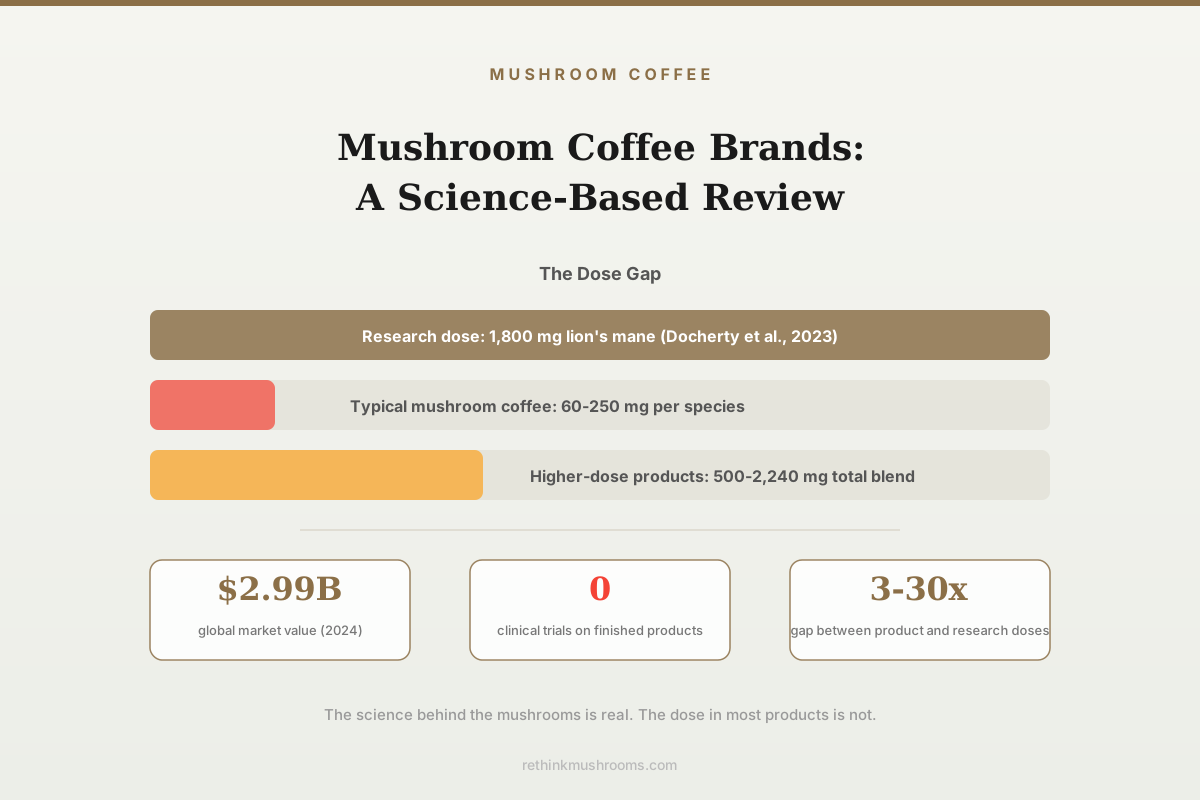
The global mushroom coffee market was valued at nearly $3 billion in 2024, yet no published clinical trial has tested any mushroom-coffee blend as a finished product.
Grand View Research, 2024
100-250 mg
typical mushroom dose per cup of mushroom coffee
750-3,000 mg
dose range in positive human studies
0 Trials
published clinical trials on mushroom coffee products
Grand View Research, 2024
 View as image ↗
Mushroom coffee is a nearly $3 billion market built on a simple proposition: add medicinal mushroom extracts to coffee for cognitive, immune, and energy benefits beyond caffeine alone. The mushroom species most commonly used (lion's mane, chaga, reishi, cordyceps) have genuine research supporting their bioactive properties. The question is whether mushroom coffee products deliver enough of these compounds to produce the effects that research has documented. The answer, for most products on the market, is no. Positive human clinical trials on lion's mane, cordyceps, and reishi use daily doses of 750-3,000 mg of concentrated extract. A typical cup of mushroom coffee contains 100-500 mg of a multi-mushroom blend. No published clinical trial has tested any mushroom-coffee product as a finished formulation. The science behind mushroom coffee is real; the dose in most products is not. For the broader question of whether mushroom coffee products contain enough mushroom to matter, see the companion analysis.
Key Takeaways
- No published clinical trial has tested any commercial mushroom coffee product for health outcomes; all evidence is extrapolated from separate research on individual mushroom species at higher doses
- Lion's mane supplementation at 1,800 mg/day for 28 days improved cognitive performance on speed and accuracy tasks in healthy young adults compared to placebo (Docherty et al., 2023)
- A single 1,800 mg dose of lion's mane improved reaction time 60 minutes post-dose in a double-blind placebo-controlled study in healthy younger adults (Surendran et al., 2025)
- Functional cordyceps coffee developed with mixed mushroom extracts retained cordycepin (0.24 mg/g) and beta-glucan (10.04 mg/g) after roasting, but no human efficacy testing was performed (Song, 2020)
- Coffee brewed with Cordyceps militaris and Hericium erinaceus fruiting bodies preserved phenolic compounds, terpenes, and sterols, though bioactive concentrations were lower than standalone mushroom supplements (Kala et al., 2024)
- A systematic review of mushroom effects on neurocognition found lion's mane showed the most consistent evidence, but study quality was generally low and sample sizes small (Cha et al., 2024)
The Dose Problem
The central issue with mushroom coffee is arithmetic. The research supporting lion's mane, cordyceps, reishi, and chaga uses specific doses of concentrated extracts or whole mushroom powders. These doses are measured in grams, not milligrams.
Docherty et al. (2023) conducted a double-blind, parallel groups pilot study giving healthy young adults 1,800 mg/day of lion's mane for 28 days. Participants taking lion's mane performed better on cognitive tasks measuring speed and accuracy compared to placebo. Stress was reduced at 28 days. The dose was 1,800 mg of a standardized extract taken as capsules, not blended into a hot beverage with coffee acids and tannins that may affect compound stability.[1]
Surendran et al. (2025) tested the acute effects of a single 1,800 mg dose of standardized lion's mane extract in healthy younger adults. In this double-blind, randomized, placebo-controlled study, participants showed improved reaction time 60 minutes after a single dose. This is among the first evidence that lion's mane produces measurable cognitive effects within an hour, relevant to the "morning focus" marketing of mushroom coffee.[2]
Now consider the typical mushroom coffee serving. Most brands deliver 100-500 mg total of a multi-mushroom blend containing 3-6 species. If a product contains 250 mg of a four-mushroom blend (lion's mane, chaga, reishi, cordyceps), each species contributes roughly 60 mg per cup. The cognitive study used 1,800 mg of lion's mane alone. That is a 30-fold difference.
Some premium products offer higher doses. Four Sigmatic's Focus coffee delivers 250 mg of lion's mane and 250 mg of chaga per serving. RYZE provides 2,000 mg total of a six-mushroom blend. MUD\WTR contains approximately 2,240 mg of total mushroom blend. These higher-dose products come closer to research thresholds, but the mushroom content is still split across multiple species, and none have been tested as finished products in clinical trials.
What the Mushroom Coffee Research Actually Shows
Song (2020) published the only peer-reviewed study specifically developing a functional mushroom coffee product. The researchers treated green coffee beans with mixed extracts from three medicinal mushrooms (Cordyceps militaris, Ganoderma lucidum, and Phellinus linteus) before roasting.[3]
The resulting coffee retained measurable cordycepin (0.24 mg/g) and beta-glucan (10.04 mg/g) after the roasting process. The coffee also showed antioxidant activity (DPPH radical scavenging) and alpha-glucosidase inhibitory activity in vitro. However, the study characterized the product's chemistry and in vitro bioactivity only. No human subjects consumed the coffee, and no health outcomes were measured. The study demonstrates that mushroom bioactives can survive coffee roasting, but it does not demonstrate that drinking the coffee produces health effects.[3]
Kala et al. (2024) analyzed coffee brewed with Cordyceps militaris and Hericium erinaceus fruiting bodies to characterize the bioactive profile of the final beverage.[4] The researchers confirmed that the mushroom-supplemented coffee retained phenolic compounds, terpenes, and sterols from both the coffee and mushroom components. The coffee maintained its characteristic flavor profile while adding mushroom-derived compounds to the chemical matrix.
The key limitation: bioactive concentrations in the brewed beverage were lower than what would be achieved by consuming the mushroom extracts separately at the same total dose. Hot water extraction during brewing releases some compounds, but the coffee matrix (with its own acids, tannins, and other reactive compounds) may bind or degrade certain mushroom metabolites. No comparative bioavailability study has tested whether mushroom compounds absorbed from mushroom coffee differ in quantity or form from those absorbed from standalone mushroom supplements.
The Neurocognitive Evidence Base
Cha et al. (2024) published a systematic review evaluating the effects of mushrooms on mood and neurocognitive health across the lifespan, covering both epidemiological and clinical studies.[5]
Lion's mane showed the most consistent evidence for cognitive benefits among all mushroom species reviewed. Studies documented improvements in cognitive function and mood, primarily in middle-aged and older adults, with lion's mane supplementation. The bioactive compounds responsible (hericenones and erinacines) stimulate nerve growth factor (NGF) synthesis, a mechanism with plausible relevance to both neuroprotection and cognitive enhancement.
However, the review noted that overall study quality was low, sample sizes were small, and most research concentrated on chronic supplementation rather than acute effects. The evidence is promising but preliminary, and it comes from studies using dedicated mushroom supplements at therapeutic doses, not from mushroom-coffee beverages at typical serving concentrations.
Other species commonly found in mushroom coffee have thinner evidence for cognitive or energy claims. Cordyceps has preclinical evidence for energy metabolism effects (through adenosine analogs and mitochondrial function), but human cognitive studies are sparse. Chaga has antioxidant evidence but no published human cognitive trials. Reishi has anxiolytic and sleep-quality evidence at doses of 1,500-5,400 mg/day, but its inclusion in morning coffee at 50-200 mg per serving is unlikely to produce these effects. For more on reishi and cordyceps as adaptogenic mushrooms for stress, see the dedicated article.
What to Look for in a Mushroom Coffee
The science does not support blanket dismissal of mushroom coffee, nor does it support the marketing claims most brands make. The relevant variables are:
Dose per serving. Products delivering 500+ mg of individual species approach the lower range of clinical evidence. Products delivering less than 200 mg total across multiple species are functionally placebo for the mushroom component. The coffee itself (caffeine, chlorogenic acid, antioxidants) provides real benefits, but those have nothing to do with the mushrooms.
Extract vs. powder. Hot water or dual-extracted mushroom concentrates contain higher beta-glucan percentages per gram than raw mushroom powder. A product using 500 mg of a 10:1 extract delivers roughly equivalent bioactives to 5,000 mg of whole mushroom powder. Products that do not specify extraction method or ratio may be using unextracted mycelium powder, which delivers lower concentrations of active compounds. For more on what extract ratios mean, see the detailed guide.
Fruiting body vs. mycelium. Fruiting body extracts generally contain higher concentrations of species-specific bioactives (beta-glucans, hericenones in lion's mane, triterpenoids in reishi). Mycelium-on-grain products contain starch from the growing substrate, diluting the mushroom content. Products that specify "fruiting body" as the source material are preferable for bioactive density.
Third-party testing. Beta-glucan percentage is the most informative quality metric. Products with certified beta-glucan content above 20% demonstrate concentrated, genuine mushroom extract. Products without published testing data provide no assurance that the label dose reflects actual mushroom content. For a broader guide on red flags in mushroom supplements, see the companion article.
Proprietary blends. Products listing a total mushroom blend weight without specifying the amount of each species make it impossible to evaluate the dose against research evidence. If a product contains 2,000 mg of a six-mushroom blend, the per-species dose ranges from 100-800 mg depending on how the blend is weighted. Without species-specific quantities, the consumer cannot determine whether any single species reaches a clinically relevant dose.
The Brand Landscape
The mushroom coffee market includes hundreds of products at varying quality levels. Without naming endorsements (this site does not sell or affiliate with any product), the general landscape breaks down into tiers:
Higher-dose products (1,500-2,500 mg total mushroom per serving): These approach the lower boundary of research-supported doses for individual species, particularly if the blend is concentrated in one or two species rather than spread thin across six. Products in this range that use fruiting body extracts and publish beta-glucan testing data offer the strongest case for potential bioactivity.
Mid-range products (500-1,000 mg total): These provide measurable mushroom content but fall below the doses used in most positive clinical studies. They may deliver enough beta-glucans and other polysaccharides for mild antioxidant and prebiotic effects, but the evidence for cognitive or immune benefits at these doses is speculative.
Low-dose products (under 500 mg total): The mushroom content is unlikely to produce effects beyond what the coffee itself provides. At 50-200 mg of a multi-species blend, the per-species dose is homeopathic relative to clinical evidence. The product functions as coffee with a marketing story.
Coffee-Mushroom Interaction: What We Do Not Know
A gap in the literature involves the interaction between coffee compounds and mushroom bioactives when combined in a single beverage.
Coffee contains chlorogenic acid, tannins, caffeine, and other compounds that interact with polysaccharides and polyphenols. Whether these interactions enhance, reduce, or have no effect on the bioavailability of mushroom beta-glucans, hericenones, triterpenoids, or cordycepin has not been studied in human absorption trials. The Song (2020) study confirmed that key mushroom compounds survive coffee roasting, and the Kala (2024) study confirmed they are present in the brewed beverage. But presence in the cup does not equal absorption in the gut.[3][4]
This is not a theoretical concern. Tannins are well-documented inhibitors of mineral absorption when consumed with iron-containing foods. Coffee polyphenols complex with proteins and may complex with polysaccharides. Until comparative bioavailability studies measure blood levels of mushroom metabolites after consuming mushroom coffee versus the same dose of mushroom extract alone, the assumption that mushroom coffee delivers the same bioactivity as standalone supplements remains untested.
For whether mushroom coffee products actually contain enough active compounds, and how MUD\WTR, Ryze, and Four Sigmatic compare on specific metrics, see the dedicated articles. For mushroom matcha and tea as alternative delivery vehicles, see the functional beverages guide.
The Bottom Line
Mushroom coffee combines genuinely researched medicinal mushroom species with a delivery format that typically provides doses far below those used in clinical studies. Positive human trials on lion's mane use 1,800 mg/day of concentrated extract; a typical mushroom coffee serving delivers 60-250 mg of lion's mane in a multi-species blend. No clinical trial has tested any commercial mushroom coffee product for health outcomes. The mushroom compounds can survive roasting and appear in the brewed beverage, but whether they are bioavailable from the coffee matrix at these low doses is unknown. Products offering higher total mushroom doses from fruiting body extracts with published beta-glucan testing data provide the strongest science-based case for potential benefit.
Frequently Asked Questions
Sources & References
- 1RTHM-00821·Docherty, Sarah et al. (2023). “The Acute and Chronic Effects of Lion's Mane Mushroom Supplementation on Cognitive Function, Stress and Mood in Young Adults: A Double-Blind, Parallel Groups, Pilot Study..” Nutrients.Study breakdown →PubMed →↩
- 2RTHM-00952·Surendran, Geyan et al. (2025). “Acute effects of a standardised extract of Hericium erinaceus (Lion's Mane mushroom) on cognition and mood in healthy younger adults: a double-blind randomised placebo-controlled study..” Frontiers in nutrition.Study breakdown →PubMed →↩
- 3RTHM-00656·Song, Hyo-Nam (2020). “Functional Cordyceps Coffee Containing Cordycepin and β-Glucan..” Preventive nutrition and food science.Study breakdown →PubMed →↩
- 4RTHM-00882·Kała, Katarzyna et al. (2024). “Coffee with Cordyceps militaris and Hericium erinaceus Fruiting Bodies as a Source of Essential Bioactive Substances..” Pharmaceuticals (Basel.Study breakdown →PubMed →↩
- 5RTHM-00868·Cha, Sara et al. (2024). “A review of the effects of mushrooms on mood and neurocognitive health across the lifespan..” Neuroscience and biobehavioral reviews.Study breakdown →PubMed →↩