Mushroom Powders
5 core species
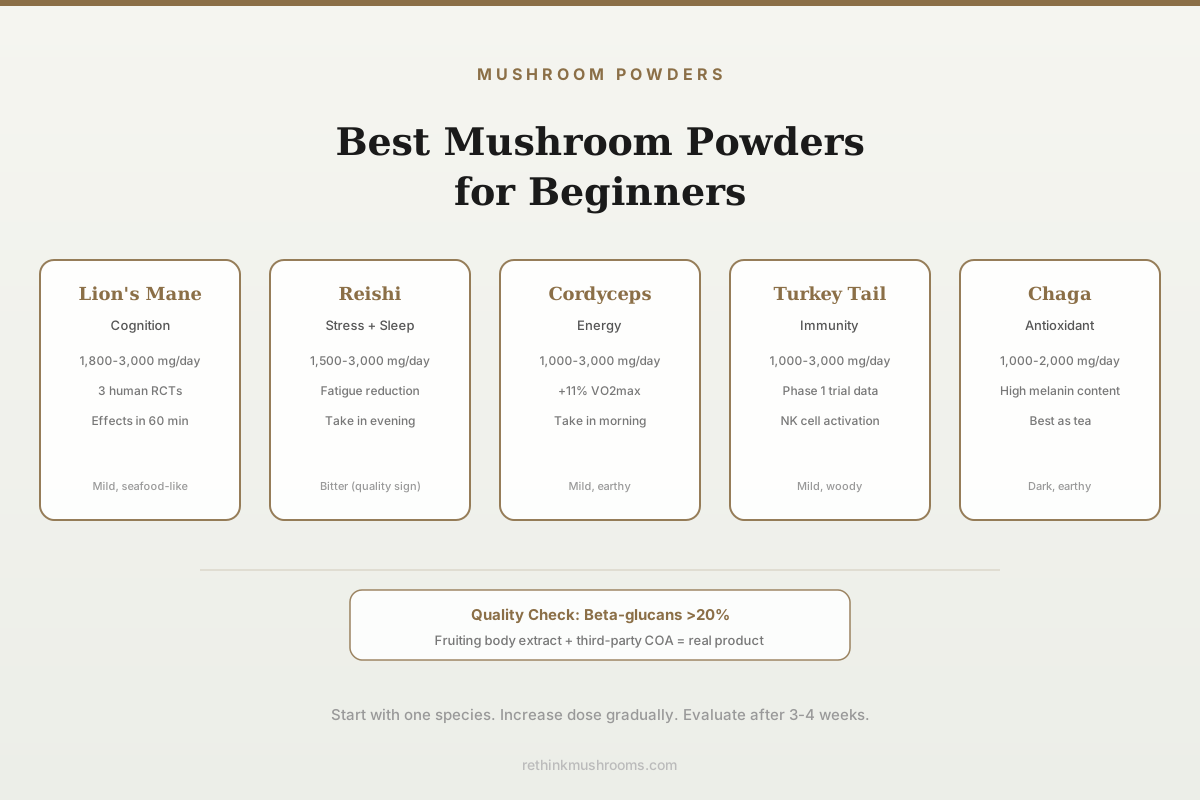
Five mushroom species have the strongest human research: lion's mane for cognition, reishi for stress, cordyceps for energy, turkey tail for immunity, and chaga for antioxidant support.
Cha et al., Neurosci. Biobehav. Rev., 2024
>20%
beta-glucan content marks quality extract
1,000-3,000 mg
typical daily dose range per species
Fruiting Body
preferred over mycelium-on-grain
Cha et al., Neurosci. Biobehav. Rev., 2024
 View as image ↗
Mushroom powders are the most accessible entry point to functional mushrooms. They can be mixed into coffee, smoothies, soups, or taken in capsules. But the category is crowded with products that vary enormously in quality, species, sourcing, and actual bioactive content. A powder labeled "lion's mane" might contain concentrated fruiting body extract with 30% beta-glucans, or it might contain mycelium grown on rice grain with more starch than mushroom. This guide covers the five species with the strongest research backing, the doses that studies actually used, and the quality markers that separate effective products from expensive fiber supplements. For the specific question of how much powder per serving, see the dedicated dosing guide.
Key Takeaways
- Lion's mane is the best-studied mushroom for cognitive benefits, with human RCTs showing effects at 1,800-3,000 mg/day of fruiting body powder or extract (Docherty et al., 2023; Mori et al., 2009)
- Reishi spore powder at 3,000 mg/day reduced fatigue and improved well-being in a clinical study, while Ganoderma lucidum supplementation reduced psychological stress in a controlled trial (Zhao et al., 2012; Mitra et al., 2024)
- Cordyceps militaris at 4,000 mg/day (mushroom blend) improved VO2max by 11% after 3 weeks of supplementation in a double-blind RCT of 28 participants (Hirsch et al., 2017)
- Turkey tail (Trametes versicolor) polysaccharide extract at 3,000-9,000 mg/day enhanced immune function in breast cancer patients undergoing conventional treatment in a Phase 1 clinical trial (Torkelson et al., 2012)
- Fruiting body extracts with beta-glucan content above 20% indicate genuine concentrated mushroom material; mycelium-on-grain products typically test below 5% beta-glucans due to starch dilution
- Ergothioneine, a brain-accumulating antioxidant found in all edible mushrooms, is bioavailable from dietary consumption with plasma levels increasing dose-dependently (Weigand-Heller et al., 2012)
The Five Core Species
The functional mushroom market includes dozens of species, but five have the strongest combination of human research data and commercial availability as powders.
Lion's Mane: Cognition and Nerve Health
Lion's mane (Hericium erinaceus) is the clearest choice for cognitive support. Three randomized controlled trials show measurable cognitive improvements at doses of 1,800-3,000 mg/day.[1][2]
Docherty et al. (2023) found that 1,800 mg/day improved Stroop task speed within 60 minutes of a single dose in healthy adults aged 18-45.[1] Mori et al. (2009) showed progressive cognitive improvement over 16 weeks at 3,000 mg/day in older adults with mild cognitive impairment, with scores declining after cessation.[2]
Lion's mane powder has a mild, slightly seafood-like flavor that blends well into coffee, smoothies, and soups. For beginners, it is the most versatile species: palatable flavor, strong evidence, and measurable effects within days to weeks. For the full evidence base on lion's mane nootropic combinations, see the guide on mushroom nootropic stacks.
Beginner dose: Start at 1,000 mg/day and increase to 1,800-3,000 mg/day over 1-2 weeks.
Reishi: Stress and Sleep
Reishi (Ganoderma lucidum) is the traditional "mushroom of longevity," used in Chinese medicine for centuries. Its modern evidence centers on stress modulation and fatigue reduction rather than acute cognitive enhancement.
Zhao et al. (2012) demonstrated that reishi spore powder at 3,000 mg/day improved cancer-related fatigue and physical well-being in breast cancer patients over four weeks.[3] Mitra et al. (2024) found that reishi supplementation reduced psychological stress markers and improved physical performance parameters in sedentary college students.[4]
Reishi powder is bitter due to its triterpenoid content. This bitterness is actually a rough quality indicator: very bitter reishi powder likely contains higher triterpenoid concentrations. Most beginners prefer reishi in capsule form or mixed into chocolate-based beverages to mask the taste. For more on adaptogenic mushrooms and the HPA stress axis, see the dedicated article.
Beginner dose: Start at 1,000 mg/day, increase to 1,500-3,000 mg/day. Take in the evening due to calming properties.
Cordyceps: Physical and Mental Energy
Cordyceps (Cordyceps militaris) is the energy mushroom. Its evidence centers on exercise performance and cellular energy production rather than direct cognitive effects.
Hirsch et al. (2017) showed that a mushroom blend containing cordyceps at 4,000 mg/day improved VO2max by 11% and time to exhaustion after three weeks of supplementation in a double-blind RCT.[5] Choi et al. (2020) demonstrated the mechanism: cordyceps promotes cellular energy production through enhanced ATP synthesis and improved mitochondrial function.[6]
Cordyceps powder has a mild, slightly earthy flavor that blends easily into pre-workout drinks, coffee, or smoothies. It is the most palatable of the five core species for most people.
Beginner dose: Start at 1,000 mg/day, increase to 1,500-3,000 mg/day. Take in the morning or before exercise.
Turkey Tail: Immune Support
Turkey tail (Trametes versicolor) has the longest clinical track record among medicinal mushrooms, with its polysaccharide extracts (PSK and PSP) used as adjunct cancer therapy in Japan since the 1970s.
Torkelson et al. (2012) conducted a Phase 1 clinical trial of Trametes versicolor in breast cancer patients following standard chemotherapy and radiation. Participants received 3,000, 6,000, or 9,000 mg/day of turkey tail powder for six months. The treatment augmented immune function, specifically increasing lymphocyte counts and natural killer cell activity in a dose-dependent manner.[7]
Turkey tail powder has a mild, woody flavor. It mixes well into broths and teas. For beginners focused on immune support, turkey tail has the most clinical data supporting its traditional use.
Beginner dose: Start at 1,000-2,000 mg/day, increase to 3,000 mg/day.
Chaga: Antioxidant Foundation
Chaga (Inonotus obliquus) grows on birch trees and contains exceptionally high concentrations of melanin and betulinic acid, contributing to strong antioxidant activity. Its evidence is primarily preclinical (cell culture and animal studies), with limited published human clinical trials.
Chaga's traditional preparation is as a tea, simmered for hours to extract the water-soluble polysaccharides and polyphenols. The powder is very dark and earthy-flavored, blending best into coffee or hot chocolate.
Beginner dose: 1,000-2,000 mg/day as powder or tea.
Fruiting Body vs. Mycelium: The Critical Distinction
This is the single most important quality factor for mushroom powders. Understanding it prevents the most common purchase mistakes.
Fruiting body is the visible mushroom structure. It contains the highest concentrations of species-specific bioactive compounds: beta-glucans, triterpenoids (in reishi), hericenones (in lion's mane), and other secondary metabolites. All of the human clinical trials cited above used fruiting body preparations or concentrated fruiting body extracts.
Mycelium-on-grain is fungal tissue grown on sterilized rice or oat substrate. The mycelium cannot be fully separated from the grain it grows on, so the final product contains substantial starch from the substrate. Independent testing consistently shows that mycelium-on-grain products contain 3-5% beta-glucans (with much of that being alpha-glucan from the grain starch), compared to 20-50% beta-glucans in fruiting body extracts.
This is not a theoretical distinction. A 1,000 mg serving of a mycelium-on-grain product delivering 4% beta-glucans provides 40 mg of beta-glucans. A 1,000 mg serving of a fruiting body extract delivering 30% beta-glucans provides 300 mg. That is a 7.5-fold difference in the primary bioactive compound. For a deeper analysis of extract ratios and what they mean, see the dedicated guide. For a broader list of red flags in mushroom supplements, see the quality checklist.
Quality Markers: What to Check Before Buying
Beta-glucan percentage. This is the most informative single metric. Products should state beta-glucan content on the label or in a certificate of analysis. Above 20% indicates concentrated fruiting body extract. Below 10% suggests dilution with substrate material or non-extracted whole mushroom powder.
Species identification. The label should name the species (e.g., Hericium erinaceus, not just "lion's mane"). Some products use related but less-studied species without disclosure.
Extraction method. Hot water extraction concentrates polysaccharides and beta-glucans. Dual extraction (hot water + alcohol) additionally captures alcohol-soluble compounds like triterpenoids (relevant for reishi and chaga). "Whole mushroom powder" without extraction means the bioactive compounds remain locked in chitin cell walls with lower bioavailability.
Third-party testing. Certificates of analysis (COAs) from independent labs verify that the product contains what the label claims and is free from heavy metals, pesticides, and microbial contamination. Products without available COAs provide no quality assurance.
Country of origin. Most commercial mushroom extracts originate from China, which produces over 85% of the world's cultivated mushrooms. Chinese origin is not inherently negative (much of the published research uses Chinese-sourced material), but products should demonstrate testing for heavy metals and pesticide residues regardless of origin.
The Ergothioneine Bonus
Every mushroom powder provides ergothioneine, a sulfur-containing amino acid with unique antioxidant properties. Humans have a dedicated transporter (OCTN1) for ergothioneine, which accumulates it in brain tissue, liver, kidneys, and red blood cells.
Weigand-Heller et al. (2012) confirmed that ergothioneine from dietary mushroom consumption is bioavailable in humans, with plasma levels rising dose-dependently after a single serving of Agaricus bisporus.[8] Low plasma ergothioneine has been associated with cognitive decline and neurodegenerative disease risk in epidemiological studies.
King oyster, oyster, shiitake, and maitake contain the highest ergothioneine concentrations (0.4-2.0 mg/g dry weight). Even if a beginner chooses a mushroom powder primarily for cognition (lion's mane) or energy (cordyceps), the ergothioneine content provides an additional antioxidant benefit.
A Beginner's First Month
Week 1: Start with one species at the lower dose range. Lion's mane is the most versatile starting point (1,000 mg/day in morning coffee or smoothie). Note any digestive changes, which are uncommon but possible.
Week 2-3: Increase to the target dose (1,800-2,000 mg/day for lion's mane). If adding a second species, introduce it at the lower range. Lion's mane (morning) plus reishi (evening) covers cognition and stress without overlapping mechanisms.
Week 4: Evaluate effects. Cognitive benefits from lion's mane should be noticeable by week 3-4 based on the Docherty et al. (2023) timeline. Reishi's stress-modulation effects may take 2-4 weeks to become apparent. Cordyceps exercise benefits required 3 weeks in the Hirsch et al. (2017) study.
For more on how to use mushroom powders in smoothies, cooking, and beverages, see the practical guide. For which mushroom powders blend best by taste, see the flavor comparison.
The Bottom Line
Five mushroom species have sufficient human research to form the basis of a beginner's mushroom powder routine: lion's mane for cognition (1,800-3,000 mg/day), reishi for stress and sleep (1,500-3,000 mg/day), cordyceps for energy (1,000-3,000 mg/day), turkey tail for immunity (1,000-3,000 mg/day), and chaga for antioxidant support (1,000-2,000 mg/day). Quality depends primarily on the distinction between fruiting body extracts (20-50% beta-glucans) and mycelium-on-grain products (3-5% beta-glucans). Start with one species at a low dose, increase gradually, and evaluate effects after 3-4 weeks.
Frequently Asked Questions
Sources & References
- 1RTHM-00821·Docherty, Sarah et al. (2023). “The Acute and Chronic Effects of Lion's Mane Mushroom Supplementation on Cognitive Function, Stress and Mood in Young Adults: A Double-Blind, Parallel Groups, Pilot Study..” Nutrients.Study breakdown →PubMed →↩
- 2RTHM-00165·Mori, Koichiro et al. (2009). “Improving effects of the mushroom Yamabushitake (Hericium erinaceus) on mild cognitive impairment: a double-blind placebo-controlled clinical trial..” Phytotherapy research : PTR.Study breakdown →PubMed →↩
- 3RTHM-00276·Zhao, Hong et al. (2012). “Spore Powder of Ganoderma lucidum Improves Cancer-Related Fatigue in Breast Cancer Patients Undergoing Endocrine Therapy: A Pilot Clinical Trial..” Evidence-based complementary and alternative medicine : eCAM.Study breakdown →PubMed →↩
- 4RTHM-00895·Mitra, Sudeep et al. (2024). “Efficacy of Lingzhi or Reishi Medicinal Mushroom Ganoderma lucidum (Agaricomycetes) Supplementation on Psychological Stress and Selective Fitness Profile Parameters in Female College Students in West Bengal, India..” International journal of medicinal mushrooms.Study breakdown →PubMed →↩
- 5RTHM-00473·Hirsch, Katie R et al. (2017). “Cordyceps militaris Improves Tolerance to High-Intensity Exercise After Acute and Chronic Supplementation..” Journal of dietary supplements.Study breakdown →PubMed →↩
- 6RTHM-00613·Choi, Eunhyun et al. (2020). “Beneficial Effect of Cordyceps militaris on Exercise Performance via Promoting Cellular Energy Production..” Mycobiology.Study breakdown →PubMed →↩
- 7RTHM-00267·Torkelson, Carolyn J et al. (2012). “Phase 1 Clinical Trial of Trametes versicolor in Women with Breast Cancer..” ISRN oncology.Study breakdown →PubMed →↩
- 8RTHM-00270·Weigand-Heller, AuBrei J et al. (2012). “The bioavailability of ergothioneine from mushrooms (Agaricus bisporus) and the acute effects on antioxidant capacity and biomarkers of inflammation..” Preventive medicine.Study breakdown →PubMed →↩