Lion's Mane & Dementia / Alzheimer's
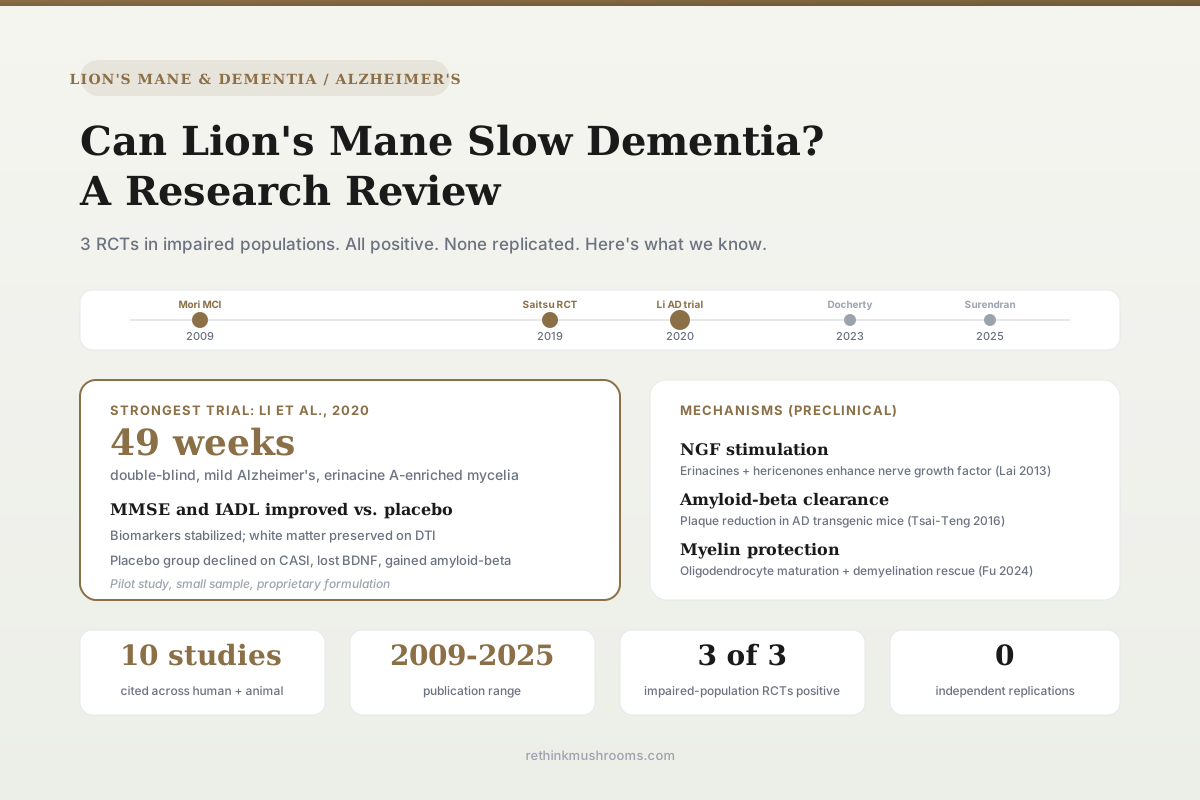
49 weeks of treatment
In a pilot double-blind placebo-controlled trial, erinacine A-enriched Hericium erinaceus mycelia given for 49 weeks improved MMSE scores and Instrumental Activities of Daily Living in patients with mild Alzheimer's disease, while the placebo group declined.
Li et al., Frontiers in Aging Neuroscience, 2020
3 RCTs
in cognitively impaired populations show cognitive score improvements over placebo
Week 16
peak benefit in MCI trial; scores declined within 4 weeks of stopping (Mori et al., 2009)
30 mg/day
dose threshold: Mori used ~3 g/day; Li used ~1 g/day with concentrated erinacine A
Li et al., Frontiers in Aging Neuroscience, 2020
 View as image ↗
Lion's mane (Hericium erinaceus) is one of the few edible mushrooms with direct clinical trial evidence in dementia. Three randomized, placebo-controlled trials have tested it in cognitively impaired populations, and all three reported improvements in at least one cognitive measure compared with placebo. That sounds promising, and it is, but the trials are small (15-30 per arm), short relative to dementia progression timelines, and none has been independently replicated. A 2025 narrative review surveying the full preclinical and clinical literature concluded that H. erinaceus is a "possible future therapeutic treatment" for Alzheimer's prevention and delayed progression, while acknowledging that the clinical evidence remains preliminary. The mechanistic story is stronger: erinacines and hericenones stimulate nerve growth factor (NGF) synthesis, reduce amyloid-beta plaque burden in transgenic mice, and promote oligodendrocyte maturation and myelination. The gap between that mechanistic promise and clinical proof is the subject of this review. For the specific clinical trial data on mild cognitive impairment, see lion's mane and mild cognitive impairment: clinical trial results.
Key Takeaways
- In 30 Japanese adults (50-80 years) with mild cognitive impairment, 3 g/day of H. erinaceus dry powder for 16 weeks produced score increases on the Revised Hasegawa Dementia Scale at weeks 8, 12, and 16 compared with placebo; scores declined within 4 weeks of discontinuation (Mori et al., 2009)[1]
- A 49-week pilot double-blind trial in patients with mild Alzheimer's disease found that erinacine A-enriched mycelia (three 350 mg capsules/day) improved MMSE and IADL scores, while the placebo group showed decline on the Cognitive Abilities Screening Instrument (Li et al., 2020)[2]
- A 12-week RCT in older adults found that H. erinaceus fruiting body supplementation improved MMSE scores compared with placebo (Saitsu et al., 2019)[3]
- In healthy young adults (18-45 years), a single 1.8 g dose of H. erinaceus improved reaction time on the Stroop task at 60 minutes post-dose (p = 0.005); chronic 28-day supplementation showed a non-significant trend toward reduced subjective stress (p = 0.051) (Docherty et al., 2023)[4]
- Erinacine A-enriched H. erinaceus mycelium reduced amyloid-beta plaque burden in APPswe/PS1dE9 transgenic Alzheimer's mice after 30 days of oral administration (Tsai-Teng et al., 2016)[5]
- A 2025 narrative review concluded that H. erinaceus bioactive compounds (erinacines and hericenones) cross the blood-brain barrier, stimulate NGF synthesis, and target multiple Alzheimer's pathways, but that human evidence remains insufficient for clinical recommendations (Cornford & Charnley, 2025)[6]
- Cell & Lab Studiescompleted
NGF-synergized neurite outgrowth in NG108-15 cells (Lai 2013); oligodendrocyte precursor differentiation and myelin basic protein induction (Huang 2021)
- Animal Studiescompleted
Amyloid-beta plaque reduction in APPswe/PS1dE9 mice (Tsai-Teng 2016); erinacine S preserved myelin in cuprizone-demyelinated rodents (Fu 2024)
- Case Reports & Early Seriesmissing
No formal case series specific to dementia outcomes
- Small Human Trialscurrent
Three small RCTs in impaired populations (Mori 2009, n=30; Li 2020, mild AD, 49 weeks; Saitsu 2019) plus healthy-adult trials (Docherty 2023; Surendran 2025)
- Large Randomized Trialsmissing
No multi-center, adequately-powered, long-duration RCT has been conducted
- Meta-Analyses & Systematic Reviewsmissing
None; the most comprehensive synthesis to date is a 2025 narrative review (Cornford & Charnley)
The mechanistic case is complete through cell and animal work, and the evidence has reached small human trials — three of which reported cognitive improvements over placebo. But it stops there: no large, replicated, multi-center trial exists, and no meta-analysis. This is the exact gap between mechanistic promise and clinical proof.
Aggregate of Lai 2013, Huang 2021, Tsai-Teng 2016, Fu 2024, Mori 2009, Li 2020, Saitsu 2019, Docherty 2023, Surendran 2025, and Cornford & Charnley 2025
The MCI Landmark: Mori et al., 2009
The foundational human trial for lion's mane in cognitive impairment is Mori et al. (2009), published in Phytotherapy Research. Thirty Japanese men and women aged 50-80, all diagnosed with mild cognitive impairment (MCI), were randomized into two equal groups. The intervention group took four 250 mg tablets containing 96% H. erinaceus dry powder three times daily (approximately 3 g/day total) for 16 weeks. The primary outcome was the Revised Hasegawa Dementia Scale (HDS-R), a validated Japanese cognitive screening instrument comparable to the MMSE.[1]
The results: at weeks 8, 12, and 16, the lion's mane group showed statistically increased HDS-R scores compared with placebo. The improvement was dose-duration dependent, with scores increasing progressively over the 16-week intake period. No adverse effects were detected in laboratory tests.
The most telling finding came after the trial ended. During the 4-week follow-up observation period, the intervention group's cognitive scores declined. This suggests the cognitive benefit required ongoing supplementation to maintain, which is consistent with a symptomatic rather than disease-modifying mechanism: the mushroom compounds were supporting cognitive function while present but not reversing the underlying pathology.
The trial's weaknesses: small sample (15 per group), single center, no dose-response comparison, the HDS-R is a screening tool rather than a comprehensive neuropsychological battery, and the study has not been independently replicated in 16 years. No dementia-stage patients were included.
The Mild Alzheimer's Trial: Li et al., 2020
Li et al. (2020), published in Frontiers in Aging Neuroscience, is the only published double-blind trial testing lion's mane in diagnosed Alzheimer's disease. The trial enrolled patients with mild AD (registered at ClinicalTrials.gov, NCT04065061). After a 3-week no-drug screening period, patients were randomized to receive either three capsules of erinacine A-enriched H. erinaceus mycelia (EAHE; 350 mg/capsule, containing 5 mg/g erinacine A) per day or matching placebo for 49 weeks.[2]
Three cognitive and functional outcomes distinguished the groups. The placebo group showed a significant decrease on the Cognitive Abilities Screening Instrument (CASI) over 49 weeks, representing expected disease progression. The EAHE group showed a significant improvement on the Mini-Mental State Examination (MMSE). Instrumental Activities of Daily Living (IADL) scores differed between the groups, favoring the intervention.
The trial also captured biomarker and neuroimaging data. In the placebo group, serum albumin, apolipoprotein E4, hemoglobin, and brain-derived neurotrophic factor (BDNF) declined, while alpha1-antichymotrypsin and amyloid-beta peptide 1-40 increased, all consistent with AD progression. These changes were not observed in the EAHE group. Diffusion tensor imaging showed that mean apparent diffusion coefficient values in the arcuate fasciculus increased in the placebo group (indicating white matter degradation) but remained stable in the EAHE group. The parahippocampal cingulum showed decreased ADC values in the EAHE group, suggesting possible white matter improvement. For the amyloid-beta mechanism specifically, see lion's mane and amyloid beta: mechanisms of neuroprotection.
This is the strongest clinical result in the literature: a nearly year-long double-blind trial with cognitive, biomarker, and neuroimaging endpoints all pointing in the same direction. The limitations: it was a pilot study with a small sample, four participants dropped out due to gastrointestinal discomfort, nausea, and skin rash, and it used a proprietary erinacine A-enriched mycelia formulation that differs from commercially available lion's mane supplements (which are typically fruiting body powder with unknown erinacine content). The use of mycelia rather than fruiting body is a critical distinction: erinacines are found primarily in the mycelium, while hericenones are found in the fruiting body. Most consumer products are fruiting body-based. Whether generic lion's mane supplements produce the same effect is unknown.
Li et al. (2020) · Frontiers in Aging Neuroscience
- Population
- Patients with mild Alzheimer's disease (NCT04065061)
- Intervention
- Three EAHE capsules/day (350 mg each; 5 mg/g erinacine A) for 49 weeks
- Comparator
- Matching placebo
- Finding
- The EAHE group improved on the MMSE while the placebo group declined on the CASI. Biomarkers (BDNF, amyloid-beta 1-40, ApoE4) and diffusion-tensor white-matter measures stabilized in the treatment group but worsened on placebo.
preliminary The strongest single result in the literature, but a small pilot: four participants dropped out for gastrointestinal upset, nausea, and skin rash, and it used a proprietary erinacine A-enriched mycelium that differs from typical fruiting-body supplements.
Li et al., Frontiers in Aging Neuroscience, 2020
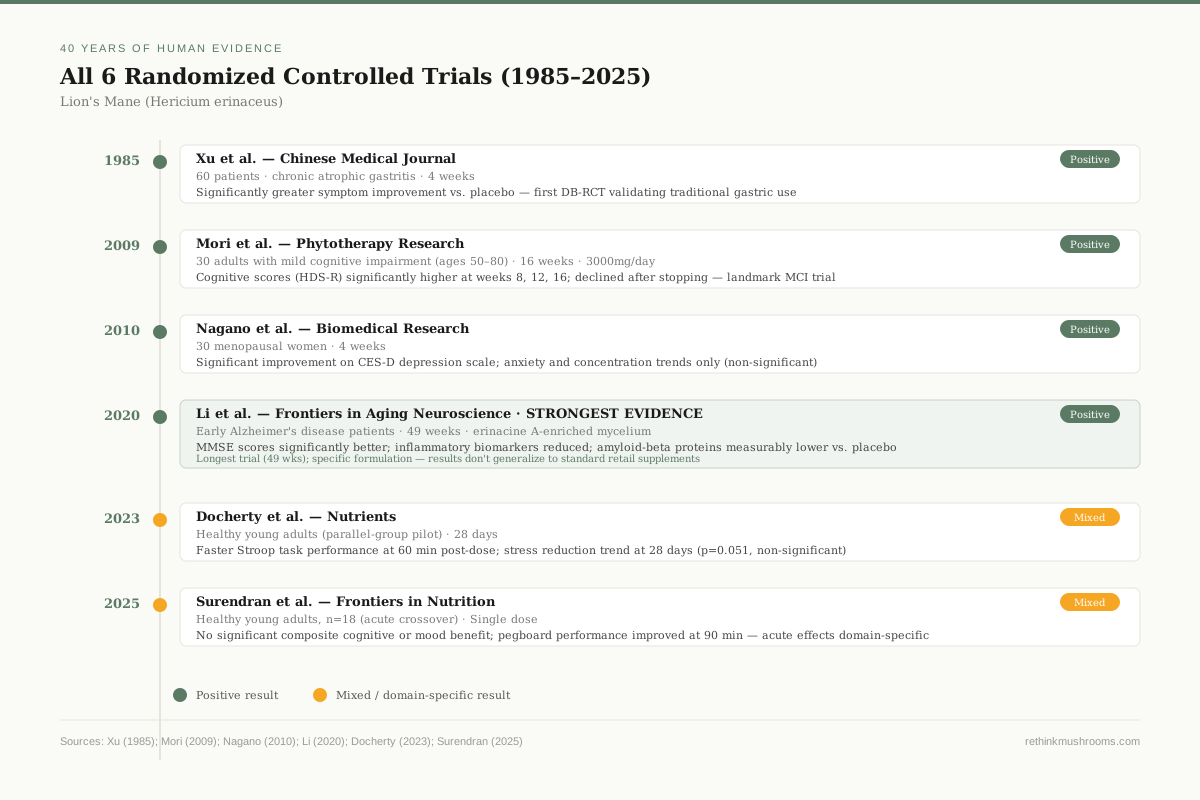
40 Years of Human Evidence
All 6 Randomized Controlled Trials (1985–2025)
Xu et al. — Chinese Medical Journal
Positive60 patients, chronic atrophic gastritis · 4 weeks
Significantly greater symptom improvement vs. placebo — validating traditional gastric use
First DB-RCT; traditional indication confirmed
Mori et al. — Phytotherapy Research
Positive30 adults with mild cognitive impairment (ages 50–80) · 16 weeks
HDS-R cognitive scores significantly higher at weeks 8, 12, 16; scores declined after stopping
Landmark MCI trial; 3000mg/day (four 250mg tabs × 3)
Nagano et al. — Biomedical Research
Positive30 menopausal women · 4 weeks
Significant improvement on CES-D depression scale; anxiety and concentration showed non-significant trends
Mood-focused trial; hormone context limits generalizability
Li et al. — Frontiers in Aging Neuroscience
PositiveEarly Alzheimer's disease patients · 49 weeks
MMSE significantly higher; inflammatory biomarkers reduced; amyloid-beta proteins measurably lower vs. placebo
Strongest evidence to date; used erinacine A-enriched mycelium
Docherty et al. — Nutrients
MixedHealthy young adults (parallel-group pilot) · 28 days
Faster Stroop task performance at 60 min post-dose; stress reduction trend at 28 days (p = 0.051, non-significant)
Acute domain-specific effect (processing speed) in healthy adults
Surendran et al. — Frontiers in Nutrition
MixedHealthy young adults, n=18 (acute crossover) · Single dose
No significant composite cognitive or mood effect; pegboard performance improved at 90 min (task-specific)
Null composite; suggests acute effects are domain-specific, not general
Sources: Xu (1985); Mori (2009); Nagano (2010); Li (2020); Docherty (2023); Surendran (2025)
 View as image ↗
Cognitive Effects in Non-Impaired Populations
Three trials have tested lion's mane in healthy adults without cognitive impairment. Saitsu et al. (2019) conducted a 12-week randomized, double-blind, placebo-controlled parallel-group study. Participants received H. erinaceus fruiting body supplements and were assessed with the MMSE, Benton Visual Retention Test, and Standard Verbal Paired-Associate Learning Test. Only the MMSE showed improvement in the lion's mane group versus placebo.[3]
Docherty et al. (2023) ran a double-blind pilot study in 41 healthy adults aged 18-45. The intervention was 1.8 g/day of H. erinaceus for 28 days. Acutely (60 minutes after a single dose), participants in the intervention group performed faster on the Stroop task (p = 0.005). After 28 days of supplementation, the lion's mane group showed a non-significant trend toward reduced subjective stress (p = 0.051), not a statistically significant reduction. The authors described the chronic cognitive findings as modest and the study as a pilot requiring larger replication.[4]
Surendran et al. (2025) took a different approach with a double-blind, crossover design in 18 healthy adults aged 18-35, testing acute effects of a single 3 g dose of 10:1 H. erinaceus fruiting body extract. The study did not demonstrate an overall cognitive or mood improvement compared to placebo.[10]
These results collectively suggest that lion's mane may produce acute, measurable cognitive effects (processing speed) in healthy young adults, but the effects are small and not consistently reproducible across different doses, extracts, and test batteries. The implication for dementia: if effects are marginal in healthy brains, the question is whether impaired brains respond differently, or whether the MCI/AD trial results reflect something specific to the disease state that healthy-brain studies cannot capture.
The Animal Mechanistic Case
The preclinical literature provides the biological plausibility that the small clinical trials lack in statistical power. Tsai-Teng et al. (2016) administered erinacine A-enriched H. erinaceus mycelia orally to 5-month-old female APPswe/PS1dE9 transgenic mice (a standard Alzheimer's model) for 30 days. The treatment attenuated cerebral amyloid-beta plaque burden, with the reduction concentrated in the non-compact plaque structure. Insulin-degrading enzyme levels were elevated by the treatment, suggesting an enhanced amyloid clearance mechanism.[5]
Lai et al. (2013) demonstrated that H. erinaceus aqueous extract synergized with exogenous nerve growth factor (NGF) to stimulate neurite outgrowth in NG108-15 neuroblastoma-glioma cells. The combination of 10 ng/mL NGF with 1 ug/mL mushroom extract yielded the highest neurite outgrowth compared with either compound alone. The extract also showed neuroprotective effects against oxidative stress. This work established the neurotrophic mechanism: hericenones and erinacines don't replace NGF but enhance the neurotrophic signaling environment.[7]
Myelin Protection: A Less Discussed Pathway
Beyond the NGF and amyloid pathways that dominate the lion's mane narrative, two recent studies reveal a distinct mechanism: oligodendrocyte maturation and myelin protection.
Huang et al. (2021) found that H. erinaceus mycelium extract promoted the differentiation of oligodendrocyte precursor cells into mature oligodendrocytes and increased myelin basic protein expression. In an ex vivo cerebellar slice model, the extract enhanced myelination.[8]
Fu et al. (2024) identified erinacine S as a specific bioactive compound responsible for oligodendrocyte protection. In cuprizone-exposed rats (a standard demyelination model), oral administration of H. erinaceus mycelium extract and erinacine S preserved myelin and oligodendrocytes in the corpus callosum and alleviated mood abnormalities associated with demyelination.[9]
This is relevant to dementia because white matter degeneration and myelin loss are consistent features of Alzheimer's disease, often preceding gray matter atrophy. The Li 2020 trial's diffusion tensor imaging data showed white matter preservation in the treatment group, which may connect to this oligodendrocyte mechanism. If lion's mane is protecting myelin integrity rather than (or in addition to) clearing amyloid, this would explain why the Li 2020 trial showed benefits on functional measures (IADL) and white matter imaging while also showing biomarker stabilization. For the myelin-specific preclinical evidence, see can lion's mane repair myelin? evidence from preclinical studies.
What Holds This Evidence Together and Where It Falls Apart
Cornford and Charnley (2025) published the most comprehensive narrative review of H. erinaceus for Alzheimer's prevention and progression delay. They concluded that the mushroom's bioactive compounds cross the blood-brain barrier, stimulate NGF synthesis, reduce neuroinflammation, and target multiple Alzheimer's pathological processes. The review framed H. erinaceus as targeting multiple pathways simultaneously: cholinergic support via NGF, amyloid clearance via enzyme upregulation, tau pathology modulation, anti-neuroinflammation, and myelin protection. This multi-target profile is precisely what current single-target AD drugs lack.[6]
The review also identified the core problems. No large-scale, multi-center, long-duration clinical trial has been conducted. The existing trials use different preparations (fruiting body vs. mycelium, various extraction methods, different concentrations of active compounds), making cross-study comparison difficult. The distinction between erinacines (mycelium) and hericenones (fruiting body) is critical because most commercial supplements use fruiting body, while the strongest clinical trial (Li 2020) used erinacine A-enriched mycelium. Most consumers taking "lion's mane for brain health" are not taking the formulation that was actually tested. For dosing specifics in elderly populations, see lion's mane for elderly cognitive decline: dosing and evidence.
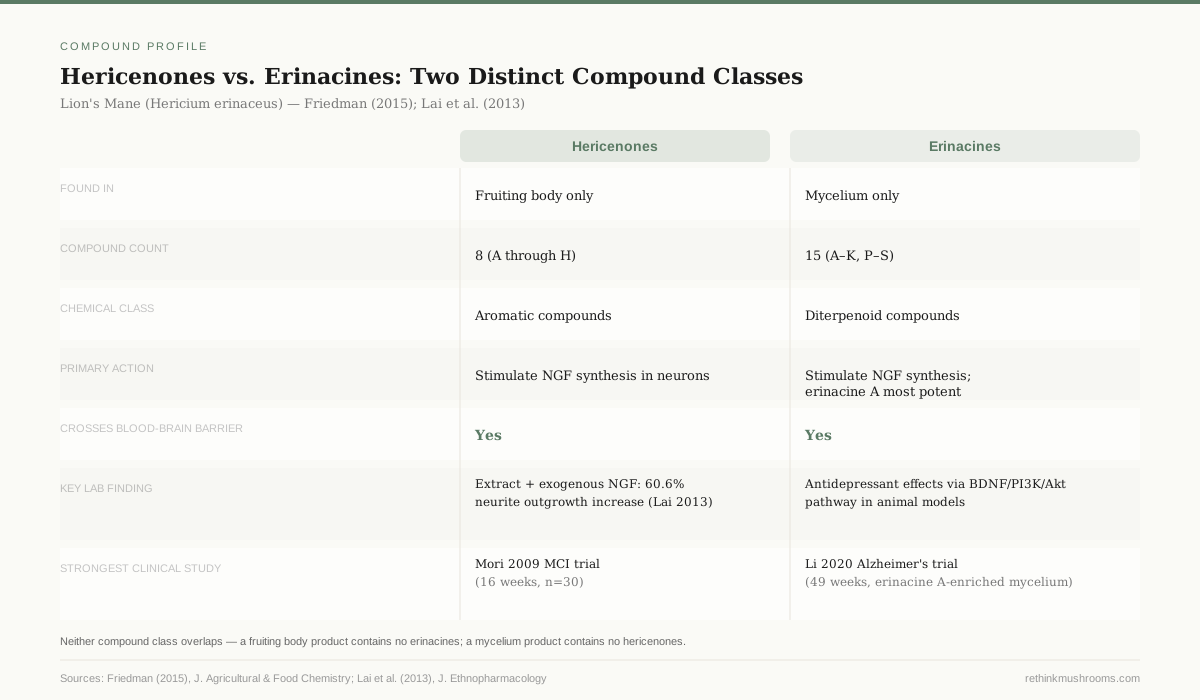
Compound Profile
Hericenones vs. Erinacines: Two Distinct Compound Classes
Hericenones
Erinacines
Found in
Fruiting body only
Mycelium only
Compound count
8 (A through H)
15 (A–K, P–S)
Chemical class
Aromatic compounds
Diterpenoid compounds
Primary action
Stimulate NGF synthesis in neurons
Stimulate NGF synthesis; erinacine A most potent
Crosses blood-brain barrier
Yes
Yes
Key lab finding
H. erinaceus aqueous extract + NGF yielded 60.6% neurite outgrowth increase
Erinacine A produces antidepressant-like effects via BDNF/PI3K/Akt pathway in animal models
Strongest clinical study
Mori 2009 MCI trial (16 weeks, n=30)
Li 2020 Alzheimer's trial (49 weeks, erinacine A-enriched mycelium)
Neither class overlaps — a fruiting body product contains no erinacines; a mycelium product contains no hericenones. The research on one doesn't automatically transfer to the other, which is why the source (fruiting body vs. mycelium) matters when interpreting clinical trial results.
Source: Friedman (2015), J. Agricultural & Food Chemistry; Lai et al. (2013), J. Ethnopharmacology
 View as image ↗
The dose question is also unresolved. Mori (2009) used approximately 3 g/day of dry powder. Li (2020) used about 1 g/day of concentrated erinacine A-enriched mycelia. Docherty (2023) used 1.8 g/day. Surendran (2025) used a single 3 g dose of 10:1 extract. These are different products delivering different bioactive profiles at different concentrations. Whether a standardized dose-response relationship exists, and what minimum erinacine or hericenone concentration is required for cognitive effects, has not been established. For the broader Alzheimer's evidence context, see lion's mane for Alzheimer's disease: what does the research say?. For how lion's mane fits into multi-compound cognitive stacks, see building a mushroom nootropic stack: lion's mane, cordyceps, and ergothioneine.
Safety & scope
ModerateGenerally well tolerated in trials, but this is not a treatment or medical advice
Concern
In the 49-week Li 2020 Alzheimer's trial, four participants withdrew due to gastrointestinal discomfort, nausea, and skin rash. Lion's mane can also trigger allergic reactions, and its effects have not been established in people taking dementia medications or managing other conditions.
What the research says
The clinical evidence is preliminary and comes from small, unreplicated pilot studies. Lion's mane should not be used to treat, delay, or self-manage dementia or Alzheimer's disease in place of evaluation and care from a qualified clinician.
Particularly relevant for: Anyone with a dementia diagnosis, a caregiver, or someone taking prescription medications
What to do
Discuss any supplement with a physician before starting — especially alongside cognitive, anticoagulant, or other prescription medications.
Li et al., Frontiers in Aging Neuroscience, 2020
The Bottom Line
Lion's mane has the strongest clinical trial evidence of any edible mushroom for cognitive impairment. Three RCTs in cognitively impaired populations all reported improvements over placebo, with the 49-week Li 2020 Alzheimer's trial showing concordant cognitive, biomarker, and neuroimaging benefits. The mechanistic case is multi-layered: NGF stimulation, amyloid-beta plaque reduction, and oligodendrocyte/myelin protection. But all three positive trials are small (15-30 per arm), none has been independently replicated, and the formulations used (especially erinacine A-enriched mycelia) differ from most commercial lion's mane products. The evidence justifies serious continued research, not confident clinical claims.
Frequently Asked Questions
Sources & References
- 1RTHM-00165·Mori, Koichiro et al. (2009). “Improving effects of the mushroom Yamabushitake (Hericium erinaceus) on mild cognitive impairment: a double-blind placebo-controlled clinical trial..” Phytotherapy research : PTR.Study breakdown →PubMed →↩
- 2RTHM-00631·Li, I-Chen et al. (2020). “Prevention of Early Alzheimer's Disease by Erinacine A-Enriched Hericium erinaceus Mycelia Pilot Double-Blind Placebo-Controlled Study..” Frontiers in aging neuroscience.Study breakdown →PubMed →↩
- 3RTHM-00585·Saitsu, Yuusuke et al. (2019). “Improvement of cognitive functions by oral intake of Hericium erinaceus..” Biomedical research (Tokyo.Study breakdown →PubMed →↩
- 4RTHM-00821·Docherty, Sarah et al. (2023). “The Acute and Chronic Effects of Lion's Mane Mushroom Supplementation on Cognitive Function, Stress and Mood in Young Adults: A Double-Blind, Parallel Groups, Pilot Study..” Nutrients.Study breakdown →PubMed →↩
- 5RTHM-00452·Tsai-Teng, Tzeng et al. (2016). “Erinacine A-enriched Hericium erinaceus mycelium ameliorates Alzheimer's disease-related pathologies in APPswe/PS1dE9 transgenic mice..” Journal of biomedical science.Study breakdown →PubMed →↩
- 6RTHM-00922·Cornford, Nisha et al. (2025). “Hericium erinaceus: A possible future therapeutic treatment for the prevention and delayed progression of Alzheimer's disease? - A narrative review..” Nutrition research reviews.Study breakdown →PubMed →↩
- 7RTHM-00295·Lai, Puei-Lene et al. (2013). “Neurotrophic properties of the Lion's mane medicinal mushroom, Hericium erinaceus (Higher Basidiomycetes) from Malaysia..” International journal of medicinal mushrooms.Study breakdown →PubMed →↩
- 8RTHM-00692·Huang, Hui-Ting et al. (2021). “Hericium erinaceus mycelium and its small bioactive compounds promote oligodendrocyte maturation with an increase in myelin basic protein..” Scientific reports.Study breakdown →PubMed →↩
- 9RTHM-00878·Fu, Jing-Ting et al. (2024). “Erinacine S, a small active component derived from Hericium erinaceus, protects oligodendrocytes and alleviates mood abnormalities in cuprizone-exposed rodents..” Biomedicine & pharmacotherapy = Biomedecine & pharmacotherapie.Study breakdown →PubMed →↩
- 10RTHM-00952·Surendran, Geyan et al. (2025). “Acute effects of a standardised extract of Hericium erinaceus (Lion's Mane mushroom) on cognition and mood in healthy younger adults: a double-blind randomised placebo-controlled study..” Frontiers in nutrition.Study breakdown →PubMed →↩