Cognitive Performance
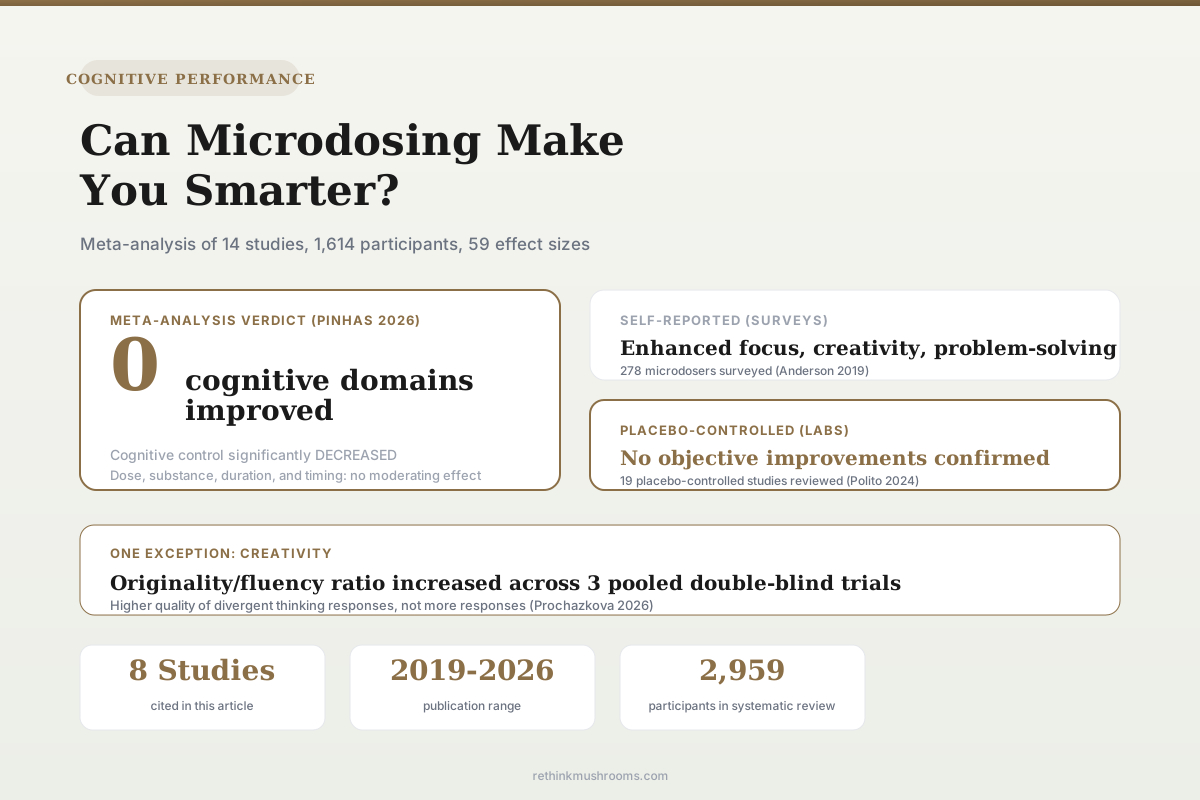
0 cognitive domains improved
A preregistered meta-analysis of 14 microdosing studies (N = 1,614) found no detectable improvement in any cognitive domain except a significant decrease in cognitive control.
Pinhas et al., Neuroscience & Biobehavioral Reviews, 2026
14 studies
pooled in the first preregistered meta-analysis of microdosing cognition
Originality up
ratio of original to total responses increased across 3 double-blind trials
EEG changed
brain activity altered at 0.5 g dried mushrooms but no cognitive benefit measured
Pinhas et al., Neuroscience & Biobehavioral Reviews, 2026
 View as image ↗
Microdosing psilocybin for cognitive enhancement is one of the most widely promoted and least supported claims in the psychedelic space. The narrative, popularized in Silicon Valley and repeated across social media, holds that sub-perceptual doses of psilocybin (typically 0.1 to 0.3 g of dried mushrooms) can sharpen focus, boost working memory, and improve problem-solving without the perceptual distortions of a full psychedelic experience. As of 2026, the controlled evidence tells a different story: a preregistered meta-analysis of 14 studies found no improvement in any cognitive domain and a measurable decrease in cognitive control.[1]
This is not a debate about whether psilocybin affects the brain. It does, even at low doses. EEG patterns shift, subjective states change, and at higher doses psilocybin reliably modifies emotional processing and creative thinking. The question is whether the specific dose range used in microdosing produces measurable cognitive improvement on standardized tests, because that is the claim being marketed. The answer, from every placebo-controlled trial to date, is either no or not reliably. For how sub-perceptual doses interact with brain structure rather than cognitive performance, see can doses too small to feel still change the brain?.
Key Takeaways
- A 2026 meta-analysis pooling 14 microdosing studies (N = 1,614) found a significant decrease in cognitive control and no detectable improvement in any other cognitive domain; substance type, dosage, and timing did not moderate results (Pinhas et al., 2026)
- A double-blind placebo-controlled study of 0.5 g dried psilocybin mushrooms found altered EEG rhythms and subjective effects but no improvements in working memory, executive function, or divergent thinking (Cavanna et al., 2022)
- Pooled analysis of three double-blind trials found microdosing increased the ratio of original responses (originality/fluency ratio), the clearest signal for any cognitive metric across controlled studies (Prochazkova et al., 2026)
- A systematic review of 20 psilocybin studies (N = 2,959) found global cognitive function and processing speed mostly unchanged in healthy individuals, with some improvements only in treatment-resistant depression patients (Meshkat et al., 2024)
- Self-reported cognitive benefits dominate observational surveys; Anderson et al. (2019) catalogued enhanced focus, creativity, and problem-solving as the most frequently reported benefits among 278 microdosers, none confirmed by objective testing
- A rapid review of all 19 placebo-controlled microdosing studies identified eight methodological reasons why calling microdosing a pure placebo is premature, including insufficient dose ranges and sample sizes (Polito & Liknaitzky, 2024)
The Meta-Analysis Verdict
Pinhas et al. (2026) published the first preregistered meta-analysis of microdosing's cognitive effects, analyzing 59 effect sizes extracted from 14 controlled studies with a combined sample of 1,614 participants. The analysis covered multiple cognitive domains: attention, working memory, executive function, cognitive flexibility, processing speed, and creative thinking.[1]
The headline result: microdosing produced a statistically significant decrease in cognitive control. No other cognitive domain showed a detectable effect in either direction. This was not a case of mixed signals canceling out. The confidence intervals for most domains were narrow enough to rule out meaningful positive effects at conventional dose ranges. Neither substance type (psilocybin or LSD), dosage (0.1 to 0.5 g psilocybin or 6.5 to 20 µg LSD), nor microdosing duration (1 to 42 days) emerged as a significant moderator. Assessment timing, whether participants were tested while the microdose was active or on a rest day, also did not change the result.
The cognitive control finding deserves attention because it runs counter to the enhancement narrative. Cognitive control encompasses the ability to inhibit prepotent responses, resist distraction, and maintain task-relevant information. If microdosing impairs this domain even modestly, it may explain why some users perceive enhanced creativity (reduced inhibition can feel like freer thinking) while objective task performance declines. For how this connects to convergent and divergent thinking specifically, see microdosing and convergent vs. divergent thinking: what the lab data shows.
What Double-Blind Trials Actually Found
Cavanna et al. (2022) conducted the most rigorous single-dose microdosing study to date. Participants received either 0.5 g of dried psilocybin mushrooms or placebo in a double-blind crossover design and were tested on a battery of cognitive tasks including digit span (working memory), set-shifting (executive function), the Stroop task (cognitive control), and the Alternative Uses Task (divergent thinking).[2]
The active dose produced detectable subjective effects and measurable changes in EEG rhythms, confirming that the dose was pharmacologically active. Participants could not reliably distinguish the microdose from placebo above chance. Despite the confirmed biological activity, no cognitive improvements appeared on any task. Stroop accuracy and convergent thinking showed modest decrements in the active condition, a finding consistent with the meta-analysis result of impaired cognitive control.
Prochazkova et al. (2026) pooled data from three separate double-blind placebo-controlled longitudinal trials of psilocybin microdosing. The primary finding was an increase in the originality-to-fluency ratio during divergent thinking tasks under active microdosing. This ratio captures the quality of creative output relative to total output: participants did not generate more ideas, but a higher proportion of their ideas were rated as original.[3]
This is currently the strongest controlled evidence for any cognitive effect of microdosing, but it requires context. The effect was specific to divergent thinking quality, not general intelligence, not working memory, not processing speed. And the effect size was modest enough that it only emerged when three trials were pooled. Individual trials lacked the power to detect it reliably. For the full creativity evidence, see microdosing and creativity: what the research shows.
Working Memory, Attention, and Processing Speed
Meshkat et al. (2024) conducted a systematic review of 20 psilocybin studies involving 2,959 participants, spanning both micro- and macro-dose research. In healthy individuals, global cognitive function and processing speed remained mostly unchanged across studies. Working memory showed no consistent improvement. Sustained attention produced scattered positive findings in some studies but not in others, and the reviewers attributed much of the inconsistency to varying dose sizes and testing timelines.[4]
The review found one noteworthy exception: patients with treatment-resistant depression showed improvements in certain cognitive domains after psilocybin therapy, particularly executive function and emotional processing. This raises an important distinction. Psilocybin may improve cognition indirectly in people whose cognitive function is impaired by depression, without improving cognition in people whose baseline is already normal. The "smart drug" narrative fails because it assumes enhancement above baseline in healthy people, and the evidence does not support that.
Savides and Outhoff (2024) reviewed the psilocybin microdosing literature with specific attention to dose-response relationships and 5-HT2A receptor occupancy. At microdose levels, receptor occupancy is low, and the downstream signaling cascades that drive neuroplasticity at full doses may not reach the threshold for functional change.[5] The biological plausibility for cognitive enhancement at microdose levels is weak: the dose is too small to produce the receptor activation patterns associated with cognitive change at higher doses, and too large to be inert.
The Gap Between Self-Report and Measured Performance
Anderson et al. (2019) published the most comprehensive codebook of self-reported microdosing effects, surveying 278 active microdosers. The most commonly reported benefits were enhanced focus, heightened creativity, improved mood, and better problem-solving ability. Cognitive enhancement was central to users' reasons for microdosing and appeared across age groups, genders, and substance types.[6]
Rootman et al. (2021) found a similar pattern in a larger observational study: microdosers reported lower anxiety and depression and higher well-being scores compared to non-microdosers. Psilocybin was the most commonly used substance (85% of microdosers), and health and wellness motivations dominated reported reasons for use.[7]
The disconnect between these self-reported benefits and the null findings from controlled trials is the central tension in microdosing research. Three explanations are in play. First, expectancy: people who choose to microdose expect cognitive benefits and subsequently notice or attribute improvements to the substance. Second, mood improvement may create the subjective impression of sharper thinking without actual cognitive enhancement. Third, self-selected microdosing populations may differ from the general population in baseline motivation, openness, or health behaviors in ways that confound observational comparisons. For the broader placebo problem in microdosing research, see breaking through the placebo problem: next-gen microdosing research.
Why the Jury Is Still Technically Out
Polito and Liknaitzky (2024) reviewed all 19 placebo-controlled microdosing studies and identified eight methodological issues that make definitive conclusions premature. The number of controlled studies is still small. Sample sizes have been modest. Most studies tested only one or two doses, leaving unexplored whether a different dosing schedule might produce effects. The doses tested may have been too small. Studies have focused almost exclusively on healthy, non-clinical populations. Selection bias in recruitment is pervasive. And the measured impact of expectancy in self-blinding designs is smaller than headline coverage suggests.[8]
This matters because "no evidence of effect" is different from "evidence of no effect." The meta-analysis found no cognitive improvement, but the input studies were heterogeneous in design, dose, substance, duration, and outcome measures. The optimal microdosing protocol for cognition, if one exists, may not have been tested yet. That said, the burden of proof rests with the enhancement claim, and after 19 controlled studies, not one has demonstrated clear cognitive enhancement on any standard battery test besides a modest creativity signal.
What Macro-Dose Psilocybin Does Differently
The Meshkat (2024) review highlights that full-dose psilocybin (15 to 30 mg) produces cognitive effects that microdoses do not: enhanced emotional empathy, modified emotional processing, and in depressed patients, improved executive function post-treatment. Cognitive flexibility initially declines during acute intoxication but may improve in the days following a session. These effects operate through strong 5-HT2A agonism, default mode network disruption, and increased thalamic connectivity, none of which is replicated at microdose receptor occupancy levels.[4]
This creates an irony. The cognitive benefits of psilocybin that have the strongest evidence base require doses that produce perceptible psychedelic effects. The dose range that avoids those effects (microdosing) loses the cognitive benefits along with the perceptual changes. The appeal of microdosing is precisely the claim that you can separate the two, but controlled data does not support that separation for cognition.
The Dose-Response Problem
A recurring issue across microdosing cognitive research is the absence of systematic dose-response mapping. Most studies test a single dose or a narrow range, typically 0.1 to 0.5 g of dried psilocybin mushrooms. Whether doses slightly above or below this range would produce different cognitive outcomes is unknown. The Pinhas meta-analysis found no dose-dependent moderation, but the dose range across included studies was narrow enough that detecting a moderating effect would require more statistical power than the pooled data provided.[1]
Polito and Liknaitzky (2024) raised this explicitly: the tested doses may have been too small to produce cognitive effects, or the testing schedules may have missed a delayed effect that builds over longer dosing protocols.[8] Existing trials have ranged from single-dose designs to protocols spanning six weeks. The possibility that a 12-week protocol at a different dose might produce effects cannot be excluded, but it also cannot be assumed. Until the dose-response curve for cognition is mapped with the same rigor applied to psilocybin's antidepressant effects, the enhancement claim rests on anecdote rather than pharmacology. For how dose interacts with focus and productivity specifically, see microdosing psilocybin for focus and productivity.
The Bottom Line
Controlled research does not support psilocybin microdosing as a cognitive enhancer in healthy people. A 2026 meta-analysis of 14 studies found no improvement in any cognitive domain and a decrease in cognitive control. Self-reported benefits from observational surveys are robust but have not survived placebo-controlled testing, except for a modest improvement in divergent thinking quality across three pooled trials. The dose range is biologically active but may be below the threshold for the receptor activation patterns that drive cognitive change at full doses.
Frequently Asked Questions
Sources & References
- 1RTHM-00961·Pinhas, Netta et al. (2026). “Effects of psychedelic microdosing on cognitive functions: A systematic review and meta-analysis..” Neuroscience and biobehavioral reviews.Study breakdown →PubMed →↩
- 2RTHM-00748·Cavanna, Federico et al. (2022). “Microdosing with psilocybin mushrooms: a double-blind placebo-controlled study..” Translational psychiatry.Study breakdown →PubMed →↩
- 3RTHM-00962·Prochazkova, Luisa et al. (2026). “Microdosing psilocybin and its effect on creativity: Lessons learned from three double-blind placebo controlled longitudinal trials..” Neuropharmacology.Study breakdown →PubMed →↩
- 4RTHM-00894·Meshkat, Shakila et al. (2024). “Impact of psilocybin on cognitive function: A systematic review..” Psychiatry and clinical neurosciences.Study breakdown →PubMed →↩
- 5RTHM-00905·Savides, Isabella A et al. (2024). “Less is more? A review of psilocybin microdosing..” Journal of psychopharmacology (Oxford.Study breakdown →PubMed →↩
- 6RTHM-00541·Anderson, Thomas et al. (2019). “Psychedelic microdosing benefits and challenges: an empirical codebook..” Harm reduction journal.Study breakdown →PubMed →↩
- 7RTHM-00715·Rootman, Joseph M et al. (2021). “Adults who microdose psychedelics report health related motivations and lower levels of anxiety and depression compared to non-microdosers..” Scientific reports.Study breakdown →PubMed →↩
- 8RTHM-00900·Polito, Vince et al. (2024). “Is microdosing a placebo? A rapid review of low-dose LSD and psilocybin research..” Journal of psychopharmacology (Oxford.Study breakdown →PubMed →↩