Mushrooms & Alzheimer's
4 Species
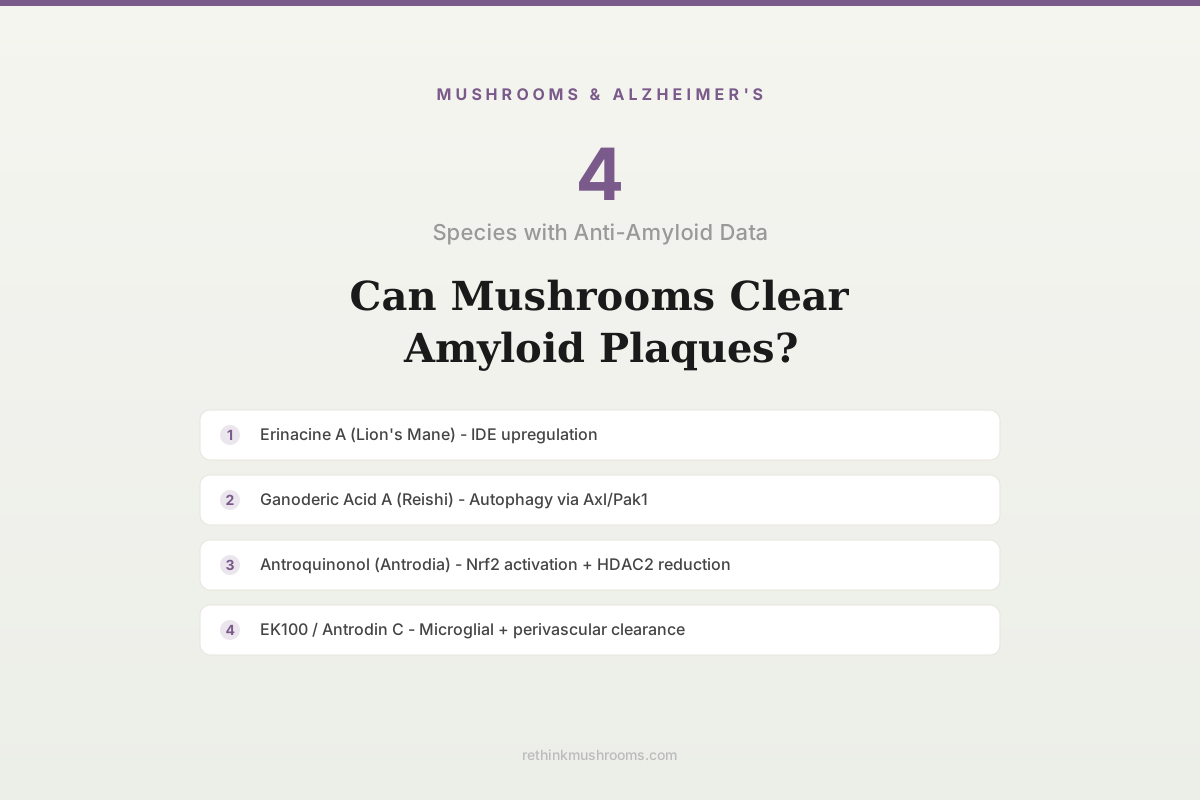
At least four mushroom species contain compounds that reduce amyloid-beta plaques in transgenic Alzheimer's mouse models: lion's mane, reishi, Antrodia camphorata, and Antrodia cinnamomea.
Tsai-Teng et al., J Biomed Sci, 2016
Erinacine A
from lion's mane reduced cerebral Aβ plaque burden in APPswe/PS1dE9 mice
Ganoderic Acid A
promoted Aβ clearance via autophagy in microglial cells
1 Human Trial
49-week pilot RCT of erinacine A in mild Alzheimer's patients
Tsai-Teng et al., J Biomed Sci, 2016
 View as image ↗
Amyloid-beta plaques are one of two hallmark pathologies in Alzheimer's disease, alongside tau neurofibrillary tangles. Decades of pharmaceutical research targeting amyloid have produced limited clinical success, which has driven interest in natural compounds that might reduce amyloid burden through alternative mechanisms. At least four mushroom species contain compounds that reduce amyloid-beta in transgenic mouse models of Alzheimer's disease: lion's mane (Hericium erinaceus), reishi (Ganoderma lucidum), Antrodia camphorata, and Antrodia cinnamomea. Each works through a different mechanism, from promoting enzymatic degradation to activating microglial clearance to inducing autophagy. One compound, erinacine A from lion's mane, has reached a 49-week human pilot trial. For the broader multi-species landscape, see cross-species mushroom research in Alzheimer's: lion's mane, reishi, and cordyceps.
Key Takeaways
- Erinacine A-enriched H. erinaceus mycelium reduced cerebral Aβ plaque burden in APPswe/PS1dE9 transgenic mice after 30 days of oral administration and elevated insulin-degrading enzyme, a key Aβ-clearing protease (Tsai-Teng et al., 2016)
- In a 49-week double-blind pilot RCT, erinacine A capsules (5 mg/g, 3 per day) improved MMSE scores in mild AD patients while the placebo group showed rising amyloid-beta 1-40 and declining BDNF (Li et al., 2020)
- Ganoderic acid A from Ganoderma lucidum promoted Aβ clearance in BV2 microglial cells via autophagy through the Axl/Pak1 pathway and reduced Aβ42 levels in an AD mouse model (Qi et al., 2021)
- Antroquinonol from Antrodia camphorata reduced hippocampal Aβ levels and improved spatial learning in APP transgenic mice over two months via Nrf2 activation and HDAC2 reduction (Chang et al., 2015)
- EK100 and antrodin C from Antrodia cinnamomea reduced amyloid plaque number and burden in APPswe/PS1dE9 mice by promoting microglial and perivascular clearance pathways (Tsay et al., 2021)
- Ganoderma lucidum polysaccharides downregulated Aβ42-induced pro-inflammatory cytokines and modulated microglial phagocytosis behavior in cell and zebrafish models (Cai et al., 2017)
Lion's Mane: Erinacine A and Amyloid Plaque Reduction
The most advanced anti-amyloid evidence from any mushroom species comes from lion's mane, specifically from erinacine A, a diterpenoid compound found in the mycelium (not the fruiting body). Tsai-Teng et al. (2016) tested erinacine A-enriched H. erinaceus mycelium (HE-My) and its ethanol extracts (HE-Et) in APPswe/PS1dE9 transgenic mice, the most widely used mouse model of Alzheimer's disease.[1]
After 30 days of oral administration to 5-month-old female transgenic mice, both HE-My and HE-Et attenuated cerebral amyloid-beta plaque burden. The authors noted that the attenuated portion was primarily the non-compact plaque structure, which is the diffuse, biologically active form of amyloid most associated with ongoing neuronal damage. The mechanism involved elevated levels of insulin-degrading enzyme (IDE), a zinc metalloprotease that degrades amyloid-beta monomers before they aggregate into plaques. By increasing IDE, erinacine A appears to accelerate the brain's existing enzymatic clearance system rather than introducing an entirely novel mechanism.
Beyond amyloid reduction, the study documented downstream benefits: diminished plaque-activated microglia and astrocytes in the cerebral cortex and hippocampus, an increased ratio of mature nerve growth factor (NGF) to its precursor form (proNGF), and promoted hippocampal neurogenesis. These are not independent effects. Amyloid plaques trigger neuroinflammation (microglial and astrocyte activation), which suppresses neurogenesis and disrupts neurotrophic signaling. Reducing plaque burden upstream may cascade into these downstream improvements.
Cornford et al. (2025) reviewed the full lion's mane-Alzheimer's literature and noted that H. erinaceus has demonstrated consistent preclinical anti-Alzheimer's effects across multiple research groups, but emphasized that "researchers have yet to discover a therapeutic treatment that delays neurodegenerative progression or restores associated Alzheimer neuropathological processes" in humans.[2] The gap between reducing plaques in a transgenic mouse engineered to overproduce amyloid and treating a complex neurodegenerative disease in humans is substantial.
The Human Pilot Trial: Erinacine A in Mild AD
Li et al. (2020) conducted the only published human trial directly relevant to amyloid and mushroom compounds. This was a 49-week double-blind, placebo-controlled pilot study in patients with mild Alzheimer's disease.[3] Patients received three capsules per day of erinacine A-enriched H. erinaceus mycelia (EAHE, 350 mg per capsule, containing 5 mg/g erinacine A) or identical placebo capsules.
After 49 weeks, the EAHE group showed significant improvement in Mini-Mental State Examination (MMSE) scores, while the placebo group showed significant decline in Cognitive Abilities Screening Instrument (CASI) scores. The EAHE group also achieved better contrast sensitivity in ophthalmic assessments. Biomarker trajectories diverged: the placebo group experienced significant declines in calcium, albumin, apolipoprotein E4, hemoglobin, and brain-derived neurotrophic factor (BDNF), and significant elevations in alpha1-antichymotrypsin and amyloid-beta peptide 1-40 over the study period. The EAHE group did not show these deteriorations.
The rising amyloid-beta 1-40 in the placebo group (a peripheral biomarker correlated with brain amyloid accumulation) and its stabilization in the EAHE group is the most directly relevant finding for the amyloid clearance question. The limitation is that this was a pilot study with a small sample size, and peripheral amyloid-beta levels are an imperfect proxy for brain plaque burden. Amyloid PET imaging was not used. A larger confirmatory trial with neuroimaging endpoints has not been completed. For related memory research, see can lion's mane improve memory? Evidence from human and animal studies.
Reishi: Ganoderic Acid A and Autophagy-Driven Clearance
Ganoderic acid A (GAA), the principal triterpene in Ganoderma lucidum (reishi), uses a fundamentally different mechanism to clear amyloid than erinacine A. Where erinacine A increases enzymatic degradation via IDE, GAA promotes autophagy, the cellular self-cleaning process that degrades and recycles damaged proteins and organelles.
Qi et al. (2021) demonstrated that GAA promoted amyloid-beta clearance in BV2 microglial cells through an intracellular clearance assay.[4] The mechanism involved activation of the Axl receptor tyrosine kinase and downstream phosphorylation of RAC/CDC42-activated kinase 1 (Pak1), which stimulated autophagosome formation as measured by increased LC3B-II levels. When the researchers blocked either Axl (with the inhibitor R428) or Pak1 (with IPA-3), the amyloid-clearing effect of GAA was reversed, confirming the pathway's specificity.
In the in vivo component, GAA administration at 100 mg/kg for 16 days ameliorated cognitive deficits in an AD mouse model and reduced brain Aβ42 levels. The cognitive improvement was measured using standard behavioral assays, and the Aβ42 reduction was confirmed by biochemical analysis of brain tissue.
The autophagy mechanism is therapeutically interesting because it addresses a known problem in Alzheimer's pathology. Autophagy declines with aging, and impaired autophagy in microglia and neurons has been proposed as a contributing factor to amyloid accumulation. A compound that reactivates autophagy specifically in microglia could complement enzymatic degradation approaches like IDE upregulation.
Cai et al. (2017) provided additional evidence for reishi's effects on microglial behavior in the context of amyloid. Ganoderma lucidum polysaccharides (GLP) downregulated Aβ42-induced pro-inflammatory cytokines, promoted anti-inflammatory cytokine expression, and modulated microglial migration, morphology, and phagocytosis in both BV2 cells and primary mouse microglia. These effects were confirmed in a zebrafish brain model.[5] The polysaccharide effects focus on the inflammatory response to amyloid rather than on amyloid clearance directly, but the two are linked: chronic microglial activation by amyloid plaques creates a neuroinflammatory environment that accelerates neuronal damage.
Chen et al. (2024) reviewed the broader Ganoderma lucidum-Alzheimer's literature and concluded that the mushroom's therapeutic potential operates through multiple mechanisms: inhibiting Aβ formation, inhibiting tau hyperphosphorylation, modulating activated microglia, regulating NF-κB/MAPK signaling, inhibiting neuronal apoptosis, modulating the immune system, and inhibiting acetylcholinesterase.[6] This multi-target profile is characteristic of complex natural products and is both a strength (multiple simultaneous interventions) and a challenge (difficult to determine which mechanism matters most, hard to standardize dosing for optimal effect on any single target).
Antrodia: Two Species, Multiple Mechanisms
Antrodia camphorata and Antrodia cinnamomea (sometimes classified as the same species or closely related taxa) have produced some of the most mechanistically detailed anti-amyloid data.
Chang et al. (2015) tested antroquinonol, a ubiquinone derivative isolated from Antrodia camphorata, in APP transgenic mice.[7] Two months of oral antroquinonol consumption improved spatial learning and memory in the Morris water maze, reduced hippocampal amyloid-beta levels, and reduced astrogliosis. The compound crossed the blood-brain barrier (confirmed pharmacokinetically) and showed no adverse effects via oral intake. The molecular mechanism involved activation of Nrf2 (nuclear factor erythroid 2-related factor 2), a master regulator of the cellular antioxidant response, and reduction of histone deacetylase 2 (HDAC2), an epigenetic regulator that is elevated in Alzheimer's and suppresses synaptic plasticity gene expression.
The Nrf2-HDAC2 axis is particularly relevant because these are established drug targets in Alzheimer's research. Nrf2 activation protects against Aβ-induced oxidative stress, while HDAC2 inhibition has been shown independently to improve memory in AD models. That antroquinonol hits both targets suggests it may address multiple pathological processes simultaneously.
Francesca et al. (2022) reviewed the antroquinonol preclinical literature comprehensively and confirmed its promise as a disease-modifying agent in AD, while emphasizing the gap between animal models and human pathology.[8]
Wang et al. (2012) compared fruiting body and mycelium extracts of Antrodia camphorata for their effects against Aβ-induced neurotoxicity and memory impairment, establishing that both forms of the mushroom contain protective compounds, though with different potency profiles.[9]
Tsay et al. (2021) identified two specific compounds from Antrodia cinnamomea, EK100 and antrodin C, that reduced amyloid plaque number and burden in APPswe/PS1dE9 mice through a distinct mechanism: promoting microglial and perivascular clearance pathways.[10] The perivascular clearance pathway (also called the glymphatic system) removes waste proteins from the brain along the walls of blood vessels. Promoting this clearance route is an emerging target in Alzheimer's research and represents a mechanism that no approved drug currently exploits.
EK100 and antrodin C also showed differences from each other: they varied in their effects on astrocyte activation, microglial morphology regulation, and promotion of plaque-associated microglia to express oxidative enzymes. EK100 additionally improved hippocampal neurogenesis. By comparison, ibuprofen and ergosterol (used as control compounds) produced relatively small effects. For more on Antrodia's neuroprotective properties, see Antrodia camphorata and neurodegenerative disease.
The Mechanisms Compared
| Compound | Source | Mechanism | Model | Key finding |
|---|---|---|---|---|
| Erinacine A | Lion's mane mycelium | IDE upregulation (enzymatic degradation) | APPswe/PS1dE9 mice; human pilot RCT | Reduced plaque burden; improved MMSE in humans |
| Ganoderic acid A | Reishi | Autophagy via Axl/Pak1 | BV2 cells; AD mouse model | Promoted Aβ clearance; reduced Aβ42 in vivo |
| Antroquinonol | Antrodia camphorata | Nrf2 activation; HDAC2 reduction | APP transgenic mice | Reduced hippocampal Aβ; improved spatial learning |
| EK100 / Antrodin C | Antrodia cinnamomea | Microglial + perivascular clearance | APPswe/PS1dE9 mice | Reduced plaque number and burden; improved nesting |
| Ganoderma polysaccharides | Reishi | Anti-inflammatory microglial modulation | BV2 cells; zebrafish | Reduced Aβ-induced neuroinflammation |
The diversity of mechanisms is the most striking feature of this literature. These are not five studies testing the same pathway. They represent four distinct approaches to amyloid reduction: enzymatic degradation, autophagy, antioxidant-epigenetic intervention, and perivascular clearance. Whether multiple mechanisms could be combined synergistically has not been tested.
What the Transgenic Mouse Model Does and Does Not Show
APPswe/PS1dE9 mice carry two human transgenes that cause overproduction of amyloid-beta. They develop amyloid plaques, microglial activation, and cognitive deficits on a predictable timeline. This makes them useful for screening compounds that reduce amyloid burden, but they have serious limitations as models of human Alzheimer's disease.
First, they are engineered to overproduce amyloid. Reducing amyloid in a model that massively overproduces it is a lower bar than reducing amyloid in human brains where production and clearance are roughly balanced. Second, APP transgenic mice do not develop tau tangles (the other hallmark Alzheimer's pathology), do not show the pattern of neuronal loss seen in human AD, and do not develop the disease from the same causes as humans. Third, dozens of compounds have reduced amyloid in these mice without translating to human clinical benefit. The anti-amyloid antibodies that eventually showed modest efficacy in human trials (lecanemab, donanemab) took decades to develop despite consistent mouse model success.
This does not mean the mushroom compound data are worthless. It means they should be interpreted as demonstrating biological plausibility, not as predicting clinical efficacy. For related dietary evidence, see dietary mushroom intake and Alzheimer's risk: population studies.
The Tau Gap
Amyloid plaques are one half of Alzheimer's pathology. Tau neurofibrillary tangles are the other, and they correlate more closely with cognitive decline and neuronal death than amyloid plaques do. Chen et al. (2024) noted that Ganoderma lucidum compounds inhibit tau hyperphosphorylation in preclinical models, but the tau data for mushroom compounds are substantially less developed than the amyloid data.[6] For a dedicated review of the tau evidence, see mushroom compounds and tau protein: Alzheimer's mechanisms.
The recent history of Alzheimer's drug development has repeatedly demonstrated that amyloid reduction alone is insufficient. Anti-amyloid antibodies that successfully cleared plaques from human brains produced only modest cognitive benefits and carried significant side effects. Any mushroom-derived therapeutic would likely face the same challenge: even if amyloid reduction translates from mice to humans, reducing plaques may not be enough to halt or reverse cognitive decline without also addressing tau, neuroinflammation, synaptic loss, and vascular dysfunction.
The Bottom Line
Compounds from four mushroom species reduce amyloid-beta in transgenic Alzheimer's mouse models through distinct mechanisms: enzymatic degradation (erinacine A from lion's mane), autophagy (ganoderic acid A from reishi), antioxidant-epigenetic modulation (antroquinonol from Antrodia camphorata), and microglial/perivascular clearance (EK100 and antrodin C from Antrodia cinnamomea). One 49-week human pilot trial of erinacine A showed cognitive improvement and biomarker stabilization in mild AD patients. No large-scale human trial has confirmed anti-amyloid effects from any mushroom compound.
Frequently Asked Questions
Sources & References
- 1RTHM-00452·Tsai-Teng, Tzeng et al. (2016). “Erinacine A-enriched Hericium erinaceus mycelium ameliorates Alzheimer's disease-related pathologies in APPswe/PS1dE9 transgenic mice..” Journal of biomedical science.Study breakdown →PubMed →↩
- 2RTHM-00922·Cornford, Nisha et al. (2025). “Hericium erinaceus: A possible future therapeutic treatment for the prevention and delayed progression of Alzheimer's disease? - A narrative review..” Nutrition research reviews.Study breakdown →PubMed →↩
- 3RTHM-00631·Li, I-Chen et al. (2020). “Prevention of Early Alzheimer's Disease by Erinacine A-Enriched Hericium erinaceus Mycelia Pilot Double-Blind Placebo-Controlled Study..” Frontiers in aging neuroscience.Study breakdown →PubMed →↩
- 4RTHM-00712·Qi, Li-Feng-Rong et al. (2021). “Ganoderic Acid A Promotes Amyloid-β Clearance (In Vitro) and Ameliorates Cognitive Deficiency in Alzheimer's Disease (Mouse Model) through Autophagy Induced by Activating Axl..” International journal of molecular sciences.Study breakdown →PubMed →↩
- 5RTHM-00462·Cai, Qing et al. (2017). “Polysaccharides from Ganoderma lucidum attenuate microglia-mediated neuroinflammation and modulate microglial phagocytosis and behavioural response..” Journal of neuroinflammation.Study breakdown →PubMed →↩
- 6RTHM-00871·Chen, Xu-Jia et al. (2024). “Therapeutic potential of the medicinal mushroom Ganoderma lucidum against Alzheimer's disease..” Biomedicine & pharmacotherapy = Biomedecine & pharmacotherapie.Study breakdown →PubMed →↩
- 7RTHM-00366·Chang, Wen-Han et al. (2015). “Antroquinonol Lowers Brain Amyloid-β Levels and Improves Spatial Learning and Memory in a Transgenic Mouse Model of Alzheimer's Disease..” Scientific reports.Study breakdown →PubMed →↩
- 8RTHM-00758·Francesca, Fernandez et al. (2022). “Antroquinonol administration in animal preclinical studies for Alzheimer's disease (AD): A new avenue for modifying progression of AD pathophysiology..” Brain.Study breakdown →PubMed →↩
- 9RTHM-00269·Wang, Li-Chun et al. (2012). “In vitro and in vivo comparisons of the effects of the fruiting body and mycelium of Antrodia camphorata against amyloid β-protein-induced neurotoxicity and memory impairment..” Applied microbiology and biotechnology.Study breakdown →PubMed →↩
- 10RTHM-00724·Tsay, Huey-Jen et al. (2021). “EK100 and Antrodin C Improve Brain Amyloid Pathology in APP/PS1 Transgenic Mice by Promoting Microglial and Perivascular Clearance Pathways..” International journal of molecular sciences.Study breakdown →PubMed →↩