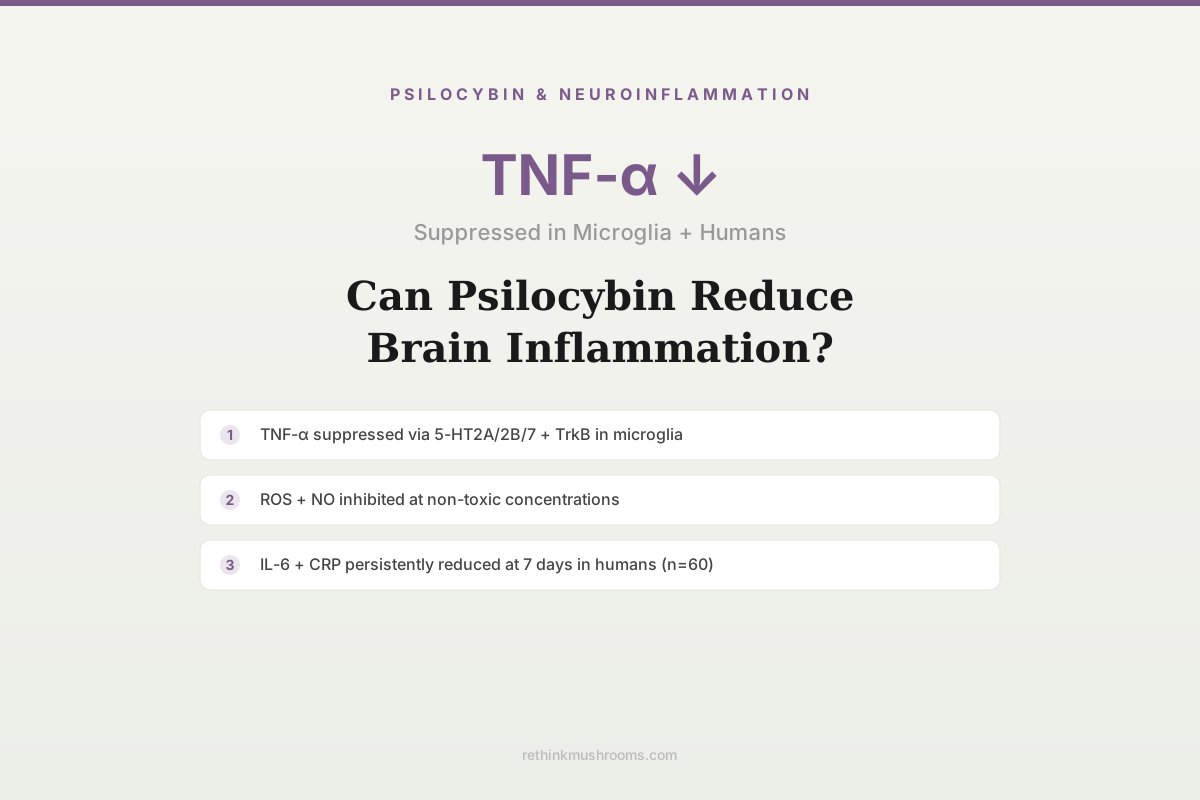
Psilocybin & Neuroinflammation
TNF-α ↓
Psilocybin and psilocin significantly suppress TNF-alpha expression in LPS-activated microglia through 5-HT2A, 5-HT2B, 5-HT7, and TrkB signaling, while simultaneously increasing BDNF levels.
Laabi et al., Int Immunopharmacol, 2025
5 Receptors
5-HT2A, 5-HT2B, 5-HT7, TrkB, and AhR mediate psilocybin's microglial effects
ROS + NO
psilocin inhibits reactive oxygen species and nitric oxide in microglia
Human Data
psilocybin reduced TNF-alpha acutely and IL-6/CRP at 7 days in 60 volunteers
Laabi et al., Int Immunopharmacol, 2025
 View as image ↗
Microglia are the brain's resident immune cells. When they detect damage or infection, they shift into an activated state, releasing pro-inflammatory cytokines (TNF-alpha, IL-1beta, IL-6), reactive oxygen species, and nitric oxide. This inflammatory response is protective in the short term but becomes destructive when chronically activated, a state called neuroinflammation that is implicated in depression, Alzheimer's disease, Parkinson's disease, and traumatic brain injury. Psilocybin, the prodrug metabolized to psilocin in the body, has now been shown to modulate microglial inflammatory responses through multiple receptor pathways, with effects documented in cell culture, animal models, and a placebo-controlled human study. For a broader view of mushroom-derived anti-inflammatory compounds, see antrodia and neuroinflammation: microglial regulation.
Key Takeaways
- Psilocybin and psilocin suppress TNF-alpha expression and increase BDNF levels in LPS-activated microglia through 5-HT2A, 5-HT2B, 5-HT7, and TrkB signaling, with AhR required for BDNF upregulation but not TNF-alpha suppression (Laabi et al., 2025)
- Psilocin inhibits microglial phagocytic activity, reactive oxygen species release, and nitric oxide production at non-toxic concentrations through a 5-HT2 receptor-dependent mechanism (Wiens et al., 2024)
- In 60 healthy volunteers, psilocybin immediately reduced TNF-alpha concentrations, and at 7 days post-administration, IL-6 and CRP were persistently reduced compared to placebo (Mason et al., 2023)
- Psilocin (but not psilocybin) exerts anti-inflammatory effects on classically activated macrophages, with dose-dependent modulation of TNF-alpha that varies between resting and activated states (Laabi et al., 2024)
- A single psilocybin dose increases synaptic density in prefrontal cortex and hippocampus for at least 7 days, measured by SV2A PET imaging in pigs (Raval et al., 2021)
- Pooled data from 91 participants across three RCTs showed a transient increase in IL-8 within one week of psilocybin, with no sustained changes at four weeks or beyond (DiRenzo et al., 2024)
TNF-Alpha Suppression: The Core Microglial Finding
The most mechanistically detailed study on psilocybin and microglia comes from Laabi et al. (2025), who systematically dissected the receptor pathways mediating psilocybin's anti-inflammatory effects on brain immune cells.[1]
Using in vitro models of both resting and LPS-activated microglia, they tested psilocybin and its active metabolite psilocin for effects on TNF-alpha (a major pro-inflammatory cytokine), IL-10 (an anti-inflammatory cytokine), and BDNF (brain-derived neurotrophic factor, a marker of neuroplasticity). Both compounds significantly suppressed TNF-alpha expression and increased BDNF levels in activated microglia.
The receptor pharmacology was mapped using selective antagonists. Five receptor systems contributed to the effects:
- 5-HT2A (the primary psychedelic receptor): involved in both TNF-alpha suppression and BDNF increase
- 5-HT2B: contributed to both effects
- 5-HT7: contributed to both effects
- TrkB (the BDNF receptor itself): involved in a positive feedback loop where psilocin-induced BDNF signals back through TrkB to amplify the neuroplastic response
- AhR (aryl hydrocarbon receptor): required specifically for psilocin-induced BDNF upregulation but not for TNF-alpha suppression
An unexpected finding: IL-10 levels remained unchanged under normal treatment conditions, but increased significantly when serotonergic, TrkB, or AhR signaling was blocked. This suggests that psilocybin's anti-inflammatory effect does not work by simply boosting anti-inflammatory cytokines. Instead, it directly suppresses pro-inflammatory signaling. The IL-10 increase under receptor blockade may represent a compensatory mechanism where alternative anti-inflammatory pathways activate when the primary serotonergic route is disrupted.
Psilocin's Direct Effects on Microglial Function
Wiens et al. (2024) focused specifically on psilocin (the active metabolite, not the prodrug psilocybin) and its effects on functional outputs of activated microglia, not just cytokine expression.[2]
At non-toxic concentrations, psilocin did not reduce TNF secretion from immune-stimulated microglial cells in this study (a contrast with the Laabi et al. findings, likely attributable to differences in cell lines, activation protocols, and concentration ranges). However, psilocin significantly inhibited three other microglial functions:
- Phagocytic activity: microglia's ability to engulf and digest cellular debris and pathogens was reduced
- Reactive oxygen species (ROS) release: the oxidative burst that damages surrounding neurons was suppressed
- Nitric oxide (NO) production: another damaging molecule produced by activated microglia was reduced
The ROS and NO inhibition was shown to be 5-HT2 receptor-dependent, because two selective 5-HT2R agonists produced similar inhibitory effects. This confirms that the anti-inflammatory mechanism runs through the same serotonin receptors responsible for psilocybin's psychoactive effects, though this does not prove that the anti-inflammatory and psychoactive effects are inseparable.
The phagocytosis finding requires careful interpretation. Reduced phagocytic activity is beneficial when microglia are aberrantly engulfing healthy synapses (a process implicated in Alzheimer's disease and schizophrenia). It could be harmful if microglia need to clear genuinely damaged tissue or pathogens. Context determines whether dampening microglial phagocytosis is protective or detrimental.
Human Evidence: TNF-Alpha, IL-6, and CRP
Mason et al. (2023) published the first placebo-controlled human study measuring psilocybin's effects on inflammatory biomarkers.[3] Sixty healthy volunteers received either placebo or 0.17 mg/kg psilocybin in a parallel-group design. Blood samples were collected before dosing, immediately after, and 7 days later.
The immediate effects: psilocybin acutely reduced TNF-alpha concentrations. IL-1beta, IL-6, and C-reactive protein (CRP) were not changed acutely. At 7 days post-administration, TNF-alpha had returned to baseline, but IL-6 and CRP were now persistently reduced in the psilocybin group compared to placebo. The delayed reduction in IL-6 and CRP is particularly interesting because these are systemic inflammatory markers associated with depression severity, cardiovascular risk, and chronic disease burden.
Two mechanistic connections emerged. First, the acute TNF-alpha reduction correlated with lower glutamate concentrations in the hippocampus, linking the anti-inflammatory effect to neurometabolic changes in a brain region critical for mood regulation and memory. Second, the magnitude of IL-6 and CRP reduction at 7 days predicted the degree of persisting positive mood and social effects that participants reported, suggesting that the anti-inflammatory response may partially mediate psilocybin's sustained psychological benefits. For related context on receptor pharmacology, see psilocybin and neuroinflammation: anti-inflammatory brain effects.
The Macrophage Studies: Psilocin vs. Psilocybin
Laabi et al. (2024) tested both psilocybin (the prodrug) and psilocin (the active metabolite) on RAW 264.7 murine macrophages to determine whether the anti-inflammatory effects are compound-specific.[4]
An important cytotoxicity finding: psilocybin was approximately twice as cytotoxic as psilocin, with LC50 values of 12 ng/mL and 28 ng/mL respectively. This distinction matters because in vivo, psilocybin is rapidly converted to psilocin, so cells in the body are predominantly exposed to psilocin rather than the parent compound.
The inflammatory modulation was complex and dose-dependent. In resting macrophages, both compounds triggered significant TNF-alpha release after 4 hours at the lowest tested dose. In LPS-activated macrophages, psilocin (but not psilocybin) exerted anti-inflammatory effects, reducing pro-inflammatory cytokine production. This bidirectional effect (pro-inflammatory in resting cells, anti-inflammatory in activated cells) suggests psilocin acts as an immunomodulator rather than a simple immunosuppressant, adjusting the inflammatory response contextually rather than unilaterally dampening it.
The Peripheral Cytokine Data: A More Complex Picture
DiRenzo et al. (2024) pooled serum data from 91 participants across three separate randomized controlled clinical trials to examine peripheral cytokine changes after psilocybin administration.[5] Participants included healthy volunteers (n=35), people with depression (n=25), and cancer patients with anxiety (n=31).
In the pooled analysis, sera collected within one week of psilocybin showed increased levels of IL-8, a chemokine involved in neutrophil recruitment. At 4 weeks and beyond, no sustained cytokine changes were observed. In individual study analyses, no consistent changes reached significance.
This result appears to contradict the Mason et al. findings of sustained IL-6 and CRP reduction at 7 days. The contradiction may reflect differences in participant populations (healthy volunteers vs. mixed clinical populations), psilocybin doses, or the timing of blood collection relative to administration. It also demonstrates why single studies, even well-designed ones, should not be treated as definitive. The peripheral immune picture after psilocybin is not yet settled.
Neuroplasticity: The Anti-Inflammatory Connection
The relationship between neuroinflammation and neuroplasticity is bidirectional. Chronic neuroinflammation suppresses BDNF production, reduces synaptic density, and inhibits neurogenesis. Conversely, restoring neuroplasticity may help resolve neuroinflammation by improving the brain's resilience to inflammatory insults.
Raval et al. (2021) demonstrated that a single psilocybin dose increased synaptic vesicle glycoprotein 2A (a marker of synaptic density) in pig prefrontal cortex and hippocampus, with effects persisting at least 7 days.[6] Zhao et al. (2024) showed that psilocybin promotes structural dendritic spine growth in mouse prefrontal cortex neurons.[7]
The Laabi et al. (2025) finding that psilocybin simultaneously suppresses TNF-alpha and increases BDNF in microglia connects these two research threads: the compound may address neuroinflammation and neuroplasticity deficits through the same cellular target. The TrkB involvement creates a potential positive feedback loop: psilocin increases BDNF, BDNF activates TrkB, and TrkB activation further amplifies BDNF production and anti-inflammatory signaling.
Kinderlehrer (2025) reviewed the intersection of psilocybin's anti-inflammatory and neuroplastic effects and proposed that these dual mechanisms may explain why psilocybin shows efficacy across neuropsychiatric conditions that share neuroinflammation as a common feature, from depression to anxiety to substance use disorders.[8] For the receptor pharmacology underlying these effects, see psilocybin and TNF-alpha: systemic anti-inflammatory evidence.
The 5-HT2A Question: Are Anti-Inflammatory and Psychedelic Effects Separable?
Madsen et al. (2019) established that psilocybin's psychedelic effects correlate with serotonin 2A receptor occupancy and plasma psilocin levels.[9] Erkizia-Santamaria et al. (2022) confirmed that 5-HT2A (along with 5-HT2C and 5-HT1A) mediates the acute behavioral effects of psilocybin in mice.[10]
The microglial studies show that 5-HT2A is one of several receptors mediating anti-inflammatory effects, but not the only one. Laabi et al. (2025) demonstrated that 5-HT2B, 5-HT7, TrkB, and AhR also contribute. Wiens et al. (2024) showed that ROS and NO inhibition is 5-HT2 receptor-dependent but did not require specifically 5-HT2A over 5-HT2B or 5-HT2C.
This raises a question with practical implications: could the anti-inflammatory benefits of psilocybin be achieved without the psychedelic experience? If non-hallucinogenic 5-HT2A agonists or selective 5-HT2B/5-HT7 agonists can replicate the microglial effects, it would open a path to anti-neuroinflammatory therapies that do not require supervised psychedelic sessions. This remains speculative; no such selective compound has been tested for microglial modulation. For the broader psilocybin-microglia connection, see psilocybin and microglial modulation: anti-inflammatory effects in the brain.
What the Evidence Supports and What It Does Not
| Evidence type | Finding | Confidence |
|---|---|---|
| Microglial TNF-alpha | Psilocybin/psilocin suppress TNF-alpha in LPS-activated microglia via 5-HT2A/2B/7 + TrkB | Moderate |
| Microglial ROS/NO | Psilocin inhibits oxidative burst and nitric oxide, 5-HT2-dependent | Low to moderate |
| Human TNF-alpha | Acute reduction in 60 healthy volunteers vs placebo | Moderate |
| Human IL-6/CRP | Persisting reduction at 7 days, correlating with sustained mood effects | Low to moderate |
| Peripheral cytokines | Pooled RCT data: transient IL-8 increase, no sustained changes at 4+ weeks | Low |
| Clinical neuroinflammation | No trial has tested psilocybin specifically for a neuroinflammatory condition | None |
For related research on other mushroom species with neuroinflammatory effects, see antrodia and neuroinflammation: brain protection research and ALS and neuroinflammation: can mushrooms help?.
The Bottom Line
Psilocybin and its active metabolite psilocin suppress pro-inflammatory TNF-alpha expression, inhibit reactive oxygen species and nitric oxide production, and increase BDNF levels in activated microglia through 5-HT2A, 5-HT2B, 5-HT7, TrkB, and AhR receptor signaling. In 60 healthy human volunteers, psilocybin acutely reduced TNF-alpha and persistently reduced IL-6 and CRP at 7 days. Pooled clinical data show a more complex picture with transient changes. No trial has tested psilocybin specifically for a neuroinflammatory condition.
Frequently Asked Questions
Sources & References
- 1RTHM-00934·Laabi, Salma et al. (2025). “Psilocybin and psilocin regulate microglial immunomodulation and support neuroplasticity via serotonergic and AhR signaling..” International immunopharmacology.Study breakdown →PubMed →↩
- 2RTHM-00914·Wiens, Kennedy R et al. (2024). “Psilocin, the Psychoactive Metabolite of Psilocybin, Modulates Select Neuroimmune Functions of Microglial Cells in a 5-HT2 Receptor-Dependent Manner..” Molecules (Basel.Study breakdown →PubMed →↩
- 3RTHM-00845·Mason, N L et al. (2023). “Psilocybin induces acute and persisting alterations in immune status in healthy volunteers: An experimental, placebo-controlled study..” Brain.Study breakdown →PubMed →↩
- 4RTHM-00887·Laabi, Salma et al. (2024). “Deciphering psilocybin: Cytotoxicity, anti-inflammatory effects, and mechanistic insights..” International immunopharmacology.Study breakdown →PubMed →↩
- 5RTHM-00874·DiRenzo, Dana et al. (2024). “Impact of Psilocybin on Peripheral Cytokine Production..” Psychedelic medicine (New Rochelle.Study breakdown →PubMed →↩
- 6RTHM-00714·Raval, Nakul Ravi et al. (2021). “A Single Dose of Psilocybin Increases Synaptic Density and Decreases 5-HT2A Receptor Density in the Pig Brain..” International journal of molecular sciences.Study breakdown →PubMed →↩
- 7RTHM-00920·Zhao, Xiangting et al. (2024). “Psilocybin promotes neuroplasticity and induces rapid and sustained antidepressant-like effects in mice..” Journal of psychopharmacology (Oxford.Study breakdown →PubMed →↩
- 8RTHM-00929·Kinderlehrer, Daniel A (2025). “Mushrooms, Microdosing, and Mental Illness: The Effect of Psilocybin on Neurotransmitters, Neuroinflammation, and Neuroplasticity..” Neuropsychiatric disease and treatment.Study breakdown →PubMed →↩
- 9RTHM-00578·Madsen, Martin K et al. (2019). “Psychedelic effects of psilocybin correlate with serotonin 2A receptor occupancy and plasma psilocin levels..” Neuropsychopharmacology : official publication of the American College of Neuropsychopharmacology.Study breakdown →PubMed →↩
- 10RTHM-00757·Erkizia-Santamaría, I et al. (2022). “Serotonin 5-HT2A, 5-HT2c and 5-HT1A receptor involvement in the acute effects of psilocybin in mice. In vitro pharmacological profile and modulation of thermoregulation and head-twich response..” Biomedicine & pharmacotherapy = Biomedecine & pharmacotherapie.Study breakdown →PubMed →↩