Psilocybin & Neuroinflammation
2 receptor pathways
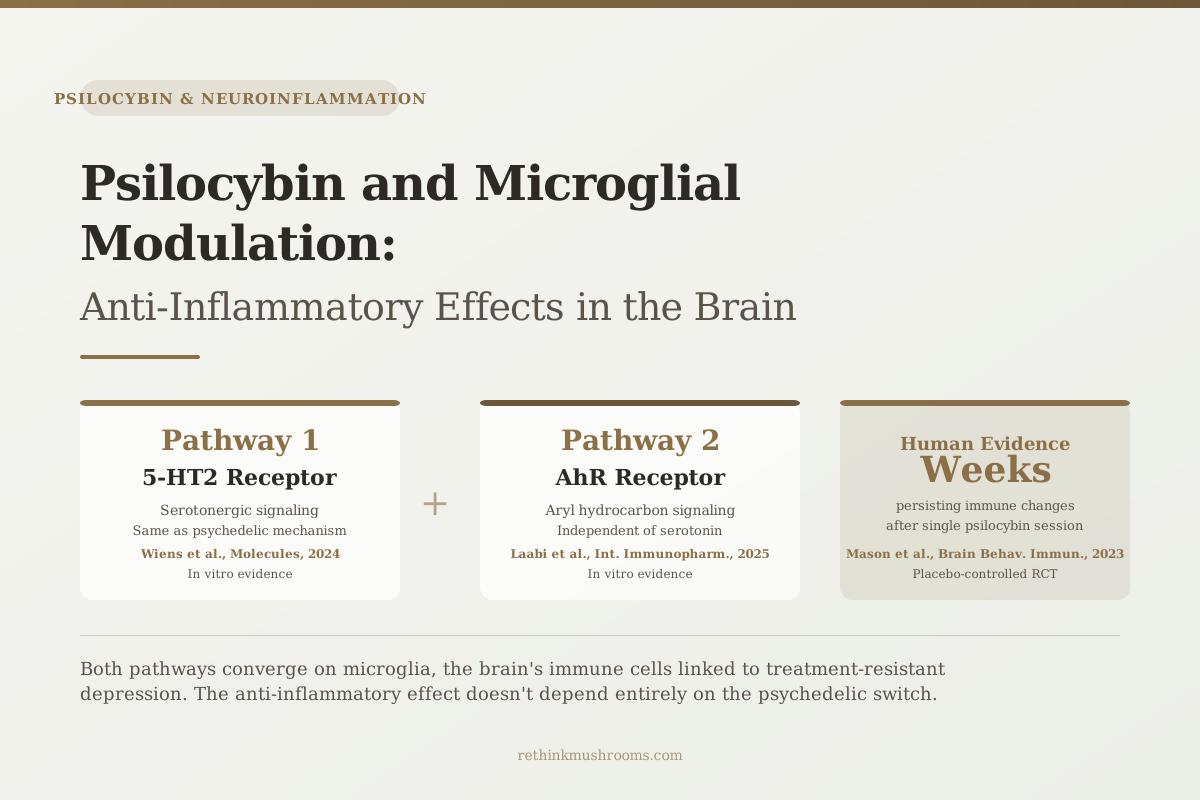
Laabi and colleagues found psilocybin and psilocin modulate brain immune cells through two independent signaling routes, serotonergic 5-HT2 and aryl hydrocarbon receptor (AhR), meaning the anti-inflammatory effect isn't entirely dependent on the psychedelic switch.
Laabi et al., International Immunopharmacology, 2025
5-HT2
serotonin receptor pathway through which psilocin modulates microglia (Wiens et al., 2024)
AhR
second, serotonin-independent receptor pathway for psilocybin's microglial effects (Laabi 2025)
Weeks
duration of persisting immune status changes in Mason 2023 placebo-controlled human study
Laabi et al., International Immunopharmacology, 2025
 View as image ↗
Microglia are the brain's resident immune cells. They patrol neural tissue constantly, clearing dead cells and cellular debris, monitoring for infection and injury, and when they detect a problem, releasing inflammatory signals to mobilize a response.
The issue is what happens when that activation becomes chronic. In people with treatment-resistant depression and PTSD, microglia often stay in an activated, pro-inflammatory state long after any immediate threat has passed. The inflammatory signals they release, instead of protecting neurons, begin damaging them. This is the neuroinflammation hypothesis of depression, and it helps explain why serotonin-focused treatments only reach part of the population: they don't directly address the underlying inflammatory state.
In 2024, a laboratory study found that psilocin, the active compound psilocybin converts into after ingestion, directly modulates microglial activity through 5-HT2 receptors, the same serotonin receptor subtype responsible for psilocybin's psychedelic effects.[1] In 2025, a second study by the same lead researcher identified a parallel pathway: a receptor called the aryl hydrocarbon receptor, an entirely separate signaling route, also mediates psilocybin's effects on microglia.[2] This microglia and brain inflammation research sits within the broader story of how psilocybin affects the brain's core networks, but it points to a mechanism that's distinct from the serotonin-only explanation.
Key Takeaways
- Psilocin (psilocybin's active metabolite) directly modulates brain immune cells called microglia through 5-HT2 serotonin receptors, the same receptor pathway that produces psilocybin's psychedelic effects (Wiens et al., Molecules, 2024)
- A 2025 study by Laabi and colleagues identified a second microglial pathway: the aryl hydrocarbon receptor (AhR), which operates independently of serotonin and means psilocybin's anti-inflammatory brain effects are not entirely dependent on full 5-HT2 activation
- An earlier 2024 study by Laabi and colleagues established direct anti-inflammatory effects at the cellular level and confirmed psilocybin's effects extend beyond its psychedelic serotonergic mechanism
- Mason and colleagues (Brain, Behavior, and Immunity, 2023) ran the first placebo-controlled human study measuring immune changes after psilocybin: both acute and persisting immune status alterations were detected weeks after a single session
- Overactivated microglia release pro-inflammatory cytokines linked to treatment-resistant depression and PTSD; psilocybin's ability to modulate microglia directly is the mechanism no consumer content has yet covered
- All microglial findings are in vitro (cell culture); the Mason 2023 study is the only controlled human evidence; clinical translation to treatment has not been established
The Brain's Immune Cells: Helpful Watchmen That Can Turn Into the Problem
Microglia account for roughly 10-15% of all cells in the brain. Unlike neurons, they don't transmit signals. Their job is maintenance and defense: they move through brain tissue continuously, extending arm-like projections that probe the environment for signs of damage, infection, or cellular waste.
When microglia detect a problem, they shift into an activated state. Their shape changes. They retract their scanning extensions and grow larger. They start producing and releasing cytokines, small signaling proteins that recruit other immune responses and mark the problem area for attention. This is the brain's equivalent of calling in reinforcements, and in the short term it's exactly what the brain needs after injury or infection.
The problem is what happens when activation doesn't resolve. In chronic stress, repeated trauma, or neurodegenerative conditions, microglia can get stuck in a persistent inflammatory state. The cytokines they keep producing, substances like TNF-alpha and IL-6, don't just signal other immune cells: they also interfere with the brain's ability to regulate neurotransmitters, including serotonin and dopamine. They can directly damage nearby neurons. They disrupt the formation of new neural connections.
Studies examining post-mortem brain tissue from individuals who died with major depression have found evidence of elevated microglial activation. The same pattern appears in people with PTSD and treatment-resistant depression. This has led researchers to ask whether the inflammation is a contributing cause of these conditions rather than just a side effect of them, and whether treatments that reduce microglial activation might work where purely serotonergic drugs don't.
The 2024 Finding: Psilocin Reaches Microglia Through the Same Switch That Causes Psychedelic Effects
When psilocybin is ingested, the body rapidly converts it to psilocin, the form that actually crosses into the brain and produces effects. It's psilocin that binds to 5-HT2A receptors and triggers the cascade that leads to the psychedelic experience. It's also psilocin that Wiens and colleagues studied in their 2024 cell-culture investigation of microglial function.[1]
Their finding: psilocin modulates microglial neuroimmune functions through 5-HT2 receptors in a dose-dependent way. Microglia express 5-HT2 receptor subtypes on their surface, which means the same signaling molecule that triggers the psychedelic experience also communicates directly with the brain's immune cells.
The implications run in two directions. First, this provides a mechanism for how psilocybin might produce anti-inflammatory brain effects directly, not as a downstream consequence of mood improvement, but as a direct pharmacological effect on immune cells. Second, and more speculatively, it raises a question about the relationship between the psychedelic experience and the anti-inflammatory effect: if both run through 5-HT2 receptors, are they causally linked? Or do they happen in parallel?
The Wiens study doesn't resolve that question. It establishes the mechanism, not the clinical relationship. The evidence level here is low: these are laboratory studies in cell cultures, not human trials. But the mechanism is clear enough to take seriously as a hypothesis about how psilocybin affects the brain's immune environment.
For the broader story of how 5-HT2A receptor activation works and what it does throughout the brain, see psilocybin and 5-HT2A receptors: the gateway to psychedelic effects.
A Second Pathway: How Laabi's Research Uncovered an Anti-Inflammatory Route That Works Without Serotonin
The 2024 study from Laabi and colleagues established that psilocybin has direct anti-inflammatory effects at the cellular level, effects that go beyond its serotonergic mechanism and appear to involve the drug acting on immune processes through a separate route.[3] That work set up a more specific question: if the anti-inflammatory effect isn't fully explained by serotonin, what other pathway is involved?
The 2025 follow-up from the same group answered it.[2] Psilocybin and psilocin, they found, also activate the aryl hydrocarbon receptor, called AhR for short. The AhR is a receptor found throughout the body, including in microglia. It's intracellular: when activated, it moves into the cell's nucleus and directly regulates which genes are expressed. The AhR was originally studied because environmental toxins like dioxins bind to it, but it's increasingly recognized as a central regulator of immune function and inflammatory responses.
When Laabi's 2025 study found that both serotonergic signaling AND AhR activation mediate psilocybin's microglial effects, the finding changed the picture in a specific way. It means the anti-inflammatory effect isn't dependent on full 5-HT2A activation. A dose that doesn't produce strong psychedelic effects might still modulate microglia through the AhR pathway. Or conversely, the AhR effects might partly explain why psilocybin's therapeutic effects persist long after the drug has cleared the body, since gene expression changes driven by AhR can be more durable than receptor-level signaling effects.
Critically, the 2025 study also found that psilocybin supports neuroplasticity, the brain's ability to form new connections, through the same dual-pathway mechanism. The anti-inflammatory and the neuroplasticity-promoting effects appear to be linked, driven by overlapping mechanisms rather than happening independently. The relationship between microglial modulation and psilocybin's neuroplasticity effects is one of the more compelling emerging areas of psilocybin neuroscience.
From Cell Cultures to People: What the First Controlled Human Study Found
The Laabi and Wiens studies are in vitro: they used microglial cell cultures, not living brains. What they establish is mechanism. What they can't establish is whether these mechanisms produce measurable immune changes in actual people.
That's what Mason and colleagues investigated. In 2023, they published a placebo-controlled study measuring immune status changes in healthy volunteers after psilocybin administration, the first study of its kind.[4]
The key findings: psilocybin produced both acute immune alterations, changes detectable in the hours immediately following the session, and persisting alterations that were still measurable weeks later. The persisting changes are the clinically significant part. The acute immune response during the session could plausibly reflect the pharmacological activity of the drug; the question is whether it resets something in the immune system that holds beyond the drug's clearance from the body.
Mason's study was conducted in healthy volunteers, not in people with depression or any condition associated with elevated neuroinflammation. This is an important limitation: the immune changes observed in a healthy population may be different in magnitude and kind from what would occur in people whose baseline inflammatory state is elevated. The study also doesn't measure which specific immune cells or pathways account for the changes, which means it doesn't directly confirm that microglia in living humans respond the way the cell-culture data suggests.
What it does provide is the first controlled human evidence that psilocybin affects immune status at all, and that the effect outlasts the acute experience. That's the bridge between the mechanistic preclinical data and the hypothesis that psilocybin might produce therapeutic effects partly through immune modulation.
The Depression Connection: What This Might Explain and What It Doesn't
The emerging picture is this: psilocybin modulates microglia through at least two receptor pathways; it produces persisting immune changes in healthy humans; and neuroinflammation, specifically chronic microglial overactivation, is implicated in treatment-resistant depression.
The hypothesis that follows is clear: psilocybin's anti-inflammatory effects may contribute to its antidepressant properties, potentially explaining why those effects outlast the drug itself. Standard antidepressants work on neurotransmitter reuptake but don't directly address the inflammatory component of depression. If psilocybin does, that could help explain why it seems to reach patients who haven't responded to conventional treatment.
What that hypothesis doesn't have yet is direct clinical evidence. No study has measured neuroinflammation markers in depressed patients before and after psilocybin therapy and then correlated those changes with clinical outcomes. The mechanistic chain from cell-culture results through human immune data to antidepressant effects is plausible but not yet demonstrated. The Mason 2023 study provides one piece. The Wiens and Laabi studies provide another. A study that connects them in clinical patients hasn't been published.
The honest framing: this is a biologically coherent hypothesis supported by preclinical mechanism data and one controlled human study. It is not a proven mechanism of action. The clinical relevance of psilocybin's microglial effects, whether they contribute to therapeutic outcomes in depressed patients and by how much, is an open research question.
For the broader evidence on psilocybin's anti-inflammatory brain effects and how they relate to depression, see that article. For the specific evidence on inflammatory cytokines including TNF-alpha, see psilocybin and TNF-alpha: systemic anti-inflammatory evidence. For the full neuroimmune argument connecting anti-inflammatory effects to therapeutic durability, see the neuroimmune connection: how psilocybin's anti-inflammatory effects may drive healing.
The Bottom Line
Four studies, two in vitro mechanism papers (Wiens 2024, Laabi 2025), one cellular foundation study (Laabi 2024), and one placebo-controlled human trial (Mason 2023), collectively establish that psilocybin and its active form psilocin modulate microglia through two receptor pathways and produce persisting immune changes in people. The preclinical evidence identifies the 5-HT2 serotonin receptor and the aryl hydrocarbon receptor (AhR) as the specific routes through which psilocin reaches brain immune cells. The human evidence confirms measurable immune status changes lasting weeks after a single session. The clinical implication, that these effects contribute to psilocybin's antidepressant properties, remains a hypothesis without direct clinical evidence.
Frequently Asked Questions
Sources & References
- 1RTHM-00914·Wiens, Kennedy R et al. (2024). “Psilocin, the Psychoactive Metabolite of Psilocybin, Modulates Select Neuroimmune Functions of Microglial Cells in a 5-HT2 Receptor-Dependent Manner..” Molecules (Basel.Study breakdown →PubMed →↩
- 2RTHM-00934·Laabi, Salma et al. (2025). “Psilocybin and psilocin regulate microglial immunomodulation and support neuroplasticity via serotonergic and AhR signaling..” International immunopharmacology.Study breakdown →PubMed →↩
- 3RTHM-00887·Laabi, Salma et al. (2024). “Deciphering psilocybin: Cytotoxicity, anti-inflammatory effects, and mechanistic insights..” International immunopharmacology.Study breakdown →PubMed →↩
- 4RTHM-00845·Mason, N L et al. (2023). “Psilocybin induces acute and persisting alterations in immune status in healthy volunteers: An experimental, placebo-controlled study..” Brain.Study breakdown →PubMed →↩