Psilocybin & Neuroinflammation
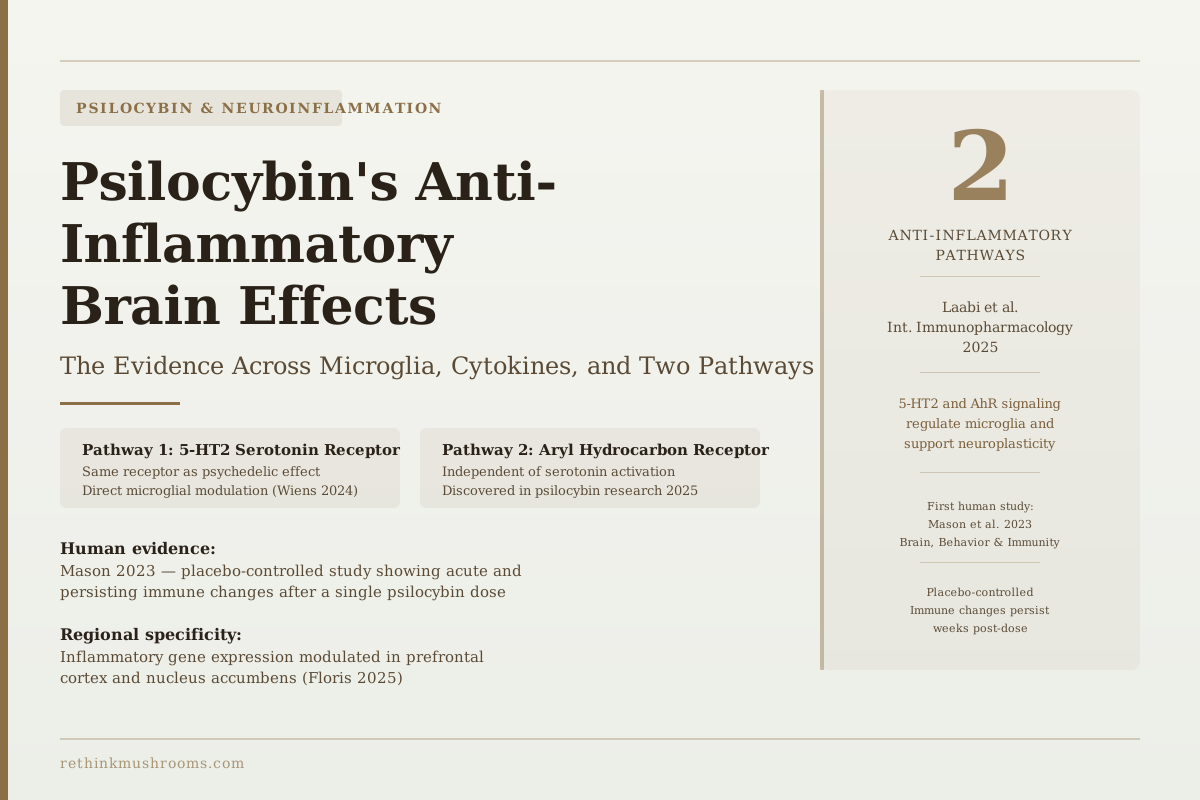
2 anti-inflammatory pathways
A 2025 study found psilocybin and psilocin regulate microglial immune function and support neuroplasticity through two independent receptor pathways, including one that operates without full serotonin activation.
Laabi et al., International Immunopharmacology, 2025
Human-confirmed
Mason 2023 placebo-controlled study showed both acute and persisting immune alterations after psilocybin
Microglia-direct
Wiens 2024: psilocin modulates brain immune cells through 5-HT2 serotonin receptors
Brain-specific
Floris 2025: inflammatory gene expression modulated in prefrontal cortex and nucleus accumbens
Laabi et al., International Immunopharmacology, 2025
 View as image ↗
Neuroinflammation — chronic, low-grade inflammation in the brain — is increasingly implicated in depression, particularly in people who don't respond to standard antidepressants. Patients with treatment-resistant depression consistently show elevated inflammatory markers: overactivated microglia (the brain's resident immune cells), higher concentrations of pro-inflammatory proteins called cytokines, and measurable changes in the brain regions that regulate mood. This pattern has led researchers to propose that reducing brain inflammation might be a route to antidepressant effects that standard drugs don't take.
Psilocybin's anti-inflammatory and neuroinflammation effects represent exactly that potential route. Psilocybin has shown anti-inflammatory activity across multiple levels: it modulates microglia, reduces peripheral cytokine production, and alters inflammatory gene expression in specific brain regions linked to mood and addiction. These effects have been observed in controlled human studies, in animal models, and in cellular experiments — though the strength of evidence varies considerably across those three types.
The full neuroscience context for how psilocybin reshapes brain activity is covered in psilocybin and the default mode network. This article focuses specifically on the inflammatory side of that story.
Key Takeaways
- A 2023 placebo-controlled human study found psilocybin caused both immediate and persisting changes in immune status, including effects that lasted weeks after a single dose (Mason et al., Brain, Behavior, and Immunity, 2023).
- In 2024, researchers showed that psilocin, the active metabolite of psilocybin, directly modulates the brain's immune cells (microglia) through the same serotonin receptor that produces the psychedelic experience (Wiens et al., Molecules, 2024).
- A 2024 cellular study identified direct anti-inflammatory effects of psilocybin independent of its serotonergic action, providing foundational mechanism data (Laabi et al., International Immunopharmacology, 2024).
- A 2025 study found psilocybin and psilocin regulate microglial activity through two independent pathways: the 5-HT2 serotonin receptor AND the aryl hydrocarbon receptor (AhR), a separate signaling route not previously linked to psilocybin's effects (Laabi et al., International Immunopharmacology, 2025).
- Psilocybin modulated inflammatory gene expression in the nucleus accumbens and prefrontal cortex of rats, establishing regional specificity in the brain circuits most relevant to depression and addiction (Floris et al., Molecular Psychiatry, 2025).
- The cellular and animal evidence on psilocybin's anti-inflammatory effects is emerging and has not yet been directly connected to clinical outcomes in humans.
Why Neuroinflammation Matters: The Brain Inflammation Case for Psilocybin
The brain's resident immune cells, called microglia, play a surveillance role under normal conditions. They monitor brain tissue for signs of damage, clear dead cells and debris, and coordinate the local immune response to injury. When they are working correctly, microglia are protective.
When microglia become chronically overactivated, they switch into an inflammatory mode. Overactivated microglia release pro-inflammatory proteins called cytokines, including TNF-alpha (tumor necrosis factor-alpha) and IL-6 (interleukin-6). These proteins can cross the blood-brain barrier in both directions. Elevated cytokines in the brain interfere with the production of serotonin and dopamine, reduce the brain's ability to form new neural connections, and can directly damage neurons over time.
The connection to depression is direct and increasingly well-supported. Patients with major depression, and especially patients with treatment-resistant depression who don't respond to standard antidepressants, show elevated inflammatory markers: higher circulating cytokines, more active microglia on brain scans, and elevated C-reactive protein in the blood. Some researchers now propose that a subtype of depression is fundamentally an inflammatory condition, not primarily a serotonin deficiency.
This is the context that makes psilocybin's anti-inflammatory effects worth examining carefully. If the drug that is showing the most promising results in treatment-resistant depression also happens to reduce brain inflammation, the overlap is worth investigating. Whether the anti-inflammatory effect is a cause of the antidepressant outcome or a coincidental finding is the open question. The research so far does not answer it.
The First Human Evidence: Mason 2023's Placebo-Controlled Study
Most of the evidence on psilocybin and inflammation comes from cells or animals. Mason and colleagues published a study in 2023 that moved the question into the human body under controlled conditions.
The study enrolled healthy volunteers and assigned them to receive either psilocybin or a placebo in a blinded design. Researchers then measured immune status at multiple time points: within hours of administration and again weeks later. Psilocybin produced measurable changes in immune status in both windows. The acute changes happened within hours. But the persisting changes — still present weeks after a single dose — were the more striking finding. [1]
The details of exactly which immune markers changed, and in which direction, require reading the paper directly for precision. What the study establishes at a high level is that a single dose of psilocybin affects the immune system beyond the window of the acute psychedelic experience. The effects are not simply a transient stress response that normalizes quickly. Something about psilocybin's pharmacology produces immune changes that last.
This is the most important single data point in this field, because it is the only placebo-controlled human study showing these effects. All other evidence on the mechanism is preclinical. For the cytokine-specific picture, including direct measurement of TNF-alpha and other inflammatory markers, Psilocybin and TNF-Alpha: Systemic Anti-Inflammatory Evidence covers the DiRenzo 2024 cytokine data in detail.
How Psilocybin Affects Microglia: The 5-HT2 Connection
Wiens and colleagues published a study in 2024 that answered a specific mechanistic question: does psilocin, the form of psilocybin that actually crosses the blood-brain barrier and becomes active in the body, affect microglia directly?
The answer was yes, and the mechanism was specific. Psilocin modulated several neuroimmune functions of microglial cells through 5-HT2 receptors — the same serotonin receptors that produce the psychedelic experience. [2]
This finding has a notable implication: the anti-inflammatory effect on microglia is mechanistically linked to the same receptor that produces the therapeutic experience. They are not separate pharmacological effects happening in parallel. They share the same molecular switch. When psilocin activates 5-HT2 receptors in the cortex and produces the characteristic dissolution of rigid mental patterns, the same class of receptor on microglia is also being activated — with immune consequences.
Laabi and colleagues published supporting cellular evidence in 2024, identifying direct anti-inflammatory properties of psilocybin at the cell level, before the same group's larger 2025 study. [3] The 2024 paper established the foundational in-vitro observation; the 2025 paper then identified the receptor pathways responsible.
For the full mechanistic picture of how 5-HT2A receptor activation produces both the psychedelic experience and downstream biological effects, psilocybin and 5-HT2A receptors covers the pharmacology. For how the microglial modulation relates to the broader microglial literature in depression, Psilocybin and Microglial Modulation goes deeper into the microglia-specific findings.
The AhR Pathway: Psilocybin's Second Anti-Inflammatory Route
The 2025 study from Laabi and colleagues identified something unexpected: psilocybin and psilocin regulate microglial activity through two independent receptor systems, not one. [4]
The first pathway is the 5-HT2 route described above. The second is the aryl hydrocarbon receptor, known as AhR. The AhR is not a serotonin receptor. It is a completely separate signaling pathway involved in immune regulation and cellular responses to environmental compounds. It has previously been linked to immune modulation by other psychoactive plant alkaloids, but this appears to be one of the first studies connecting it directly to psilocybin's effects.
Why does this second pathway matter? Because it means psilocybin's anti-inflammatory effects on microglia are not entirely dependent on full 5-HT2 receptor activation. The AhR route operates independently. This raises questions about whether lower doses of psilocybin — insufficient to produce a full psychedelic experience — might still produce some anti-inflammatory effects through AhR signaling alone.
The same 2025 paper found that psilocybin and psilocin also supported neuroplasticity — the brain's ability to form new connections — through both pathways simultaneously. This connects the anti-inflammatory mechanism to the neuroplasticity mechanism in the same study. For the full neuroplasticity evidence, psilocybin and neuroplasticity covers the structural brain change literature in depth.
This is in-vitro evidence from cell cultures, not human data. The AhR pathway and its role in psilocybin's in-vivo anti-inflammatory effects has not yet been studied in humans or animals. It is a mechanistic discovery, not a clinical finding — but mechanistic discoveries are the necessary first step toward testable clinical hypotheses.
Regional Specificity: Where in the Brain Inflammation Shifts
Floris and colleagues published an animal study in 2025 that added a dimension of regional specificity to the neuroinflammation picture. Their study was primarily about heroin-seeking behavior — they found psilocybin significantly reduced cue-induced heroin seeking in male rats — but the neuroinflammatory measurement was a secondary finding of significant interest.
Psilocybin modulated inflammatory gene expression in two specific brain regions: the nucleus accumbens, the brain's primary reward center, and the prefrontal cortex, the region responsible for impulse control and executive decision-making. [5]
This matters for understanding neuroinflammation in the context of both depression and addiction. Chronic substance use drives neuroinflammation in exactly these two regions, impairing the function of both the reward system and the prefrontal cortex's ability to override reward-driven impulses. If psilocybin modulates inflammation specifically in these regions, the anti-inflammatory effect may directly support the functional improvements — better impulse control, reduced craving — observed in clinical settings.
The limitation is significant: this is preclinical data from male-only subjects, and the primary finding was about heroin seeking. The neuroinflammatory result is a secondary observation that should be taken as hypothesis-generating. No study has yet directly compared inflammatory gene expression in these regions in humans before and after psilocybin treatment.
Could Anti-Inflammatory Effects Explain Why Psilocybin Works Longer Than Other Drugs?
Most antidepressants must be taken daily to sustain their effects. Psilocybin produces antidepressant effects that last weeks to months after a single session. The leading explanation has been psychological — the therapeutic insights, the mystical experience, the reset of rigid cognitive patterns. These explanations may be correct, and the evidence for them is substantial.
But the Mason 2023 finding of persisting immune alterations weeks after a single dose introduces a biological candidate to add alongside the psychological explanation. If chronic neuroinflammation is partly maintaining depression, and psilocybin reduces that inflammation in ways that persist beyond the acute pharmacological effect, then the anti-inflammatory mechanism could help explain the duration of clinical benefit.
This is a hypothesis, not a conclusion. No study has connected the persisting immune changes measured by Mason directly to the persisting antidepressant effects measured in clinical trials. The two findings are consistent with the hypothesis; they do not prove it. For the extended version of this argument and the full neuroimmune theoretical framework, The Neuroimmune Connection: How Psilocybin's Anti-Inflammatory Effects May Drive Healing builds the case in detail.
What the existing evidence does establish: psilocybin affects the immune system at multiple levels, through multiple pathways, in ways that are measurable in humans and specific at the cellular and regional level. Whether those effects cause, contribute to, or merely accompany the therapeutic outcomes is the next research question.
The Bottom Line
Psilocybin's anti-inflammatory effects operate through at least two receptor pathways. The 5-HT2 serotonin pathway — the same receptor producing the psychedelic experience — directly modulates microglia, the brain's immune cells (Wiens 2024). A 2025 study identified a second independent pathway via the aryl hydrocarbon receptor (AhR), which operates without requiring full serotonin activation (Laabi 2025). Mason 2023's placebo-controlled human study confirmed that psilocybin produces both acute and persisting alterations in immune status after a single dose. Floris 2025 showed that inflammatory gene expression specifically changes in the prefrontal cortex and nucleus accumbens. The evidence is emerging; the clinical significance of these anti-inflammatory effects, and whether they causally drive the antidepressant outcomes, remains to be established.
Frequently Asked Questions
Sources & References
- 1RTHM-00845·Mason, N L et al. (2023). “Psilocybin induces acute and persisting alterations in immune status in healthy volunteers: An experimental, placebo-controlled study..” Brain.Study breakdown →PubMed →↩
- 2RTHM-00914·Wiens, Kennedy R et al. (2024). “Psilocin, the Psychoactive Metabolite of Psilocybin, Modulates Select Neuroimmune Functions of Microglial Cells in a 5-HT2 Receptor-Dependent Manner..” Molecules (Basel.Study breakdown →PubMed →↩
- 3RTHM-00887·Laabi, Salma et al. (2024). “Deciphering psilocybin: Cytotoxicity, anti-inflammatory effects, and mechanistic insights..” International immunopharmacology.Study breakdown →PubMed →↩
- 4RTHM-00934·Laabi, Salma et al. (2025). “Psilocybin and psilocin regulate microglial immunomodulation and support neuroplasticity via serotonergic and AhR signaling..” International immunopharmacology.Study breakdown →PubMed →↩
- 5RTHM-02082·Floris, Gabriele et al. (2025). “Psilocybin reduces heroin seeking behavior and modulates inflammatory gene expression in the nucleus accumbens and prefrontal cortex of male rats..” Molecular psychiatry.Study breakdown →PubMed →↩