Coprinus comatus and Diabetes
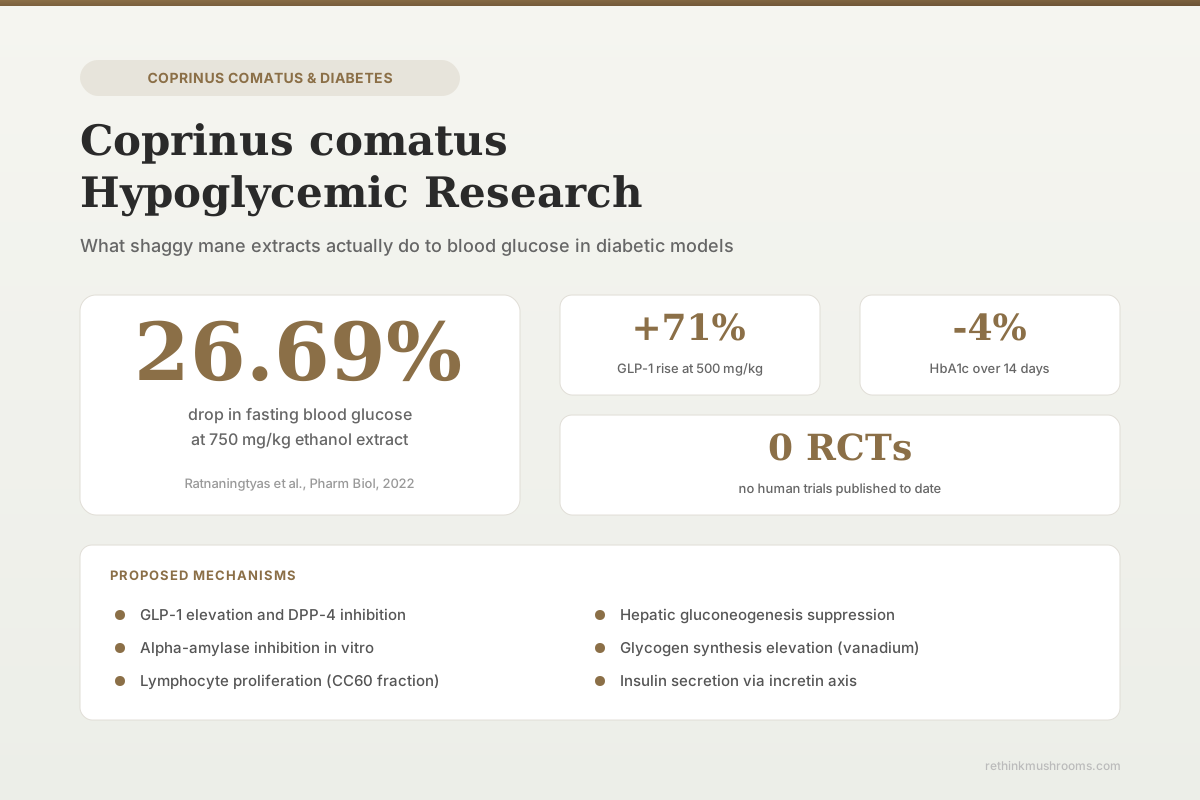
26.69% fasting glucose drop
Ethanol extract of Coprinus comatus at 750 mg/kg cut fasting blood glucose by 26.69% in streptozotocin-diabetic rats while boosting GLP-1 by 71%.
Ratnaningtyas et al., Pharmaceutical Biology, 2022
CC60 fraction
most potent polysaccharide at 1,000 mg/kg
HbA1c -4%
over 14 days in diabetic rats
0 RCTs
no human trials published yet
Ratnaningtyas et al., Pharmaceutical Biology, 2022
 View as image ↗
Coprinus comatus diabetes research has produced a consistent signal across roughly two decades of animal work: extracts from the shaggy mane mushroom lower blood glucose in chemically induced diabetic rodents. The catch is scope. No randomized controlled trial has ever tested Coprinus comatus in humans with diabetes, and the 2020 clinical review identified only scattered case reports for this species.[4] For the broader cross-species picture, see Comparing Mushroom Species for Diabetes Management.
The preclinical literature splits into three extract types with different active compounds: water-soluble polysaccharides (the CC30, CC60, CC80 fractions), ethanol extracts containing flavonoids and terpenoids, and vanadium-enriched fermented biomass (CCRV) that concentrates an insulin-mimetic trace element. Each lowers glucose through partially different mechanisms, and the effect sizes are large enough to be worth taking seriously, even if the evidence stops at rats.
Key Takeaways
- Ethanol extract of C. comatus fruiting body at 750 mg/kg reduced fasting blood glucose by 26.69% and DPP-4 activity by 6.97% in streptozotocin-diabetic rats (Ratnaningtyas et al., 2022)
- The same 2022 study found 500 mg/kg increased GLP-1 by 71.09%, insulin by 13.83%, and glutathione by 11.19% over 14 days
- Polysaccharide fraction CC60 (60% ethanol precipitation) reduced blood glucose within 120 minutes at 1,000 mg/kg orally and maintained a long-term hypoglycemic effect across 21 days of injection in alloxan-diabetic mice (Zhou et al., 2015)
- Vanadium-enriched C. comatus biomass (CCRV) decreased blood glucose and HbA1c, inhibited gluconeogenesis, and elevated glycogen synthesis in alloxan-hyperglycemic mice (Han et al., 2006; Lv et al., 2009)
- Intracellular polysaccharides from liquid-fermented C. comatus inhibited alpha-amylase in vitro, suggesting a carbohydrate-digestion mechanism (Cao et al., 2019)
- Only a handful of case reports and no randomized trials exist in humans, according to a 2020 clinical review of medicinal mushrooms for type 2 diabetes (Lindequist & Haertel, 2020)
What Is Coprinus comatus?
Coprinus comatus, commonly called shaggy mane, shaggy ink cap, or lawyer's wig, is an edible mushroom found across Europe, North America, and parts of Asia. Unlike most medicinal mushrooms, which are tough polypores, shaggy mane is a soft-fleshed agaric that autodigests into an inky black liquid within hours of maturity. This self-destruction is why the species has resisted commercial cultivation at scale for most of its history. For an introduction to the species and its edible relatives, see What Is Shaggy Mane Mushroom? The Blood Sugar Mushroom and the identification guide at Shaggy Mane and Ink Cap Mushrooms: Edible vs. Toxic Species.
The fruiting body contains beta-glucan polysaccharides, ergothioneine, sterols, vanadium at concentrations higher than most fungi, and in ethanol extracts, flavonoids, alkaloids, terpenoids, rutin, saponins, and vitamins C and E.[2] The diabetes-relevant compounds span multiple chemical classes, which is why different extraction methods produce extracts with different pharmacological profiles.
The Three Extract Types That Lower Glucose
Water-Soluble Polysaccharides (CC60)
Zhou et al. (2015) fractionated hot-water extracts of C. comatus fruiting bodies by sequential ethanol precipitation at 30%, 60%, and 80% concentrations, yielding three polysaccharide fractions designated CC30, CC60, and CC80.[1] In alloxan-induced diabetic mice, CC60 emerged as the most active fraction. At 1,000 mg/kg administered orally, it significantly reduced blood glucose within 120 minutes. Across 21 days of repeated injection at the same dose, CC60 produced sustained hypoglycemic effects.
The mechanism is unexpected. Zhou and colleagues tested whether CC60 inhibited protein tyrosine phosphatase 1B (PTP1B), a well-characterized insulin-sensitizing target. It did not. Instead, CC60 stimulated spleen lymphocyte proliferation, suggesting the glucose-lowering effect runs through immune modulation rather than direct insulin signaling. This is an unusual finding. Most mushroom polysaccharides studied for diabetes are assumed to work through alpha-glucosidase inhibition or insulin sensitization. An immune-mediated pathway, if it holds up, would put shaggy mane polysaccharides in a different pharmacological category than most of the field.
Ethanol Extract (Fruiting Body)
Ratnaningtyas et al. (2022) is the most clinically detailed animal study on C. comatus to date. Streptozotocin-induced diabetic Wistar rats received either metformin (45 mg/kg), ethanol extract of C. comatus at 250, 500, or 750 mg/kg, or vehicle, for 14 days.[2] At the 750 mg/kg dose, fasting blood glucose dropped 26.69%. DPP-4 activity fell 6.97%. At 500 mg/kg, GLP-1 rose 71.09%, insulin rose 13.83%, glutathione rose 11.19%, and HbA1c fell between 4.0% and 4.30%.
The GLP-1 and DPP-4 findings are notable because they overlap with the mechanism of GLP-1 agonists and DPP-4 inhibitors, two drug classes that currently dominate modern type 2 diabetes treatment. GLP-1 stimulates glucose-dependent insulin secretion, slows gastric emptying, and reduces appetite. DPP-4 is the enzyme that degrades GLP-1. If C. comatus ethanol extract genuinely raises GLP-1 and lowers DPP-4 in humans, the clinical relevance would be substantial. It does not yet.
The extract contains flavonoids, alkaloids, terpenoids, rutin, saponins, and vitamins C and E. Which compound drives the GLP-1 effect is unknown. Rutin and certain flavonoids have independent GLP-1-enhancing activity in other dietary contexts, but the relative contribution of each constituent in the C. comatus matrix has not been isolated.
Vanadium-Enriched Fermented Biomass (CCRV)
Vanadium is an insulin-mimetic trace element. It reproduces several insulin effects in the absence of insulin and has been studied as a potential antidiabetic compound for decades. Free vanadium salts are poorly absorbed and toxic at higher doses. Biological accumulation in fungal biomass offers a potential workaround. Han et al. (2006) fermented C. comatus in vanadium-enriched media to produce vanadium-rich mycelium, designated CCRV.[5]
In alloxan-hyperglycemic mice, CCRV reduced blood glucose and HbA1c, inhibited adrenalin-induced glucose elevation, and improved glucose tolerance. Body weight, which typically drops in hyperglycemic mice due to catabolic loss, increased gradually with CCRV treatment. Neither vanadium alone nor C. comatus alone produced effects of the same magnitude, suggesting the combination was more active than either component. Lv et al. (2009) replicated and extended the work, testing CCRV against fermented mushroom enriched with other trace elements (chromium, zinc, magnesium, copper, iron, nickel).[3] Only the vanadium-enriched preparation inhibited gluconeogenesis in normal mice while elevating glycogen synthesis in hyperglycemic mice. The others did not.
This is mechanistically coherent. Vanadium's insulin-mimetic effects operate partly through inhibition of hepatic gluconeogenesis, which is exactly the activity CCRV displayed. Whether similar effects occur at human-tolerable vanadium doses from dietary mushroom consumption is a separate question. Wild shaggy mane is a known vanadium accumulator, but concentrations vary with soil content and are typically far lower than the experimental CCRV preparations.
Mechanisms: Four Pathways to Lower Glucose
The collective evidence points to at least four distinct glucose-lowering mechanisms, each anchored to a specific extract or compound.
GLP-1 Elevation and DPP-4 Inhibition
The ethanol extract raised GLP-1 by 71.09% at 500 mg/kg while reducing DPP-4 activity by 6.97% at 750 mg/kg over 14 days.[2] This is the incretin axis. Elevated GLP-1 stimulates glucose-dependent insulin secretion from pancreatic beta cells. Suppressed DPP-4 means the endogenous GLP-1 that is produced has a longer half-life and more opportunity to act. The in vivo effect direction mirrors the clinical outcomes sought with GLP-1 agonists and DPP-4 inhibitors, though the effect size in rats does not map cleanly to human dosing.
Alpha-Amylase Inhibition
Cao et al. (2019) tested intracellular and extracellular polysaccharides from liquid-fermented C. comatus for alpha-amylase inhibition in vitro.[6] The intracellular polysaccharide fraction (ICPs) showed the strongest activity. Alpha-amylase breaks dietary starch into shorter polysaccharides and maltose for absorption. Inhibiting it slows carbohydrate digestion and flattens the postprandial glucose spike. The diabetes drug acarbose works on alpha-glucosidase, a related enzyme one step downstream. The in vitro activity does not confirm gut-level effects in intact organisms, and no animal study has specifically tested this mechanism for C. comatus. But the compositional data suggests that liquid-fermented extracts differ from fruiting-body extracts in their monosaccharide profile, with extracellular polysaccharides containing more galactose and xylose.
Hepatic Gluconeogenesis Inhibition and Glycogen Synthesis
The CCRV studies (Han et al., 2006; Lv et al., 2009) established two hepatic effects: suppression of gluconeogenesis in normal mice and elevation of glycogen synthesis in hyperglycemic mice.[5][3] Both effects reduce the amount of glucose circulating in the bloodstream. The liver is a major contributor to fasting hyperglycemia in type 2 diabetes through excessive gluconeogenesis, which is why metformin's primary mechanism is hepatic gluconeogenesis inhibition. Vanadium reproduces this effect through insulin-mimetic signaling, and the fermented C. comatus biomass may serve as a delivery matrix.
Immune-Mediated Lymphocyte Proliferation
Zhou et al. (2015) ruled out PTP1B inhibition for CC60 and proposed immune stimulation as the active mechanism.[1] The evidence is indirect: CC60 stimulated spleen lymphocyte proliferation in the same dose range that produced hypoglycemic effects. The connection between lymphocyte activity and glucose lowering is not fully worked out. Cytokine modulation of insulin signaling is one candidate pathway. Whether this mechanism replicates with different extraction protocols or translates to humans is unknown.
Comparison to Other Diabetes Mushrooms
The evidence base for shaggy mane is smaller than for several competitors. Agaricus blazei has one human RCT (Hsu et al., 2007) with 72 patients showing a 25.3% HOMA-IR reduction. Chaga has extensive animal data and several small human studies. Reishi and maitake have published human trials, some positive, some null. For an organized comparison of the relative evidence weight across species, Comparing Mushroom Species for Diabetes Management lays out which mushrooms have what level of support.
C. comatus sits in a distinct position. The animal effect sizes are as large as or larger than those reported for agaricus and chaga, particularly the 26.69% fasting glucose reduction and 71% GLP-1 increase in the Ratnaningtyas ethanol-extract study. The mechanistic stories for vanadium-mediated gluconeogenesis inhibition and CC60 polysaccharide immune stimulation are also well-defined. What is absent is the human layer. For related subtopics in this cluster, see Shaggy Mane and Blood Sugar: Coprinus comatus Research on Diabetic Mice and Shaggy Mane and Blood Sugar: Why Diabetics Are Paying Attention.
The Human Evidence Gap
Lindequist and Haertel (2020) reviewed clinical trials of medicinal mushrooms in type 2 diabetes and found that for the genus Coprinus, only a few clinical trials and/or case reports have been published.[4] The review authors contrasted the large preclinical literature with the thin clinical record across the entire mushroom-diabetes field, but Coprinus was among the weakest represented. Searches of ClinicalTrials.gov and published literature through early 2026 do not turn up a randomized controlled trial of shaggy mane in diabetic patients.
The reasons are practical. Commercial cultivation of C. comatus is harder than for most medicinal mushrooms because of the rapid autodigestion. Standardized extract manufacturers tend to prefer species with longer post-harvest stability. Funding for clinical trials on unpatentable mushroom extracts is limited. Populations who consume significant amounts of wild-foraged shaggy mane are not large enough to support observational studies at meaningful statistical power. None of these reasons speak to whether the mushroom would work in humans. They speak to why the question has not been asked.
What Animal Doses Mean for Humans
Translating rodent doses to humans is imprecise. Allometric scaling (body surface area conversion) estimates that a 750 mg/kg rat dose corresponds to roughly 120 mg/kg in humans, or about 7-9 grams of ethanol extract for a 60-70 kg adult. That is a substantial daily dose. Most commercially available shaggy mane supplements are dosed at 500-2,000 mg of extract daily, which would correspond to rat doses well below the levels producing 26.69% fasting glucose reductions.
The 1,000 mg/kg CC60 polysaccharide dose from Zhou et al. (2015) would scale to roughly 160 mg/kg in humans, or 10-11 grams for a 60-70 kg adult. Again, far higher than typical supplement doses. This does not mean low doses have no effect. It means the preclinical effect sizes should not be read as predictions of what happens when a person takes two capsules of mushroom extract.
Limitations
Every study cited above used rodent models of chemically induced diabetes, either alloxan or streptozotocin. These agents destroy pancreatic beta cells to produce a severe, largely type-1-like hyperglycemia. Human type 2 diabetes is primarily a disease of insulin resistance with gradual beta-cell dysfunction, not acute beta-cell destruction. The chemical models are useful for testing direct glucose-disposal mechanisms but poor at predicting effects in insulin-resistant humans where glucose transport, not beta-cell output, is the limiting factor.
Extract preparation varies widely. Hot-water polysaccharide fractions, ethanol extracts, and vanadium-enriched fermented biomass each contain different active compounds in different concentrations. Results from one extract type do not transfer cleanly to another. Commercial shaggy mane supplements are typically hot-water or dual-extracts of fruiting body, which corresponds most closely to Zhou et al. (2015), not to the ethanol extract that produced the most dramatic clinical-surrogate effects in Ratnaningtyas et al. (2022).
The vanadium content of cultivated versus wild C. comatus varies dramatically. Supplement labels do not typically report vanadium concentrations. If vanadium is a significant contributor to glucose lowering, extract potency will depend heavily on cultivation conditions that are not standardized.
Finally, sample sizes across these studies are small (typically 6-10 rodents per group), durations are short (14-21 days), and none of the work has been replicated by independent laboratories using the exact same extracts and protocols.
The Bottom Line
Coprinus comatus ethanol extracts, polysaccharide fractions, and vanadium-enriched fermented biomass each lower blood glucose in alloxan- or streptozotocin-diabetic rodents through at least four mechanisms: GLP-1 elevation with DPP-4 inhibition, alpha-amylase inhibition, hepatic gluconeogenesis suppression, and lymphocyte-mediated immune modulation. The effect sizes are large, with 26.69% fasting glucose reductions and 71% GLP-1 increases in the best-designed animal study. The human evidence consists of scattered case reports. No RCT has been conducted.
Frequently Asked Questions
Sources & References
- 1RTHM-00414·Zhou, Shuai et al. (2015). “Hypoglycemic Activity of Polysaccharide from Fruiting Bodies of the Shaggy Ink Cap Medicinal Mushroom, Coprinus comatus (Higher Basidiomycetes), on Mice Induced by Alloxan and Its Potential Mechanism..” International journal of medicinal mushrooms.Study breakdown →PubMed →↩
- 2RTHM-00793·Ratnaningtyas, Nuniek Ina et al. (2022). “Ethanol extract of the mushroom Coprinus comatus exhibits antidiabetic and antioxidant activities in streptozotocin-induced diabetic rats..” Pharmaceutical biology.Study breakdown →PubMed →↩
- 3RTHM-00164·Lv, Yingtao et al. (2009). “Comparison of hypoglycemic activity of trace elements absorbed in fermented mushroom of Coprinus comatus..” Biological trace element research.Study breakdown →PubMed →↩
- 4RTHM-00632·Lindequist, Ulrike et al. (2020). “Medicinal Mushrooms for Treatment of Type 2 Diabetes: An Update on Clinical Trials..” International journal of medicinal mushrooms.Study breakdown →PubMed →↩
- 5RTHM-00098·Han, Chunchao et al. (2006). “Hypoglycemic activity of fermented mushroom of Coprinus comatus rich in vanadium..” Journal of trace elements in medicine and biology : organ of the Society for Minerals and Trace Elements (GMS).Study breakdown →PubMed →↩
- 6RTHM-00546·Cao, Hui et al. (2019). “Comparative study on the monosaccharide compositions, antioxidant and hypoglycemic activities in vitro of intracellular and extracellular polysaccharides of liquid fermented Coprinus comatus..” International journal of biological macromolecules.Study breakdown →PubMed →↩