Cordyceps Cellular Energy
2 pathways · non-overlapping
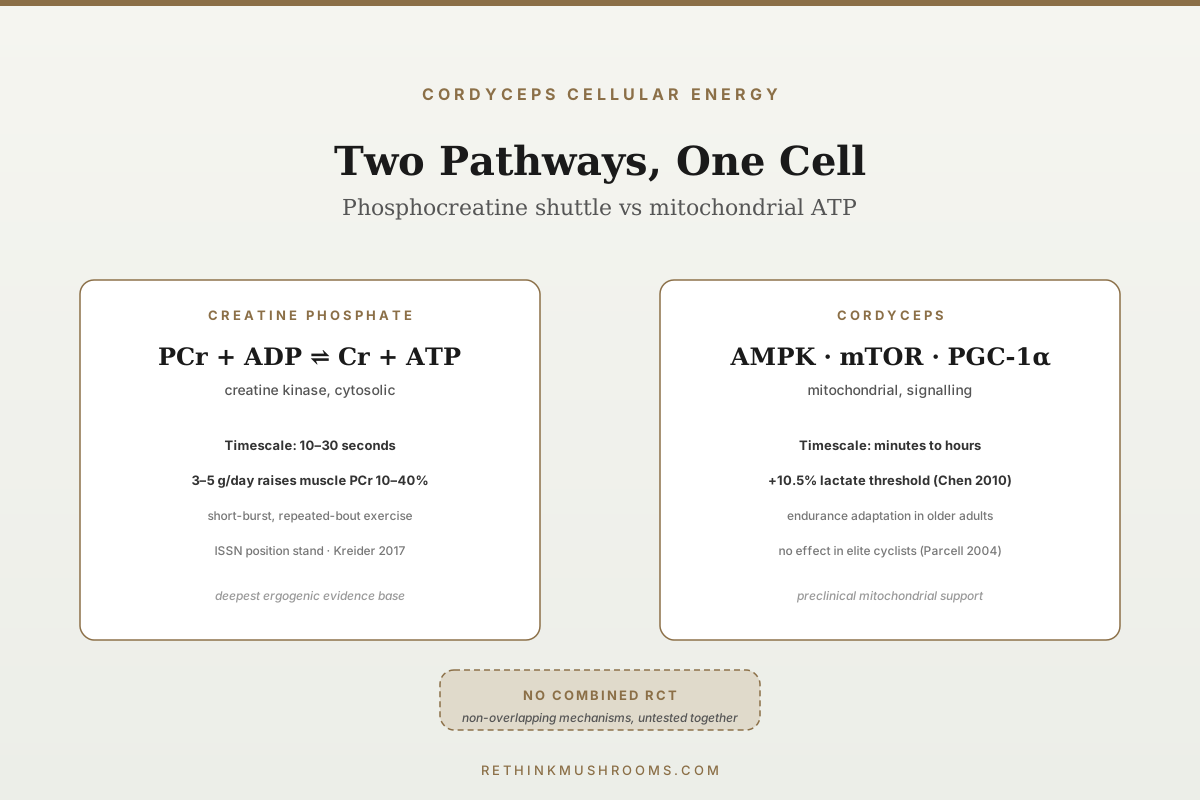
Cordyceps operates through adenosine-receptor engagement, AMPK/mTOR signalling and mitochondrial integrity support. Creatine phosphate operates through the phosphocreatine shuttle that rephosphorylates ADP to ATP via creatine kinase. The two pathways address different temporal and cellular energy problems.
Song et al., 2015; Chai et al., 2022; Kreider et al., JISSN, 2017
Mitochondrial, sustained
cordyceps energy: minutes to hours
PCr shuttle, burst
creatine: seconds to short minutes
No combined RCT
both independently evidenced, never stacked
Song et al., 2015; Chai et al., 2022; Kreider et al., JISSN, 2017
 View as image ↗
Cordyceps and creatine are two of the most-studied energy-supporting compounds in the nutritional supplement space, and they operate through largely non-overlapping biochemistry. Cordyceps works at the mitochondrial and receptor level, modulating adenosine signalling, activating AMPK and supporting mitochondrial capacity for sustained ATP production. Creatine works at the high-energy-phosphate level, providing a rapid cytosolic reserve for rephosphorylating ADP back to ATP during short bursts of high demand. The two compounds address different energy problems, and understanding the distinction matters for interpreting the separate evidence bases and for any reasoning about combined use.
For related framings, see cordyceps and ATP: how it boosts cellular energy, cordyceps and mitochondrial function: research on energy metabolism, cordyceps for fatigue: clinical evidence on energy levels, and how cordycepin enhances adenosine signaling.
Key Takeaways
- Cordyceps (through its alkaloid cordycepin, a 3'-deoxyadenosine adenosine analogue) engages adenosine receptors and modulates the AMPK/mTOR axis (Song et al., 2015; Chai et al., 2022)
- Zhang et al. (2021) showed cordycepin raised ATP, preserved mitochondrial morphology via Drp1 attenuation, and activated AMPK in preclinical Parkinson's disease models
- Chen et al. (2010) reported a 10.5% lactate threshold rise in older adults after 12 weeks of Cs-4 cordyceps, and Hirsch et al. (2017) reported improved high-intensity exercise tolerance after three weeks of cordyceps-blend supplementation
- Creatine phosphate (phosphocreatine, PCr) is a high-energy storage molecule that rephosphorylates ADP to ATP via the creatine kinase reaction during short bursts of activity
- Creatine monohydrate supplementation at ~3–5 g/day (or ~20 g/day for a one-week loading phase) consistently raises muscle total creatine and phosphocreatine concentrations, with ergogenic effects in high-intensity and repeated-bout exercise
- The International Society of Sports Nutrition position stand (Kreider et al., 2017) summarised creatine as one of the most efficacious and well-documented ergogenic aids for improving anaerobic capacity and body composition under resistance training
- The two compounds operate on different energy timescales: creatine buffers seconds-to-minutes ATP demand, cordyceps supports minutes-to-hours mitochondrial capacity
- No published randomised trial has evaluated the two as a combined intervention
The Two Energy Pathways, Briefly
Cellular energy is ATP. Every energy-consuming process in the body ultimately runs on hydrolysis of ATP to ADP and inorganic phosphate, releasing the phosphate bond's energy. The question for any "energy" intervention is where in the ATP supply-demand cycle it operates.
Two core pathways buffer and restore ATP supply at different timescales. The phosphocreatine (PCr) shuttle uses creatine kinase to rapidly rephosphorylate ADP to ATP in the cytosol, drawing on PCr reserves that get depleted within seconds to minutes of high demand. The mitochondrial oxidative phosphorylation pathway synthesises ATP from ADP using the energy of electron transport driven by nutrient oxidation, operating on minutes-to-hours timescales and depending on mitochondrial number, health and substrate supply.
Creatine supplementation intervenes on the first pathway by expanding the intracellular creatine pool and therefore the PCr reserve. Cordyceps supplementation intervenes on the second pathway by modulating the signalling (adenosine receptors, AMPK, mTOR, SIRT1/PGC-1α) and structural (mitochondrial morphology via Drp1) determinants of mitochondrial ATP output. The two interventions do not target the same molecules and do not compete for the same bottleneck.
The Creatine Phosphate Pathway
Creatine is a nitrogenous organic acid synthesised endogenously from arginine, glycine and methionine in liver and kidney, and supplied exogenously through dietary meat and fish. Roughly 95% of body creatine is stored in skeletal muscle, with the majority existing as phosphocreatine (PCr).
The creatine kinase reaction, catalysed by the enzyme creatine kinase in both cytosolic and mitochondrial isoforms, reversibly transfers a phosphate group between PCr and ADP: PCr + ADP + H+ ⇌ Cr + ATP. The reaction is fast, near-equilibrium, and provides a critical buffer against cytosolic ADP accumulation and ATP depletion during rapid high-demand work. The biochemical half-life of PCr reserves during maximal exercise is on the order of 10–30 seconds, and replenishment during rest takes minutes and depends on oxidative capacity.
Supplemental creatine monohydrate at 3–5 g/day (or a one-week loading phase at ~20 g/day split across doses) reliably raises muscle total creatine and PCr concentrations by 10–40%, with the magnitude depending on baseline levels. Vegetarians and vegans, who consume less dietary creatine, typically show larger rises than omnivores. The ergogenic consequences include improved short-duration high-intensity exercise capacity, greater work output in repeated-bout protocols, and increased lean mass accretion under resistance training.
The International Society of Sports Nutrition position stand on creatine (Kreider and colleagues, Journal of the International Society of Sports Nutrition, 2017) reviewed the extensive creatine literature and concluded that creatine monohydrate is one of the most efficacious ergogenic nutritional supplements available, with a well-characterised safety profile across several decades of use. The position stand also addressed cognitive, neuroprotective and therapeutic applications that extend beyond athletic performance.
The Cordyceps Energy Pathway
Cordyceps supplementation affects cellular energy through a distinct set of mechanisms. The principal bioactive alkaloid is cordycepin (3'-deoxyadenosine), structurally analogous to adenosine and able to engage adenosine receptors and adenosine-related biology. For the molecular detail, see cordycepin and adenosine signaling: the energy connection.
Song and colleagues (2015) demonstrated that Cordyceps militaris fruit body extract raised ATP content and antioxidant enzyme activity while reducing lactic acid and reactive oxygen species in mouse anti-fatigue models, with the effect mapping to AMPK phosphorylation and AKT/mTOR pathway engagement.[1] Chai and colleagues (2022) identified an additional complementary pathway: TIGAR/SIRT1/PGC-1α activation, which drives mitochondrial biogenesis and oxidative-stress handling, also contributes to cordycepin's anti-fatigue effects.[2]
Zhang and colleagues (2021) extended the mitochondrial story specifically. In rotenone-induced Parkinson's disease models, cordycepin preserved mitochondrial network integrity by attenuating Drp1-mediated fission, raised intracellular ATP content, and increased AMPK phosphorylation.[3] Drp1 is the principal mitochondrial fission driver, and excessive Drp1 activity fragments the mitochondrial network and reduces ATP synthesis capacity. Cordycepin's preservation of mitochondrial morphology directly supports the sustained-energy phenotype.
Choi and colleagues (2020) tested C. militaris ethyl acetate extract in exercise-performance models and reported increases in ATP generation pathway biomarkers, though with limited direct effect on muscle fatigue biomarkers.[4] The pattern across these studies is consistent: cordyceps raises ATP via mitochondrial and signalling support, with indirect downstream effects on muscle and CNS performance.
The Human Translation For Cordyceps
Chen and colleagues (2010) provided the clearest human-level translation for cordyceps in the endurance domain. A 12-week double-blind placebo-controlled trial of Cs-4 (Cordyceps sinensis mycelial extract, 333 mg three times daily) in 20 healthy older adults raised the metabolic (lactate) threshold by 10.5% and the ventilatory threshold by 8.5%.[5] Both thresholds are classical markers of endurance capacity that reflect mitochondrial and oxidative adaptation.
Hirsch and colleagues (2017) found improved high-intensity cycle exercise tolerance after three weeks of C. militaris mushroom blend at 4 g/day, but not after one week.[6] The cumulative-dose effect is consistent with a mitochondrial-adaptation rather than acute-stimulant mechanism.
Parcell and colleagues (2004) tested Cs-4 at 3 g/day for five weeks in 22 trained male cyclists and found no improvement in VO2peak or time trial.[7] The discrepancy between trained athletes and older/less-conditioned subjects is a real constraint. The cordyceps signal is measurable where the underlying oxidative system has room to adapt, and attenuated where it is already optimised.
Chen and colleagues (2014) tested a Rhodiola crenulata and Cordyceps sinensis combination during two weeks of altitude training and reported improved aerobic capacity and autonomic profile changes, confirming that cordyceps-containing stacks can produce measurable human performance effects under physiologically stressful conditions.[8]
The Creatine Human Evidence
Creatine's human evidence base is substantially deeper than cordyceps's across the exercise domain. Hundreds of RCTs have tested creatine monohydrate across populations, protocols and endpoints. Consistent findings include:
- Improved maximal strength and power output in resistance training studies
- Improved repeated-sprint and interval exercise performance
- Increased lean body mass accretion under training, beyond placebo
- Faster recovery between high-intensity bouts within a session
- Maintained effect across age ranges, though absolute effect size may vary
Beyond athletic performance, creatine has accumulated evidence for cognitive effects in sleep-deprived or cognitively stressed individuals, neuroprotective signals in preclinical models of neurodegenerative disease, and therapeutic applications in certain muscle and neurological disorders. Rawson and Venezia (Amino Acids, 2011) reviewed the cognitive-function evidence and concluded that creatine supplementation produced measurable improvements in memory and executive function under specific stress conditions.
Timescale And Cellular Compartment
The clearest way to understand why cordyceps and creatine do not compete for the same mechanism is to map their effects onto time and cellular compartment.
Seconds to tens of seconds (cytosolic ATP buffering). The PCr/Cr system dominates. Creatine kinase catalyses rapid ADP rephosphorylation using PCr as the phosphate donor. This is the mechanism supplemental creatine monohydrate targets. Cordyceps does not appreciably affect this system.
Minutes (mitochondrial ATP synthesis under steady aerobic load). The electron transport chain and oxidative phosphorylation dominate. Mitochondrial capacity and efficiency are the relevant determinants. Cordyceps supports this system through AMPK activation, mitochondrial morphology preservation and biogenesis. Creatine does not directly affect mitochondrial synthesis but does shuttle ATP equivalents between mitochondrial and cytosolic compartments via the creatine kinase shuttle.
Hours (sustained training adaptation). Signalling cascades (AMPK, PGC-1α, SIRT1) drive transcription of mitochondrial biogenesis genes and metabolic-adaptation genes. Cordycepin engages several of these directly (Song 2015; Chai 2022). Creatine's effects at this timescale are largely indirect through repeated training stimulus quality.
CNS energy metabolism. Both compounds have CNS evidence. Cordyceps through adenosine receptor engagement and mitochondrial support (Hu 2013; Zhang 2021 in dopaminergic neurons); creatine through PCr stabilisation in brain tissue (Rawson and Venezia 2011 review).
Complementarity And Open Questions
Because the pathways do not overlap, the prior for complementary (rather than competitive or redundant) effects when combined is reasonable. Creatine could support the short-burst component of an exercise session; cordyceps could support sustained capacity and recovery.
Three unknowns apply to any claim about the combined intervention.
No head-to-head RCT. No published trial has tested cordyceps plus creatine against placebo, against each alone, or against an alternative. Any combined-effect claim is extrapolation.
Dose interactions. Effective creatine dosing is well-characterised (3–5 g/day maintenance, 20 g/day for week-long loading). Effective cordyceps dosing is less settled (300 mg to several grams of varied extract types). Whether combining affects either's effective dose has not been studied.
Population response profiles. Creatine responders and non-responders are well-documented in the literature, with baseline muscle creatine levels predicting response magnitude. Cordyceps response profiles differ between trained and untrained subjects (Parcell 2004 vs Chen 2010). Whether the two responder categories align is unknown.
Safety Profile
Creatine monohydrate has one of the strongest safety records in the sports nutrition literature. The ISSN position stand (Kreider 2017) summarised that long-term creatine use at recommended doses has no documented adverse effects in healthy populations, and that concerns about renal function, cramping or gastrointestinal effects are not supported by the controlled-trial evidence at typical doses.
Cordyceps supplementation has a generally acceptable safety profile in short-term controlled trials. Ashraf and colleagues (2020) reviewed the therapeutic and safety literature and concluded that cordycepin and Cordyceps extracts are well-tolerated at typical supplement doses.[9] Wang and colleagues (1998) documented direct adrenocortical stimulation by C. sinensis extract, which is a consideration for populations with adrenal disorders or on corticosteroid therapy but is not a safety concern in healthy adults.[10]
Combined use has no specific safety literature. Because the compounds do not share metabolic pathways and neither is pharmacologically active at receptor sites likely to be affected by the other, a priori interaction risk is low, but absence of studies means absence of empirical reassurance.
Limitations Of The Evidence
The cordyceps human-performance evidence base is smaller than the creatine evidence base by orders of magnitude. Cordyceps trials are often small, use heterogeneous preparations, and show mixed results (Chen 2010 and Hirsch 2017 positive; Parcell 2004 negative). Standardisation of cordyceps products, including cordycepin and adenosine content, varies substantially across commercial supplements.
Creatine's evidence is primarily from single-compound trials. Stacking studies with creatine are common (creatine plus protein, creatine plus beta-alanine, creatine plus caffeine) but none specifically with cordyceps or cordycepin.
Mechanism-level studies are largely preclinical for cordyceps's mitochondrial and AMPK effects. Human mitochondrial biopsies under cordyceps supplementation are rare. The translation from mouse AMPK phosphorylation to human exercise performance is logically supported but not directly tested.
Timescale and cellular-compartment framing is a theoretical overlay. The two pathways are real and biochemically distinct, but the practical consequence for a supplementing individual depends on the specific demand pattern of their activity, recovery status, training experience and baseline muscle creatine and mitochondrial status.
What The Evidence Establishes
The two pathways support a precise set of claims:
- Creatine monohydrate expands the muscle creatine and PCr pool via well-characterised pharmacokinetics, with ergogenic effects in short-burst and repeated-bout exercise that are among the most consistently replicated in the sports nutrition literature (Kreider et al., 2017)
- Cordyceps modulates cellular energy at the mitochondrial and signalling level through AMPK/mTOR activation, adenosine receptor engagement, SIRT1/PGC-1α and mitochondrial morphology preservation, with controlled-trial evidence for endurance threshold improvements in older and less-trained populations (Song 2015; Chai 2022; Zhang 2021; Chen 2010; Hirsch 2017)
- The two pathways operate at different timescales and in different cellular compartments, with creatine buffering seconds-to-minutes ATP demand and cordyceps supporting minutes-to-hours mitochondrial capacity and training-adaptation signalling
- No published randomised trial has evaluated cordyceps plus creatine as a combined intervention; any combined-effect claim rests on mechanism complementarity rather than empirical demonstration
The Bottom Line
Cordyceps and creatine support cellular energy through non-overlapping biochemistry. Creatine expands the phosphocreatine reserve that rephosphorylates ADP to ATP in the cytosol during seconds-to-minutes high-demand bursts, with a deep sports-nutrition evidence base. Cordyceps modulates adenosine signalling, AMPK/mTOR activation, SIRT1/PGC-1α and mitochondrial morphology to support sustained ATP production and training adaptation, with a narrower but real controlled-trial evidence base. The two are mechanistically complementary rather than redundant, but no head-to-head trial has evaluated the combination.
Frequently Asked Questions
Sources & References
- 1RTHM-00401·Song, Jingjing et al. (2015). “Studies on the Antifatigue Activities of Cordyceps militaris Fruit Body Extract in Mouse Model..” Evidence-based complementary and alternative medicine : eCAM.Study breakdown →PubMed →↩
- 2RTHM-00749·Chai, Xiaoming et al. (2022). “Cordycepin exhibits anti-fatigue effect via activating TIGAR/SIRT1/PGC-1α signaling pathway..” Biochemical and biophysical research communications.Study breakdown →PubMed →↩
- 3RTHM-00735·Zhang, Xiao-Ling et al. (2021). “Anti-inflammatory and neuroprotective effects of natural cordycepin in rotenone-induced PD models through inhibiting Drp1-mediated mitochondrial fission..” Neurotoxicology.Study breakdown →PubMed →↩
- 4RTHM-00613·Choi, Eunhyun et al. (2020). “Beneficial Effect of Cordyceps militaris on Exercise Performance via Promoting Cellular Energy Production..” Mycobiology.Study breakdown →PubMed →↩
- 5RTHM-00176·Chen, Steve et al. (2010). “Effect of Cs-4 (Cordyceps sinensis) on exercise performance in healthy older subjects: a double-blind, placebo-controlled trial..” Journal of alternative and complementary medicine (New York.Study breakdown →PubMed →↩
- 6RTHM-00473·Hirsch, Katie R et al. (2017). “Cordyceps militaris Improves Tolerance to High-Intensity Exercise After Acute and Chronic Supplementation..” Journal of dietary supplements.Study breakdown →PubMed →↩
- 7RTHM-00075·Parcell, Allen C et al. (2004). “Cordyceps Sinensis (CordyMax Cs-4) supplementation does not improve endurance exercise performance..” International journal of sport nutrition and exercise metabolism.Study breakdown →PubMed →↩
- 8RTHM-00313·Chen, Chung-Yu et al. (2014). “Rhodiola crenulata- and Cordyceps sinensis-based supplement boosts aerobic exercise performance after short-term high altitude training..” High altitude medicine & biology.Study breakdown →PubMed →↩
- 9RTHM-00605·Ashraf, Syed Amir et al. (2020). “Cordycepin for Health and Wellbeing: A Potent Bioactive Metabolite of an Entomopathogenic Cordyceps Medicinal Fungus and Its Nutraceutical and Therapeutic Potential..” Molecules (Basel.Study breakdown →PubMed →↩
- 10RTHM-00027·Wang, S M et al. (1998). “Effects of a water-soluble extract of Cordyceps sinensis on steroidogenesis and capsular morphology of lipid droplets in cultured rat adrenocortical cells..” Journal of cellular biochemistry.Study breakdown →PubMed →↩