Cordyceps and Liver Health
NS5B polymerase inhibited
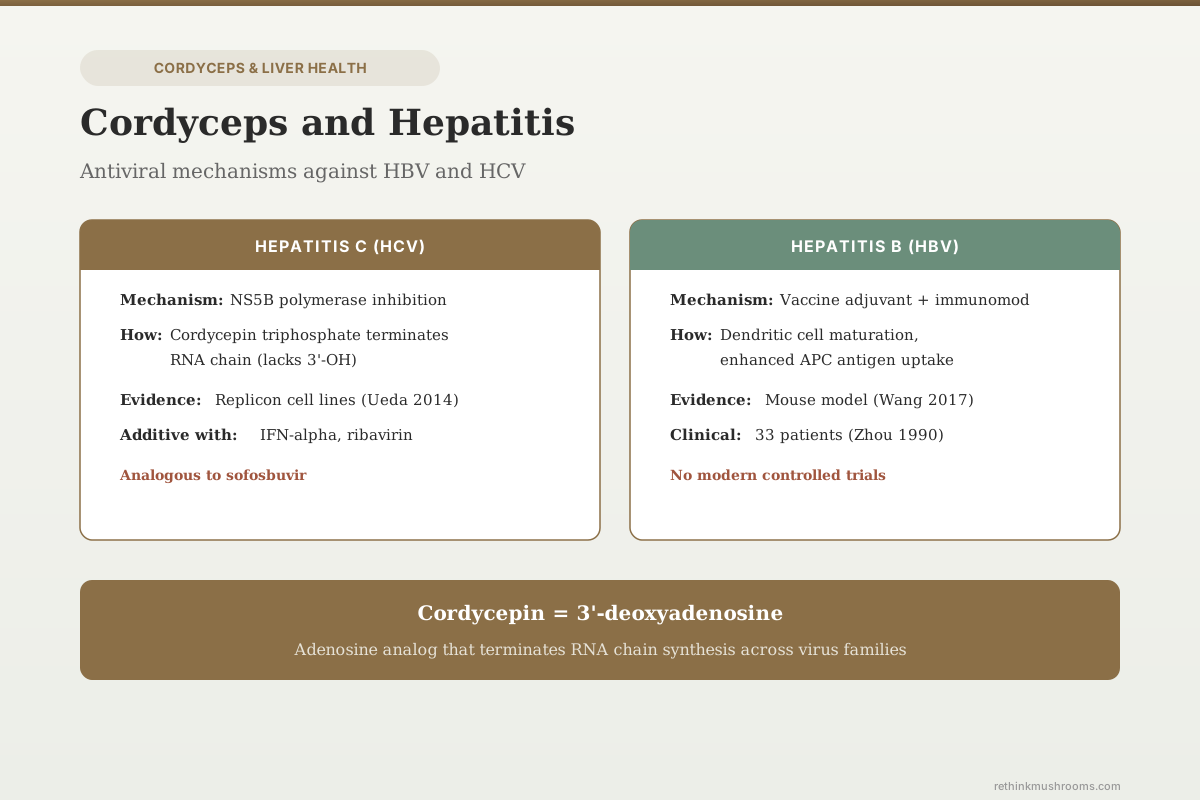
Cordycepin from Cordyceps militaris inhibited hepatitis C virus replication in human liver cell lines by targeting the RNA-dependent RNA polymerase NS5B, with additive effects when combined with interferon-alpha or ribavirin.
Ueda et al., Biochemical and Biophysical Research Communications, 2014
Anti-HCV
cordycepin inhibits HCV RNA replication via NS5B in cell culture
HBV Adjuvant
cordycepin accelerated HBsAg antibody production in mice
33 Patients
oldest clinical data: 1990 Chinese study in chronic hepatitis B
Ueda et al., Biochemical and Biophysical Research Communications, 2014
 View as image ↗
Viral hepatitis kills over a million people annually. Hepatitis B (HBV) and hepatitis C (HCV) cause chronic liver infection that progresses through inflammation, fibrosis, cirrhosis, and hepatocellular carcinoma. Current antivirals are effective but imperfect: direct-acting antivirals cure over 95% of HCV infections, but access remains limited globally; nucleos(t)ide analogs suppress HBV replication but rarely achieve functional cure. Cordyceps species have been investigated in this space from three angles: direct antiviral activity against HCV, vaccine adjuvant activity for HBV, and clinical use in chronic hepatitis B patients. For the broader picture of cordyceps and liver biology, see the cordyceps and liver health overview.
The evidence is thin compared to the liver protection literature. One in vitro study demonstrates anti-HCV activity. One systems pharmacology study proposes cordycepin as an HBV vaccine adjuvant. One small Chinese clinical trial from 1990 tested Cordyceps sinensis mycelia in chronic hepatitis B. That is the complete landscape of direct hepatitis-specific evidence. The remaining studies on cordyceps and liver fibrosis, inflammation, and hepatoprotection are relevant background but do not test antiviral activity against hepatitis viruses. This article separates the hepatitis-specific evidence from the general hepatoprotective story.
Key Takeaways
- Cordyceps militaris capsule extract showed moderate anti-HCV activity in genome-length HCV replicon cell lines, with cordycepin identified as the likely active molecule inhibiting HCV RNA-dependent RNA polymerase NS5B (Ueda et al., Biochemical and Biophysical Research Communications, 2014)
- C. militaris ethanol extract reduced HCV Core and NS3 protein levels in HCV-infected human hepatocarcinoma cells while inducing apoptosis through Bim, Bax, and caspase-3/9 activation (Lee et al., Journal of Microbiology, 2015)
- Cordycepin was identified through systems pharmacology screening as a candidate hepatitis B vaccine adjuvant, accelerating HBsAg-specific antibody production in mice by enhancing antigen uptake by antigen-presenting cells (Wang et al., Scientific Reports, 2017)
- Cordycepin functions as a chain terminator of RNA synthesis because it lacks the 3'-hydroxyl group needed for the next phosphodiester bond, directly relevant to inhibiting viral RNA replication (Rabie, ACS Omega, 2022)
- In the only published clinical study, cultured Cordyceps sinensis mycelia improved liver function and promoted HBsAg seroconversion in 33 chronic hepatitis B patients, though without controls or modern trial design (Zhou et al., Zhongguo Zhong Yao Za Zhi, 1990)
- Cordycepin enhanced dendritic cell maturation and boosted both humoral and cellular immune responses when used as a vaccine adjuvant, tested against rabies vaccine in a mouse model (Chen et al., Frontiers in Cellular and Infection Microbiology, 2024)
How Cordycepin Works as an Antiviral
Cordycepin (3'-deoxyadenosine) is an adenosine analog missing the hydroxyl group at the 3' position of the ribose sugar. This structural difference is the basis of its antiviral mechanism. During RNA synthesis, each incoming nucleotide triphosphate forms a phosphodiester bond with the 3'-hydroxyl of the previous nucleotide. Cordycepin triphosphate can be incorporated into the growing RNA chain in place of ATP, but because it lacks the 3'-hydroxyl, no further nucleotides can be added. The chain terminates.
This is the same mechanism used by several approved antiviral drugs. Remdesivir (a delayed chain terminator) and sofosbuvir (a direct chain terminator targeting HCV NS5B) both exploit modified nucleoside structures to halt viral RNA synthesis. Cordycepin's advantage is broad-spectrum activity against any RNA polymerase that accepts it as a substrate. Its disadvantage is low selectivity: it can also terminate host cell RNA synthesis, limiting therapeutic dosing.
Rabie demonstrated in 2022 that cordycepin potently inhibited SARS-CoV-2 replication through this chain termination mechanism.[1] The finding confirmed that cordycepin triphosphate is recognized by viral RNA-dependent RNA polymerases across different virus families, from coronaviruses to flaviviruses (HCV).
Ueda 2014: Direct Anti-HCV Activity
Ueda and colleagues at Okayama University tested Cordyceps militaris capsule extract against HCV using multiple replicon cell lines (OR6, AH1R, ORL8, ORL11) that allow genome-length HCV RNAs of several genotype 1b strains to replicate in human hepatoma cells.[2]
Results:
- C. militaris extract showed moderate anti-HCV activity across all replicon systems
- Cordycepin was identified as the likely active molecule
- The mechanism involved inhibition of NS5B, the HCV RNA-dependent RNA polymerase
- In combination with interferon-alpha, the effect was additive
- In combination with ribavirin, the effect was additive
The additive (not synergistic) interaction with interferon and ribavirin suggests cordycepin acts through an independent mechanism, consistent with direct polymerase inhibition rather than immune modulation. NS5B is the validated target of sofosbuvir, the drug that revolutionized HCV treatment. Cordycepin hitting the same enzyme is mechanistically credible.
The limitation: "moderate" activity in a replicon assay does not predict clinical utility. Direct-acting antivirals like sofosbuvir achieve near-complete viral suppression at therapeutic doses. Whether cordycepin can reach sufficient concentration in human hepatocytes to meaningfully inhibit HCV replication, given its rapid deamination by adenosine deaminase in vivo, has not been tested. The in vitro finding establishes proof of concept, not clinical viability.
Lee 2015: Anti-Tumor and Antiviral in HCV-Infected Cells
Lee and colleagues extended the antiviral investigation by testing Cordyceps militaris ethanol extract (CME) in HCV-infected human hepatocarcinoma 7.5 cells (J6/JFH1-Huh 7.5).[3]
Both HCV-infected and uninfected hepatocarcinoma cells were highly susceptible to CME. The extract induced early apoptosis through upregulation of pro-apoptotic proteins Bim and Bax, activation of caspase-9 and caspase-3, and cleavage of PARP. In HCV-infected cells specifically, CME reduced HCV Core and NS3 protein levels.
The dual activity is relevant: HCV-infected hepatocytes are at elevated risk of hepatocellular carcinoma, and a compound that both suppresses viral protein expression and induces apoptosis in infected cells theoretically addresses both the viral and oncogenic aspects of chronic HCV infection. The study is in vitro only, in a cell line (not primary hepatocytes), and uses concentrations that may not be achievable in vivo. For how cordyceps interacts with general liver fibrosis pathways, see the dedicated article.
Wang 2017: Cordycepin as HBV Vaccine Adjuvant
Wang and colleagues used systems pharmacology to screen Ophiocordyceps sinensis compounds for potential hepatitis B vaccine adjuvant activity.[4] From 190 candidate compounds, cordycepin was selected based on its predicted interaction with immune-related targets.
In vivo validation in BALB/c mice showed:
- Cordycepin accelerated HBsAg-specific antibody production when co-administered with HBV surface antigen
- Higher doses produced faster antibody responses than the existing vaccine alone
- No observed side effects at tested doses
- Enhanced antigen uptake by antigen-presenting cells (APCs)
The rationale: current hepatitis B vaccines fail to induce adequate immune responses in 5-10% of recipients (non-responders), and antibody titers wane over time in many others. An adjuvant that enhances APC uptake and processing of HBsAg could improve both initial seroconversion rates and durability of protection.
Chen and colleagues provided supporting mechanistic evidence in 2024 by testing cordycepin as an adjuvant for an inactivated rabies vaccine.[5] Cordycepin stimulated stronger phenotypic and functional maturation of dendritic cells, enhancing both humoral and cellular immune responses. The dendritic cell maturation effect explains how cordycepin could function as an adjuvant across different vaccines: mature dendritic cells are more efficient at antigen presentation, T cell activation, and initiating adaptive immune responses.
Zhou 1990: The Only Clinical Hepatitis Study
Zhou and colleagues published the only clinical study testing Cordyceps sinensis directly in hepatitis patients (Zhongguo Zhong Yao Za Zhi, 1990). Thirty-three patients with chronic hepatitis B received cultured Cordyceps sinensis mycelia. The reported outcomes:
- Improved liver function markers
- Promoted HBsAg seroconversion (negative transfer)
- Raised plasma albumin
- Reduced elevated gamma globulin
- Adjusted immunocompetence
This study has significant limitations. It was published in a Chinese-language journal in 1990 with limited methodological detail available in English. The sample size (33 patients) is small. There is no mention of randomization, blinding, or placebo control. The duration, dosing, and specific seroconversion rate are not detailed in the available abstract. Contemporary evidence standards would classify this as a case series rather than a clinical trial.
A second Chinese study tested Cordyceps sinensis in 25 chronic hepatitis B patients, measuring T lymphocyte subsets. After 3 months of treatment, CD4 count and CD4/CD8 ratio increased (p < 0.05), while fibrosis markers hyaluronic acid and procollagen type III decreased (p < 0.05). This suggests immunomodulatory and anti-fibrotic effects, but again without controls. For a comparison of how other mushroom species approach hepatitis, see Agaricus blazei for hepatitis B and C.
The Fibrosis Connection
Chronic viral hepatitis progresses to liver fibrosis, cirrhosis, and hepatocellular carcinoma through sustained inflammation and hepatic stellate cell activation. Cordyceps compounds have been tested in this downstream pathway independently of their antiviral effects.
Peng and colleagues demonstrated that cultured mycelium Cordyceps sinensis alleviated CCl4-induced liver inflammation and fibrosis in mice by activating hepatic natural killer cells and increasing NKG2D expression.[6] Hepatic NK cells kill activated stellate cells through NKG2D-NKG2D ligand interactions, representing an immune-mediated anti-fibrotic mechanism.
This is relevant to viral hepatitis because HBV and HCV cause fibrosis through the same stellate cell activation pathway. A compound that both inhibits viral replication (through NS5B for HCV) and promotes NK cell-mediated stellate cell killing could theoretically address both the cause and the consequence of chronic viral hepatitis. No study has tested this dual mechanism in a viral hepatitis model. The CCl4 model produces chemical fibrosis, not viral fibrosis. For the full picture of cordyceps and liver fibrosis biology, see cordyceps and liver fibrosis.
Chain Termination vs. Immune Modulation
The evidence points to two independent mechanisms by which cordyceps compounds might affect viral hepatitis:
Direct antiviral (chain termination):
- Cordycepin triphosphate inhibits NS5B (HCV RNA polymerase) in cell culture
- The same mechanism inhibits SARS-CoV-2 RNA polymerase
- This is structurally analogous to approved drugs (sofosbuvir, remdesivir)
- Limited by rapid in vivo deamination and low selectivity
Immunomodulatory (adjuvant/NK cell):
- Cordycepin enhances dendritic cell maturation and antigen presentation
- Cordycepin accelerates HBsAg-specific antibody production in mice
- Cordyceps mycelium activates hepatic NK cells (anti-fibrotic)
- C. sinensis mycelia improved immune parameters in clinical hepatitis B patients
These mechanisms are complementary rather than redundant. An antiviral that also enhances the immune response against the same virus is more valuable than either mechanism alone. Whether cordycepin achieves both effects at achievable in vivo concentrations in humans remains entirely untested. For how drug-induced liver injury intersects with these pathways, see the cordyceps and DILI article.
What Would Move This Forward
The gap between the current evidence and clinical utility is large. What would narrow it:
For HCV: testing cordycepin in a primary human hepatocyte HCV infection model with pharmacokinetic measurements of intracellular cordycepin triphosphate levels, to determine whether anti-HCV concentrations are achievable. The replicon data (Ueda 2014) establishes the target; pharmacokinetics determines whether the target can be hit in vivo.
For HBV: a randomized, placebo-controlled trial of cordycepin as an adjuvant to standard HBV vaccination in known non-responders, measuring anti-HBs titers at 1, 6, and 12 months. The mouse data (Wang 2017) provides the rationale; human immunogenicity data determines whether it translates.
For chronic hepatitis B: a properly controlled clinical trial with standardized Cordyceps sinensis preparation, serial HBV DNA quantification, HBsAg levels, ALT, liver stiffness, and T cell subset analysis. The 1990 Zhou study provides historical precedent; modern trial design and endpoints are needed to generate actionable evidence. For how cordyceps addresses the fatty liver component of hepatic disease, see cordyceps for fatty liver.
The Bottom Line
Cordyceps compounds have been tested against hepatitis B and C through three distinct approaches. Cordycepin inhibited HCV replication via NS5B polymerase in cell culture (Ueda 2014), with additive effects alongside interferon and ribavirin. As a vaccine adjuvant, cordycepin accelerated HBsAg-specific antibody production in mice by enhancing dendritic cell maturation (Wang 2017, Chen 2024). One clinical study of 33 chronic hepatitis B patients reported improved liver function and HBsAg seroconversion after Cordyceps sinensis mycelia treatment, but without controls or modern trial design (Zhou 1990). The chain termination mechanism (3'-deoxyadenosine lacking the hydroxyl for RNA elongation) is structurally analogous to approved antivirals, but in vivo pharmacokinetics and selectivity remain untested.
Frequently Asked Questions
Sources & References
- 1RTHM-00791·Rabie, Amgad M (2022). “Potent Inhibitory Activities of the Adenosine Analogue Cordycepin on SARS-CoV-2 Replication..” ACS omega.Study breakdown →PubMed →↩
- 2RTHM-00354·Ueda, Youki et al. (2014). “Anti-HCV activity of the Chinese medicinal fungus Cordyceps militaris..” Biochemical and biophysical research communications.Study breakdown →PubMed →↩
- 3RTHM-00385·Lee, Seulki et al. (2015). “Anti-tumor effect of Cordyceps militaris in HCV-infected human hepatocarcinoma 7.5 cells..” Journal of microbiology (Seoul.Study breakdown →PubMed →↩
- 4RTHM-00497·Wang, Jingbo et al. (2017). “Systems Pharmacology-based strategy to screen new adjuvant for hepatitis B vaccine from Traditional Chinese Medicine Ophiocordyceps sinensis..” Scientific reports.Study breakdown →PubMed →↩
- 5RTHM-00869·Chen, Xin et al. (2024). “Adjuvant activity of cordycepin, a natural derivative of adenosine from Cordyceps militaris, on an inactivated rabies vaccine in an animal model..” Heliyon.Study breakdown →PubMed →↩
- 6RTHM-00440·Peng, Yuan et al. (2016). “Cultured Mycelium Cordyceps sinensis allevi¬ates CCl4-induced liver inflammation and fibrosis in mice by activating hepatic natural killer cells..” Acta pharmacologica Sinica.Study breakdown →PubMed →↩