Cordyceps Exercise Performance
42 seconds
Wang Junxia's 1993 world record in the 10,000 meters beat the previous mark by 42 seconds. Her coach attributed it to cordyceps and turtle blood. The record stood for 23 years.
1993 Chinese National Games, Beijing
3 World Records
broken in one week
6 Athletes
later tested positive for EPO
23 Years
before records were broken
1993 Chinese National Games, Beijing
 View as image ↗
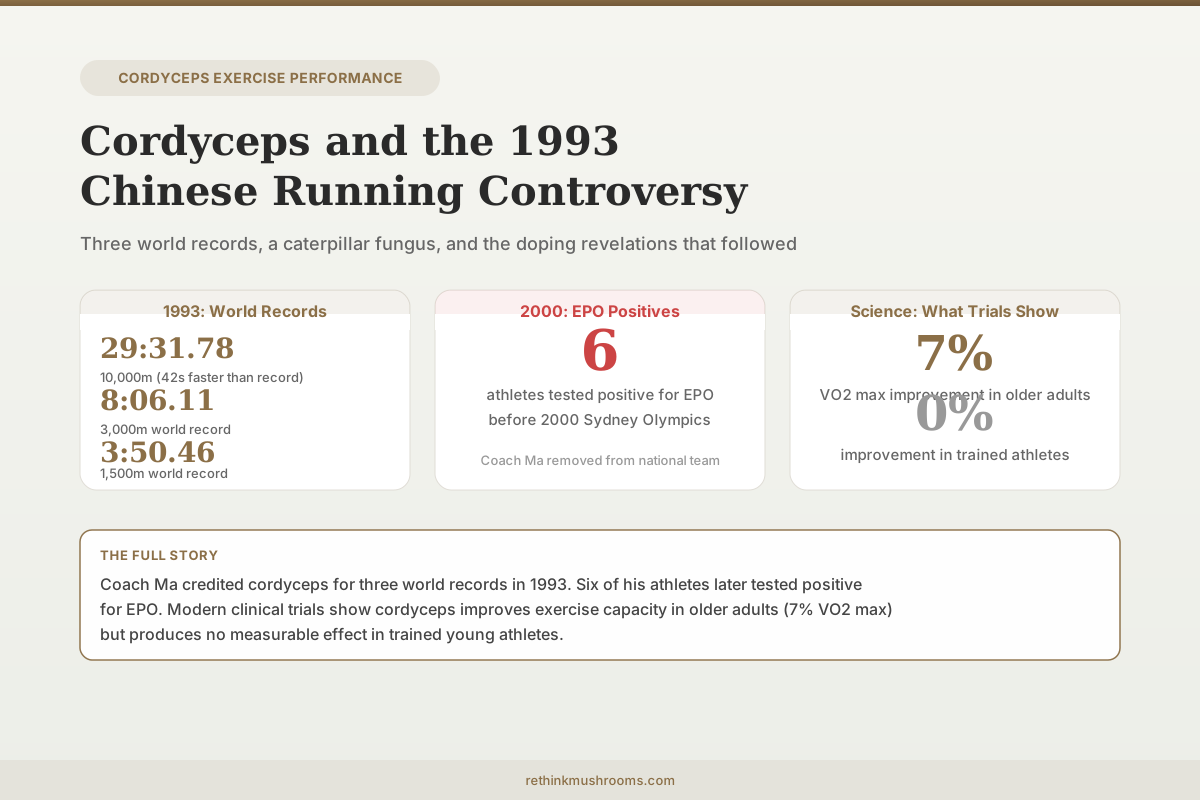
In September 1993, a group of Chinese female distance runners coached by Ma Junren shattered three world records at the Chinese National Games in Beijing. Wang Junxia ran the 10,000 meters in 29:31.78, beating the previous world record by 42 seconds. She also set a world record in the 3,000 meters at 8:06.11. Qu Yunxia ran the 1,500 meters in 3:50.46. These margins were not incremental improvements. They were the largest single-event leaps in distance running history. When pressed for an explanation, Coach Ma credited a regimen of intense training, turtle blood soup, and Cordyceps sinensis, the Tibetan caterpillar fungus. That claim launched cordyceps from traditional Chinese medicine obscurity into global supplement fame. What followed over the next two decades revealed a more complicated story. For the actual clinical trial data on cordyceps and exercise performance, the evidence tells a very different story from the 1993 headlines.
Key Takeaways
- Three world records fell at the 1993 Chinese National Games: 10,000m (29:31.78), 3,000m (8:06.11), and 1,500m (3:50.46), all by Ma Junren's athletes
- Coach Ma attributed the performances to cordyceps and turtle blood, sparking global interest in the supplement
- In 2000, six of Ma's athletes tested positive for erythropoietin (EPO), a banned blood-boosting drug
- In 2016, a letter allegedly signed by Wang Junxia and nine other athletes claimed Ma forced them to use performance-enhancing drugs
- Modern clinical trials show cordyceps produces modest improvements in VO2 max in older adults (7% increase) but no significant effects in trained young athletes (Parcell et al., 2004; Chen et al., 2010)
- The 1993 controversy remains the single most influential event in cordyceps marketing history, despite the subsequent doping evidence
Fact Check
Did cordyceps power the 1993 world records?
The claim
“Chinese runners shattered three world records in 1993 because they took cordyceps.”
Coach Ma Junren's explanation to journalists, later amplified by supplement marketing.
What research shows
MisleadingSix of Ma's athletes tested positive for the banned blood-booster EPO before the 2000 Olympics, and a 1995 letter signed by Wang Junxia and nine teammates alleged systematic, forced doping.
In the one population the claim was about — trained athletes — controlled trials show cordyceps produces no measurable performance gain (Parcell et al., 2004).
Parcell et al. (2004) [ref 1]; 2000 EPO positives and 2016-published 1995 athlete letter (article body).
What Happened in September 1993
The 7th Chinese National Games, held in Beijing, became the most controversial athletics event of the decade. Ma Junren's squad of female distance runners, recruited from rural villages in Liaoning province and trained under near-military discipline, produced performances that stunned the international athletics community.
Wang Junxia's 10,000-meter time of 29:31.78 obliterated Ingrid Kristiansen's 1986 world record of 30:13.74. The 42-second improvement was unprecedented in a distance event. For context, world records in the 10,000 meters typically fall by 1-5 seconds at a time. Wang also broke the 3,000-meter record with 8:06.11. Qu Yunxia clocked 3:50.46 in the 1,500 meters, breaking the record that had stood since 1980.
All three records stood for more than 20 years. Qu Yunxia's 1,500-meter mark was finally broken by Genzebe Dibaba in 2015. Wang Junxia's 10,000-meter record fell to Almaz Ayana at the 2016 Rio Olympics, though Ayana's performance itself generated doping speculation.
The international response was immediate skepticism. American distance runner Mary Slaney publicly warned the performances would "ruin the sport." The International Association of Athletics Federations (IAAF) investigated but found no failed drug tests at the time. The athletes had passed all doping controls during the competition.
The Cordyceps Claim
When journalists demanded an explanation, Coach Ma Junren offered one that was exotic enough to generate worldwide headlines: his athletes consumed a daily regimen of traditional Chinese preparations including Cordyceps sinensis (caterpillar fungus harvested from the Tibetan Plateau) and the warm blood of freshly killed soft-shell turtles.
Ma later suggested he had been joking about some of these claims, but the damage, or benefit depending on perspective, was done. The cordyceps connection entered global consciousness. Supplement companies began marketing cordyceps products with explicit or implicit references to the 1993 Chinese runners, a practice that continues to this day.
The claim was scientifically plausible on the surface. Cordyceps sinensis had been used in traditional Chinese medicine for centuries to treat fatigue, improve stamina, and enhance lung function. The fungus grows at 3,000-5,000 meters elevation on the Tibetan Plateau, and high-altitude populations had long used it as an adaptogen. If any traditional remedy could plausibly improve endurance performance, cordyceps was a reasonable candidate.
The Unraveling: EPO and the 2000 Positive Tests
The first major crack in the cordyceps narrative came at the 2000 Sydney Olympics. Six of the seven athletes Ma Junren was preparing for the Games tested positive for erythropoietin (EPO), a hormone that stimulates red blood cell production and dramatically improves oxygen-carrying capacity. EPO is one of the most effective performance-enhancing drugs in endurance sports and had become detectable through new testing methods in the late 1990s. All six athletes were banned from competition. Ma was removed from his coaching position with the Chinese national team.
EPO directly increases the blood's ability to deliver oxygen to working muscles, the exact physiological capacity needed for distance running. The magnitude of improvement from EPO use (estimated at 5-10% in VO2 max) aligns far more closely with the scale of the 1993 record-breaking than any supplement could.
The 2016 Letter
The final piece emerged in 2016 when a letter, reportedly written in 1995 and signed by Wang Junxia and nine other athletes, was published. The letter alleged that Coach Ma had forced his athletes to use performance-enhancing drugs. The signatories described systematic doping under Ma's direction, contradicting the cordyceps narrative entirely.
The IAAF investigated following the letter's publication. While the letter's authenticity was debated, the combination of the 2000 EPO positives, the improbable performance margins, the athletes' rapid decline after leaving Ma's program, and the firsthand allegations created an overwhelming circumstantial case that the 1993 performances were pharmaceutical rather than fungal in origin.
What Modern Science Actually Shows About Cordyceps and Exercise
The 1993 controversy created enormous commercial interest in cordyceps for athletic performance. That interest funded clinical research that has produced a mixed but honest picture.
The Negative Result: Parcell et al. (2004)
The first rigorous test came from Parcell et al. (2004), who gave CordyMax Cs-4 (a standardized C. sinensis mycelium product) or placebo to endurance-trained cyclists for 5 weeks. The study measured VO2 peak, ventilatory threshold, time to exhaustion, and peak power output. Cordyceps supplementation produced no significant improvement in any measure compared to placebo.[1]
This study is often cited as evidence that cordyceps does not work for exercise performance. The critical detail: the participants were young, trained endurance athletes, the population most directly relevant to the 1993 Chinese runners' claims.
The Positive Result: Chen et al. (2010)
Chen et al. (2010) tested the same Cs-4 product in a different population: healthy older adults aged 50-75. In this double-blind, placebo-controlled trial of 20 subjects, 12 weeks of Cs-4 supplementation improved metabolic threshold by 10.5% and ventilatory threshold by 8.5%. VO2 max increased by approximately 7%.[2]
The age-dependent difference between Parcell and Chen's results suggests cordyceps may improve exercise capacity in people with declining baseline fitness but not in already-optimized young athletes. This is consistent with an adaptogenic rather than ergogenic mechanism.
Hirsch et al. (2017): Acute and Chronic Supplementation
Hirsch et al. (2017) randomized 28 participants to a mushroom blend containing C. militaris or placebo. After 3 weeks of supplementation, the cordyceps group showed improved tolerance to high-intensity exercise, measured by time to exhaustion and maximal oxygen consumption. Acute (single-dose) supplementation showed no effect, while chronic (3-week) supplementation did, suggesting cumulative metabolic adaptation rather than acute stimulation.[3]
High-Altitude Performance: Chen et al. (2014)
Chen et al. (2014) tested a combination of Rhodiola crenulata and C. sinensis in athletes training at high altitude. The supplement group showed improved aerobic exercise performance after short-term high-altitude exposure, with better oxygen utilization metrics than placebo.[4]
The high-altitude connection is relevant because C. sinensis grows at extreme elevations, and the hypoxia tolerance studies by Singh et al. (2013) showed cordyceps increases heme oxygenase-1 expression via the Nrf2 pathway, a cellular response to oxygen deprivation.[5]
The Mechanism: Cellular Energy Production
Choi et al. (2020) demonstrated that C. militaris promoted cellular energy production, specifically ATP generation, in mouse models. The effect was mediated through improved mitochondrial function rather than through increased oxygen delivery (the mechanism EPO uses).[6]
Chai et al. (2022) showed cordycepin specifically exhibits anti-fatigue effects through the TIGAR/SIRT1/PGC-1α signaling pathway, which governs mitochondrial biogenesis. This provides a molecular mechanism for the exercise improvements observed in human trials, distinct from the hemodynamic effects of EPO.[7]
For a detailed analysis of how cordyceps boosts cellular energy through ATP production, that article covers the mitochondrial pathways.
- Cell & mechanism studiescompleted
Hypoxia tolerance via HO-1/Nrf2 (Singh 2013); ATP and TIGAR/SIRT1/PGC-1α anti-fatigue pathways (Choi 2020, Chai 2022).
- Animal studiescompleted
C. militaris improves exercise performance and grip strength in rodent models (Choi 2020).
- Small human RCTscurrent
No effect in trained cyclists (Parcell 2004, n=22); ~7% VO₂ max gain in older adults (Chen 2010, n=20); improved tolerance after 3 weeks (Hirsch 2017, n=28).
- Large RCTs in athletesmissing
No adequately powered trial shows a performance benefit in trained, elite athletes.
- Meta-analysismissing
No pooled quantitative synthesis isolating cordyceps in athletic populations.
The evidence is real but early: small trials suggest modest gains in untrained or older people, while the elite-athlete benefit the 1993 story implies has never been demonstrated.
Parcell 2004 [ref 1]; Chen 2010 [ref 2]; Hirsch 2017 [ref 3]; Singh 2013 [ref 5]; Choi 2020 [ref 6]; Chai 2022 [ref 7].
Why the Distinction Matters
The difference between what cordyceps does (modest improvements in oxygen utilization and mitochondrial function, primarily in untrained or older individuals) and what the 1993 performances suggested (world-record-shattering endurance in elite athletes) is enormous. The clinical trial data shows effects in the range of 7-10% improvement in metabolic thresholds in older adults, with no measurable effect in trained athletes. The 1993 records represented improvements of 2-4% over previous world records in already-elite performers, a magnitude far more consistent with EPO than with any supplement.
Effect Magnitude
The Numbers Don’t Add Up to a World Record
Plotted on the same axis — percent improvement in aerobic capacity, or margin over the previous mark. Cordyceps’ measured effect is zero in the exact group the 1993 claim was about (trained athletes), and even its best result in older adults sits below the known effect of the banned drug six of the athletes later tested positive for.
Cordyceps — trained young athletes
~0%No measurable change (Parcell 2004, Cs-4, 5 wks)
Cordyceps — healthy older adults (50–75)
~7%~7% VO₂ max, 8.5–10.5% thresholds (Chen 2010, Cs-4, 12 wks)
1993 records vs. prior world marks
~2–4%~2–4% margin — but in already-elite performers
EPO (erythropoietin)
~5–10%~5–10% VO₂ max — the 2000 positive tests
A ~3% margin in an already-elite runner is a far larger physiological feat than a ~7% gain in an untrained older adult — which is why the 1993 margins point toward a blood-boosting drug, not a supplement whose effect vanishes in trained athletes.
Sources: Parcell et al. (2004) [ref 1]; Chen et al. (2010) [ref 2]; EPO and record-margin figures from the article body.
Cordyceps supplement marketing continues to reference the 1993 performances, either directly or through euphemistic language about "Chinese athletes" and "world records." This marketing conflates a plausible adaptogenic mushroom with what subsequent evidence strongly suggests was pharmaceutical doping.
The science supports cordyceps as having real effects on exercise tolerance and VO2 max, particularly in populations with room for improvement. It does not support the implication that cordyceps can produce elite athletic performance or replicate the effects of blood-boosting drugs.
The Legacy for Cordyceps Research
The 1993 controversy had two lasting effects on cordyceps science. First, it generated the commercial demand that funded clinical trials, producing a genuine evidence base that would not otherwise exist. Second, it created unrealistic expectations that the clinical evidence consistently fails to meet, leading to consumer disappointment and skepticism about the real effects cordyceps does have.
The honest picture is that cordyceps supports mitochondrial energy production and may improve exercise tolerance in sedentary or aging populations. It is not a substitute for EPO, and the 1993 world records were almost certainly not produced by caterpillar fungus. For information on how long cordyceps takes to affect athletic performance, that article reviews the timeline data from clinical trials.
For Competing Athletes
ModerateCordyceps is legal, but supplement adulteration is the real risk
Concern
Cordyceps itself is not prohibited by WADA. The documented danger for tested athletes is contamination: dietary supplements have repeatedly been found spiked with undeclared stimulants or banned substances, and under anti-doping rules the athlete is strictly liable for whatever is in the product.
What the research says
Cordyceps is classified as a food supplement, not a prohibited substance, and the 1993 case turned on EPO — not the mushroom. The exposure comes from unverified products, not the fungus.
Particularly relevant for: Drug-tested athletes and anyone subject to anti-doping controls.
What to do
Choose products independently batch-tested for sport (e.g. NSF Certified for Sport or Informed Sport), and treat any supplement marketed with '1993 Chinese runners' claims as a marketing red flag, not evidence.
World Anti-Doping Agency Prohibited List (cordyceps not listed); article body on the 2000 EPO positives.
The Bottom Line
The 1993 Chinese National Games produced three world records in distance running, and Coach Ma Junren's attribution of these performances to cordyceps launched the fungus into global supplement fame. Subsequent evidence, including EPO positive tests in 2000 and a 2016 letter alleging systematic doping, strongly suggests the performances were pharmaceutical rather than fungal. Modern clinical trials show cordyceps produces modest exercise improvements (7-10% in metabolic thresholds) in untrained or older adults, with no significant effects in trained athletes, consistent with an adaptogenic mechanism rather than the ergogenic effects seen in 1993.
Frequently Asked Questions
Sources & References
- 1RTHM-00075·Parcell, Allen C et al. (2004). “Cordyceps Sinensis (CordyMax Cs-4) supplementation does not improve endurance exercise performance..” International journal of sport nutrition and exercise metabolism.Study breakdown →PubMed →↩
- 2RTHM-00176·Chen, Steve et al. (2010). “Effect of Cs-4 (Cordyceps sinensis) on exercise performance in healthy older subjects: a double-blind, placebo-controlled trial..” Journal of alternative and complementary medicine (New York.Study breakdown →PubMed →↩
- 3RTHM-00473·Hirsch, Katie R et al. (2017). “Cordyceps militaris Improves Tolerance to High-Intensity Exercise After Acute and Chronic Supplementation..” Journal of dietary supplements.Study breakdown →PubMed →↩
- 4RTHM-00313·Chen, Chung-Yu et al. (2014). “Rhodiola crenulata- and Cordyceps sinensis-based supplement boosts aerobic exercise performance after short-term high altitude training..” High altitude medicine & biology.Study breakdown →PubMed →↩
- 5RTHM-00305·Singh, Mrinalini et al. (2013). “Cordyceps sinensis increases hypoxia tolerance by inducing heme oxygenase-1 and metallothionein via Nrf2 activation in human lung epithelial cells..” BioMed research international.Study breakdown →PubMed →↩
- 6RTHM-00613·Choi, Eunhyun et al. (2020). “Beneficial Effect of Cordyceps militaris on Exercise Performance via Promoting Cellular Energy Production..” Mycobiology.Study breakdown →PubMed →↩
- 7RTHM-00749·Chai, Xiaoming et al. (2022). “Cordycepin exhibits anti-fatigue effect via activating TIGAR/SIRT1/PGC-1α signaling pathway..” Biochemical and biophysical research communications.Study breakdown →PubMed →↩