Cordyceps and Exercise Performance
+10.5% metabolic threshold
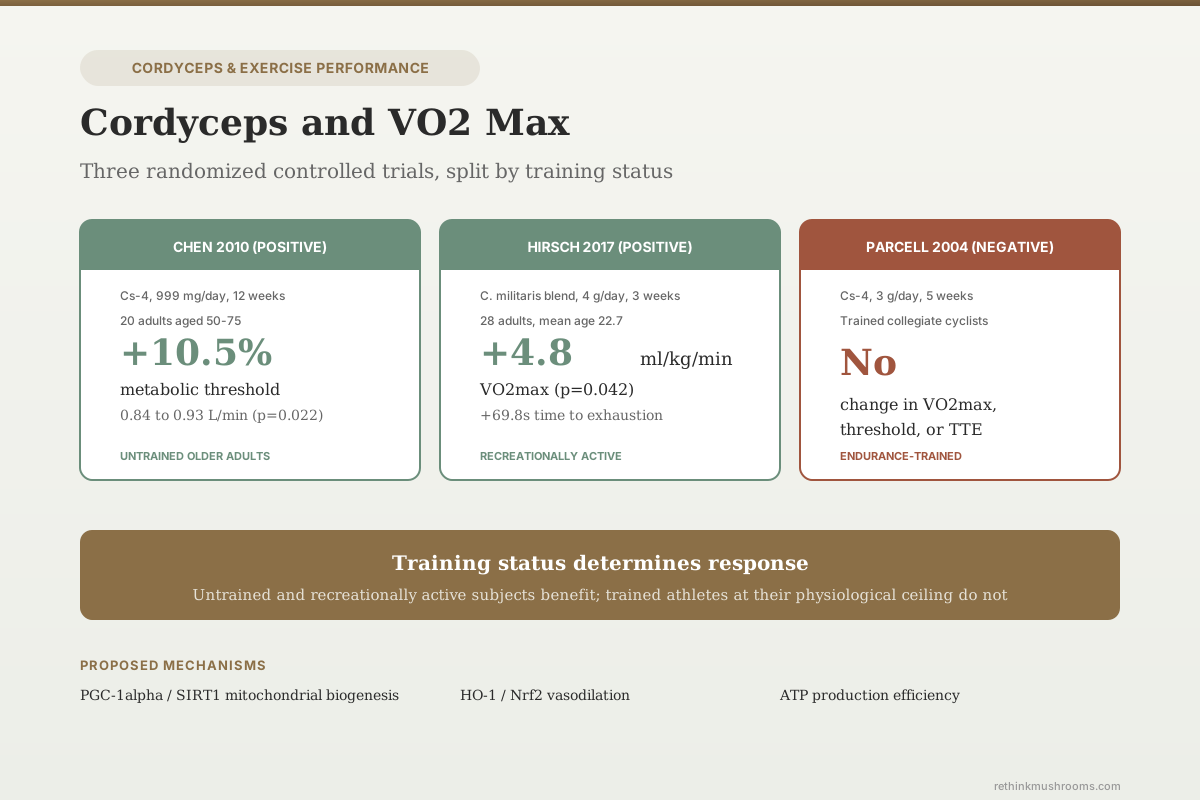
Healthy adults aged 50-75 supplementing with Cs-4 (Cordyceps sinensis) at 333 mg three times daily for 12 weeks increased their metabolic threshold by 10.5% (p < 0.02) in a double-blind, placebo-controlled trial.
Chen et al., Journal of Alternative and Complementary Medicine, 2010
+4.8 ml/kg/min
VO2max increase after 3 weeks C. militaris in young adults
Negative in Trained
Cs-4 showed no benefit in trained cyclists
3 Human RCTs
three randomized controlled trials with VO2 or threshold endpoints
Chen et al., Journal of Alternative and Complementary Medicine, 2010
 View as image ↗
VO2 max is the maximum rate at which an individual can consume oxygen during exercise. It is the gold standard measure of cardiorespiratory fitness and the single strongest predictor of all-cause mortality in epidemiological studies. Improving VO2 max by even a few ml/kg/min has measurable health and performance implications. Cordyceps species have been tested for this specific endpoint in three randomized controlled trials, with results that split cleanly along two lines: age of participants and training status. For the broader exercise performance picture, see the cordyceps and exercise performance overview.
The short answer: Cs-4 (Cordyceps sinensis fermentation product) improved metabolic threshold and oxygen utilization in untrained older adults but produced no benefit in trained young cyclists. C. militaris (a different species) improved VO2 max and time to exhaustion in recreationally active young adults after 3 weeks but not 1 week. The pattern suggests cordyceps may have a window of effectiveness in individuals with suboptimal baseline cardiorespiratory function, with diminishing returns in those already near their physiological ceiling.
Key Takeaways
- Cs-4 at 333 mg three times daily for 12 weeks increased metabolic threshold by 10.5% (from 0.83 to 0.93 L/min, p < 0.02) in healthy adults aged 50-75 in a double-blind, placebo-controlled trial (Chen et al., Journal of Alternative and Complementary Medicine, 2010)
- A C. militaris-containing mushroom blend increased VO2max by 4.8 ml/kg/min (p = 0.042) and time to exhaustion by 69.8 seconds after 3 weeks of supplementation in recreationally active adults, but not after 1 week (Hirsch et al., Journal of Dietary Supplements, 2017)
- Cs-4 at 3 g/day for 5 weeks produced no improvement in VO2max, ventilatory threshold, or time to exhaustion in 22 endurance-trained male cyclists (Parcell et al., International Journal of Sport Nutrition and Exercise Metabolism, 2004)
- Cordyceps sinensis increased hypoxia tolerance in human lung epithelial cells (A549 cell line) by inducing heme oxygenase-1 (HO-1) and metallothionein through Nrf2 activation, providing a mechanistic basis for oxygen utilization improvement (Singh et al., BioMed Research International, 2013)
- C. militaris fruit body extract improved forced swimming time and reduced blood lactate and ammonia in mice, with increased hepatic and muscular glycogen stores (Song et al., Evidence-Based Complementary and Alternative Medicine, 2015)
- Cordycepin activated the TIGAR/SIRT1/PGC-1alpha pathway in fatigue models, promoting mitochondrial biogenesis and cellular energy production (Chai et al., Biochemical and Biophysical Research Communications, 2022)
The Three Human VO2/Threshold Trials
Chen 2010: Positive in Older Adults
Chen and colleagues conducted the best-designed cordyceps exercise trial to date.[1] Twenty healthy older adults (aged 50-75) were randomized to Cs-4 (333 mg three times daily, equivalent to 999 mg/day) or placebo for 12 weeks. Exercise testing used cycle ergometry with gas exchange analysis before and after supplementation.
Results:
- Metabolic threshold increased from 0.83 +/- 0.06 L/min to 0.93 +/- 0.08 L/min in the Cs-4 group (10.5% improvement, p < 0.02); ventilatory threshold rose 8.5% (from 1.25 to 1.36 L/min)
- VO2max did not change significantly in either the Cs-4 or the placebo group
- No significant changes in the placebo group
- No adverse effects reported
The metabolic threshold (also called anaerobic threshold or lactate threshold) is the exercise intensity above which anaerobic metabolism increasingly supplements aerobic ATP production; the study measured the closely related ventilatory threshold separately, which rose 8.5%. A higher threshold means an individual can sustain higher work rates aerobically before accumulating lactate. This is functionally more meaningful for daily activities in older adults than absolute VO2max, because most daily tasks occur at submaximal intensities.
The 12-week duration matters. The Hirsch 2017 study (below) showed no effect at 1 week but positive results at 3 weeks, suggesting cordyceps requires chronic supplementation for exercise benefits. Chen's 12-week protocol may have captured a cumulative adaptation that shorter studies miss.
Hirsch 2017: Positive in Recreationally Active Young Adults
Hirsch and colleagues tested a mushroom blend containing Cordyceps militaris (4 g/day of mushroom blend) in 28 recreationally active individuals (mean age 22.7 +/- 4.1 years) using a randomized, double-blind, placebo-controlled design. All 28 were tested at baseline and after 1 week; a subset of 10 volunteers continued supplementation and were tested again at 3 weeks.[2]
After 1 week:
- No significant changes in VO2max (p = 0.364), ventilatory threshold (p = 0.514), or time to exhaustion (p = 0.540)
- However, 95% confidence interval analysis showed time to exhaustion improved by 28.1 seconds in the mushroom group (not in placebo)
After 3 weeks:
- VO2max increased by 4.8 ml/kg/min in the mushroom group vs. 0.9 ml/kg/min in placebo (p = 0.042)
- Time to exhaustion improved by 69.8 seconds in the mushroom group (not in placebo)
- Ventilatory threshold improved by 0.7 L/min in the mushroom group (not in placebo)
The time course is informative: 1 week was insufficient, 3 weeks was sufficient. This suggests the mechanism involves adaptive changes (mitochondrial biogenesis, enzyme upregulation) rather than acute pharmacological effects (like caffeine's immediate performance boost). The study used a mushroom blend, not pure cordyceps, making it impossible to attribute the entire effect to C. militaris alone. For how cordyceps connects to ATP production and mitochondrial function, see cordyceps and ATP and cordyceps and mitochondrial function.
Parcell 2004: Negative in Trained Cyclists
Parcell and colleagues gave Cs-4 (CordyMax) at 3 g/day for 5 weeks to 22 endurance-trained male cyclists in a randomized, double-blind, placebo-controlled parallel-group design.[3]
No significant improvements were found in:
- VO2max
- Ventilatory threshold
- Time to exhaustion
- Respiratory exchange ratio
- Heart rate at any intensity
This is the most cited negative cordyceps study and the most important one for understanding where cordyceps fails. Trained cyclists already operate near their physiological ceiling for oxygen utilization. Their mitochondrial density, capillary-to-fiber ratio, and oxidative enzyme activity are already high. A compound that works by improving these parameters (as the mechanistic studies suggest) would have diminishing returns in individuals who have already maximized them through training.
The dose (3 g/day) was three times higher than Chen 2010's effective dose (999 mg/day). The species was the same (Cs-4). The duration (5 weeks) was between Chen's 12 weeks and Hirsch's 3 weeks. The difference was the population: trained athletes vs. untrained older adults vs. recreationally active young adults. For the broader context of how cordyceps performs across athletic populations, see cordyceps for runners and endurance athletes.
Why Training Status Matters
Response by Training Status
Who Responds Tracks Baseline Fitness — Not Dose or Species
The three human trials split cleanly by how much room the participants had to improve. The measured benefit shrinks as baseline fitness rises, and disappears entirely in trained cyclists — even though their dose (3 g/day) was the highest of the three.
Untrained older adults (50-75)
Lowest baselineChen 2010 · Cs-4 999 mg/day · 12 wks — +10.5% metabolic threshold (p < 0.02)
Recreationally active young adults
Mid baselineHirsch 2017 · C. militaris 4 g/day · 3 wks — +4.8 ml/kg/min VO₂max (p = 0.042)
Endurance-trained cyclists
Trained ceilingParcell 2004 · Cs-4 3 g/day · 5 wks — No change in VO₂ or threshold
The same pattern seen with creatine, beta-alanine, and nitrate: larger effects in less-trained people, negligible effects once the mitochondrial and enzymatic adaptations cordyceps appears to enhance are already maximized by training.
Sources: Chen et al. (2010) [ref 1]; Hirsch et al. (2017) [ref 2]; Parcell et al. (2004) [ref 3].
The split between positive results in untrained/recreationally active subjects and negative results in trained athletes is consistent with how other ergogenic compounds work. Creatine, beta-alanine, and nitrate supplementation all show larger effects in less trained individuals and attenuated effects in highly trained athletes. The reason is the same: trained individuals have already maximized the physiological systems these compounds target.
For cordyceps specifically, the relevant ceiling is mitochondrial oxidative capacity. VO2max is limited by three factors: cardiac output (central), oxygen delivery to muscles (hemoglobin/blood volume), and peripheral oxygen extraction (mitochondrial density and enzyme activity). Endurance training maximizes all three. A supplement that enhances mitochondrial biogenesis or enzyme activity adds meaningful capacity to an untrained system but minimal capacity to one already at its adaptive limit.
Mechanistic Support: How Could Cordyceps Improve VO2 Max?
Singh 2013: Hypoxia Tolerance Through Nrf2
Singh and colleagues demonstrated that Cordyceps sinensis increased hypoxia tolerance in human lung epithelial cells (the A549 cell line) by inducing heme oxygenase-1 (HO-1) and metallothionein (MT) through Nrf2 activation.[4]
HO-1 catalyzes the degradation of heme to carbon monoxide, biliverdin, and free iron. Carbon monoxide is a vasodilator (like nitric oxide), and biliverdin is converted to bilirubin, a potent antioxidant. Upregulating HO-1 could improve oxygen delivery to exercising muscles through vasodilation and protect against oxidative damage from high metabolic rates during intense exercise. MT is a cysteine-rich protein that scavenges free radicals and chelates heavy metals, providing additional antioxidant protection during metabolic stress. For how Nrf2 activation connects to cordyceps' broader protective effects, the cordyceps and cellular aging article covers the antioxidant signaling landscape.
Song 2015: Antifatigue in Mouse Model
Song and colleagues tested Cordyceps militaris fruit body extract in a mouse forced swimming model.[5] The extract:
- Extended forced swimming time (time to exhaustion)
- Reduced blood lactate accumulation
- Decreased blood ammonia
- Increased hepatic and muscular glycogen stores
Reduced lactate accumulation suggests enhanced aerobic metabolism (less glycolytic contribution at the same work rate), consistent with improved mitochondrial oxidative capacity. Increased glycogen stores suggest enhanced glycogen synthesis or reduced glycogen utilization rate. Both would manifest as improved endurance performance.
Choi 2020: Cellular Energy Production
Choi and colleagues demonstrated that Cordyceps militaris improved exercise performance in mice by promoting cellular energy production.[6] The mechanism involved enhanced mitochondrial ATP synthesis and improved efficiency of the electron transport chain. This is the most direct mechanistic connection to VO2max: oxygen consumption during exercise is consumed almost entirely by mitochondrial oxidative phosphorylation. A compound that makes mitochondria more efficient at coupling oxygen consumption to ATP production would increase the maximum rate of oxygen utilization.
Chai 2022: TIGAR/SIRT1/PGC-1alpha Pathway
Chai and colleagues identified a specific signaling pathway through which cordycepin exerts anti-fatigue effects.[7] Cordycepin activated TIGAR (TP53-induced glycolysis and apoptosis regulator), which redirected glucose metabolism from glycolysis toward the pentose phosphate pathway, generating NADPH for antioxidant defense. Simultaneously, cordycepin activated SIRT1, which deacetylated PGC-1alpha (the master regulator of mitochondrial biogenesis).
PGC-1alpha activation is the most mechanistically relevant finding for VO2max improvement. PGC-1alpha drives the transcription of genes encoding mitochondrial proteins, oxidative enzymes, and fatty acid oxidation enzymes. It is the same pathway activated by endurance training. If cordycepin activates PGC-1alpha through SIRT1, it would promote the same mitochondrial adaptations that training produces, explaining both the positive results in untrained subjects (additive with their baseline) and the null results in trained athletes (who have already maximized PGC-1alpha-driven adaptations). For the adenosine signaling context, see cordycepin and adenosine signaling.
The High-Altitude Connection
Chen and colleagues tested a Rhodiola crenulata and Cordyceps sinensis-based supplement in trained male cyclists performing a 2-week high-altitude training block (2,100 meters).[8] The supplement improved aerobic exercise performance after the training block compared to placebo, suggesting that cordyceps may have a specific benefit under hypoxic conditions where oxygen delivery is compromised.
This connects to Singh's Nrf2/HO-1 findings: at altitude, reduced arterial oxygen partial pressure limits VO2max. A compound that enhances HO-1-mediated vasodilation and antioxidant defense could partially compensate for the reduced oxygen availability. The practical implication, if it holds, is that cordyceps might benefit athletes training at altitude more than those training at sea level. The study used a combination product (rhodiola + cordyceps), so the individual contribution of cordyceps cannot be isolated. For timing strategies around cordyceps supplementation, see best time to take cordyceps.
What the Evidence Supports and What It Does Not
The human trial data supports three conclusions:
- Cs-4 improves metabolic threshold in untrained older adults after 12 weeks of chronic supplementation at ~1 g/day (Chen 2010, double-blind RCT)
- C. militaris improves VO2max and time to exhaustion in recreationally active young adults after 3 weeks of supplementation at 4 g/day (Hirsch 2017, double-blind RCT), but not after 1 week
- Cs-4 does not improve VO2max in trained cyclists at 3 g/day for 5 weeks (Parcell 2004, double-blind parallel-group RCT)
The evidence does not support:
- Cordyceps as an ergogenic aid for trained athletes
- Acute performance enhancement (1-week studies are negative)
- Any specific dose recommendation for VO2max improvement (effective doses ranged from 1-4 g/day across studies, and the negative study used 3 g/day)
- Superiority over any training intervention (no comparative study exists)
The mechanistic studies (PGC-1alpha, HO-1, ATP production, glycogen sparing) provide biological plausibility for the human results and explain the training-status-dependent response. More human trials with standardized preparations, dose-response designs, and stratification by baseline fitness are needed to clarify the effective population and dose range. The 1993 Chinese athletics controversy is covered separately in the cordyceps and the 1993 Chinese Olympic controversy article.
The Bottom Line
Three randomized controlled trials have tested cordyceps effects on VO2max and related endpoints in humans. Cs-4 increased metabolic threshold by 10.5% in untrained older adults after 12 weeks (Chen 2010). C. militaris increased VO2max by 4.8 ml/kg/min in recreationally active young adults after 3 weeks (Hirsch 2017). Cs-4 produced no benefit in trained cyclists after 5 weeks (Parcell 2004). The pattern indicates cordyceps may improve oxygen utilization in individuals with suboptimal baseline fitness through PGC-1alpha-mediated mitochondrial biogenesis, with diminishing returns in trained athletes who have already maximized these adaptations.
Frequently Asked Questions
Sources & References
- 1RTHM-00176·Chen, Steve et al. (2010). “Effect of Cs-4 (Cordyceps sinensis) on exercise performance in healthy older subjects: a double-blind, placebo-controlled trial..” Journal of alternative and complementary medicine (New York.Study breakdown →PubMed →↩
- 2RTHM-00473·Hirsch, Katie R et al. (2017). “Cordyceps militaris Improves Tolerance to High-Intensity Exercise After Acute and Chronic Supplementation..” Journal of dietary supplements.Study breakdown →PubMed →↩
- 3RTHM-00075·Parcell, Allen C et al. (2004). “Cordyceps Sinensis (CordyMax Cs-4) supplementation does not improve endurance exercise performance..” International journal of sport nutrition and exercise metabolism.Study breakdown →PubMed →↩
- 4RTHM-00305·Singh, Mrinalini et al. (2013). “Cordyceps sinensis increases hypoxia tolerance by inducing heme oxygenase-1 and metallothionein via Nrf2 activation in human lung epithelial cells..” BioMed research international.Study breakdown →PubMed →↩
- 5RTHM-00401·Song, Jingjing et al. (2015). “Studies on the Antifatigue Activities of Cordyceps militaris Fruit Body Extract in Mouse Model..” Evidence-based complementary and alternative medicine : eCAM.Study breakdown →PubMed →↩
- 6RTHM-00613·Choi, Eunhyun et al. (2020). “Beneficial Effect of Cordyceps militaris on Exercise Performance via Promoting Cellular Energy Production..” Mycobiology.Study breakdown →PubMed →↩
- 7RTHM-00749·Chai, Xiaoming et al. (2022). “Cordycepin exhibits anti-fatigue effect via activating TIGAR/SIRT1/PGC-1α signaling pathway..” Biochemical and biophysical research communications.Study breakdown →PubMed →↩
- 8RTHM-00313·Chen, Chung-Yu et al. (2014). “Rhodiola crenulata- and Cordyceps sinensis-based supplement boosts aerobic exercise performance after short-term high altitude training..” High altitude medicine & biology.Study breakdown →PubMed →↩