Cordyceps for Athletes
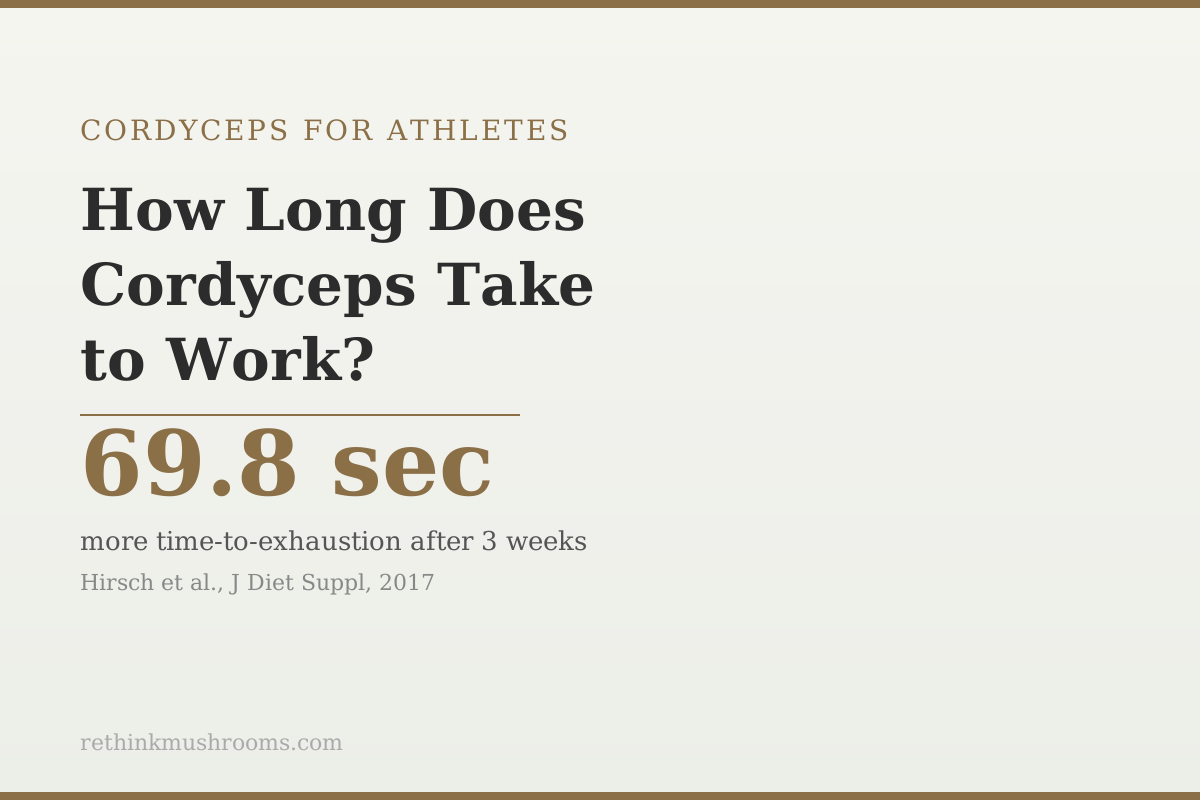
69.8 sec more time to exhaustion after 3 weeks
Hirsch et al. (2017) measured cordyceps effects at two timepoints in the same trial: after 1 week, time-to-exhaustion improved by 28.1 seconds. After 3 weeks, it improved by 69.8 seconds. Effects build with continued supplementation.
Hirsch et al., J Diet Suppl, 2017
14 RCTs
in the 2025 Shu meta-analysis, 528 athletes, all finding effects in the 2-12 week window
6 weeks
minimum duration for VO2max improvements in Chen et al. (2010) older adult trial
Parcell 2004
null result with Cs-4 sinensis mycelium; not all formulations or durations work
Hirsch et al., J Diet Suppl, 2017
 View as image ↗
If you want to know how long cordyceps takes to work for athletic performance, the clearest data comes from a 2017 randomized double-blind trial by Hirsch and colleagues.[1] They tested the same athletes at two timepoints: after 1 week and after 3 weeks of Cordyceps militaris supplementation. After 1 week, time-to-exhaustion improved by 28.1 seconds compared to baseline. After 3 weeks, it improved by 69.8 seconds. VO2max (the maximum rate at which the body can use oxygen during exercise) improved significantly only at the 3-week mark.
That progression, from modest improvement to more substantial improvement as supplementation continues, is the central finding of this article. Cordyceps does not appear to work immediately at full effect. The mechanisms behind its performance benefits require an adaptation period measured in weeks, not days. How long you need to take it depends on what outcome you are targeting and which study population most resembles yours.
For the complete research picture on cordyceps and endurance sports, see what cordyceps is and the science behind the energy mushroom. This article focuses specifically on timing.
Key Takeaways
- Hirsch et al. (2017) measured cordyceps effects at 1 week (+28.1 sec time-to-exhaustion) and 3 weeks (+69.8 sec TTE, significant VO2max improvement); the only study comparing back-to-back timepoints in the same cohort
- The 2025 Shu meta-analysis pooled 14 RCTs with 528 athletes and found consistent evidence across the 2-12 week supplementation window, confirming effects do not typically appear before 2 weeks
- Chen et al. (2010) found VO2max improved 6.7% and anaerobic threshold improved 12.6% at 6 weeks; at 12 weeks, metabolic threshold improved 10.5%, showing continued gains beyond the 3-week mark
- The mechanism for time-dependent effects involves mitochondrial biogenesis via the TIGAR/SIRT1/PGC-1α signaling pathway, which requires weeks to produce measurable changes in muscle cell energy infrastructure (Chai et al., 2022)
- Parcell et al. (2004) found no performance improvement with Cordyceps sinensis Cs-4 mycelium extract; a null result likely explained by formulation type (fermented mycelium vs. fruiting body) and possibly insufficient duration
- Practical implication: for a target race or competition, starting supplementation 6-8 weeks in advance with Cordyceps militaris fruiting body at 2-3 g/day captures the most consistently evidenced improvement window
Week 1 to 3: The Only Study That Measured Both Timepoints
Most clinical research on cordyceps tests athletes at a single endpoint, measuring the change from baseline to a fixed study duration. Hirsch and colleagues took a different approach.[1]
Their randomized, double-blind, placebo-controlled trial gave participants Cordyceps militaris and measured performance on a high-intensity cycling protocol at three points: before supplementation, after 1 week, and after 3 weeks. This within-trial comparison produces the most direct data available on how quickly cordyceps effects emerge.
After 1 week: time-to-exhaustion improved by 28.1 seconds versus baseline. That is a real but modest improvement.
After 3 weeks: time-to-exhaustion improved by 69.8 seconds versus baseline. The effect was more than twice as large. VO2max, which did not change significantly at 1 week, showed a significant improvement at 3 weeks.
What Hirsch's study shows is not just that cordyceps works. It shows that the magnitude of improvement roughly doubles between weeks 1 and 3. This dose-response relationship across time is consistent with a mechanism that requires an adaptation period rather than an acute pharmacological effect.
The 2025 Shu meta-analysis, which pooled data from 14 randomized controlled trials involving 528 athletes across endurance, team, and multi-sport populations, confirmed that the 2-12 week window is where effects reliably appear.[2] Studies shorter than 2 weeks are not well-represented in the literature, and the Shu analysis did not identify consistent effects in very short supplementation windows.
A 2025 narrative review of 5 intervention studies covering 321 participants ages 16-35 reached similar conclusions, noting that trials of at least 3 weeks produced the clearest performance improvements and that formulation differences between C. militaris and C. sinensis products contributed to variability in results.[7]
Why Effects Build Over Time: Three Adaptation Processes
The time-dependency of cordyceps benefits is not arbitrary. Three distinct biological processes that cordyceps appears to activate all require weeks of sustained change to produce measurable performance outcomes.
Mitochondrial biogenesis. The process by which muscle cells build new mitochondria (the organelles that produce energy from oxygen and nutrients) takes weeks, not hours. Chai and colleagues showed that cordycepin, the primary pharmacologically active compound in Cordyceps militaris, activates the TIGAR/SIRT1/PGC-1α signaling pathway in fatigued animals.[3] To understand what this means without the acronyms: cordycepin activates a chain of molecular switches that tell muscle cells to build more energy-producing machinery. PGC-1α, the last protein in this chain, is often called the "master regulator of mitochondrial biogenesis" because it controls the genes that direct the construction of new mitochondria. Building that infrastructure is a slow process that proceeds over weeks of consistent activation.
ATP pathway upregulation. Choi and colleagues demonstrated that Cordyceps militaris extract enhanced exercise performance by increasing activity in the cellular pathway that generates ATP, the chemical currency of energy in every cell in the body.[4] Upregulating metabolic enzyme activity, like increasing mitochondrial mass, requires sustained gene expression changes that take time to accumulate.
Satellite cell mobilization. A 2024 human study by Dewi and colleagues found that Cordyceps sinensis significantly accelerated the recruitment of satellite cells to skeletal muscle following exercise.[5] Satellite cells are the muscle's resident stem cells: dormant in healthy muscle, they activate after damage or exercise stress and contribute to repair and growth. Faster satellite cell recruitment means faster recovery between training sessions, which over weeks and months produces cumulative improvements in the muscle's capacity. This is a recovery-based mechanism whose benefit compounds with each training cycle.
Together, these three mechanisms explain the observed timeline: early effects (week 1) reflect acute changes in cellular energy handling, while the larger effects at week 3 and beyond reflect genuine structural adaptations in the muscle's energy-producing infrastructure. For more on the ATP and cellular energy mechanisms specifically, see cordyceps and ATP: how it boosts cellular energy. For the recovery and tissue repair angle, see cordyceps and anti-aging: research on longevity.
Weeks 6-12: The Data From Longer Trials
The 3-week Hirsch data represents the shortest timepoint with compelling results. What happens if you continue supplementation?
Chen and colleagues ran two related supplementation trials.[6] In a 6-week trial of older adults receiving 3 g/day of Cs-4 (a Cordyceps sinensis preparation), VO2max improved by 6.7% and anaerobic threshold improved by 12.6% compared to placebo. In a 12-week trial with a lower dose, ventilatory threshold improved by 8.5% and metabolic threshold improved by 10.5%. These are meaningful physiological improvements in a population where exercise capacity typically declines with age.
The Chen data shows that performance gains do not plateau at week 3 and then stop. The 12-week results indicate that longer supplementation produces greater improvements in exercise threshold markers, suggesting that the mitochondrial and metabolic adaptations continue accumulating beyond the initial improvement period.
The Kreipke 2021 RCT, which combined Cordyceps sinensis and Rhodiola in a multi-ingredient supplement tested over 10 weeks, showed performance improvements in active men undergoing concurrent strength and endurance training.[8] The multi-ingredient design means Cordyceps-specific attribution is uncertain, but the 10-week timeframe and the nature of improvements (endurance performance alongside body composition) are consistent with the mitochondrial biogenesis mechanism requiring extended activation.
The Shu 2025 meta-analysis, covering studies from 2 to 12 weeks, found evidence for benefit across this full range, with effect sizes generally larger in longer trials.[2]
The Null Result: When Duration and Formulation Both Matter
Not every cordyceps trial has produced improvements. The Parcell 2004 study is the most-cited negative result in this literature.[9]
Parcell and colleagues gave athletes CordyMax Cs-4, a fermented mycelium preparation of Cordyceps sinensis, and found no significant improvement in endurance performance versus placebo. The honest summary of this study: a specific Cordyceps sinensis mycelium extract did not improve performance in this trial.
Two factors likely explain the discrepancy with positive trials. First, Cs-4 is a fermented mycelium product rather than a fruiting body extract. The fruiting body contains higher concentrations of cordycepin, the compound responsible for the TIGAR/SIRT1/PGC-1α pathway activation documented by Chai 2022. Mycelium, particularly when grown on grain substrate, may have lower cordycepin content and a different bioactive profile. Second, the specific trial design, population, and duration may have been insufficient to detect improvements even if some were occurring.
The Parcell result does not contradict the positive trials; it contextualizes them. For cordyceps, not all products are equivalent and not all trial lengths capture the adaptation period required for the mechanism to produce measurable results. The species and formulation debate is covered in detail at cordyceps militaris vs. sinensis: which is better?.
Practical Timing for Athletes
The evidence, taken together, points toward a clear practical recommendation for athletes planning a supplementation strategy around a specific event.
For a target race or competition: starting cordyceps 6-8 weeks before the event captures the full adaptation window. By 3 weeks, the Hirsch data shows VO2max improvement and meaningful TTE gains. By 6-12 weeks, the Chen data shows continued metabolic threshold improvements. Front-loading the adaptation period before competition provides more accumulated benefit than starting 1-2 weeks out.
Formulation: the positive RCT evidence is stronger for Cordyceps militaris fruiting body than for Cordyceps sinensis Cs-4 mycelium. When choosing a product, standardization to a measurable cordycepin content is more informative than relying on extract ratios alone.
Dose: the Shu 2025 meta-analysis used doses of 2-3 g/day or 10 mg/kg body weight. Hirsch used 4 capsules per day (approximately 1 g total, with 22.5% active ingredient). Chen used 3 g/day for the 6-week trial. Most positive trials cluster around 2-3 g/day of fruiting body extract.
Does it work right away? The Hirsch data shows a detectable TTE improvement at 1 week, so there is some acute response. But the 1-week effect (28.1 sec) is substantially smaller than the 3-week effect (69.8 sec), and VO2max did not change at 1 week in that trial. Expecting full performance benefits on the first day of supplementation is not supported by the timeline data.
For the full research review on cordyceps and running performance including iron, ferritin, and recovery data, see cordyceps for runners and endurance athletes: research review. For the clinical trial evidence on VO2max specifically, see cordyceps and exercise performance: what the clinical trials show and cordyceps and VO2 max: can a mushroom improve oxygen uptake?.
The Bottom Line
The clearest timeline data on cordyceps athletic performance comes from Hirsch et al. (2017): time-to-exhaustion improved by 28.1 seconds after 1 week and 69.8 seconds after 3 weeks, with VO2max improving significantly only at the 3-week mark. The 2025 Shu meta-analysis (14 RCTs, 528 athletes) confirmed that effects appear consistently in the 2-12 week window. Longer trials (6-12 weeks, Chen 2010) show continued gains in metabolic thresholds beyond the initial improvement period. The mechanism for time-dependency involves mitochondrial biogenesis via the TIGAR/SIRT1/PGC-1α pathway, satellite cell mobilization, and ATP pathway upregulation, all of which are adaptation processes requiring weeks. The Parcell 2004 null result with Cs-4 sinensis mycelium highlights that formulation matters: Cordyceps militaris fruiting body has a stronger positive evidence base than fermented sinensis mycelium.
Frequently Asked Questions
Sources & References
- 1. Source details for this reference are not yet available.
- 2. Source details for this reference are not yet available.
- 3. Source details for this reference are not yet available.
- 4. Source details for this reference are not yet available.
- 5. Source details for this reference are not yet available.
- 6. Source details for this reference are not yet available.
- 7. Source details for this reference are not yet available.
- 8. Source details for this reference are not yet available.
- 9. Source details for this reference are not yet available.