Wood Ear Mushroom
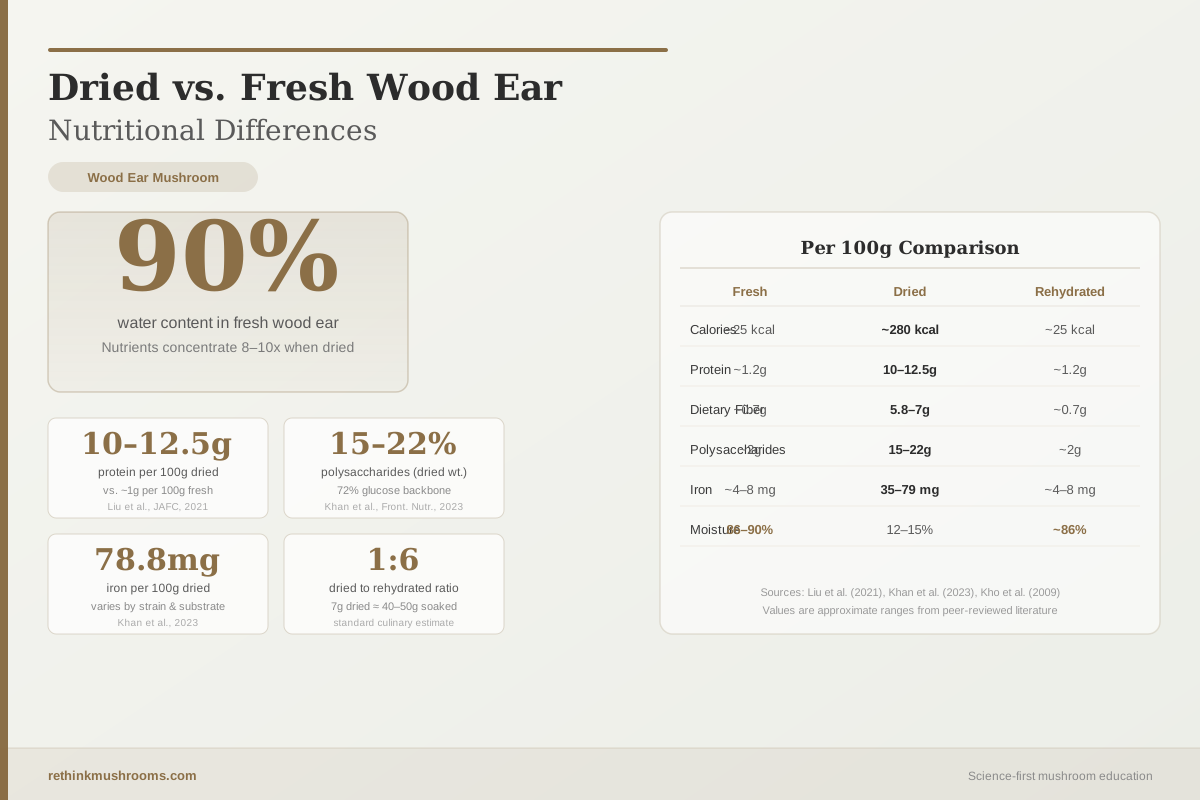
90% water
Fresh wood ear mushroom is approximately 90% water by weight, meaning drying concentrates every nutrient 8–10x on a per-gram basis.
Liu et al., Journal of Agricultural and Food Chemistry, 2021
10–12.5g
protein per 100g dried
15–22%
polysaccharides (dried weight)
78.8mg
iron per 100g dried (some strains)
Liu et al., Journal of Agricultural and Food Chemistry, 2021
 View as image ↗
When a recipe calls for 7 grams of dried wood ear and a nutrition label shows 25 calories for that amount, neither number tells the full story. That 7-gram handful rehydrates to roughly 40–50 grams. The protein, fiber, and minerals compress during drying and re-expand during soaking. Understanding what changes, what stays, and where real nutrient density lives requires looking past the water math.
This article examines the peer-reviewed evidence on how drying, rehydration, and different processing methods affect the nutritional profile of Auricularia auricula-judae, the black jelly mushroom sold commercially as wood ear. For a deeper look at the complete spectrum of nutrients, see Wood Ear Nutritional Profile: Complete Breakdown.
Key Takeaways
- Fresh wood ear is ~90% water; drying concentrates all nutrients 8–10x by weight on a dry-matter basis
- Dried wood ear provides 10–12.5g protein per 100g vs. roughly 1g per 100g fresh, per Liu et al. (2021) review in JAFC
- Polysaccharide content reaches 15–22% of dried weight; monosaccharide composition is ~72% glucose, 10% xylose, 8% mannose, and 10% fucose per Wu et al. (2010)
- Iron content in dried fruiting bodies can reach 78.8 mg per 100g depending on strain and substrate, per Khan et al. (2023, Frontiers in Nutrition)
- Freeze-drying preserves antioxidant capacity better than oven-drying; DPPH IC50 was 2.87 mg/mL for freeze-dried vs. higher (worse) values for oven-dried samples per Kho et al. (2009)
- 7g dried wood ear rehydrates to approximately 40–50g; a 1:6 dried-to-soaked ratio is a reasonable working estimate for recipe conversion
The Water Problem: Why Dried and Fresh Numbers Cannot Be Compared Directly
The single biggest source of confusion in wood ear nutrition is moisture content. Fresh A. auricula-judae fruiting bodies contain 86–90% water by weight.[1] Dried product typically retains 12–15% moisture. Everything else, protein, fiber, minerals, and polysaccharides, occupies the remaining dry matter.
This means a 100g portion of fresh mushroom contains roughly 10–14g of actual dry material. A 100g portion of dried mushroom contains about 85–88g of that same dry material. To compare the two fairly, all values must be converted to the same basis, either fresh weight or dry weight.
Most food labels report fresh-weight values. Most research papers report dry-weight values. Neither is wrong, but mixing them produces nonsensical comparisons like "dried wood ear has 12 times more protein than fresh." On a dry-matter basis, the protein concentration is nearly identical. What changed was the water.
The practical question is different: what do you actually ingest per serving? The answer depends on whether you are comparing a serving of fresh mushroom to an equivalent serving of dried or to the rehydrated equivalent. Both calculations matter, and both are covered below.
Macronutrient Comparison: Protein, Fat, Carbohydrates
A 2021 review in the Journal of Agricultural and Food Chemistry by Liu et al. consolidated proximate analysis data from multiple cultivation studies of A. auricula-judae.[1] The reported ranges for dried fruiting bodies:
| Nutrient | Dried (per 100g) | Approximate Fresh Equivalent (per 100g) |
|---|---|---|
| Protein | 10–12.5g | 1.0–1.5g |
| Fat | 0.2–1.7g | 0.02–0.2g |
| Carbohydrates | 65–81g | 6.5–10g |
| Dietary Fiber | 5.8–7.0g | 0.6–0.9g |
| Ash | 3.6–9.4g | 0.4–1.1g |
| Moisture | 12–15g | 86–90g |
The fresh-equivalent column applies a rough 10x dilution factor for illustrative purposes. Actual fresh samples will vary based on species variant, cultivation method, and harvest timing.
Protein in Auricularia is relatively high compared to most vegetables on a dry-weight basis. Wu et al. (2017) reported crude protein values of 12–14% in A. polytricha fruiting bodies cultivated on agrowaste substrates, with variation tied directly to nitrogen content in the growing medium.[2] The protein is incomplete as a standalone source, lacking sufficient leucine and methionine for complete dietary replacement, but it contributes meaningfully within a varied diet.
Fat content is low regardless of form. Most of the fatty acid profile is unsaturated, consistent with other edible fungi. This feature holds across both dried and fresh preparations.
Carbohydrates dominate on a dry-weight basis. A substantial fraction is structural polysaccharides, not simple sugars. Understanding that carbohydrate fraction requires looking at the fiber and polysaccharide data separately.
Fiber and Polysaccharides: The Biologically Active Fraction
The carbohydrate fraction in wood ear is not homogeneous. A portion is digestible starch and simple sugars, but a substantial portion is dietary fiber and biologically active polysaccharides that behave differently from standard carbohydrates.
Dietary fiber in dried wood ear runs 5.8–7% by weight, or approximately 5–7g per 100g dried serving.[1] A 7g dried serving, one standard package unit, contributes roughly 0.4–0.5g fiber. Rehydrated to 40g, that same material provides fiber equivalent to about half a gram of broccoli. Per-calorie, the fiber density is high.
Polysaccharides are the fraction attracting the most research attention. Wu et al. (2010) characterized the monosaccharide composition of A. auricula polysaccharides using GC-MS: glucose 72%, xylose 10%, mannose 8%, and fucose 10%.[3] The backbone is beta-1,3-linked glucan with beta-1,6 branches, a structural arrangement associated with immune recognition via dectin-1 receptors.
Khan et al. (2023) measured crude polysaccharide content across 50 strains of Auricularia cornea, a closely related species, and found values ranging from 8.4% to 21.6% of dried fruiting body weight, with some strains reaching total polysaccharide concentrations of 200–216 mg per gram.[4] This variability is important: polysaccharide concentration is not fixed. It shifts with strain genetics, growing substrate, and harvest timing.
Chen et al. (2008) reported that water-extracted A. auricula polysaccharides contain 42.5% total carbohydrate, 19.6% uronic acids, and 15.8% sulfate groups.[5] The sulfate and uronic acid content contribute to the compound's anionic character, which appears relevant to its effects on lipid metabolism in animal models.
Fresh wood ear contains the same polysaccharides, just diluted by water. Drying does not synthesize new compounds. It removes water, raising the concentration of everything else.
Minerals: What the Evidence Shows
Wood ear is often cited as an iron-rich food, particularly in Chinese traditional nutrition. The peer-reviewed data supports a high mineral concentration on a dried-weight basis, with important caveats about strain and substrate variability.
Khan et al. (2023) measured mineral content across multiple A. cornea strains and found iron values ranging from 350 to 788 mg per kg of dried fruiting body, equivalent to 35–78.8 mg per 100g dried weight.[4] Zinc ranged from 32 to 486 mg per kg across strains. The wild-domesticated strain Ac28 showed iron of 350 mg/kg, while hybrid strain Ac3 reached 788 mg/kg. This is not a trivial difference, and it underscores that published "typical" values may not reflect what any particular commercial product contains.
Hao et al. (2022) showed that growing substrate composition significantly alters the mineral profile of harvested A. auricula.[6] Mushrooms cultivated on walnut-branch sawdust showed macro mineral element concentrations 18–89% higher than those on conventional mixed sawdust. Substrate mineral content directly transfers into fruiting body mineral content. Products labeled as "wood ear" without substrate disclosure could have substantially different mineral profiles.
For broader context on black fungus mineral content, Black Fungus Mineral Content: Iron, Calcium, and More covers the full mineral spectrum in detail.
Bioavailability of iron from plant and fungal sources is lower than from meat sources due to the non-heme form and the presence of compounds that can inhibit absorption. The published literature on wood ear does not include human absorption studies for minerals specifically, so claims about iron bioavailability remain speculative at this point.
How Processing Method Affects Antioxidant Capacity
Drying is not a single process. Oven drying, freeze drying, spray drying, and sun drying each expose the mushroom to different temperatures, oxygen levels, and duration. These factors affect the phenolic compounds responsible for antioxidant activity.
Kho et al. (2009) compared fresh, oven-dried, and freeze-dried A. auricula-judae fruiting body extracts for DPPH radical scavenging and ferric reducing antioxidant power (FRAP).[7] Freeze-dried extracts showed a DPPH IC50 of 2.87 mg/mL, the best-performing preparation. Oven-dried and fresh preparations showed higher IC50 values, meaning more material was needed to achieve the same antioxidant effect. The paper also found a positive correlation between FRAP values and total phenolic content (R² = 0.77), suggesting that phenolic degradation during oven drying is the primary driver of reduced antioxidant activity.
Ren et al. (2022) examined what sulfite treatment does to black fungus quality: sodium metabisulfite altered total sugar, soluble protein, polyphenols, flavonoids, and soluble vitamins in measurable ways.[8] Sulfite is sometimes used as a preservative or bleaching agent in commercial dried mushroom products. The compounds most affected were the same phenolics that drive antioxidant scores.
The practical takeaway: products dried at high temperatures or treated with sulfites may show lower antioxidant activity than fresh wood ear, even when compared on a dry-weight basis. Products labeled "freeze-dried" or "cold-dried" are more likely to preserve phenolic content, though product-specific testing is the only way to confirm. For prep guidance including how to hydrate and handle wood ear safely, see How to Prepare Wood Ear Mushrooms: Cooking Guide.
Rehydration: Running the Math in Reverse
Dried wood ear absorbs water during soaking, but not uniformly. The rehydration ratio, dried weight to soaked weight, varies with soak duration, water temperature, and mushroom piece size. A commonly used estimate in culinary contexts is 1:6 (one part dried yields six parts soaked by weight), though some sources cite 1:4 and others go as high as 1:8 for long soaks.
Shamaruddin et al. (2021) measured moisture content in A. polytricha prepared by different cooking methods and found that the uncooked rehydrated control had moisture of 86.52%, consistent with fresh mushroom values.[9] Stir-frying reduced that to 61.98%. Boiling, steaming, and microwaving produced intermediate moisture values.
What this means nutritionally: a fully rehydrated wood ear has approximately the same nutrient density per gram as fresh wood ear. Soaking in water does not extract or destroy the structural polysaccharides, fiber, or minerals to any significant degree. Small amounts of water-soluble compounds, including some phenolics and water-soluble vitamins, will leach into the soaking liquid. How much leaches depends on water temperature and soak duration.
Steaming cooked A. polytricha showed the highest total phenolic content (11.23 mg gallic acid equivalents per gram) and antioxidant activity among cooking methods tested, including the highest DPPH inhibition at 90.41% and FRAP at 33.54 mg Trolox equivalents per gram.[9] Boiling and stir-frying showed lower values. For safety considerations around soaking, including bongkrekic acid risk from extended room-temperature soaking, see Wood Ear Food Safety: Proper Soaking, Storage, and Bongkrekic Acid Risks.
What Fresh Wood Ear Offers That Dried Does Not
The case for fresh wood ear, where available, is not primarily nutritional in the sense of higher nutrient density. On a dry-matter basis, the nutrients are the same. The case is textural, phenolic, and practical.
Fresh wood ear has a more tender, gelatinous texture. It is also rarer outside of East Asia. In most Western markets, dried is the only form available. For Asian cuisine uses, the subtle textural differences matter. For nutritional purposes, the choice between fresh and dried comes down to convenience and what processing method the dried version underwent, not to any fundamental difference in what the mushroom contains per unit of dry matter.
The one area where fresh genuinely may outperform commercial dried product is in compounds degraded by heat processing. Certain volatile aromatic compounds and heat-labile vitamins are present in fresh mushroom but not necessarily retained through industrial drying. Freeze-dried product comes closest to preserving the fresh profile.
Liang et al. (2019) evaluated Auricularia cultivated on sawdust supplemented with grass plants and found that nutritional values, including protein, fat, fiber, and ash, varied based on substrate, not just species or processing method.[10] This reinforces the point that "wood ear nutrition" is not a single number. It is a range shaped by how and where the mushroom was grown, how it was dried, and how it was stored.
For more context on how wood ear fits into its culinary role, see Wood Ear in Asian Cuisine: Hot and Sour Soup and Beyond.
The Bottom Line
Dried and fresh wood ear mushroom contain the same nutrients per unit of dry matter. Drying removes water and concentrates protein (10–12.5g per 100g dried), fiber, polysaccharides (15–22% of dry weight), and minerals (iron up to 78.8 mg per 100g in some strains) without fundamentally altering the nutritional profile. Processing method matters: freeze-drying preserves antioxidant capacity better than oven-drying, and substrate composition at cultivation directly influences mineral content. The most meaningful variable for consumers is not fresh vs. dried per se, but the drying method and growing conditions behind the specific product.
Frequently Asked Questions
Sources & References
- 1RTHM-00702·Liu, Enchao et al. (2021). “Review on Auricularia auricula-judae as a Functional Food: Growth, Chemical Composition, and Biological Activities..” Journal of agricultural and food chemistry.Study breakdown →PubMed →↩
- 2RTHM-00928·Wu, Chiu-Yeh et al. (2017). “Effect of Different Proportions of Agrowaste on Cultivation Yield and Nutritional Composition of the Culinary-Medicinal Jelly Mushroom Auricularia polytricha (Higher Basidiomycetes)..” International journal of medicinal mushrooms.Study breakdown →PubMed →↩
- 3RTHM-00201·Wu, Qin et al. (2010). “Chemical characterization of Auricularia auricula polysaccharides and its pharmacological effect on heart antioxidant enzyme activities and left ventricular function in aged mice..” International journal of biological macromolecules.Study breakdown →PubMed →↩
- 4RTHM-00835·Khan, Asif Ali et al. (2023). “Characterization, antioxidant activity, and mineral profiling of Auricularia cornea mushroom strains..” Frontiers in nutrition.Study breakdown →PubMed →↩
- 5RTHM-00128·Chen, G et al. (2008). “Effect of polysaccharide from Auricularia auricula on blood lipid metabolism and lipoprotein lipase activity of ICR mice fed a cholesterol-enriched diet..” Journal of food science.Study breakdown →PubMed →↩
- 6RTHM-00763·Hao, Zhenkun et al. (2022). “Enhancing the Nutritional and Functional Properties of Auricularia auricula through the Exploitation of Walnut Branch Waste..” Foods (Basel.Study breakdown →PubMed →↩
- 7RTHM-00158·Kho, Y S et al. (2009). “Antioxidant capacity of fresh and processed fruit bodies and mycelium of Auricularia auricula-judae (Fr.) Quél..” Journal of medicinal food.Study breakdown →PubMed →↩
- 8RTHM-01608·Ren, Yichen et al. (2022). “Effects of sulfite treatment on the quality of black fungus..” Food chemistry.Study breakdown →PubMed →↩
- 9RTHM-00718·Shamaruddin, Norsyazleen et al. (2021). “Comparison of Cooking Methods on Physicochemical and Sensory Properties of the Black Jelly Mushroom, Auricularia polytricha (Heterobasidiomycetes)..” International journal of medicinal mushrooms.Study breakdown →PubMed →↩
- 10RTHM-01093·Liang, Chih-Hung et al. (2019). “Biological efficiency and nutritional value of the culinary-medicinal mushroom Auricularia cultivated on a sawdust basal substrate supplement with different proportions of grass plants..” Saudi journal of biological sciences.Study breakdown →PubMed →↩