Mushroom Genetics, Strains, and Bioactive Variation
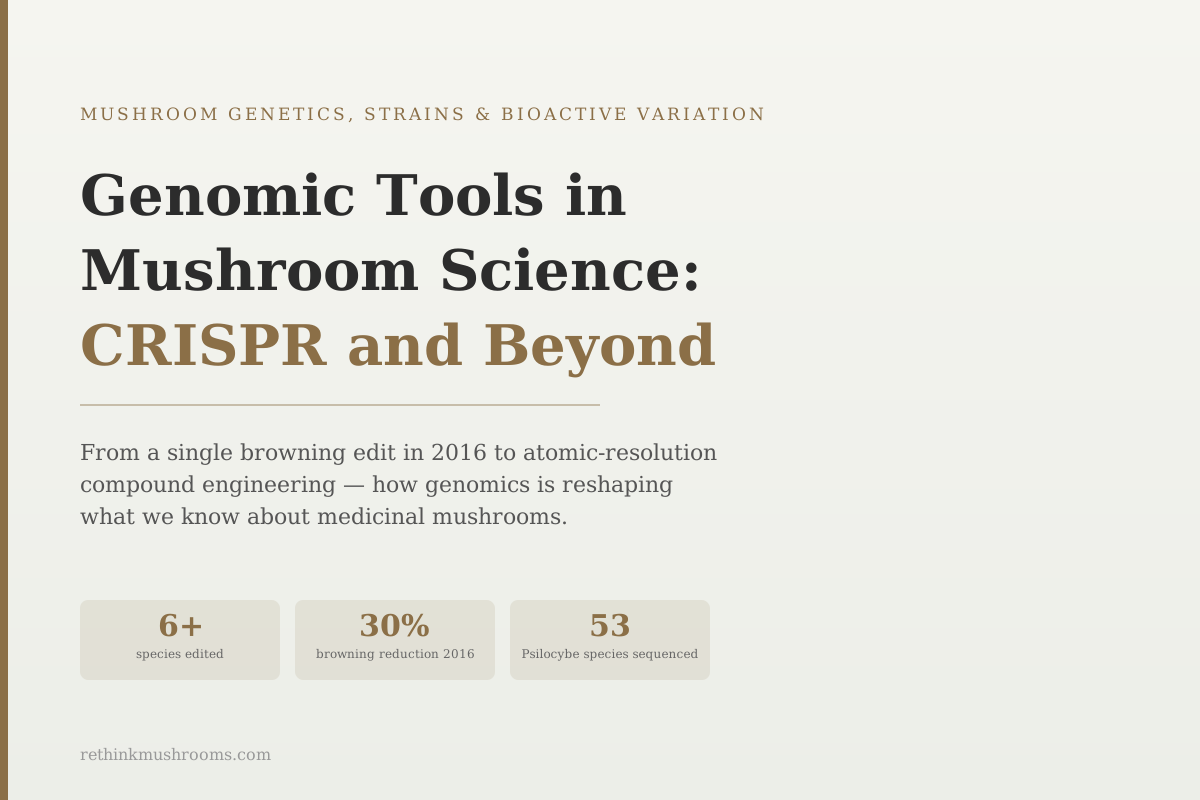
30% less browning enzyme
In 2016 a Penn State researcher knocked out one of six browning-enzyme genes in the white button mushroom, cutting the enzyme's activity by about 30%. The USDA — not the FDA — then declined to regulate it, because the edit added no plant-pest DNA.
Waltz, Nature, 2016; Zhang et al., Frontiers in Microbiology, 2023
10
edible fungi with published CRISPR/Cas9 applications as of 2023 (Zhang et al., Frontiers in Microbiology)
2 of 26
Ganoderma lucidum dikaryon transformants that carried the edit in both nuclei (Choi et al., Journal of Microbiology, 2025)
51–68%
balanced accuracy of machine-learning bioactivity prediction on fungal gene clusters — near chance at the low end (Riedling et al., Microbiology Spectrum, 2024)
Waltz, Nature, 2016; Zhang et al., Frontiers in Microbiology, 2023
 View as image ↗
In 2016, a plant pathologist at Penn State used CRISPR to edit the white button mushroom. The edit disabled a gene for the enzyme that turns a mushroom brown when it is cut or bruised. The result was a cultivar that resisted discoloration — and, more consequentially, a regulatory decision that is still cited a decade later.
That decision made the mushroom briefly famous, and it is also the part of the story most often garbled. What followed it is more interesting anyway. CRISPR and related genomic tools have moved steadily into edible fungi, and researchers are now applying them not only to agricultural problems but to the biosynthetic machinery behind medicinal mushroom chemistry. This article covers what CRISPR has actually accomplished in fungi, the technical problems that are specific to mushrooms and have no counterpart in plant or animal work, and what genome mining and machine learning can — and demonstrably cannot yet — tell us about the compounds these species still have not revealed.
For the broader context of genetic variation across species and strains, see mushroom genetics and bioactive variation, the genetic diversity of medicinal mushroom species, and how selective breeding changes mushroom chemistry. For what genetic programs mean for supplement selection, mushroom genetics and strain selection covers the consumer angle. These all sit under the mycology fundamentals pillar.
Key Takeaways
- CRISPR/Cas9 has been applied to 10 edible and medicinal fungi as catalogued in a 2023 review, including Ganoderma lucidum (Reishi), Cordyceps militaris, Flammulina filiformis (enoki), and both major Pleurotus species
- The 2016 anti-browning mushroom was ruled outside USDA APHIS jurisdiction — not "approved by the FDA" — because it contained no introduced DNA from plant pests, a narrow legal basis rather than a safety verdict
- Mushroom cells commonly carry two genetically distinct nuclei in shared cytoplasm, so an edit frequently lands in one nucleus and not the other; in one Ganoderma experiment only 2 of 26 dikaryotic transformants carried the edit in both
- Pleurotus ostreatus has become the field's model organism because it has efficient transformation protocols and multiple selection markers, and techniques validated there transfer to less tractable medicinal species
- Genome mining reliably finds candidate biosynthetic gene clusters, but raw cluster counts carry, in the authors' own words, "very limited biological significance" until the compounds are isolated
- Machine learning does not yet predict fungal compound bioactivity reliably: the 2024 benchmark reached only 51–68% balanced accuracy on fungal clusters, and its authors conclude the data shortage "currently limits" the approach
- The 2024 atomic-resolution structure of psilocybin's final enzyme is a genuine milestone, but it revealed a built-in efficiency ceiling as much as an engineering opportunity
What Actually Happened in 2016 — and Which Agency Said What
CRISPR is a gene-editing tool that locates a specific sequence in an organism's DNA, cuts it, and either disables the gene or replaces it. The first widely publicised application in an edible mushroom came in 2016, when one of the six polyphenol oxidase (PPO) genes — the enzyme family responsible for browning — was knocked out in Agaricus bisporus, the white button mushroom. That single knockout reduced the enzyme's activity by about 30%.[1]
The regulatory outcome is the part that is routinely reported incorrectly. The researcher, Yinong Yang, presented the mushroom to USDA regulators in October 2015 and filed a formal letter of inquiry that month. On 13 April 2016, the USDA's Animal and Plant Health Inspection Service (APHIS) replied that it "does not consider CRISPR/Cas9-edited white button mushrooms as described in your October 30, 2015 letter to be regulated."[2]
Three details matter and are usually lost. First, the agency was APHIS, part of the USDA — not the FDA. Second, APHIS did not declare the mushroom safe, and did not rule that it "is not a GMO." It concluded only that the mushroom fell outside the scope of its own biotechnology regulations, because it contained no introduced genetic material from plant pests such as viruses or bacteria.[2] Third, that is a jurisdictional finding about how the edit was made, not a food-safety clearance — the FDA's food-safety consultation is a separate and voluntary process.
The distinction is not pedantry. The entire regulatory precedent rests on the absence of foreign DNA, and as the later sections show, that single legal fact has since shaped which laboratory methods researchers bother to develop.
By 2023, a review in Frontiers in Microbiology catalogued published CRISPR/Cas9 work across ten fungal species — considerably more than the handful usually named, and including several with direct medicinal relevance.[1]
Ten species, not six
Every Edible Fungus With Published CRISPR/Cas9 Work
The 2023 review most often cited on this topic catalogues ten species — including Reishi and Cordyceps, the two that matter most to anyone buying mushroom supplements. Summaries that stop at “a handful of edible mushrooms” tend to drop exactly those two.[1]
What kind of fungus the work has reached
Species
Role
Why it is on this list
Ganoderma lucidum
Reishi, lingzhi
The highest-value medicinal species on the roster, and the one in which both-nuclei editing has since been demonstrated directly.
Cordyceps militaris
Cordyceps
Commercial source of cordycepin; the species most often named when secondary-metabolite engineering is discussed.
Shiraia bambusicola
Bamboo parasite
A traditional-medicine fungus rather than a mushroom crop. Not a culinary species.
Schizophyllum commune
Split gill
Long-standing genetics model, and the natural source of the polysaccharide schizophyllan.
Agaricus bisporus
White button, cremini, portobello
The 2016 case. One of six polyphenol oxidase genes was knocked out, cutting browning-enzyme activity by about 30%.
Pleurotus ostreatus
Oyster mushroom
Doubles as a major crop and as the field’s model organism; most new mushroom editing methods are validated here first.
Pleurotus eryngii
King oyster
Benefits directly from protocols developed in its better-characterised sister species.
Flammulina filiformis
Enoki
High-volume cultivated crop.
Coprinopsis cinerea
Inky cap
Classic laboratory basidiomycete, studied for fruiting-body development rather than eaten.
Ustilago maydis
Corn smut, huitlacoche
A maize pathogen eaten as a delicacy in Mexico, and one of the oldest fungal genetics models.
What “has CRISPR applications” does and does not mean
Appearing on this list means published CRISPR/Cas9 work exists in that species — not that a medicinal compound has been successfully boosted, and not that an edited strain is in production. Of the ten, only Agaricus bisporus has a specific edit and outcome named in the cited review: one of six browning-enzyme genes disabled, for a roughly 30% drop in enzyme activity.[1]
Species roster and the A. bisporus edit detail from ref [1]. The role column is editorial classification of each species’ established identity, not a category drawn from the source.
Secondary metabolites are the compounds a fungus makes not for basic cell function but for defence, signalling, and competition. They include the beta-glucans, triterpenoids, and cordycepin that carry most of the documented medicinal interest. Genes for a given metabolite typically sit next to each other in the genome in a biosynthetic gene cluster, and it is these clusters that CRISPR work on medicinal chemistry ultimately has to reach.[5]
Why Editing Mushroom DNA Is Harder Than Editing Almost Anything Else
CRISPR was developed in bacterial systems and adapted for plants and animals. Fungi present a distinct set of obstacles, and the 2023 edible-fungi review is candid that "low editing efficiency is a common problem in the CRISPR/Cas9 system for edible fungi."[1]
The first obstacle is physical. Fungal cells are wrapped in a rigid wall built largely from chitin, the same material as insect exoskeletons. Getting CRISPR components across it is non-trivial, and the review identifies the "complex cell wall structures of edible fungi" as a reason stable, efficient transformation systems remain hard to establish.[1] In practice, laboratories work around the wall rather than through it: the two dominant delivery routes are protoplast-mediated transformation, which strips the wall away enzymatically first, and Agrobacterium-mediated transformation, which borrows a bacterial delivery system.[5]
The second obstacle is stranger, and it is the one with no counterpart in crop or livestock editing.
The 2023 review describes the practical consequence bluntly: because of the heterokaryosis of edible fungi, "many unedited nuclei in protoplasts are mixed in the screening of mutants, increasing the difficulty of screening," and the difficulty of isolating clean mutants is compounded by non-homozygous editing and a shortage of available selection markers.[1]
Two recent experiments put numbers on that, and the numbers are more sobering than the qualitative description suggests.
Choi et al. (2025) · Journal of Microbiology
- Population
- Dikaryotic Ganoderma lucidum (Reishi) protoplasts
- Intervention
- Cas9-gRNA ribonucleoprotein complex targeting the pyrG gene
- Finding
- 31 colonies survived selection and 26 were confirmed dikaryotic — but only 2 of those 26 carried a disrupted pyrG in both nuclei. Ten carried it in one nucleus and 14 in the other. The edited nuclear states stayed stable across 10 serial transfers over six months.
mixed A genuine proof that ribonucleoprotein delivery can reach both nuclei in a medicinal species — at a yield of roughly 8% of dikaryotic transformants.
Choi et al., Journal of Microbiology, 2025
The authors open by stating the general case directly: the presence of multiple nuclei in a common cytoplasm "poses a significant challenge to genetic modification in mushrooms."[3] Their result matters because Ganoderma lucidum is Reishi — the most commercially significant medicinal mushroom to have had both-nuclei editing demonstrated at all.
A parallel effort in oyster mushroom reached a better hit rate by a different route. Working in dikaryotic Pleurotus ostreatus with plasmid-based CRISPR/Cas9 aimed at the meiosis genes mer3 and msh4, researchers screened 38 dikaryotic transformants, found 8 that produced no spores, and confirmed that 7 of those 8 carried the mutation in both nuclei.[4] The screen worked because loss of spore production is a visible phenotype — a shortcut unavailable when the target is an invisible metabolic gene.
Transformed ≠ edited
Getting the Edit Into Both Nuclei Is Where Mushroom CRISPR Actually Fails
Selection tells you the editing machinery got in. It does not tell you the gene is off. In a dikaryon — two genetically distinct nuclei sharing one cytoplasm — a transformant that carries the edit in one nucleus still has a working copy of the gene in the other, and behaves accordingly.
Ganoderma lucidum · Reishi
2 of 26[3]
Cas9-gRNA ribonucleoprotein into dikaryotic protoplasts, targeting pyrG
Bar spans 26 confirmed dikaryotic transformants.
Every confirmed dikaryon genotyped — no phenotype shortcut
About 8%. The other 24 split 10 and 14 between the two mating types — transformed, selected, and still carrying an intact copy of the gene.
Pleurotus ostreatus · Oyster mushroom
7 of 38[4]
Plasmid-based CRISPR/Cas9, targeting the meiosis genes mer3 or msh4
Bar spans 38 dikaryotic transformants analysed.
Pre-screened on a visible phenotype: transformants that produced no spores
About 18% of everything analysed — but 7 of the 8 that showed the target phenotype. The visible readout did the hard work of finding them.
These two numbers are not a head-to-head
The Pleurotus work targeted genes whose loss produces a visible result — no spores — so most non-edited transformants could be discarded before any sequencing. The Ganoderma work genotyped every confirmed dikaryon, with no such shortcut. Ranking 8% against 18% would compare a screening strategy, not a species or a delivery method. The shared finding is the one that matters: in both experiments, most things that survived selection were not edited in both nuclei.
Ganoderma counts from ref [3]; Pleurotus counts from ref [4]. Percentages computed from the reported counts.
Their stated motivation is worth noting: generating dikaryotic strains carrying the mutation in both nuclei by classical crossing is "laborious and time-consuming," which is precisely the bottleneck CRISPR is meant to remove.[4]
There is a third constraint that is easy to overlook because it is institutional rather than biological. Efficient genetic transformation systems exist mainly for model strains and a handful of industrial ones; extending them to the wider range of fungi remains explicitly identified as necessary and unfinished work.[5] Editing efficiency also depends on unglamorous variables — guide RNA design, gene copy number, repair template, the repair mechanism the cell happens to use — and off-target effects apply to fungi as much as to any other organism.[5]
Pleurotus ostreatus: The Mushroom That Became the Field's Model Organism
Every fast-moving field of biology has a model organism: a species where protocols and genome data are developed to a standard others can build on. For bacteria it is E. coli; for vertebrate genetics, the mouse. For mushroom-forming fungi, the oyster mushroom has taken that role.
A 2024 review in Applied Microbiology and Biotechnology makes the case explicitly, arguing that Pleurotus ostreatus now serves as a model mushroom for genetics, cell biology, and materials science.[6] The reason given is a toolbox rather than any single breakthrough: efficient transformation protocols and multiple selection markers have enabled gene knockout and genome editing, and findings have accumulated on wood-component degradation, sexual development, protein secretion systems, and cell wall structure.[6]
Because Pleurotus is well characterised, techniques validated there provide a template for less tractable species. That is not a hypothetical benefit — the dikaryon-targeting work described above was carried out in Pleurotus, and a largely overlapping group of researchers went on to use the same platform to address a problem posed by GMO regulation.
Conventional CRISPR work in mushrooms usually leaves fragments of the delivery plasmid behind in the genome, and the authors of the 2024 study state plainly that this integration of foreign DNA "raises concerns regarding genetically modified organisms and their regulatory restrictions."[7] Their solution is a trans-nuclei method that avoids it: a donor monokaryon carrying Cas9 and guide RNA is mated with a recipient monokaryon, the Cas9 complex acts across nuclei during the dikaryotic stage, and the dikaryon is then broken back down into monokaryons by protoplasting. The recovered isolates carried small edits at the target site and were confirmed free of foreign DNA by genomic PCR, Southern blotting, and whole-genome resequencing — described by the authors as the first efficient genome-editing protocol in agaricomycetes that ensures no integration of exogenous DNA.[7]
The 2024 paper does not name the 2016 APHIS letter, so the link is thematic rather than documented. But it is hard to miss: the criterion APHIS used to decline jurisdiction — no introduced plant-pest DNA — is precisely the property this method was built to guarantee.
Genome Mining: Reading Gene Clusters Before Anyone Knows What They Make
Computational discovery of these clusters has advanced quickly. TOUCAN, published in NAR Genomics and Bioinformatics in 2020, is a supervised-learning framework built specifically for fungal cluster discovery. It works on amino-acid sequences rather than requiring curated genomic annotation, combines functional, evolutionary, and compositional features, and reached a 0.982 F-measure on cluster regions in the Aspergillus niger genome, outperforming earlier approaches.[8]
It is worth being precise about what that result is. TOUCAN was benchmarked on Aspergillus niger, an industrial mould with an exceptionally well-annotated genome — not on Reishi, Lion's Mane, or Cordyceps. It is a strong general-purpose fungal tool, and it has not been reported as a survey of medicinal mushroom genomes.
A 2022 methods chapter complements it with a workflow that uses similarity networking and phylogeny to perform genetic dereplication and prioritise clusters likely to make genuinely new compounds. Its framing carries an unusually direct warning about how cluster counts get used: predicting clusters is now "a routine analysis performed for each newly sequenced fungal genome," yet the usefulness of those predictions "remains restricted as they provide total numbers of biosynthetic pathways with only very limited biological significance."[9]
In other words: a headline number of uncharacterised clusters in a medicinal mushroom genome is a prompt for research, not a finding about that mushroom's pharmacology. The honest version of the scale claim comes from a different source, and it is stark enough without embellishment. Across fungi generally, more than 15,000 secondary metabolites have been chemically characterised, against millions of putative clusters sitting in sequenced genomes — meaning the structures and bioactivities of well over 99% of the compounds those pathways encode remain unknown.[10]
That gap is real, and it does support a modest and defensible claim: the compounds in today's mushroom supplements are the ones researchers already knew to look for. What it does not support is any statement about what the unknown compounds do.
Can AI Predict What an Unknown Mushroom Compound Does? Not Yet
The obvious next step is to skip the laboratory. If a cluster's sequence encodes its product, perhaps a model can read the sequence and predict the product's biological activity, letting researchers triage thousands of candidates before touching a pipette. This idea is frequently described as though it already works. The 2024 study most often cited for it reports the opposite.
Fact Check
Can machine learning predict what undiscovered fungal compounds do?
The claim
“Machine learning can now predict the bioactivity of unknown fungal compounds from genome data alone, so researchers can scan a mushroom genome and go straight to the promising candidates.”
A 2024 Microbiology Spectrum paper is widely cited as demonstrating this capability.
What research shows
MisleadingThe paper is a negative result. Models trained on fungal gene clusters reached balanced accuracies of only 51–68% — the low end is indistinguishable from guessing. The same modelling approach reaches up to 80% on bacterial clusters, and adding 1,003 bacterial clusters to the 314 fungal ones did not substantially help.
The authors attribute the shortfall to the small fungal training set and state that this 'currently limits the application of machine learning approaches to fungal SM studies.' They call for systematic work linking fungal bioactivity to clusters — a description of unfinished groundwork, not a working tool. The three activities tested were antibacterial, antifungal, and cytotoxic/antitumour; anti-inflammatory and neuroprotective activity were not among them.
Riedling et al., Microbiology Spectrum, 2024
The comparison with bacteria is the most informative part of the result, because it isolates the cause. The modelling approach is not broken — it performs respectably on bacterial clusters, where decades of natural-product chemistry have produced a large labelled dataset. Ported to fungi, the same approach has only 314 labelled clusters to learn from, and its accuracy collapses toward chance.[10]
A data problem, not an algorithm problem
What the 2024 Benchmark Actually Found
The same modelling approach reaches up to 80% on bacterial gene clusters. Ported to fungal clusters, its balanced accuracy falls to a band that touches the chance line at the bottom end. The difference is not the method — it is that there were 314 labelled fungal clusters to learn from.[10]
Balanced accuracy
Bacterial gene clusters
up to 80%
The approach working as intended, in prior work
Fungal clusters only
51–68%
The same approach, ported to fungi
Fungal + bacterial training data
56–68%
Adding the bacterial set to compensate
The 50% line is chance. For a balanced two-way classification, a model scoring 50% has learned nothing — that is what balanced accuracy means, not a finding of the study.
Labelled gene clusters available to train on
bacterial clusters available
1,003
fungal clusters available
314
clusters combined
1,317
Adding the 1,003 bacterial clusters to the 314 fungal ones did not substantially change accuracies — which is what rules out a simple “more data of any kind” fix and points at labelled fungal chemistry as the missing input.
Activities modelled
- Antibacterial
- Antifungal
- Cytotoxic / antitumour
Not among them
- Anti-inflammatory
- Neuroprotective
The two endpoints most often invoked in medicinal-mushroom claims were not tested.
The authors’ own conclusion
The low accuracy “likely stems from the small size of the data set,” and that shortage “currently limits the application of machine learning approaches to fungal SM studies.” Against more than 15,000 chemically characterised fungal metabolites sit millions of putative clusters in sequenced genomes — more than 99% of what those pathways make is still unidentified. The paper is a call for the systematic laboratory work that would make prediction possible, not a report that prediction now works.[10]
All accuracy figures, dataset sizes, activity classes and quoted conclusions from ref [10]. The 50% chance line is a property of balanced accuracy, not a study result.
This is a data problem, not an algorithm problem, and that distinction has a practical consequence: it will not be solved by a better model. It will be solved, if at all, by the slow work of isolating fungal compounds and recording what they do — which is the very bottleneck the prediction approach was supposed to bypass.
Research Gaps
What would it take for genome-to-bioactivity prediction to work in mushrooms?
What has to change before software can reliably tell researchers which uncharacterised gene cluster in a medicinal mushroom is worth laboratory time?
A substantially larger set of fungal gene clusters with experimentally confirmed compounds and bioactivities
The 2024 benchmark had 314. The authors describe systematic efforts to link fungal bioactivity to clusters as urgently needed.
Bioactivity labels beyond the antibacterial, antifungal, and cytotoxic categories
Anti-inflammatory and neuroprotective activity — the endpoints most relevant to medicinal mushroom claims — were not among the activities modelled.
Reliable cluster detection in mushroom-forming genomes specifically
Detection frameworks perform well, but the headline benchmark was in Aspergillus niger, not in Reishi, Lion's Mane, or Cordyceps.
Transformation and editing systems in medicinal species, to test predictions once made
Both-nuclei editing has now been shown in Ganoderma lucidum and Pleurotus ostreatus, at modest yields.
Riedling et al., 2024; Navarro-Muñoz & Collemare, 2022; Choi et al., 2025
Psilocybin at Atomic Resolution: What Precision Actually Looks Like
The clearest picture of what genomic tools can do when a compound gets sustained attention comes from psilocybin — and it arrives with the caveats intact.
A 2024 phylogenomic study in PNAS sequenced fungarium specimens to build a resolved phylogeny of the genus Psilocybe, obtaining 71 metagenomes including 23 type specimens and analysing 2,983 single-copy gene families.[11] Molecular-clock analysis places the stem lineage at roughly 67 million years ago, with diversification around 56 million years ago.[11]
The headline finding is one that popular accounts routinely reverse. Psilocybin biosynthesis did not arrive in Psilocybe from bacteria. It first arose within Psilocybe and then moved outward — the analysis identifies four to five possible horizontal transfers to other mushrooms between 40 and 9 million years ago.[11] Psilocybin-producing species outside the genus are, on this evidence, recipients rather than sources.
The study also found two distinct gene orders within the psilocybin cluster, corresponding to a deep split in the genus and possibly signalling two independent acquisitions of the cluster within Psilocybe.[11] That is an evolutionary observation about cluster architecture. It is worth stating plainly that the study does not measure alkaloid content and does not attribute potency differences between strains to these gene orders — a connection often asserted but not tested here.
The second 2024 result went to atomic scale. Researchers solved crystal structures of PsiM, the enzyme catalysing the final step of psilocybin biosynthesis, at 0.9 Å resolution, capturing it at multiple stages of its reaction cycle.[12] PsiM performs a dimethylation — it adds two methyl groups to the intermediate norbaeocystin — using SAM as the methyl donor.
Two findings from that structure deserve more attention than they usually get. The first is an evolutionary surprise: structural and phylogenetic analysis suggests PsiM descends from METTL16-family enzymes that methylate RNA, and the bound substrates physicochemically mimic RNA. A hallucinogen pathway was built by repurposing part of the cell's RNA-modification machinery.[12]
The second is a limitation, and it cuts against the easy reading of this work as a green light for engineering. The authors report that inherent limitations of that inherited monomethyltransferase scaffold hamper the efficiency of psilocybin assembly, and leave PsiM incapable of catalysing the third methylation that would yield aeruginascin.[12] The enzyme is not a clean platform; it is a repurposed one carrying the constraints of its ancestry. The stated value of the structures is that they will support bioengineering efforts aiming at novel psilocybin variants — a foundation for work not yet done.
Psilocybin remains a Schedule I controlled substance under US federal law, and none of this research constitutes an available treatment. This article describes laboratory genomics, not medicine, and nothing here is medical advice.
For other medicinal compounds in other species, this sequence — cluster identified, evolutionary history resolved, enzyme structure solved, engineering attempted — is the template. It has not yet been completed for erinacines in Lion's Mane, ganoderic acids in Reishi, or cordycepin in Cordyceps. What the psilocybin work shows is both how much precision is achievable when a compound receives that level of attention, and how much of that attention a single compound requires.
How far the rest of the field progresses depends on funding, regulation, and the unglamorous accumulation of characterised compounds — not on any missing conceptual breakthrough. What CRISPR, genome mining, and structural biology have established is that the medicinal chemistry of mushrooms is far more complex than the supplement industry reflects. What they have not yet established is what most of that chemistry does.
For a deeper look at how horizontal gene transfer drives genetic diversity across mushroom species, see horizontal gene transfer and psilocybin genes. The implications for supplement sourcing, including how genetic origin affects what compounds a product actually contains, are covered in fruiting body vs. mycelium on grain and do fruiting bodies have more bioactive compounds than mycelium.
The Bottom Line
CRISPR has moved from a single anti-browning experiment in 2016 to published applications across ten edible and medicinal fungi. That first mushroom was ruled outside USDA APHIS jurisdiction — not FDA-approved — on the narrow ground that it carried no plant-pest DNA, and that ruling has since shaped laboratory method, culminating in a 2024 foreign-DNA-free editing protocol. The distinctive technical obstacle in mushrooms is the dikaryon: two separate nuclei per cell, so edits frequently land in one and not the other, with both-nuclei success reported at 2 of 26 dikaryotic transformants in Reishi. Genome mining reliably locates candidate gene clusters but, by its own practitioners' account, cluster counts carry little biological meaning on their own; machine-learning prediction of what those clusters produce reached only 51–68% balanced accuracy in 2024 and its authors call the approach currently limited. The psilocybin work shows what full precision looks like — a resolved phylogeny showing the pathway arose in Psilocybe and spread outward, and a 0.9 Å enzyme structure — while also revealing a built-in efficiency ceiling in the enzyme itself.
Frequently Asked Questions
Sources & References
- 1RTHM-01833·Zhang, Yan et al. (2023). “Application progress of CRISPR/Cas9 genome-editing technology in edible fungi..” Frontiers in microbiology.Study breakdown →PubMed →↩
- 2RTHM-02393·Waltz, Emily (2016). “Gene-edited CRISPR mushroom escapes US regulation..” Nature.Study breakdown →PubMed →↩
- 3RTHM-02390·Choi, Yeon-Jae et al. (2025). “Simultaneous gene editing of both nuclei in a dikaryotic strain of Ganoderma lucidum using Cas9-gRNA ribonucleoprotein..” Journal of microbiology (Seoul.Study breakdown →PubMed →↩
- 4RTHM-02391·Yamasaki, Fuga et al. (2022). “Gene targeting of dikaryotic Pleurotus ostreatus nuclei using the CRISPR/Cas9 system..” FEMS microbiology letters.Study breakdown →PubMed →↩
- 5RTHM-01815·Wang, Duoduo et al. (2023). “Advances and Challenges in CRISPR/Cas-Based Fungal Genome Engineering for Secondary Metabolite Production: A Review..” Journal of fungi (Basel.Study breakdown →PubMed →↩
- 6RTHM-01955·Nakazawa, Takehito et al. (2024). “Pleurotus ostreatus as a model mushroom in genetics, cell biology, and material sciences..” Applied microbiology and biotechnology.Study breakdown →PubMed →↩
- 7RTHM-02392·Koshi, Daishiro et al. (2024). “Trans-nuclei CRISPR/Cas9: safe approach for genome editing in the edible mushroom excluding foreign DNA sequences..” Applied microbiology and biotechnology.Study breakdown →PubMed →↩
- 8RTHM-00604·Almeida, Hayda et al. (2020). “TOUCAN: a framework for fungal biosynthetic gene cluster discovery..” NAR genomics and bioinformatics.Study breakdown →PubMed →↩
- 9RTHM-00788·Navarro-Muñoz, Jorge C et al. (2022). “A Bioinformatics Workflow for Investigating Fungal Biosynthetic Gene Clusters..” Methods in molecular biology (Clifton.Study breakdown →PubMed →↩
- 10RTHM-00902·Riedling, Olivia et al. (2024). “Predicting fungal secondary metabolite activity from biosynthetic gene cluster data using machine learning..” Microbiology spectrum.Study breakdown →PubMed →↩
- 11RTHM-00865·Bradshaw, Alexander J et al. (2024). “Phylogenomics of the psychoactive mushroom genus Psilocybe and evolution of the psilocybin biosynthetic gene cluster..” Proceedings of the National Academy of Sciences of the United States of America.Study breakdown →PubMed →↩
- 12RTHM-01904·Hudspeth, Jesse et al. (2024). “Methyl transfer in psilocybin biosynthesis..” Nature communications.Study breakdown →PubMed →↩